


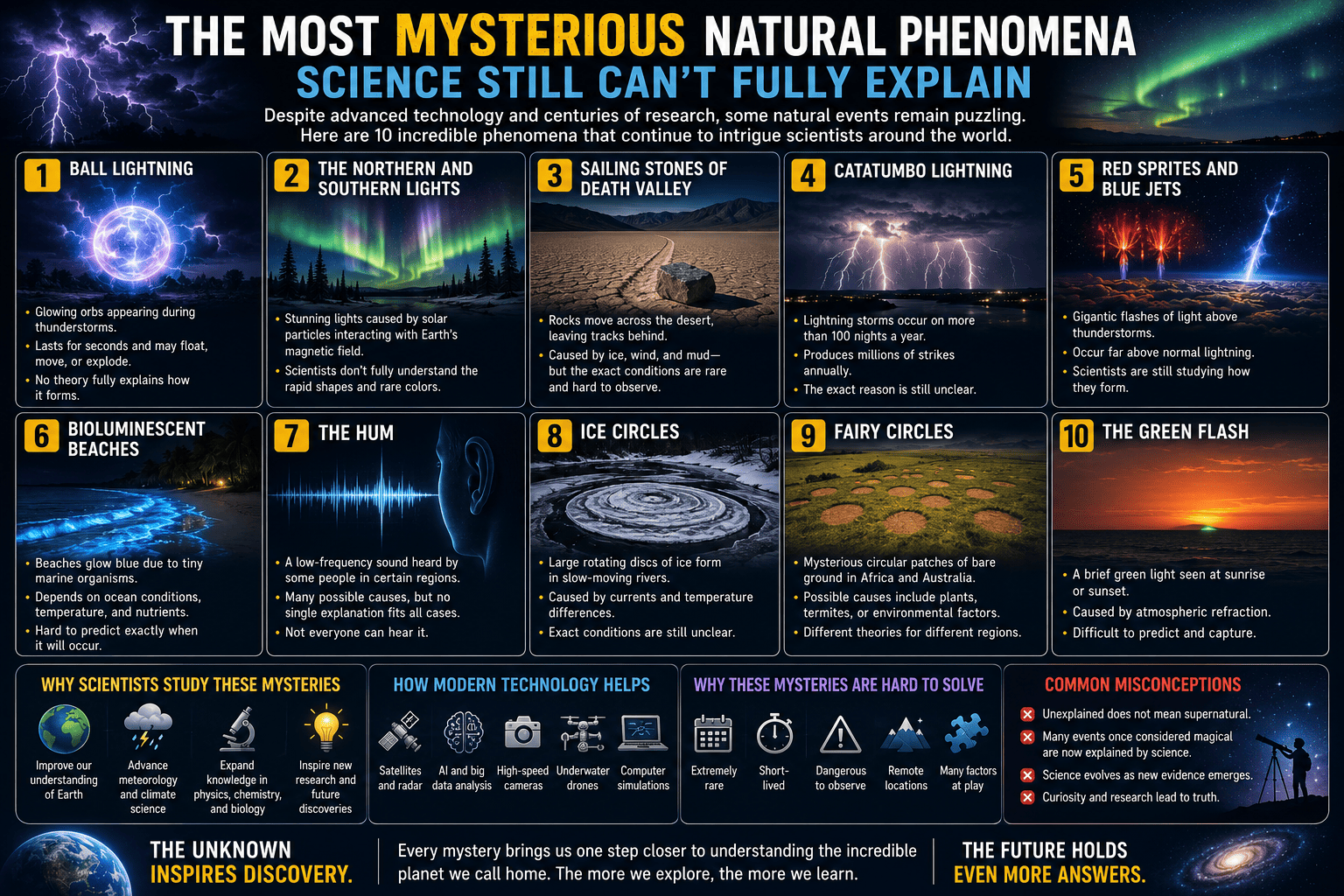
 The Most Mysterious Natural Phenomena Science Still Can't Fully Explain
Earth is an extraordinary planet filled with mountains, oceans, forests, deserts, volcanoes, and countless natural wonders. Over the centuries, scientists have uncovered the causes of earthquakes, hurricanes, eclipses, and many other events that once seemed mysterious. However, even with satellites, supercomputers, and advanced scientific instruments, some natural phenomena continue to puzzle researchers.
Rather than proving that science has failed, these mysteries demonstrate how much there is still to learn about our planet and the universe. Every unexplained event inspires new investigations, experiments, and discoveries that push scientific knowledge forward.
Let's explore ten remarkable natural phenomena that remain only partially understood.
1. Ball Lightning
Ball lightning is one of the rarest and most mysterious weather phenomena ever reported.
Witnesses describe glowing spheres of light that appear during or shortly after thunderstorms. These luminous balls may float through the air for several seconds before disappearing silently or exploding.
Although thousands of reports exist, scientists have never reached complete agreement on how ball lightning forms.
Leading Theories
- Electrically charged plasma
- Vaporized silicon particles
- Microwave energy trapped in the atmosphere
Because the event is unpredictable and short-lived, studying it remains extremely difficult.
2. The Northern and Southern Lights
The Aurora Borealis and Aurora Australis are among the most beautiful natural displays on Earth.
Scientists understand that charged particles from the Sun interact with Earth's magnetic field, causing colorful lights in the upper atmosphere.
However, researchers continue to investigate why auroras sometimes display unusual shapes, rapid movements, and rare colors that are not fully predicted by existing models.
Why They're Fascinating
- Visible in polar regions
- Constantly changing patterns
- Influenced by solar activity
3. Sailing Stones of Death Valley
For decades, visitors to Death Valley National Park noticed large rocks that appeared to move across the desert floor, leaving long tracks behind them.
The mystery puzzled scientists because no one had actually witnessed the stones moving.
Research eventually showed that thin sheets of ice, strong winds, and wet clay surfaces can work together to move the rocks. However, the exact combination of conditions is extremely rare, making the phenomenon difficult to observe directly.
4. Catatumbo Lightning
Near Lake Maracaibo in Venezuela, lightning storms occur with astonishing frequency.
Known as Catatumbo Lightning, this region can experience lightning on more than 100 nights each year, producing millions of lightning strikes annually.
Scientists believe local geography, humidity, and atmospheric conditions contribute to the phenomenon, but researchers continue studying why it is so persistent compared with other regions.
5. Red Sprites and Blue Jets
Above powerful thunderstorms, strange flashes of light sometimes appear high in the atmosphere.
These events, known as red sprites, blue jets, and gigantic jets, occur far above normal lightning.
Only in recent decades have scientists captured clear images of these spectacular electrical discharges.
Although much has been learned, researchers continue investigating exactly how these upper-atmospheric events form.
6. Bioluminescent Beaches
Certain coastlines around the world glow bright blue at night.
This stunning effect is caused by microscopic marine organisms called dinoflagellates, which emit light when disturbed by waves or movement.
Scientists understand the biological mechanism behind the glow, but predicting when and where large-scale bioluminescent events will occur remains challenging because they depend on changing ocean conditions, temperature, nutrients, and weather patterns.
7. The Hum
In several places around the world, groups of people report hearing a persistent low-frequency humming sound known simply as "The Hum."
Interestingly, many nearby residents hear nothing at all.
Scientists have proposed several possible explanations, including industrial machinery, distant traffic, ocean waves, electrical infrastructure, or individual differences in hearing sensitivity.
However, no single explanation accounts for every reported case.
8. Ice Circles
Occasionally, rivers develop enormous rotating discs of ice that slowly spin on the water's surface.
Some ice circles measure more than 15 meters (50 feet) across.
Researchers believe the spinning motion results from slow-moving river currents combined with differences in water temperature, but the precise conditions required are still being studied.
These natural formations remain both rare and visually spectacular.
9. Fairy Circles
In parts of southern Africa and Australia, mysterious circular patches of bare ground appear among otherwise healthy vegetation.
Known as fairy circles, these formations can persist for decades.
Scientists have proposed multiple explanations, including:
- Competition between plants for water.
- Activity by termites or other soil organisms.
- Interactions between vegetation and environmental conditions.
Evidence suggests that different mechanisms may contribute in different regions, and research continues.
10. The Green Flash
Just before sunrise or immediately after sunset, observers under ideal conditions may briefly see a brilliant green flash above the horizon.
This phenomenon lasts only a second or two.
Scientists explain it primarily through atmospheric refraction, where Earth's atmosphere bends different colors of light by different amounts.
However, predicting exactly when the green flash will appear remains difficult because it depends on highly specific atmospheric conditions.
Why Scientists Continue Studying Natural Mysteries
Studying unusual natural phenomena helps researchers improve scientific knowledge in many fields, including:
- Meteorology
- Atmospheric physics
- Oceanography
- Geology
- Ecology
- Climate science
Even when scientists already have strong explanations, investigating rare events often leads to new discoveries about how Earth's systems work.
How Modern Technology Helps Solve Mysteries
Today's researchers use advanced tools that were unavailable just a few decades ago.
These include:
- High-resolution satellites.
- Weather radar systems.
- Artificial intelligence for pattern analysis.
- High-speed cameras.
- Underwater drones.
- Remote sensing equipment.
- Computer simulations.
These technologies allow scientists to collect data from remote and dangerous environments with greater accuracy than ever before.
Why Some Mysteries Take So Long to Solve
Many natural mysteries are difficult to study because they are:
- Extremely rare.
- Short-lived.
- Dangerous to observe.
- Located in remote areas.
- Influenced by many interacting environmental factors.
Scientific understanding often develops gradually as new evidence becomes available.
Common Misconceptions About Natural Mysteries
Unexplained natural events are sometimes linked to supernatural or paranormal claims. However, the absence of a complete explanation does not mean that an event is beyond science.
History offers many examples:
- Lightning was once believed to have supernatural causes before electricity was understood.
- Eclipses inspired myths long before astronomy explained them.
- Earthquakes were attributed to legends before plate tectonics became established.
Science progresses by gathering evidence, testing ideas, and refining explanations over time.
The Future of Natural Science
Future research is expected to provide deeper insights into many of today's mysteries.
Advances in climate modeling, atmospheric observation, satellite technology, machine learning, and environmental monitoring will allow scientists to study rare events with unprecedented detail.
As our tools improve, many of these mysteries may eventually be understood, while new questions are likely to emerge.

You must be logged in to post a comment.