

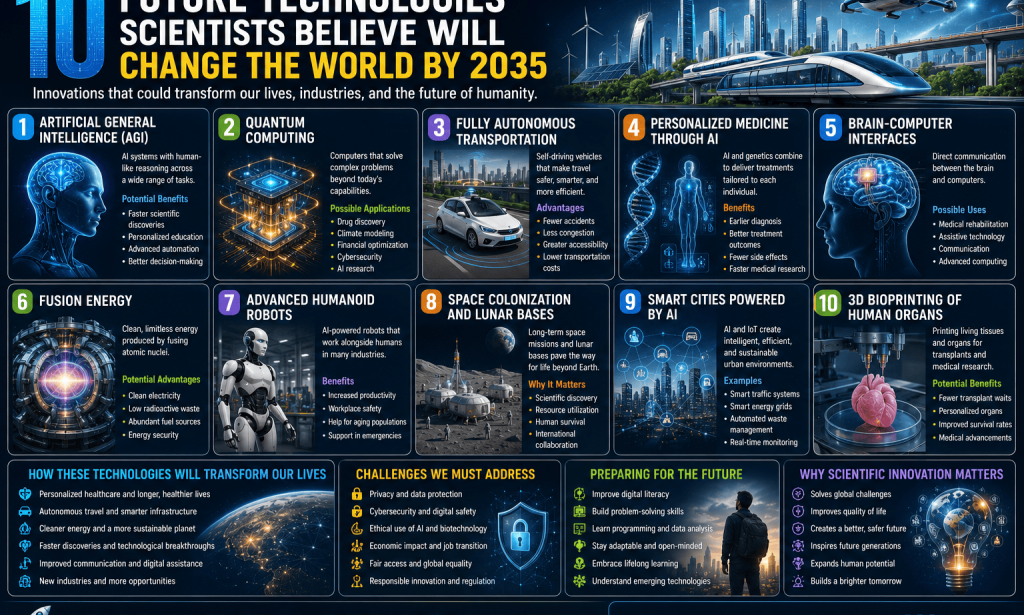

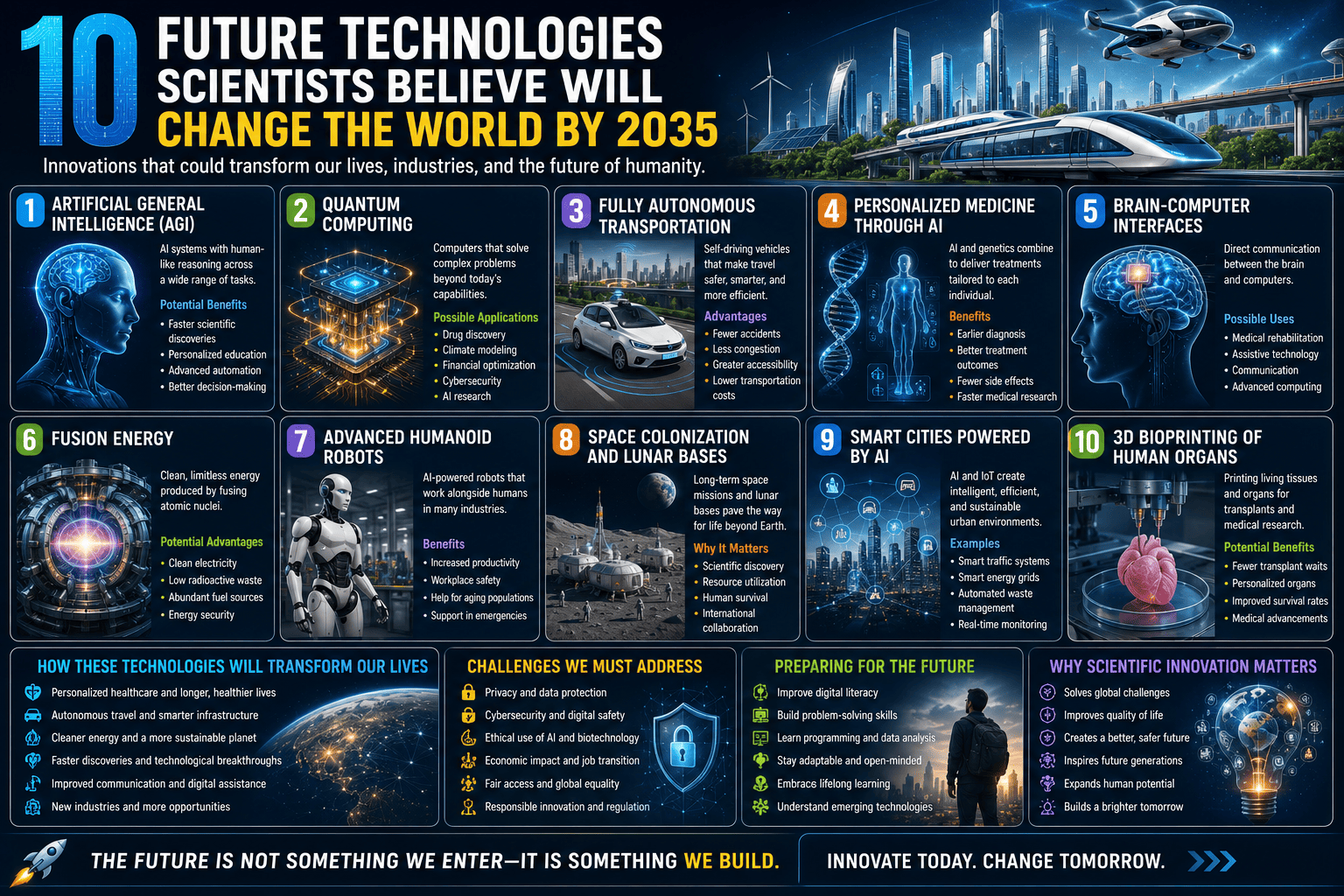
10 Future Technologies Scientists Believe Will Change the World by 2035
For thousands of years, technological innovation has driven human progress. The invention of the wheel, electricity, computers, and the internet each marked a turning point in history. Today, we are entering another era of rapid advancement, where emerging technologies are expected to transform society at an unprecedented pace.
Many innovations that once seemed like science fiction are now becoming reality. Artificial intelligence can generate text and images, self-driving vehicles are being tested on public roads, and scientists are exploring quantum computers capable of solving problems beyond the reach of today's most powerful machines.
Looking toward 2035, several technologies stand out for their potential to reshape the future.
1. Artificial General Intelligence (AGI)
Artificial Intelligence has already become part of everyday life, helping people write, translate, analyze data, and automate tasks. However, researchers are working toward a more advanced form known as Artificial General Intelligence (AGI).
Unlike current AI systems, AGI would be capable of learning and performing a wide variety of intellectual tasks at a level closer to human reasoning.
Potential Benefits
- Faster scientific discoveries
- Personalized education
- Advanced medical diagnosis
- Intelligent automation across industries
Challenges
- Ethical concerns
- Safety and regulation
- Employment changes
2. Quantum Computing
Traditional computers use bits represented as either 0 or 1. Quantum computers use qubits, which can exist in multiple states simultaneously through quantum mechanics.
This allows quantum computers to solve certain complex calculations much faster than classical computers.
Possible Applications
- Drug discovery
- Climate modeling
- Financial optimization
- Cybersecurity
- Artificial intelligence research
Although still developing, quantum computing may revolutionize many scientific fields.
3. Fully Autonomous Transportation
Self-driving technology continues to improve every year.
By 2035, experts expect autonomous vehicles to become much more common for public transportation, logistics, and personal travel.
These vehicles use cameras, sensors, radar, GPS, and AI to navigate roads safely.
Advantages
- Fewer traffic accidents
- Reduced congestion
- Increased accessibility
- Lower transportation costs
4. Personalized Medicine Through AI
Healthcare is moving toward treatments tailored specifically to each individual.
Artificial intelligence combined with genetic analysis could help doctors predict diseases before symptoms appear and recommend personalized treatments.
Instead of one-size-fits-all medicine, future healthcare may become far more precise.
Benefits
- Earlier diagnosis
- Better treatment outcomes
- Reduced side effects
- Faster medical research
5. Brain-Computer Interfaces
Brain-computer interfaces (BCIs) aim to create direct communication between the human brain and computers.
Researchers are developing systems that may allow people to control devices using only their thoughts.
Future applications could include helping individuals with paralysis communicate or control robotic limbs.
Possible Uses
- Medical rehabilitation
- Assistive technology
- Communication
- Advanced computing
6. Fusion Energy
Scientists have long pursued nuclear fusion as a clean energy source.
Unlike fossil fuels, fusion produces enormous amounts of energy with minimal greenhouse gas emissions and significantly less long-lived radioactive waste than conventional nuclear fission.
Although commercial fusion remains under development, progress continues worldwide.
Potential Advantages
- Clean electricity
- Reduced carbon emissions
- Abundant fuel sources
- Long-term energy security
7. Advanced Humanoid Robots
Robots are becoming increasingly capable of performing complex physical tasks.
Future humanoid robots may assist in healthcare, manufacturing, disaster response, elderly care, education, and household chores.
Powered by AI, these robots could work safely alongside humans.
Benefits
- Increased productivity
- Workplace safety
- Assistance for aging populations
- Support during emergencies
8. Space Colonization and Lunar Bases
Governments and private companies are planning long-term missions to the Moon and eventually Mars.
Permanent lunar bases could support scientific research, resource extraction, and preparation for deeper space exploration.
These projects may mark the beginning of humanity becoming a multi-planetary species.
Why It Matters
- Scientific discovery
- Space resource utilization
- Long-term human survival
- International collaboration
9. Smart Cities Powered by AI
Future cities are expected to become more connected through sensors, artificial intelligence, and the Internet of Things (IoT).
Smart infrastructure could improve transportation, energy use, waste management, emergency response, and public safety.
Examples
- Intelligent traffic systems
- Smart energy grids
- Automated waste collection
- Real-time environmental monitoring
10. 3D Bioprinting of Human Organs
One of the most exciting areas of medical research is 3D bioprinting.
Scientists are developing methods to print living tissues using specialized biological materials.
In the future, this technology may help create replacement organs for patients waiting for transplants.
Potential Benefits
- Reduced transplant waiting times
- Personalized organs
- Improved survival rates
- Advances in medical research
How These Technologies Could Transform Everyday Life
By 2035, many of these innovations may become part of daily routines.
People could:
- Receive personalized healthcare recommendations powered by AI.
- Travel in autonomous electric vehicles.
- Live in energy-efficient smart homes connected to intelligent city infrastructure.
- Benefit from faster scientific discoveries enabled by quantum computing.
- Communicate more naturally with intelligent digital assistants.
- Access cleaner electricity generated by advanced energy systems.
The combination of these technologies may significantly improve quality of life while creating entirely new industries.
Challenges Facing Future Technology
Despite enormous potential, emerging technologies also present important challenges:
Privacy
As devices collect more data, protecting personal information becomes increasingly important.
Cybersecurity
More connected systems create new opportunities for cyberattacks, making robust security essential.
Ethical Questions
AI, robotics, and biotechnology raise difficult questions about fairness, accountability, and responsible use.
Economic Impact
Automation may replace certain jobs while creating new career opportunities that require different skills.
Balancing innovation with responsible governance will be crucial.
Preparing for the Future
Individuals can prepare for technological change by developing valuable skills such as:
- Digital literacy
- Critical thinking
- Problem-solving
- Programming basics
- Data analysis
- Adaptability
- Lifelong learning
As technology evolves, continuous education will become increasingly important.
Why Scientific Innovation Matters
Throughout history, scientific breakthroughs have improved living standards by increasing life expectancy, enhancing communication, reducing poverty, and expanding access to knowledge.
Future technologies have the potential to address major global challenges, including climate change, healthcare, food production, clean water, and sustainable energy.
Responsible innovation can help build a safer, healthier, and more prosperous future for everyone.

You must be logged in to post a comment.