A freezer label can tell you what is in a package, but it cannot tell you that the package will be ready for tonight's meal. Thawing needs its own place in a food plan, alongside storage, preparation and cooking. When that step is missing, the temptation is to leave food on the counter and hope the centre catches up.
This guide uses United States FDA and FoodSafety.gov consumer guidance to build an original planning checklist for ordinary perishable foods. Follow the instructions for the actual product and the relevant guidance where you live. A general article cannot establish the safety of a particular food whose storage history is unknown.
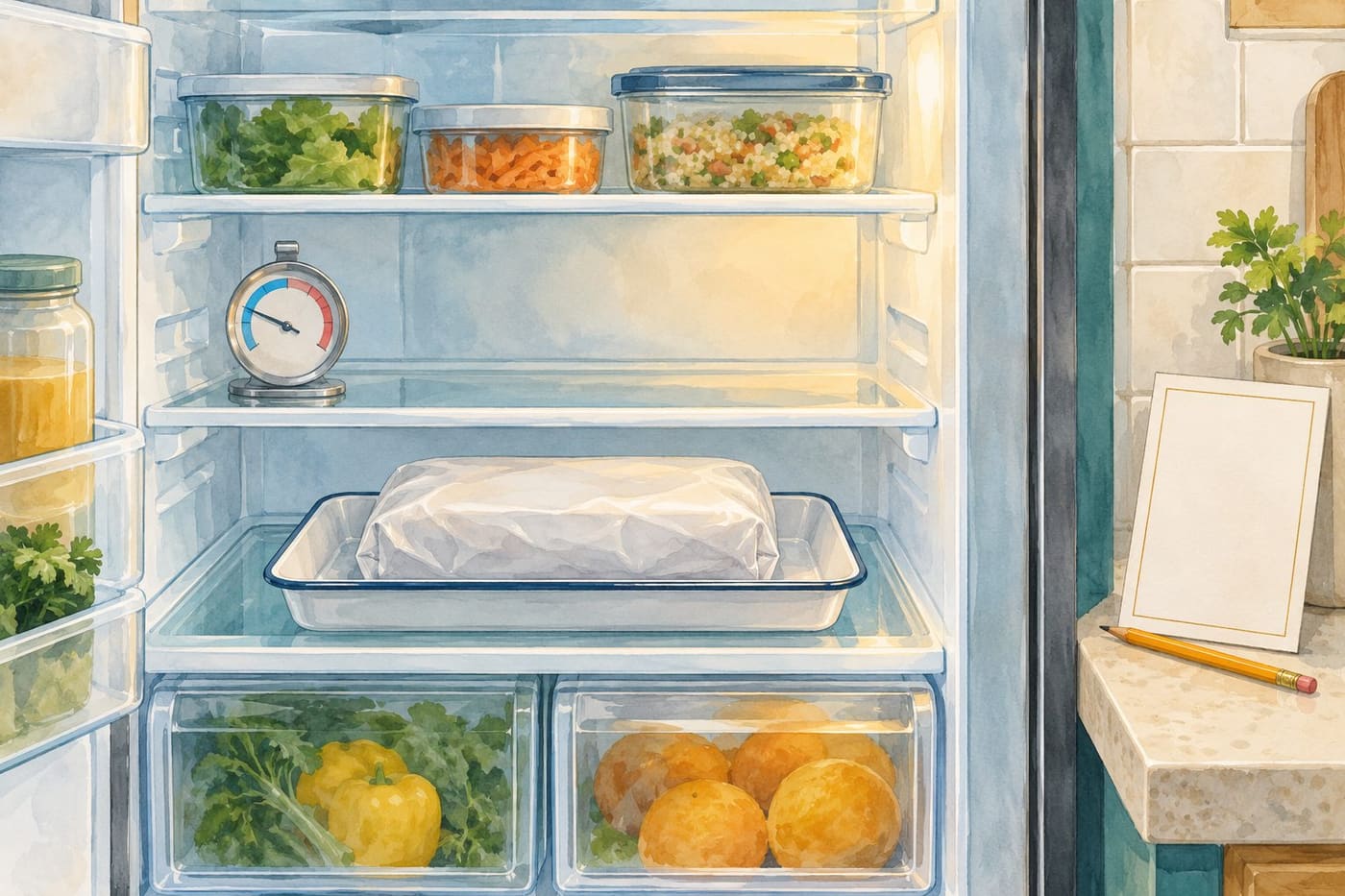
The household example is fictional. No food was thawed, cooked or laboratory-tested for this article. The original conceptual illustration shows a generic refrigerator planning arrangement, not a tested appliance or a demonstration that a particular package is safe.
Choose the method before moving the package
The FDA identifies refrigerator, cold-water and microwave thawing as safe methods when followed correctly, and says not to thaw food on a room-temperature counter. Its guidance requires immediate cooking after cold-water or microwave thawing. That difference matters when deciding whether a method fits your available time. Source: https://www.fda.gov/food/buy-store-serve-safe-food/safe-food-handling
In the invented example, Rina plans a meal for the following evening. Before taking anything from the freezer, she checks the package instructions, available refrigerator space and the cooking plan. She does not choose a method solely because its name sounds quick.
Her planning note has separate fields for the method and the intended meal. If the method requires immediate cooking, a later appointment that prevents cooking is a reason to revise the plan. It is not a reason to ignore the instruction and store the thawed food for convenience.
This is also why a recipe's preparation time is not necessarily the time needed to get a frozen ingredient ready. Read the assumptions at the beginning of the recipe. A short cooking step may assume an ingredient that has already been thawed according to its instructions.
Check the refrigerator rather than its reassuring sound
The FDA's refrigerator-thermometer guidance recommends keeping the refrigerator at 40 °F or below, using an appliance thermometer to monitor it. It also advises allowing cold-air circulation and addressing drips from thawing meat to reduce cross-contamination. A control setting alone does not necessarily display the actual storage temperature. Source: https://www.fda.gov/food/buy-store-serve-safe-food/refrigerator-thermometers-cold-facts-about-food-safety
Rina's fictional checklist asks whether the refrigerator condition has been checked, not whether the compressor can be heard. She records the relevant observation without claiming that a single note proves the temperature history of every food inside.
She also checks that the planned package can be stored without leaking onto other food. The container and placement are part of the arrangement, rather than details to address after a spill. If she cannot make an appropriate arrangement, the meal plan needs another option.
Do not fill a note with a temperature you have not measured. “Thermometer not checked” is a real information gap. Replacing it with a typical setting would make the record look complete while removing the distinction between an observation and an assumption.
Preserve the package instructions and food identity
Write down what the food actually is, whether it is raw or cooked, and any storage or preparation instructions on its package. A plain container marked “dinner” leaves too much for the next person to infer. Keep the product information available until the relevant preparation and storage decisions have been made.
The fictional package in Rina's plan is identified as raw ground beef. That description is more useful than “meat” because guidance can distinguish food categories and states. If she instead uses a cooked dish or another ingredient, she needs the instructions that apply to that food, not an inherited note from the earlier plan.
This article does not provide a universal thawing duration. A package-specific instruction should not be replaced with an attractive countdown borrowed from a different food or size. If the food is not ready for the chosen cooking method, changing the meal is an available planning decision.
For products with specialized packaging or instructions, read those details before treatment. Do not assume that every sealed pack is meant to stay sealed through every thawing or cooking method. The product's instructions and the relevant authoritative food-specific advice determine the procedure.
Separate the thawing record from the storage deadline
FoodSafety.gov's cold-storage chart gives different refrigerator limits for different categories. For example, its chart lists raw ground meats at one to two days and fresh beef steaks at three to five days under the stated refrigeration conditions. These category-specific limits should not be blended into a general “all meat lasts several days” rule. Source: https://www.foodsafety.gov/food-safety-charts/cold-food-storage-charts
The chart is a storage reference, not a personalized assessment of an unknown package. Read the food type, condition and temperature heading together. If the package or local guidance supplies a more specific instruction, keep that instruction with the food rather than copying a more convenient figure from another row.
Rina's original planning sheet separates “moved from freezer” from “thawing status checked” and “applicable storage instruction.” She does not label the transfer time as proof that thawing finished at that moment. Nor does she invent an exact completion time when the record does not establish one.
The useful output is a traceable plan for the actual food, not a neat date that nobody can explain. When another household member takes over, they should be able to see which times were recorded and which decisions still depend on the product's condition and instructions.
A frozen centre does not validate a warm exterior
The FDA warns that thawing at room temperature is unsafe because bacteria can multiply in unrefrigerated food; some organisms can produce toxins that survive cooking. It also explains that food can cause illness without looking, smelling or tasting spoiled. Those are reasons not to use a sensory check or later cooking as a rescue plan for unsafe handling.
In the fictional discussion, a friend suggests checking whether the middle still feels frozen after the package has been left out. Rina rejects that as a substitute for a safe thawing method. A cold patch does not document the history of the whole package.
She also does not taste a questionable food to settle the argument. The note needs reliable information about handling and the applicable guidance. A reassuring appearance is not the missing record, and the absence of an unpleasant smell is not a safety certificate.
If the history is uncertain, the response should follow the relevant food-safety authority's advice for that situation. Do not turn uncertainty into a precise safe window by guessing when the package became warm. A waste-reduction target does not justify inventing the information needed to declare food safe.
Treat faster methods as active tasks
The FDA's thermometer guidance says that cold-water thawing requires changing the water every half hour to keep it cold. Its safe-handling page specifies immediate cooking after cold-water or microwave thawing. Those methods therefore need attention and a cooking plan, rather than simply a place on a to-do list.
For her invented household schedule, Rina asks two questions before considering a faster method: who will follow the full applicable instructions, and who can cook immediately afterward? If the answer to either is unclear, calling the method fast has not solved the scheduling problem.
A reminder can help someone carry out an instruction, but it does not replace that instruction. Setting a timer is not proof that the water remained appropriately cold or that the food was handled correctly. Record an action as completed only when someone actually performed it.
If using a microwave, follow the appliance and food instructions for the particular task. This article does not supply a universal power setting or minutes-per-package calculation. A programme name alone is not an instruction for every type, thickness or amount of food.
Keep preparation and cooking as separate checks
The FDA's safe-handling guidance calls for separating raw foods from ready-to-eat foods and checking safe cooking temperatures with a food thermometer rather than relying on colour or texture. Its table lists 160 °F for ground meat and 165 °F for poultry. Use the temperature and any required rest instructions for the actual food category, not a single number for everything.
In the fictional plan, Rina keeps the raw-ingredient preparation arrangement separate from the final cooking check. Finishing the thaw does not finish the cooking task. Equally, selecting a cooking temperature does not retrospectively verify a food's earlier storage history.
The checklist therefore has distinct questions: has the chosen thawing method been followed, is raw-food handling kept separate, and has the relevant cooking instruction been checked? These questions prevent one completed step from being used as evidence that all the other steps must also have happened.
For a real meal, read the authoritative temperature guidance and product instructions directly. A planning note should point to the relevant instruction and record the actual check; it should not become an improvised recipe that quietly changes the safety requirements.
Make a handover that names the unfinished work
Rina's fictional handover identifies the food, the chosen method, the recorded start time, the current status and the next required action. It also states who is responsible for that action. “Food for tomorrow” is not enough information for somebody who did not see the original package or conversation.
If thawing has not been checked, the note says so. If cooking is required immediately after the selected method, that requirement stays beside the method rather than disappearing into an earlier message. The next person should not have to infer the plan from a container's location.
Keep a change visible when the plan changes. If the intended dinner is postponed, revisit the food-specific handling and storage instructions before deciding what to do with the ingredient. Do not automatically carry the original plan forward by another day because the calendar entry moved.
This is an organizational device created for the article, not a scientific monitoring system. It can improve the clarity of a handover, but it cannot certify safety or fill in missing temperature history. The distinction is particularly important in a shared kitchen where different people may assume someone else performed a check.
Give the meal plan a safe alternative
An alternative meal reduces pressure to make an unsuitable thawing shortcut. Choose an option that can be prepared according to its own instructions with the time and ingredients available. The alternative is not permission to improvise the cooking of the still-frozen ingredient.
Our broader meal-planning guide discusses using available food without treating waste reduction as a reason to guess about safety: https://monetizearticle.com/article/use-what-you-have-build-a-meal-plan-that-reduces-waste-without-guessing-about-safety-ff9418 . The same principle applies here: an efficient plan should fit safe handling, rather than requiring a claim you cannot support.
In the fictional example, Rina finishes the planning task by keeping the intended meal conditional. If the ingredient is not ready under the applicable instructions, she uses the alternative and revisits the ingredient's next step correctly. She does not announce that a particular number of hours guarantees readiness.
That is a practical finished plan: it identifies the preferred meal, the checks it depends on, the responsible person and an alternative. It does not require pretending that the package will obey a calendar invitation.
Keep safety limits distinct from quality preferences
FoodSafety.gov explains that its freezer-storage durations concern quality, while food continuously held at 0 °F, or −18 °C, or below can be kept indefinitely. That condition matters. It is not a claim that freezing repairs unsafe handling before storage or that a package with an unknown temperature history is automatically acceptable.
A household inventory can therefore have separate fields for quality preferences and safety-relevant instructions. “Prefer to use this month” and “follow this storage limit” do different jobs. Combining them under a single vague date makes it harder for another person to understand the decision.
Do not move a quality preference into the safety column to reassure yourself, or a safety instruction into the preference column to ignore it. Keep the source, food category and condition attached. A tidy freezer inventory is useful only when its labels retain their meaning.
Conclusion: plan the whole sequence
Identify the food, read its instructions, choose an appropriate thawing method and check the storage arrangement before starting. Preserve the distinction between transfer time, thawing status, storage limits and cooking requirements. For faster methods, make sure immediate cooking and the full instructions fit the actual schedule.
When the information is incomplete, do not use appearance, smell or an invented time to close the gap. A good dinner plan includes an alternative and an honest handover; it does not depend on a shortcut that the food-safety guidance rejects.
Sources and research note
US consumer guidance checked on 29 October 2026: FDA Safe Food Handling, FDA Refrigerator Thermometers, and FoodSafety.gov Cold Food Storage Chart, linked above. Brief explanations and selected category distinctions are attributed to those pages; the household, planning sheet and discussion are original fictional examples. No food-safety trial, appliance test or individual package assessment was conducted. USDA FSIS direct pages returned access restrictions or timeouts; indexed excerpts were reviewed during research but are not used as fully retrieved sources for this article. No universal thawing duration, refreezing procedure or worldwide storage rule is claimed.