Chef Damu's career invites a wider discussion than a list of television appearances. Teaching food involves making knowledge usable: a learner needs to understand ingredients, sequence, quantities and the decisions that an experienced cook may make almost automatically. His documented work across education and public cooking provides a starting point for considering how that knowledge travels.
[The News Minute reported](https://www.thenewsminute.com/amp/story/tamil-nadu/padma-shri-recipient-chef-damu-of-cooku-with-comali-fame-dies-at-72-in-chennai) that K. Damodaran, known as Chef Damu, died in Chennai on 25 October 2026, aged 72. That contemporary report supplies the news context. The older official documents used below establish career details; they are not death notices or evidence of a cause of death.
What the official record establishes
The Government of India's [2025 Padma Shri citation](https://www.padmaawards.gov.in/Document/pdf/CitationsForTickets/2025/202573.pdf) records his hotel-management training in Chennai, entry into the Tamil Nadu Tourism Development Corporation in 1977 and move into teaching in 1986. It describes books, television programmes and training connected with school meals. It also lists a 2014 largest-curry record in Little India, Singapore. These are the citation's claims, not a fresh audit of every achievement.
NCHMCT's [2024 Trailblazers anthology](https://nchm.gov.in/sites/default/files/2024-12/E_Copy_Trailblazers.pdf), page 9 of the printed publication, identifies him as an IHM Chennai alumnus from the 1977 batch. It notes his cooking programmes, books and large cooking projects, including the 2010 marathon of 617 dishes in a little over twenty-four hours.
Research checked 26 October 2026, Asia/Dhaka. This article uses that compact biographical foundation to discuss food education. The practical exercises below are original editorial suggestions, not lessons attributed to Damu or recipes presented as his work.
A recipe has to survive the handover
An experienced cook can carry a great deal of information in memory. They know which pan they mean, how finely an ingredient is cut and what a familiar measure looks like. A learner does not automatically receive that knowledge when given a short list of ingredients.
Consider an original household example: a note says to add “one cup” of an ingredient. The writer may always use a particular vessel, while the reader reaches for a different one. Both believe they followed the instruction. Recording the measure and its context makes the recipe easier to repeat without claiming that one household's vessel is the universal standard.
The same issue applies to preparation. “Add the onion” may leave a beginner unsure whether it should be whole, sliced, chopped or already cooked. A useful teaching note places the preparation beside the ingredient or at the point where it is needed, rather than relying on the learner to infer it later.
This is one reason culinary education extends beyond performing a dish successfully. The teacher must make the work intelligible to someone else. The resulting instructions should support learning while leaving room to explain why a cook might adjust the method in different circumstances.
Build a small recipe notebook that another person can use
A practical notebook need not be elaborate. Start with a familiar dish whose source you can identify and write down the version you actually make. Label the source: a family member, a named book, a programme or your own experiment. Do not blur a borrowed recipe and a new adaptation into the same claim of authorship.
An original template can contain these fields:
- Dish name and the source of this version.
- Intended number and approximate size of portions.
- Ingredients with units and preparation notes.
- Equipment that materially affects the method.
- The sequence of actions and checks.
- Changes made during the test and the result.
The last field is particularly useful. If you adjust an ingredient while cooking but never update the note, the written version no longer describes the dish you served. A learner following it later may encounter a problem that you already solved but failed to record.
Keep revisions visible. Date a new version or add a brief change note instead of silently replacing a quantity and forgetting why. Over time, the notebook becomes a record of learning rather than a collection of polished instructions with no indication of how they were developed.
Scaling quantities is only the first calculation
An original arithmetic example illustrates the difference between a quantity change and a complete method. If a tested four-portion recipe uses 200 grams of one ingredient, multiplying that ingredient by one and a half gives 300 grams for six equivalent portions. The calculation is straightforward because the units and target are explicit.
It does not follow that every cooking time should also be multiplied by one and a half. A larger batch may use different equipment or behave differently in the pan. The original recipe and suitable cooking guidance remain necessary; arithmetic alone does not validate a new process.
Portion size also needs to stay consistent for the comparison to mean anything. Six small tasting portions and six full meals are different targets. Before adjusting a recipe, define what a portion means in the particular plan rather than treating the number of people as a complete specification.
For learning, test a manageable change and record what happened. Avoid turning a first attempt into a large service for guests who depend on the result. A modest experiment allows the cook to identify an unclear instruction before multiplying the same uncertainty across many portions.
Teach the decision as well as the action
Instructions become more useful when the learner understands what to check. An action tells the person what to do next; an explanation helps them recognize whether the action achieved its purpose. The explanation should be specific enough to help, rather than simply telling the learner to rely on instinct they have not yet developed.
For an original non-safety example, a teacher might explain the intended texture of a mixture and demonstrate how it differs from the earlier stage. That is more informative than saying only that the mixture should look “right.” The teacher can also explain which changes are optional and which alter the character of the dish.
Visual descriptions have limits. They must not replace verified food-safety controls where those are required. A pleasing colour, aroma or texture is not a general test that a food is safe. Keep questions about taste and presentation separate from the guidance used for safe preparation and storage.
When a learner asks a question, use it to improve the written method. If several people misunderstand the same step, repeating the instruction more loudly is unlikely to solve the underlying ambiguity. A clearer unit, sequence or demonstration may be what is missing.
A large cooking record answers a narrow question
A record is defined by its particular challenge and rules. It should not be treated as a complete measure of a chef's teaching, the nutritional value of a dish or the ease with which a home cook can reproduce it. Those are different questions requiring different evidence.
The official documents provide a reason to discuss the public visibility of large cooking projects. They do not provide enough detail to reconstruct an event's recipe, staffing, costs or food distribution. This article therefore does not invent those details or convert a production weight into an unsupported number of people fed.
An original example makes the denominator problem clear. If an event produces a fictional 100 kilograms of food, the number of portions depends on the serving size and what is actually distributed. Without those facts, a precise claim about the number of meals would be guesswork dressed as arithmetic.
The better response to an impressive number is to identify what it measures and then ask the relevant next question. Admiration does not require exaggeration. A carefully bounded achievement can remain remarkable without being made to stand for every aspect of culinary excellence.
Preserve family variations without inventing a single standard
Food teaching often involves recipes that differ between households. A useful record can describe the version in front of the learner without declaring every other version wrong. Naming the source and the choices made is more informative than attaching an unsupported claim that a recipe is the only authentic method.
For example, if a family changes an ingredient because of availability or preference, write that change down. Describe it as an adaptation rather than quietly presenting it as the original cook's instruction. This allows later readers to understand both the source and the reason for the variation.
Translation requires the same care. A local ingredient name may not map neatly onto a familiar English term, and an imprecise substitute can confuse a learner. Where uncertain, preserve the original name alongside a verified description instead of guessing an equivalent because it sounds similar.
Respect also applies to personal stories. Ask before publishing a relative's private anecdote or identifying details alongside a recipe. The purpose of documentation is to preserve useful knowledge, not to claim ownership of another person's experience or turn a family memory into invented public history.
Bring current food-safety guidance into the lesson
For readers in Singapore, the [Singapore Food Agency's food-safety guidance](https://www.sfa.gov.sg/food-safety-tips/safe-food-practices/food-safety-tips) provides a current reference. It advises separation of raw and cooked food, appropriate refrigeration, cooking enough for the current meal where possible, and reheating stored cooked food to at least 75°C for at least two minutes. Consult the full guidance for the food and process involved.
SFA's [temperature-control article](https://www.sfa.gov.sg/food-safety-tips/food-risk-concerns/risk-at-a-glance/temperature-control-in-cooked-food) also advises portioning out food intended for later meals and cooling and refrigerating it promptly. That supports planning storage as part of the cooking task, rather than treating leftovers as an afterthought when everyone has finished eating.
These recommendations come from SFA, not from a reconstructed statement by Damu. A career profile should not use a famous name to endorse safety advice that the person is not documented as giving. Keeping the attribution clear benefits both the reader and the accuracy of the profile.
For a teaching session, include the safety reference in the handout and identify who is responsible for checking it. A recipe copied years ago can remain culturally valuable while its preparation notes still need review against current guidance. Respect for a tradition and attention to safe practice can sit together.
Compare cost without confusing purchase price and use
An original cost exercise can make a recipe more practical. Suppose a fictional 500-gram pack costs five Singapore dollars and the recipe uses 100 grams. The ingredient portion used costs one dollar, although the shopper must initially spend five dollars to buy the pack. Both numbers matter, but they answer different questions.
The distinction helps a learner plan an actual shop. A dish may have a modest ingredient-use cost while requiring several purchases that exceed the available cash for that day. Recording what is already on hand and what must be bought prevents an attractive per-portion estimate from hiding the upfront expense.
Do not present this example as a current Singapore retail price or a business-profit calculation. It excludes other ingredients, energy, equipment, time and possible waste. A commercial plan would require much more complete information than a classroom arithmetic exercise.
For a home notebook, the immediate benefit is simpler: quantities, pack sizes and intended use become visible. That can help the cook choose a manageable batch and avoid buying an item solely because a recipe mentioned it without explaining how much was needed.
Watch a demonstration as a learner, not just an audience member
A cooking programme can introduce an idea quickly, but a viewer who wants to reproduce a dish should locate the full instructions where available. An edited segment may omit waiting, preparation or a routine action that the presenter assumes the audience already understands.
Make a short list of unanswered questions before cooking. Are all quantities supplied? Does the sequence explain when an ingredient is used? Is the equipment relevant? Are the storage instructions clear? A missing answer is a reason to check, not an invitation to attribute a guessed instruction to the chef.
This approach turns viewing into an active exercise. The learner can compare the written method with the demonstration, identify uncertainties and keep notes on a later attempt. Enjoyment of the programme and careful cooking are compatible, but they are not the same activity.
Conclusion
Damu's documented career connects public recognition with the less visible work of teaching food. A useful response to that legacy is to make culinary knowledge easier to follow: record sources, specify quantities, explain decisions, preserve variations honestly and use current safety guidance. Those habits help a recipe travel beyond the person who first demonstrated it.
Sources and research note
The contemporary news report supplies the attributed death information. The Padma citation and NCHMCT anthology provide the concise career foundation; SFA supplies the separately attributed safety guidance. All were checked on 26 October 2026; the temperature-control article was checked through indexed text after a direct fetch timed out. The Singapore connection is recorded in the government citation, while the saved Trends signal is historical rather than a refreshed ranking.
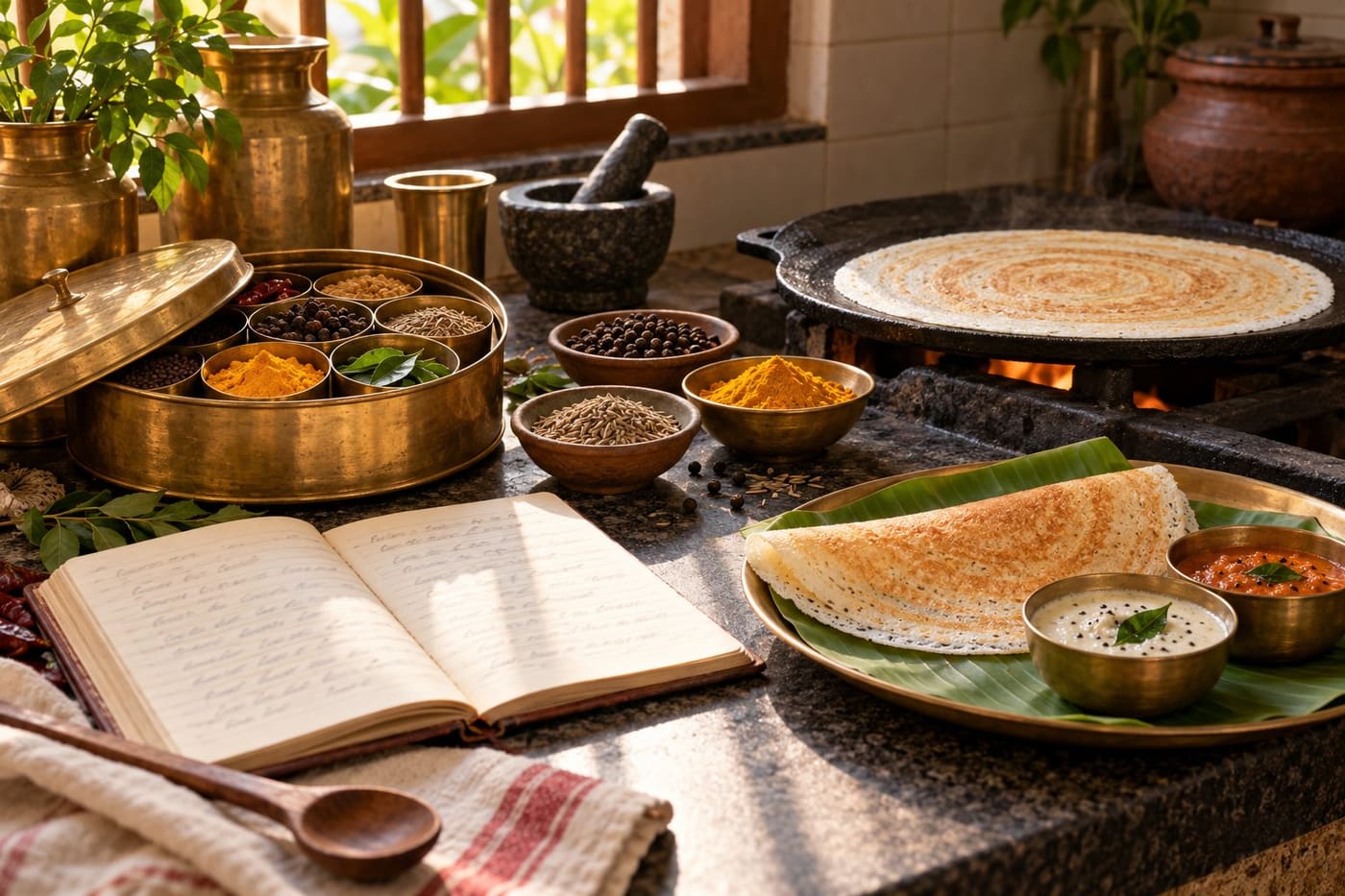
Examples, cost calculations and notebook exercises are original editorial analysis, not Damu recipes or quotations. The generated kitchen still life is conceptual and contains no portrait or documentary event. AI-assisted text received editing and limited phrase-search review; no comprehensive plagiarism certification, personal interview or first-hand cooking experience is claimed.