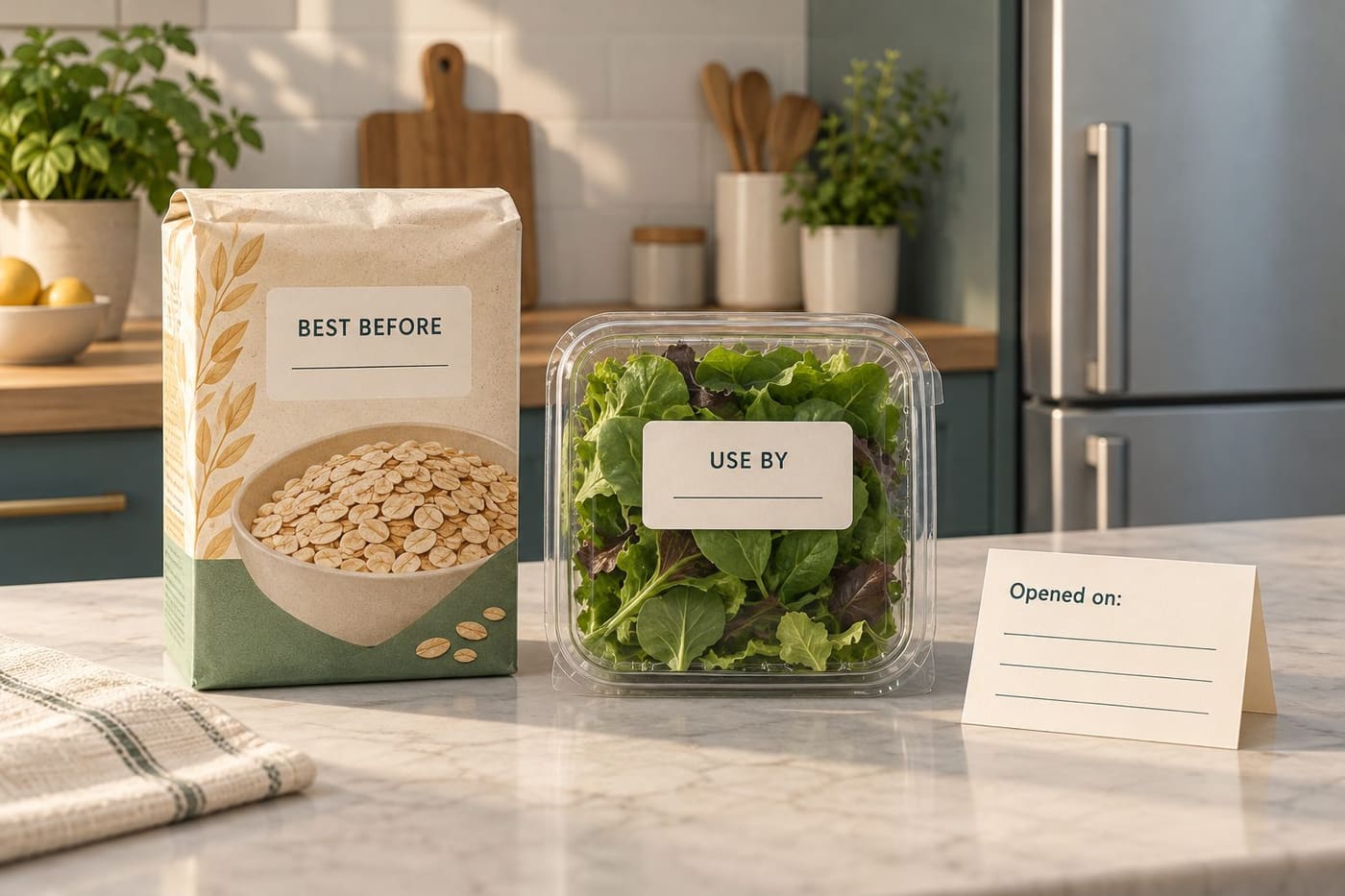
A packet has a date in large print and a storage instruction in much smaller type. At dinner time, it is tempting to read the date, put the packet on the counter and get on with cooking. Yet the smaller instruction may answer the more relevant question: what happens after this package has been opened?
Reading food date labels well means keeping several pieces of information together. The words before the date, the product's storage requirements, its opening instructions and what you know about its handling all matter. A date is one part of the label, not a substitute for its storage instructions.
This guide uses clearly identified official examples from the United Kingdom and Canada, with a separate United States infant-formula example. These examples are not interchangeable national rules. It offers a practical way to organise information, rather than a universal timetable for deciding whether every food is safe.
Start with the words beside the date
Before comparing a date with today's calendar, read its heading. Is it a best-before date, a use-by date, an expiration date or a packaging date? Do not turn every one of these into the single word “expiry” in your household notes. Doing so removes information you may need later.
For a UK example, [GOV.UK's guidance on best-before and use-by dates](https://www.gov.uk/understanding-food-labelling/best-before-and-use-by-dates) distinguishes a safety deadline from a quality indication. A use-by date concerns safety; a best-before date concerns quality. Those meanings belong with the guidance for that market and the actual product instructions.
Imagine two items on a shopping list: a chilled ready-to-eat salad and an unopened box of cereal. The useful comparison is not simply which has the earlier number. First establish what each date says and how each product must be stored. Only then can you place it sensibly in a meal plan. This is an illustrative shopping example, not an assessment of any particular salad or cereal.
Keep an unfamiliar term intact until you understand it. A translation can help you read a label, but a translated word alone does not establish how a country's labelling system treats that product. If the marking is unclear, consult the manufacturer or the relevant local food authority rather than inventing a deadline from an assumed meaning.
Treat a UK use-by date as a safety instruction
[Food Standards Scotland explains](https://www.foodstandards.gov.scot/consumer-advice/food-labels/use-by-and-best-before-dates) that food should not be eaten after its use-by date even when it looks and smells normal. Harmful organisms are not reliably identified by a pleasant smell. The same guidance also connects the date to following the label's storage instructions.
The practical implication is to make a decision while there is still time to follow the instructions. When planning tomorrow's meal, a product with a use-by date of today requires attention today. Moving it behind another container does not extend the date. Nor does writing a later date on a household sticker.
Avoid framing this as a contest between waste reduction and caution. You can change a shopping quantity, choose a different meal or buy a smaller pack next time without trying to justify eating something outside its safety instructions. The meal plan should adapt to the product, rather than requiring the product's deadline to adapt to the plan.
A household note might say, “Read the use-by and storage instructions before choosing this for tomorrow.” It should not say, “Probably fine if it smells normal.” The first note points the next cook towards evidence. The second substitutes a guess for that evidence.
A best-before date is not a complete safety assessment
Best-before dates are useful, but their meaning is narrower than many people assume. [Health Canada's consumer explanation](https://www.canada.ca/en/health-canada/services/general-food-safety-tips/how-read-food-date-labels-packaging.html) describes the durable life of an unopened food stored appropriately, including qualities such as freshness and taste. It does not present the marking as a guarantee of safety.
That distinction prevents two opposite mistakes. A quality date is not automatically a command to discard every product at midnight. Equally, a date still in the future is not proof that something has been handled properly. A calendar comparison cannot answer a storage-history question that the calendar does not contain.
When you make a pantry list, use neutral descriptions: “unopened; best-before shown; check storage instructions.” Avoid a blanket heading such as “safe until” for a mixture of products. The wording of your list should preserve the uncertainty, not erase it.
There is also a difference between recognising a quality problem and proving the absence of a safety problem. Stale texture may tell you that an item is less enjoyable. A normal appearance cannot establish that every relevant handling requirement has been met. Do not taste questionable food as an experiment to settle a safety question.
Opening the package changes the question
The [Canadian Food Inspection Agency's date-marking guidance](https://inspection.canada.ca/en/food-labels/labelling/industry/date-markings-and-storage-instructions) states that durable-life dates apply to unopened products and that opening can change their storage life. A distant printed date therefore cannot, by itself, answer how long an already-open package should remain in use.
Consider an invented household example. Rafi opens a jar for one meal and notices a separate instruction about storage after opening. He keeps that instruction with the jar and records when he opened it. Two days later, someone else can read both pieces of information. The note does not replace the manufacturer's instructions; it helps the next person apply them.
Do not copy an after-opening period from one jar to another because they look similar. Product formulations, packaging and instructions can differ. Likewise, do not transfer the unopened date to a new container and discard the only part of the package that explains its opened storage requirements.
If a label gives an opening limit and another date, read how those instructions work together. Where their relationship is unclear, ask the manufacturer. A household arithmetic shortcut should not be used to stretch a use-by deadline or manufacture permission the label does not give.
Make an opening note useful to another person
A useful opening note is short enough to maintain and specific enough to interpret. Include the product name, the opening date and a reminder of where its original instructions are kept. If a time is relevant to the product's instructions, record that as well. This is an organisational suggestion, not a new universal food-labelling requirement.
Write dates clearly. In a shared home, “03/04” may be read in two different orders. A written month name can make your own note less ambiguous. This does not mean changing the manufacturer's marking or assuming that every printed numerical date follows your preferred format.
Keep the opening note beside the product instruction. A photograph can preserve details when a sleeve would otherwise be discarded, provided the date, storage text and product identity remain readable. A blurred photograph of the front of the package is not much help when the relevant instruction was on the back.
The note should travel with the product through ordinary kitchen use. A message buried in a family chat may be missed by the next person preparing lunch. Choose a method people will actually see, and avoid covering the manufacturer's date, ingredients or other essential label information with your sticker.
Storage history is a separate piece of evidence
The UK date-label guidance makes clear that incorrect storage can make food unsafe before its use-by date. This is why “the date has not passed” cannot settle every decision. The storage conditions are part of the instruction rather than an optional extra beside it.
For household organisation, separate what you know from what you assume. “Bought this morning and stored according to the label” is a different note from “found in a bag; handling unknown.” Do not write the first simply because it would make dinner easier to organise.
When someone offers you food, ask about the information needed for that item rather than relying on a general statement that it is new. Is it unopened? What does the original package say? Have the required storage conditions been maintained? These questions help identify missing information; they do not create a safety certificate.
If you cannot establish something important, use the relevant official advice for that situation. Do not try to resolve every unknown with a smell test. Health Canada's guidance specifically cautions against judging food safety by smell, appearance or taste and advises discarding food when in doubt.
Plan cooking or freezing before the deadline
Cooking or freezing is not a magic way to rescue a product after ignoring its instructions. UK guidance allows appropriate cooking or freezing on or before a use-by date, followed by the relevant subsequent storage instructions. That is a sequence of actions with conditions, not an unlimited extension of the original package date.
For a reader making a plan, the first question is whether the product is suitable for the proposed action under its label and official guidance. The next is whether there is enough time and suitable storage to carry it out correctly. If either answer is missing, do not put “freeze later” on the list as though the problem has been solved.
Keep the record clear when the state changes. A note that identifies what was prepared and when is more useful than an old unopened-package date detached from its context. Follow the applicable guidance for cooling, freezing, defrosting and using that specific food; this article deliberately does not give one period for every product or country.
If refrigerator thawing is the next step in your meal plan, our [guide to planning the thaw before dinner](https://monetizearticle.com/article/plan-the-thaw-before-dinner-a-refrigerator-first-food-safety-checklist-fe46fa) explains why that decision belongs earlier in the process. It does not override the instructions on your package.
Keep specialist expiration dates separate
Some products need a more specific reading than ordinary pantry-quality shorthand. In its Canadian guidance, Health Canada identifies particular foods that require expiration dates, including infant formula and certain special dietary products. It advises that products should not be consumed after those expiration dates.
For a separate US example, the [FDA's infant-formula questions and answers](https://www.fda.gov/food/people-risk-foodborne-illness/questions-answers-consumers-concerning-infant-formula) explains the manufacturer's use-by date in terms of the declared nutrient amounts and acceptable quality. That is not a reason to apply a generic cereal rule to formula. Follow the applicable product and official instructions.
This distinction is especially important when moving between countries or reading advice online. A statement about an ordinary food label in one jurisdiction may not describe a regulated specialist product elsewhere. This guide does not provide infant-feeding instructions, substitute preparation methods or an extension of a manufacturer's deadline.
A printed date does not cancel a recall
A recall notice answers a different question from a date label. A product can have a date in the future and still fall within a recall's identified batch or other scope. Do not use the unexpired date as a reason to stop checking a notice that appears to match your package.
Keep identifying details when they may be needed: the product name, pack size, lot or batch code and the marking specified in the official notice. Our [food-recall package-checking guide](https://monetizearticle.com/article/food-recall-notices-how-to-check-the-package-in-your-kitchen-b11ca7) explains that matching process. Follow the actual notice's instructions rather than a social-media paraphrase.
This article makes no finding about a current recalled batch and does not clear any particular product for consumption. The examples and illustration use generic packages, not evidence of laboratory testing or a manufacturer's approval.
Conclusion: preserve the instruction, not just the number
At the next shop or meal-planning session, read the date heading, the storage text and any after-opening instruction together. Keep the product's identity and useful handling notes available to the next person. If an instruction is unclear, resolve that gap before building a meal around an assumption.
The goal is a kitchen record that helps you make a sound decision: what the marking means in its own market, what the package requires and what is actually known about its handling. A tidy date list is useful only when it preserves those distinctions.
Sources and research note
Research checked 31 October 2026. The linked GOV.UK and Food Standards Scotland pages support the UK examples; the Health Canada and CFIA pages support the Canadian distinctions; the FDA page supplies the separately identified US formula example. Health Canada's consumer page carries an older 2013 date, and the FDA FAQ is an established guidance page, not a new 2026 announcement. Relevant date-labelling passages were checked; unrelated feeding and clinical details are outside this article's scope.
The household names, notes and shopping situations are original illustrative examples, not reported customer experiences or tested storage outcomes. The original builtin AI-generated conceptual illustration shows generic date-label headings and a blank opening note; it depicts no actual product, valid deadline or safety certification. Limited exact-title and phrase web searches found related labelling material but no exact matching article in the returned results; this is not an exhaustive similarity audit or an authorship guarantee.