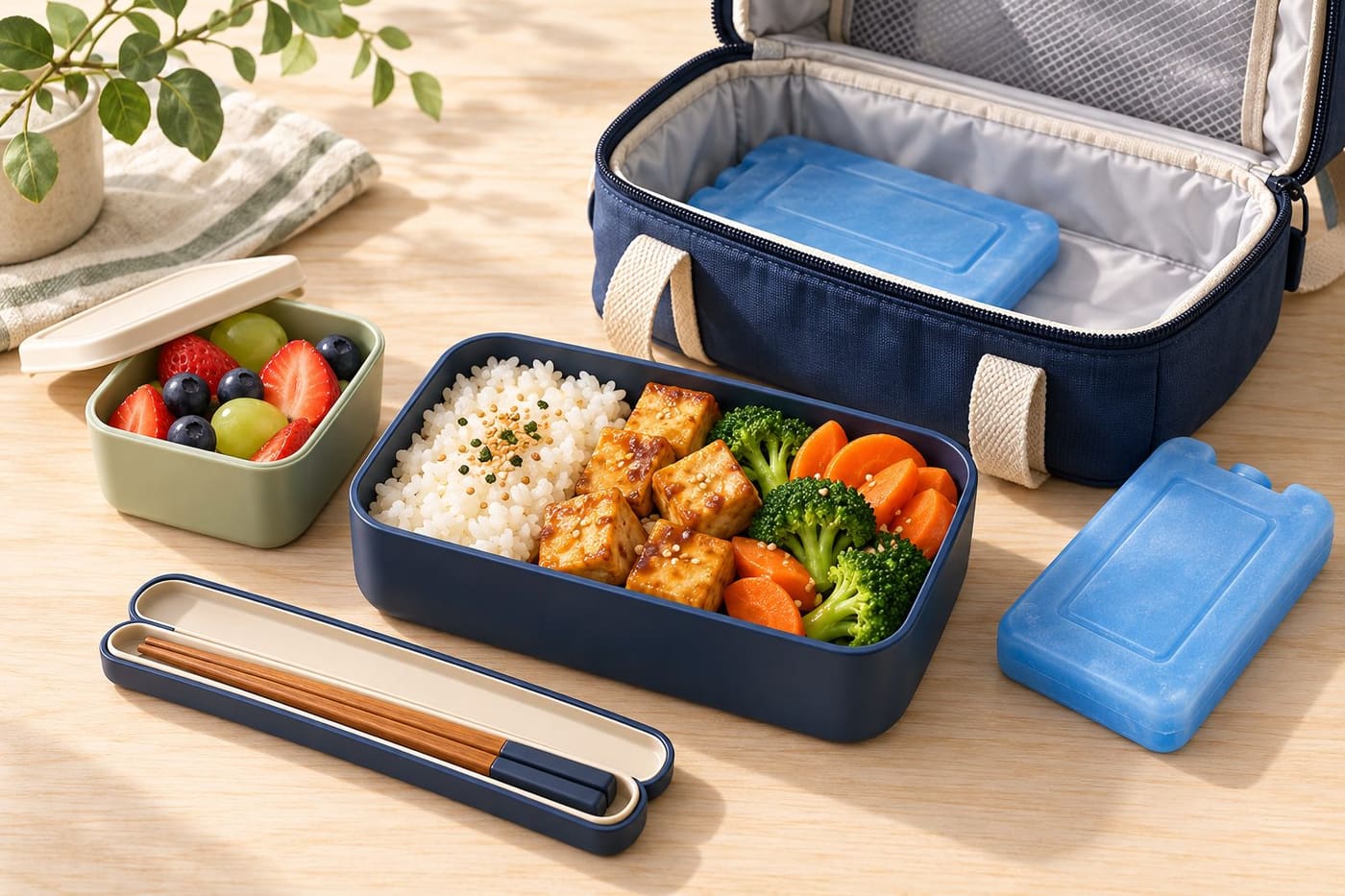
A bento lunch has to work twice: when it is packed and when someone opens it several hours later. A neat arrangement is only one part of that job. The food must suit the eater, the container must survive the journey, and the storage plan must fit the time between preparation and lunch. Starting with those constraints makes the meal easier to organise than starting with a photograph to copy.
The Japanese search term 弁当, meaning bento or a boxed meal, appeared as an active Google Trends topic when checked on 26 October 2026. Japan's Food and Drink table displayed 5K+ searches and a 1,000% increase, with the surge starting five hours earlier. The broad query did not establish a particular recipe, product launch, or reason for the interest. This guide addresses the practical lunch-planning question without inventing an event behind that search activity.
The examples below are original planning suggestions, not tested recipes or claims of first-hand cooking experience. They assume that ingredients are suitable for the person eating them and that the relevant cooking, chilling, label and storage instructions are followed. A pictured arrangement cannot establish food safety, nutrition adequacy, or allergy suitability.
Plan the journey before choosing the menu
Write down when food will leave the refrigerator, how it will travel, where it will wait, and when it will be eaten. A lunch carried directly to an office refrigerator has a different handling problem from one taken on an outdoor trip. “Packed in the morning” is not enough information to describe either case.
Ask the destination about refrigerator access before relying on it. A fridge may exist in a building without being accessible to every visitor or pupil. Similarly, a microwave may be available only during a short break or may have a queue. Build a plan around facilities that are actually available, not those that would make the intended menu convenient.
For a first attempt, use fewer components and familiar foods. Four elaborate dishes create four preparation and handling sequences. A simpler lunch can be easier to repeat reliably. That is a practical organisation choice, not a statement that any particular number of compartments produces a healthier meal.
Use Japanese bento guidance as the starting point
Japan's Ministry of Agriculture, Forestry and Fisheries provides specific [bento food-poisoning prevention guidance](https://www.maff.go.jp/j/syouan/seisaku/foodpoisoning/lunchbox.html). It advises clean, dry lunch boxes and utensils; thorough cooking; draining moisture from side dishes; and cooling rice and other dishes before closing them into a lunch box. It also recommends cold packs or insulated bags for extended carrying and explains that trapping steam creates moisture inside the box.
These points affect the order of work. Set out a clean container before food preparation starts. Identify where food will cool promptly and how it will then remain chilled. Do not discover, after cooking, that the only usable lunch box still contains yesterday's utensils or that the cold packs were never frozen.
The Ministry's advice to cool food before packing is not permission to leave cooked food on a counter for hours. Cooling, refrigeration and transport are parts of one process. A tidy lid should be the last packing step, not a way to hide warm food whose subsequent storage has not been planned.
Give rice its own handling plan
[Food Standards Scotland's storage guidance](https://www.foodstandards.gov.scot/consumer-advice/food-safety/food-safety-in-the-kitchen/food-storage) explains that cooked rice needs prompt cooling because Bacillus cereus spores can survive cooking. It advises chilling as quickly as possible, ideally within one hour, refrigerating, and consuming within 24 hours. Its guidance also says rice should not be reheated more than once and should be steaming hot throughout when reheated.
For planning purposes, record when rice was cooked rather than treating all rice in the refrigerator as interchangeable. A small dated container is easier to assess than an unidentified bowl. If the preparation history is unknown, a decorative garnish does not resolve that uncertainty. Do not assume that reheating can repair an unsafe storage history.
Consider an original scheduling example: a person wants a rice-based lunch for tomorrow but has a late evening commitment. The decision is not simply whether cooking tonight feels convenient. It is whether there is time to cool and store the rice correctly, whether it will be used within the relevant guidance, and whether tomorrow's transport can keep it cold. If that chain cannot be arranged, change the menu or preparation plan.
Avoid planning several rounds of warming and cooling merely to fit a busy morning. Choose a handling route appropriate to the food and follow the relevant guidance consistently. A rice dish already reheated once should not be assigned another reheating step because the lunch break is later than expected.
Cold storage needs more than an attractive box
USDA's archived [Kitchen Companion handbook](https://www.govinfo.gov/content/pkg/GOVPUB-A110-PURL-gpo234150/pdf/GOVPUB-A110-PURL-gpo234150.pdf) recommends at least two cold sources for perishable packed lunches, placed above and below the food, and refrigeration on arrival where available. It also distinguishes cold lunches from foods deliberately kept hot in a suitable insulated container. This is US agency guidance used here as supplementary handling context, not a Japanese product certification.
Before buying another lunch box, check whether the one already owned fits inside an insulated bag with the required cooling arrangement. A large box that fills the entire bag can leave no practical room for cold packs. A small container with a workable transport plan may be more useful than a larger one selected only for its appearance.
Do not mix a hot food container and a cold lunch compartment casually and assume both will remain at their intended temperatures. If you choose a hot-food system, follow the container manufacturer's directions and applicable hot-holding guidance. This article focuses on planning a chilled lunch; it does not test or endorse any flask's ability to keep food hot until a particular hour.
Separate textures without turning dividers into a safety claim
Containers and small cups can solve ordinary packing problems. A moist side dish can be separated from a component intended to remain crisp. A sauce can travel in a sealed container rather than pooling across rice. Fruit can be packed separately so that the eater can open it later without disturbing the rest of the meal.
Treat these as design decisions. A divider is not a refrigerator, and a compartment does not make an unsuitable ingredient safe for someone with an allergy. Likewise, a leak-resistant container should be used according to its instructions; its appearance cannot establish that it will remain sealed when carried sideways in a school bag.
A useful non-food trial is to arrange the empty containers, utensils and cold packs in the bag before preparing lunch. Check whether the lid closes, whether the box sits flat, and whether the eater can open the fasteners. This simple rehearsal identifies a packing problem without leaving prepared food waiting while the bag is reorganised.
Choose components around the eater's actual day
An original menu-planning framework is to choose a familiar main component, a suitable accompaniment, and any separately packed item the eater wants. This is a structure for making decisions, not a prescribed nutritional ratio. Portion needs vary, and a bento's visual balance cannot establish that it meets an individual's dietary requirements.
For example, a person who enjoys rice and cooked vegetables could begin with those familiar components and select an appropriate protein food they already eat. Someone who dislikes cold rice need not force it into the box to make the lunch look recognisably Japanese. The practical objective is a meal that will be eaten and handled correctly, not an imitation of somebody else's photograph.
Consider the available eating time as well. A short break may make difficult packaging or a complicated assembly step inconvenient. Ask whether utensils are needed, whether the eater can manage them, and whether small loose accessories are appropriate for their age and circumstances. Keep decorative picks and similar accessories out when they create unnecessary complications.
Record ordinary feedback after lunch: too much of one component, a sauce that leaked, an item that was awkward to eat, or a container that was difficult to open. Adjust one problem at a time. This gives the next lunch a concrete improvement rather than turning every day into a new elaborate project.
Allergies require ingredient information, not visual guesses
The [FDA's food-allergy guidance](https://www.fda.gov/food/nutrition-food-labeling-and-critical-foods/food-allergies) stresses reading labels and avoiding the relevant allergens. It also explains allergen cross-contact. Its legal labelling discussion applies to the United States; readers buying ingredients in Japan or elsewhere need the information applicable to those products and their own medical guidance.
For a household planning a bento, the practical question is whether every ingredient is suitable, including sauces, seasoning blends, fillings and garnishes. A small quantity is still an ingredient. Removing a visible topping after packing does not establish that the remaining food is suitable for a person who must avoid that substance.
Keep product packaging or a reliable ingredient record when another person needs to check the lunch. For a school or shared workplace, follow the relevant food-sharing and allergy policies. Do not describe a homemade meal as “allergy-free” simply because one familiar allergen was omitted. Suitability depends on the individual and the actual ingredients and handling, not the style of the box.
Make the evening and morning jobs explicit
The easiest time-saving tasks are not always cooking tasks. Washing and drying the container, locating its lid, cleaning utensils, checking ingredient labels, and preparing the bag can remove several morning interruptions. Make those tasks visible rather than relying on memory when someone is already trying to leave home.
A simple planning card might contain these prompts:
- Is the intended food suitable for the eater and the destination's rules?
- Are the container and utensils clean, dry and complete?
- Is the preparation and cooling plan appropriate for each component?
- Are cold packs ready, and is refrigerator access confirmed?
- Does the bag accommodate the food and cooling arrangement together?
- Is the lunch identified clearly if several people use the same refrigerator?
- What will happen if travel or lunchtime is delayed?
The last question is easy to overlook. A routine that works for a normal commute may not work unchanged on an excursion. When the day's conditions change, reconsider the food and storage plan rather than assuming the usual lunch remains suitable under any circumstances.
Learn from leftovers without taking avoidable risks
If food regularly returns uneaten, record the reason and adjust future quantities. Perhaps the break was too short, a component was disliked, or the serving was simply larger than wanted. Those observations can reduce waste at the planning stage. They are not evidence that food carried around all day is suitable for another meal.
The UK government's [home food fact checker](https://www.gov.uk/government/publications/home-food-fact-checker/home-food-fact-checker), updated in August 2026, explains why smell cannot establish the safety of food carrying a use-by date. Apply the broader lesson carefully: a pleasant appearance or normal smell does not replace knowledge of storage conditions. Do not taste a questionable lunch to decide whether it is safe.
After lunch, deal with the container and remaining food according to the relevant safety guidance rather than leaving the whole bag untouched until the next morning. Cleaning is also an opportunity to notice a damaged seal, a missing part or a compartment that is difficult to wash. Follow the manufacturer's cleaning instructions instead of assuming every component tolerates the same treatment.
A realistic first-week approach
For a first week, choose a repeatable packing arrangement and a small set of suitable foods already familiar to the eater. Keep the transport plan stable while learning how the container works. Variety can come later; it should not obscure whether the basic routine is practical.
Review the process in concrete terms. Did the bag have enough room for cooling? Was refrigerator access available as expected? Could the eater open every container? Were the portions appropriate? These questions produce useful adjustments without requiring a claim that a particular lunch is universally ideal, cheapest, or nutritionally complete.
Conclusion: design the whole lunch, including the wait
A successful bento plan accounts for preparation, cooling, transport, storage and eating. Begin with the day's facilities and the eater's needs, then choose food and containers that fit. Decorative arrangement can be enjoyable, but it comes after the handling plan is workable.
Use the linked guidance for the specific foods you choose, keep ingredient information available, and change the plan when the day's conditions change. The aim is a lunch routine that is understandable and repeatable, with no reliance on appearance as proof of safety.
Sources and research note
Checked 26 October 2026. Google Trends Japan showed the broad 弁当 query as active; no specific cause was verified. Directly read sources include Japan's MAFF bento guidance, Food Standards Scotland's storage page, FDA allergy guidance and the UK home food fact checker. USDA's FSIS lunch page returned an access error, so the linked USDA handbook was read through the official GovInfo archive instead; its archival status is explicit. Guidance from different countries is identified rather than presented as one jurisdiction's rules. Planning examples are original editorial suggestions, not kitchen-tested recipes. The original AI-generated conceptual image is a meal illustration, not evidence of tested food safety or nutrition.