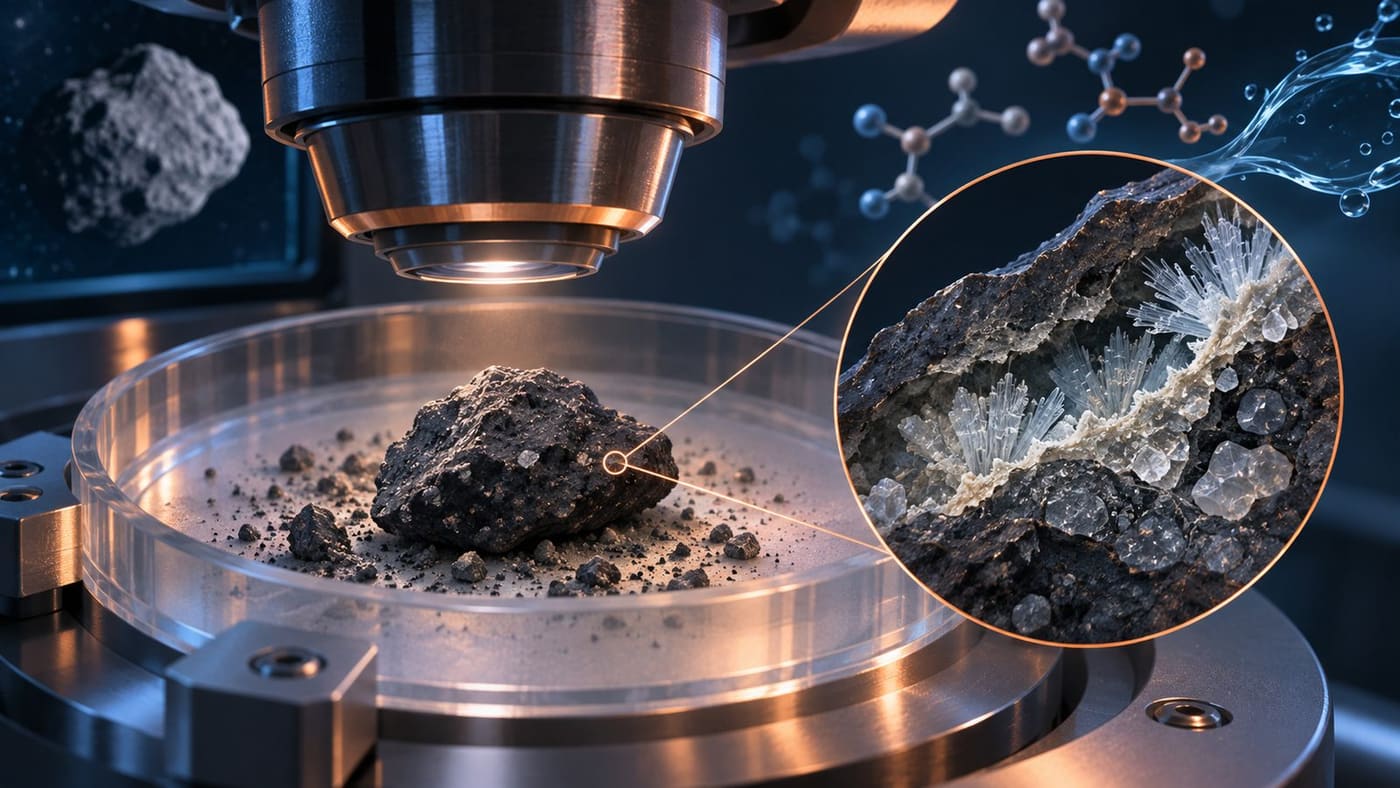
A grain of asteroid material can preserve a record of a liquid that vanished long before the grain reached Earth. It can also carry organic molecules that make sense in a story about chemistry before life. The record is incomplete in both cases. Researchers have to work out which conclusions come directly from measurements and which require an explanation of where the grain came from and what happened to it.
The samples from asteroid Bennu give that distinction unusual force. NASA's OSIRIS-REx mission brought material back to Earth in September 2023. In January 2025, research teams published separate studies of salts and soluble organic matter. One examined evidence left by an ancient brine. The other examined nitrogen-bearing chemistry. Their relationship is interesting because both kinds of evidence bear on the environments in which early solar-system materials changed.
What arrived on Earth
According to NASA's bulk sample announcement, the mission returned 121.6 grams from Bennu, with the return dated September 24, 2023. The figure describes the collected sample as a whole. A particular result might come from a fraction of it, or from a small subset of grains prepared for a particular instrument. Whenever a study reports a quantity or a mineral, it helps to ask what researchers actually placed in the instrument.
The route from the asteroid to the laboratory also matters. A meteorite can offer important evidence, but by the time someone finds it on Earth it may have interacted with soil, humidity or other surroundings. For a returned sample, the team can plan how to collect, contain and handle the material and keep a record of its exposure. That control helps researchers evaluate contamination. It does not remove the need to check what a method or handling step might introduce.
The NASA release about the first in-depth analyses points to contamination control and careful curation as part of what made the results possible. That work is especially relevant when a measurement involves a small amount of a molecule or a mineral sensitive to moisture. It also means readers should distinguish a clean handling procedure from a claim that every grain is chemically identical.
How a salt can record a vanished liquid
A salt mineral can tell you something about the liquid from which it formed. Picture a shallow vessel containing water and several dissolved substances. If some water leaves, the remaining solution can become more concentrated. Under suitable conditions, a solid can form. The liquid changes as substances enter that solid. A later solid may form from a solution with a different composition. The example illustrates the logic without recreating any specific condition inside the body that supplied Bennu's material.
The researchers behind the ancient brine study identified a suite of salt minerals in the returned material and interpreted their relationships as evidence of a sequence of precipitation. They discussed changes such as evaporation or freezing that can concentrate dissolved substances. An isolated salt identification would tell a smaller story. Relationships among several minerals help researchers ask what kind of fluid could leave them behind and how that fluid changed.
A distinction worth keeping is between the object that delivered the sample and the environment in which the minerals formed. The proposed liquid history concerns Bennu's parent body, the earlier body from which its material came. The paper describes evidence retained in the grains. A view of Bennu today is a different kind of evidence from the record of ancient chemistry inside those grains.
How a mineral sequence is inferred
Imagine finding two solids in a dried laboratory vessel. If they have been scraped together into a powder, you can identify what is present, but some clues about when each solid formed are lost. If one solid coats another or fills a space left between earlier crystals, the arrangement may help constrain their order. Researchers can use microscopic relationships in conjunction with mineral chemistry to ask which sequences are consistent with the material. This example illustrates the difference between identifying ingredients and reconstructing a process.
The Bennu study describes a proposed progression from carbonate minerals containing calcium or magnesium through other phases, including sodium-bearing carbonates, to later salts. A sequence is a more specific claim than finding several salts in a container. It connects observations to the way a changing liquid can favour different solids at different times. The paper discusses uncertainty about the relative roles of evaporation and freezing. It is possible to infer concentration of the fluid while leaving some details of the mechanism open.
Keep that scope in mind when a summary talks about ancient water. The conclusion does not require a picture of a surface lake or a known shoreline. The grains can preserve evidence of a fluid that once moved or changed within material on a parent body. The form, timing and local conditions of that fluid are separate questions. A reconstruction can be informative without specifying a place on a map or an exact amount of liquid.
What the organic chemistry adds
The study of ammonia and nitrogen-rich soluble organic matter examined a different set of questions. The researchers reported abundant ammonia and a variety of organic compounds, including amino acids. In this context, soluble means the study considered compounds that could be recovered under the relevant extraction conditions. A result for an extract describes what that preparation revealed. It need not account for all carbon in the rock or every form in which nitrogen occurs.
Amino acids are familiar because organisms on Earth use some of them to build proteins. Their relevance to biology doesn't identify their origin. Individual amino acids can also form through chemistry without organisms. The useful question is what the mix of molecules, their concentrations and their other properties tell researchers about the pathways available in the sample's history. A list of names alone cannot distinguish all the possible pathways.
The study also considered molecular handedness. Some molecules come in two forms that are mirror images and cannot be superimposed. The authors reported that the chiral non-protein amino acids they could distinguish by handedness were consistent with equal or nearly equal mixtures within measurement uncertainty. The comparison needs care. It concerns specific compounds and measurements, and the absence of a consistent biological preference does not establish an exact history for every molecule.
What the two studies can say together
The salt and organic studies provide complementary records. Mineral textures and compositions can be evidence about the history of a liquid. Organic measurements can identify compounds available for reactions and help constrain their origin. Put side by side, they support a picture of early solar-system materials where water-related changes and chemically interesting ingredients occurred. The papers do not show that a particular amino acid was manufactured inside a particular salt grain.
For an analogy, imagine reviewing two laboratory notebooks. One describes the solids that formed as an experimental solution changed. The second describes organic molecules detected in a sample from the same general experiment. The notebooks can help frame a hypothesis about the setting in which reactions were possible. To link a specific molecule to a specific step, you would look for a record connecting those samples, the timing of the experiment and the chemical conditions. The combination of the notebooks gives you reasons to investigate the link. It doesn't create the missing entry.
The same distinction matters in discussions of prebiotic chemistry. A precursor is a possible starting material for further reactions. Several precursors in one collection can help researchers ask whether a pathway was available under certain conditions. The collection does not by itself demonstrate that the entire pathway occurred, that an organism was present or that material from Bennu itself supplied life on Earth. Those claims would require evidence beyond the identification of ingredients.
Why an apparently negative result is still bounded
Suppose a study looks for a compound and does not report a detection. Before treating that as absence, check the sample fraction, preparation and detection limit. A compound might be below what a method can distinguish, tied up in a form that the extraction does not recover, or unevenly distributed across grains. Another method or a differently selected portion might address the question. Conversely, if something is detected in a small fraction, it is not automatically present at the same level everywhere.
Contamination checks apply to positive results too. A blank processed through the same laboratory procedure can help reveal material introduced by reagents or equipment. Records of handling can indicate which exposures are possible. A second technique or sample fraction can test whether the interpretation depends on a single measurement. These are ways to ask what makes a result persuasive. They do not imply that any one test can settle all uncertainties.
Curation makes these questions practical over time. The material returned by OSIRIS-REx can be documented and portioned for different investigations. An analysis that changes or consumes a grain must balance the information it can add with the value of preserving material for other methods. The 121.6 grams in NASA's announcement gives the scale of the collection. It does not mean that any research team had all of it to analyse, or that every gram was used by the January studies.
Read the next headline in three steps
First, identify the observation. Did the team measure an amino acid, identify a mineral, examine a texture or compare isotope ratios? Locate the sample description. A statement about several grains should not turn into a count of the whole asteroid. Note whether the wording refers to a finding in the returned material or a model of an earlier body.
Second, identify the inference. If an article says there was a brine, look for the mineral evidence and the explanation of what conditions could have produced it. If it says a chemical pathway was possible, look for the substances and conditions that support that statement. Give the authors room to propose mechanisms while preserving the uncertainties they identify. An inference can be well grounded without being the only explanation for every detail.
Third, identify what would strengthen or narrow the conclusion. A new measurement might resolve a mineral's association with another phase, check more grains or test which conditions favour a proposed reaction. It might also reveal that the material is more varied than the earlier sample suggested. That is a meaningful update even if the original result still stands. Progress often means finding out exactly where a conclusion holds.
The dates are another useful check. The return date tells you when the material reached Earth. The bulk mass announcement tells you when the collection total was reported. The papers give the publication dates of particular analyses. These dates do not date the grains or the fluid inferred from them. Keep them in separate fields if you are comparing reports. A newer report may be about a different fraction or instrument, so compare its question with the earlier paper before deciding whether the results disagree.
What remains after the excitement
The returned samples give scientists a way to study changes that once happened to early solar-system material. In one study, the record is preserved in minerals left by a changing liquid. In another, it is measured in ammonia and organic compounds recovered from the sample. The important question is what those records can establish in combination and where another measurement is needed.
Bennu's grains make it possible to distinguish these questions with material that can be examined in a laboratory. Read a claim about them by keeping the grain, the measurement and the explanation in view at the same time. The result is a more precise account of what the mission brought back and why the material matters.
For another example of separating an observation from a broader claim, compare claims with the underlying evidence.
Sources and research note
Sources checked November 3, 2026. The article focuses on the 2023 return, NASA's bulk mass announcement and two January 2025 papers. The vessel and notebook comparisons are conceptual examples. The discussion does not attempt a survey of later Bennu publications.