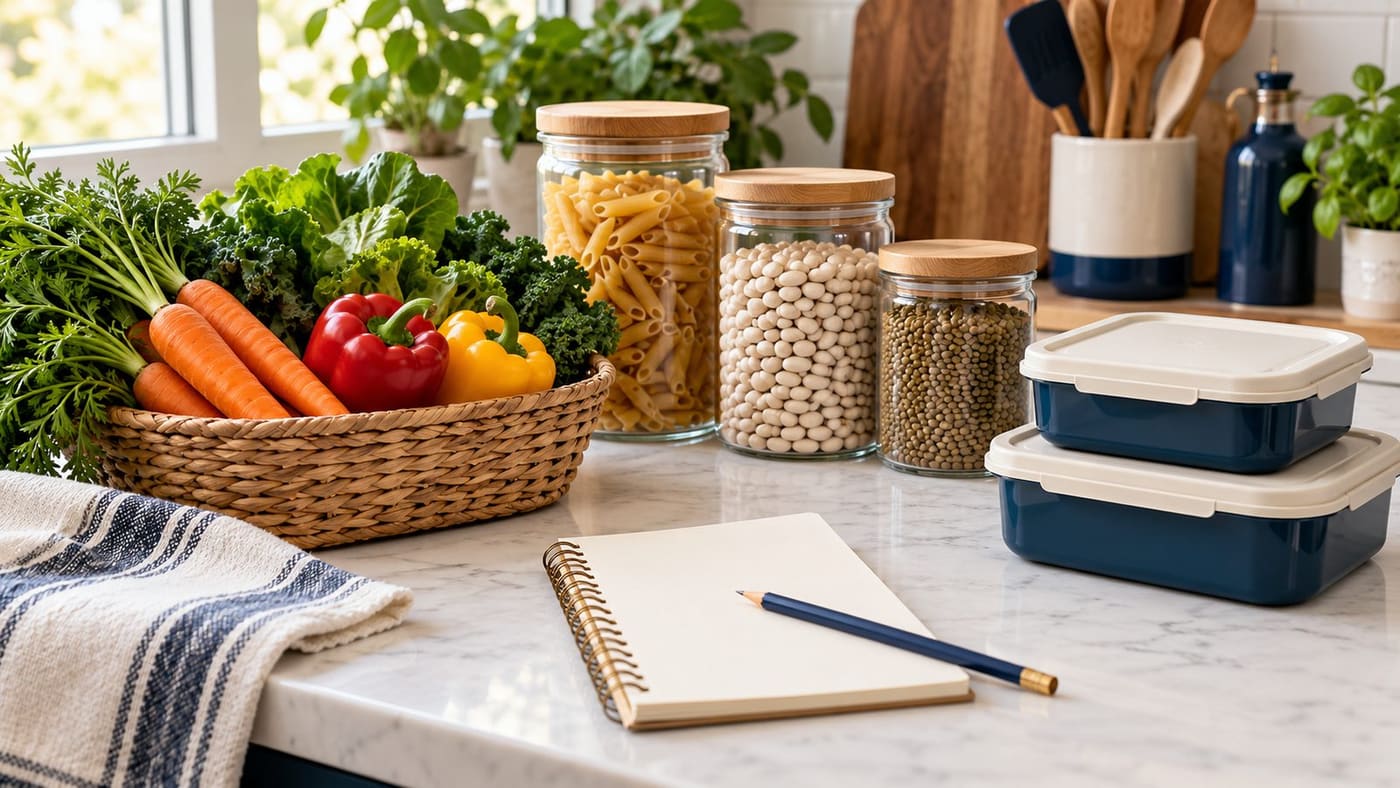
A meal plan works best when it begins in the kitchen rather than in a shopping app. Looking at what is already available can reveal the ingredients that need a purpose, the foods that can wait, and the purchases that would simply duplicate something on the shelf. The aim is not to rescue every item at any cost. It is to make realistic meals from food that is suitable and safe to use.
This guide combines official meal-planning and food-safety guidance checked on October 28, 2026 with original fictional household exercises. It is a planning method, not a tested recipe collection or an individual nutrition plan. Follow product-specific instructions and relevant local food-safety advice, particularly where a food's storage history or suitability is uncertain.
Start with meals you will actually eat
EPA recommends planning around meals a household enjoys, checking existing supplies before shopping, and matching quantities to the meals expected at home. Its guidance also points out that a bulk purchase is useful only when the food is used. These are practical reasons to connect a shopping list to a realistic schedule rather than an ideal week. Source: https://www.epa.gov/recycle/preventing-wasted-food-home
Write down which meals need planning and who will be present. Include evenings away from home and days when cooking time is limited. A plan for seven elaborate dinners can become wasteful if several evenings are already committed elsewhere. Start with the schedule that exists, not the one you hope will appear.
In a fictional household, Noor and a housemate need three shared dinners and two separate lunches. They do not plan seven shared dinners merely because a weekly template has seven boxes. Naming the actual meals gives the existing ingredients a more credible destination and reduces the amount of food bought for occasions that will not happen.
Make a short kitchen inventory
Check the refrigerator, freezer, and pantry without leaving perishable foods out while making a detailed catalogue. Record the ingredient, approximate usable quantity, relevant date or opening information, and storage instructions. Where the storage history is unknown, mark the uncertainty rather than silently treating the item as available for cooking.
Use categories that support a decision: suitable for a planned meal, check instructions or safety information, and not suitable to use. This is a planning aid rather than a substitute for safety assessment. Do not put recalled food, food with an unsafe history, or food you are advised to discard into a use-first category because wasting it feels disappointing.
Keep the list short enough to maintain. A household usually needs to know what can form the next few meals, not build a permanent database of every spice. Focus on items that might otherwise be overlooked and on ingredients whose quantities affect the next shopping decision.
Give existing ingredients a role
Canada's Food Guide offers ways to incorporate prepared vegetables, legumes, meats, fish, and whole grains into other meals. Its examples show how a prepared ingredient can have more than one use, provided it is handled appropriately. The useful idea is flexibility within safe storage, not extending a food's safe life by giving it a new recipe name. Source: https://www.canada.ca/en/health-canada/services/food-guide/eating-support/kitchen/cooking-skills/meal-planning-using-leftovers.html
For a fictional planning exercise, Noor has suitable vegetables, an unopened package of cooked beans, and pasta. Instead of selecting a recipe requiring many new ingredients, Noor looks for an appropriate recipe using that combination and checks any missing essentials. The exercise illustrates a decision process; it does not give cooking times or claim that every substitution will work.
Identify whether an ingredient supplies the main component, a side, or a flavouring. This can prevent an attractive list of ingredients from being mistaken for a complete plan. A small amount of sauce may help flavour dinner but does not establish that enough food is available for everyone expected to eat.
Keep safety decisions ahead of recipe decisions
Health Canada advises discarding cooked food left at room temperature for more than two hours and warns that contamination cannot be judged by appearance, smell, or taste. Its leftover guidance calls for prompt refrigeration in shallow containers, keeping food out of the temperature range from 4°C to 60°C, and using refrigerated leftovers within two to three days or freezing them for later. Source: https://www.canada.ca/en/health-canada/services/general-food-safety-tips/food-safety-tips-leftovers.html
A new dish does not reset the history of an ingredient. If the underlying food is unsuitable to use, turning it into soup or mixing it with fresh ingredients is not a solution. When history is uncertain, use the relevant safety guidance and do not taste the food to investigate whether it is safe.
Label prepared food clearly with contents and dates as part of the household routine. A label helps people make decisions; it does not compensate for unsafe cooling or storage. If two people share a kitchen, agree what the date means and who recorded it so that one person's assumption does not become another person's false reassurance.
Plan reheating as part of the meal
Health Canada's leftover guidance specifies reheating to an internal temperature of 74°C, checked with a digital food thermometer. It also advises discarding uneaten food after reheating. Follow its detailed instructions and the requirements relevant to the food and appliance rather than assuming that a hot-looking surface establishes a safe temperature throughout. Source: Health Canada leftover guidance linked above.
For planning purposes, choose the amount needed for the meal rather than repeatedly bringing an entire stored batch into use. Record which portions are intended for which meal, within the applicable storage guidance. This makes the plan easier to follow and reduces confusion about what has already been reheated.
Do not invent a universal microwave time. Portions, containers, equipment, and foods differ. A planning guide should direct the reader to the appropriate safety method instead of replacing temperature checks with a convenient but unsupported number of minutes.
Match the plan to available time
USDA's MyPlate meal-planning tip sheet recommends checking existing supplies, mapping meals, considering the schedule, and preparing a shopping list after accounting for food already available. It presents leftovers and freezing as options to include in planning. This is general meal organization guidance rather than a promise that one schedule suits every household. Source: https://www.myplate.gov/sites/default/files/2024-06/TipSheet-24-Meal-Planning.pdf
Noor's fictional week includes one evening with more time and another with very little. The household chooses an appropriate recipe for the longer evening and a simpler meal for the busy one. The plan includes safe handling and storage requirements rather than assuming that preparation can be postponed indefinitely.
Be honest about equipment and confidence as well as time. A recipe may be quick for an experienced cook with the right tools but unsuitable for another household's evening. The best plan is one that can be carried out correctly, not one that looks impressive on a list and then gives way to an unplanned purchase.
Write the shopping list after choosing the meals
List ingredients for the selected recipes, then subtract what is already suitable and available. Include quantities and the meal each purchase supports. This creates a reason for the item to enter the kitchen and makes it easier to reconsider a larger pack that exceeds the plan's needs.
In a fictional arithmetic example, the household needs six portions across two meals and already has two suitable portions reserved. The remaining planned requirement is four portions. That calculation is a planning illustration, not a nutritional portion recommendation. Actual amounts depend on the recipe and the people eating.
If an offer changes the quantity you would buy, identify the destination of the extra food before accepting it. Will it be used in a specific meal or stored appropriately for a later purpose? If the answer is only that it might come in handy, the larger purchase may deserve a second look.
Keep date labels and storage instructions together
FDA explains that US food date labels can use different wording and that quality-based dates need to be understood in context. Its guidance also directs consumers to storage information and product contacts where questions remain. This article does not transfer US label conventions into a universal rule for every country or product. Source: https://www.fda.gov/food/consumers/how-cut-food-waste-and-maintain-food-safety
Read the whole label, including instructions after opening, refrigeration, preparation, and any safety information. A date printed on the package does not tell the entire storage history of the food in your kitchen. Likewise, a quality label should not be used to override product-specific safety instructions or a recall notice.
When uncertain about a particular product, seek the relevant official or manufacturer guidance rather than extrapolating from a different food. Planning can reduce unnecessary purchases, but it should not become pressure to use an item whose suitability has not been established.
Build flexibility without losing track
Give each planned meal a backup that does not depend on keeping uncertain food. A suitable shelf-stable or frozen option can provide flexibility when schedules change, provided its own instructions are followed. The backup should be something the household is willing and able to prepare, not an aspirational recipe requiring another shopping trip.
If an evening changes, revise the plan promptly. Identify which ingredients need a new safe destination and which can wait under their storage guidance. Do not simply move every meal one day forward without considering the foods involved. A calendar shift can have different implications for different ingredients.
Noor's household changes one dinner arrangement and checks the prepared-food labels before deciding what to do next. If suitable freezing is chosen, the household follows the appropriate guidance and labels the food. The example does not assume that freezing makes an already unsafe item safe or that it removes the need to understand its earlier history.
Use a brief waste record to improve the next plan
At the end of the planning period, record what was not used and the reason. Useful categories might include buying too much, a changed schedule, an unpopular meal, forgotten storage, or uncertainty about handling. Keep the description factual and avoid turning the record into blame between people sharing the kitchen.
The next decision should respond to the reason. If a large bag repeatedly exceeds the household's needs, consider a different quantity. If a meal was disliked, choose another rather than planning it again because the ingredients appear economical. If food was forgotten, improve its visibility and record instead of relying only on stronger intentions.
A household observation is not a scientific savings estimate. If you track spending or discarded amounts, use consistent definitions and keep the limits visible. One quieter week does not establish an annual reduction, and this article provides no guaranteed monetary or environmental result.
A fictional two-person planning review
Noor and the housemate review their three shared dinners. Two happened as planned; one changed. They also notice that an ingredient was bought twice because neither checked the pantry list. The practical adjustment is to review the existing-food note together before the next purchase.
They retain a meal that both enjoyed and replace one that required more preparation than expected. They also make the label format consistent so that contents and dates are easier to understand. These changes are small enough to follow and directly connected to the problems observed.
The review does not celebrate using every item regardless of safety. Food that should not be eaten remains outside the meal plan. The lesson is to improve the next purchase and handling decision, rather than reinterpret an unsafe item as a creative cooking opportunity.
Keep recalls separate from ordinary planning
Before using a product affected by a recall concern, follow the official notice and identify the exact package information. Do not include it in a meal because the date appears acceptable or because the household has eaten a similar product before. The relevant question is whether the item matches the notice and what action the authority specifies.
Our guide to reading food recall notices (https://monetizearticle.com/article/food-recall-notices-how-to-check-the-package-in-your-kitchen-b11ca7) explains the package-by-package identification process in more detail. Keeping that process separate from ordinary meal planning prevents a use-first list from becoming an accidental route back into the kitchen for food that requires a different action.
Also account for allergies, dietary restrictions, and the people who will eat the meal. A flexible substitution should still be checked against ingredient information and individual requirements. A general planning method cannot establish that a product is suitable for every member of a household.
Conclusion
Using what you have begins with a realistic schedule and a clear view of suitable food already in the kitchen. Give ingredients a specific purpose, buy quantities connected to actual meals, and review what the plan missed. Keep safety, product instructions, and handling history ahead of creative reuse.
The useful outcome is a routine the household can repeat: check, plan, shop, handle correctly, and review. That makes the next decision clearer without turning food-waste reduction into a reason to guess about whether something is safe to eat.
Sources and research note
Research date: October 28, 2026. Linked EPA, USDA MyPlate, FDA, and Health Canada resources support the attributed guidance. The safety times and temperature in this article follow the cited Health Canada leftover page; product-specific and local requirements still matter. Noor, the household schedule, and all quantities are fictional exercises. No recipes were physically tested and no savings were measured. The original AI-generated conceptual illustration shows generic meal-planning materials rather than an actual household's food or storage conditions.