The McRib is attracting renewed attention in the United States, but a return headline does not mean every McDonald's restaurant has the sandwich. Before making a special trip, check the particular restaurant, the current menu and any dietary information relevant to your order.
USA TODAY's 22 October report, [republished by AOL](https://www.aol.com/articles/mcrib-coming-back-mcdonalds-see-182146000.html), says McDonald's told the newspaper that a limited regional return would begin on October 27. The report names cities including Los Angeles, Chicago, Miami, Atlanta, Philadelphia and Dallas. That date and city information is attributed to the newspaper's reporting; this review did not retrieve a separate current corporate announcement confirming the complete rollout.
The company's own [US McRib page](https://www.mcdonalds.com/us/en-us/product/mcrib.html) describes the sandwich and says availability is limited. It does not establish stock at a particular restaurant. This guide combines that primary product information with official ordering guidance and food-information resources. It is not a taste test, restaurant visit or recommendation that the sandwich suits everyone's diet.
Start with the restaurant you would actually use
A regional announcement and a local menu answer different questions. The first describes a rollout; the second helps you determine what a selected restaurant is offering through a particular ordering channel at that moment.
McDonald's [US app guidance](https://www.mcdonalds.com/us/en-us/mcdonalds-app/faqen.html) explains that menu availability varies by location and that unavailable products are identified for specific locations. Selecting the correct restaurant is therefore a necessary check, rather than a minor detail to leave until after choosing food.
For a hypothetical commuter, a restaurant near home and one near work may be convenient for different reasons. Seeing the sandwich listed near home would not establish that the work-area restaurant also has it. Check the intended pickup point before deciding to take a detour.
The same principle applies to delivery. An address can be served through a different arrangement from the restaurant a customer normally visits. Confirm the location and channel shown for the proposed order. A general product page is useful background, but it is not an inventory reservation.
If the item is not listed, avoid treating a fan's photograph from another city as stronger evidence than the current local menu. A special trip can wait until the relevant location provides usable information.
Understand what the sandwich description does and does not tell you
The official US product description identifies seasoned boneless pork with barbecue sauce, onion and pickles in a bun. It describes a composed sandwich, with several components contributing to the finished item. The name and appearance should not be used to infer an ingredient list beyond what the company publishes.
For readers checking whether it fits a personal dietary requirement, the important step is to consult current ingredient and allergen information for the US product. A historical list copied into a forum, or a page for another country, may answer a different question.
The retrieved product page did not expose a complete numerical nutrition panel in usable text during this review. No calorie, sodium or other nutrient figure is reproduced here from an old screenshot or third-party database. Readers who need those figures should use the current official nutrition information or ask the restaurant.
This limitation matters because a confident number can be less useful than an acknowledged gap. A figure for a different serving, customization or market can make a comparison look precise while comparing unlike items.
Keep the sandwich separate from the meal around it
The food ordered alongside a sandwich changes the complete order. A sandwich listing, a meal option and a delivery bundle should not be treated as interchangeable descriptions.
The [FDA's menu-information guidance](https://www.fda.gov/food/nutrition-education-resources-materials/calories-menu) explains how calorie information can appear on menus, including ranges for choices, and notes that covered establishments also make additional written nutrition information available on request. The general 2,000-calorie reference used in menu information is not an individualized requirement for every diner.
For a hypothetical comparison, suppose someone is choosing between buying one sandwich or selecting a meal with a side and drink. The useful comparison includes the actual side, drink size and any additions. Comparing the sandwich alone with the total for a different meal would answer neither question accurately.
This does not require assigning a moral label to the food. It requires identifying what is being compared. A person may be interested in portion size, sodium information, price, ingredients or simply whether the order matches what they intended. The relevant information depends on that question.
When a menu displays a range, look for the choices behind it. Do not automatically take the lower end as the value for the combination selected. If the information remains unclear, ask rather than calculate a product-specific total from incomplete inputs.
Customization is a preference decision unless the evidence supports more
Removing onions because someone dislikes them is a straightforward preference request. Removing a visible ingredient because of an allergy is a different matter. A customization option does not by itself establish that the remaining food is suitable for an allergic diner.
The company notes on its product page that shared preparation areas, equipment and utensils may allow contact with allergens. That warning should remain attached to any discussion of ingredient choices. The page's general information carries a January 2022 date unless otherwise stated, so readers should confirm current details rather than treating it as a newly issued 2026 allergy notice.
[Food Allergy Research & Education's cross-contact guidance](https://www.foodallergy.org/resources/avoiding-cross-contact) explains that allergen proteins can transfer between foods or surfaces, including in amounts that cannot be seen. Picking off a visible ingredient is therefore not a reliable way to resolve an allergy concern.
People managing a food allergy should discuss the relevant ingredients and preparation with the restaurant and follow their own clinician's advice and established care plan. This article cannot certify a customized order as safe. If staff cannot provide the information needed to make a decision, the uncertainty should not be resolved by guessing.
For a group order, communicate an allergy question before payment rather than burying it among preferences such as extra pickles or no onions. The person with the allergy needs a clear answer, not an assumption made by someone collecting the order.
Read a local offer as an offer with conditions
An advertised return does not establish a single national price. A customer should review the total shown for the selected order, including the chosen items and any applicable charges, before deciding to purchase.
This is particularly useful when comparing a pickup order with a delivery basket. The visible sandwich price is only one part of the comparison. Check what the final screen includes instead of assuming two similarly named offers have the same contents or total.
Consider a hypothetical group buying lunch. One person compares a sandwich price from a photograph with a meal price in an app and concludes that the app is more expensive. The comparison is incomplete until the contents, location and ordering channel match. A meal may include items absent from the photograph; the photograph may also be old.
A discount is useful only if its conditions fit the intended purchase. Read the expiry, participating-location language and required items. There is no need to add food that was not wanted merely to make a promotional label appear on the receipt.
This guide does not quote a current McRib price or validate a specific coupon. It also does not place orders, test reward redemption or claim that a particular offer will remain available later.
Decide what would make a special trip worthwhile
Limited availability can turn an ordinary lunch decision into a search. A practical way to keep that search proportionate is to decide what information would justify the trip before setting out.
For example, a hypothetical customer could decide to visit only if the chosen restaurant currently lists the sandwich, the total is acceptable, and the stop fits an existing journey. Another might decide that a separate long drive is not worthwhile even if the product is available. Neither decision requires treating scarcity as a reason to buy.
This approach also leaves room for changing plans. If the selected location no longer shows the item, the useful response may be to choose something else or defer the visit. Repeatedly refreshing a distant restaurant's menu does not improve the evidence about the restaurant nearby.
Do not use an ordering app while driving. If a passenger is checking an order, make sure the destination and pickup arrangement are agreed before the vehicle changes route. Convenience should not depend on rushing through a purchase or overlooking the location shown on screen.
Separate a review from a description
The official description can tell a reader the components of the sandwich. It cannot tell that reader whether they will enjoy it. A photograph can show appearance, but it cannot establish texture, temperature or how a particular order was prepared.
A useful personal review would explain what was actually purchased, where and when, and which impressions are subjective. “The sauce tasted sweeter than I expected” is a preference observation. A broad claim that every restaurant prepares the sandwich in the same way would require evidence beyond one visit.
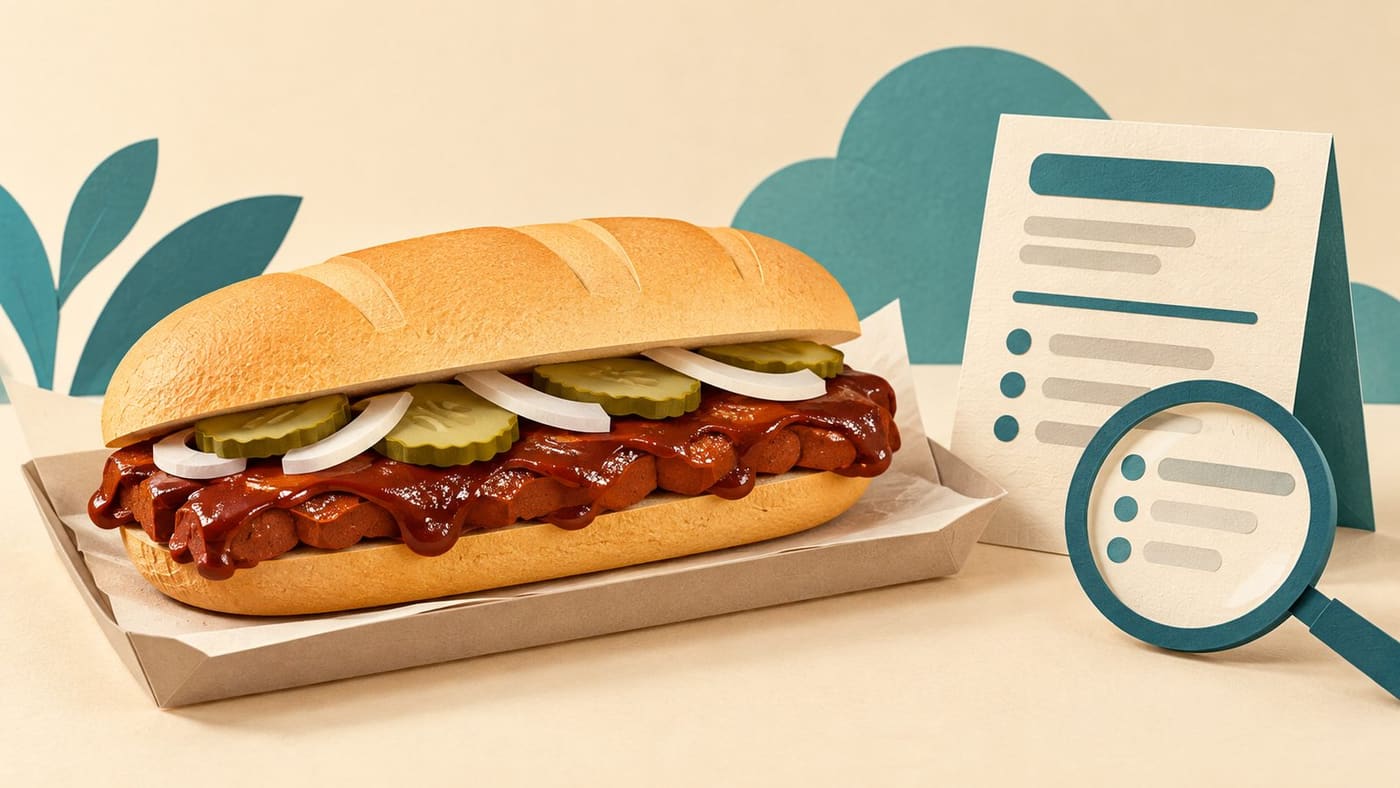
This article includes no first-hand tasting. The accompanying image is an original conceptual illustration of a generic barbecue sandwich and menu card. It is not a photograph of the McRib, a serving-size reference or evidence of what a customer will receive.
Readers comparing reviews can look for that same distinction. A writer who identifies the limits of their experience is giving more usable context than one who turns a single meal into an unsupported universal conclusion.
Avoid confusing old returns with the current one
Seasonal products accumulate years of announcements, fan photographs and search results. A page can be genuine and still describe an earlier return. The year, publication date and country are essential context.
A practical check is to read beyond a search-result headline. Look for the date in the article, the source of the rollout information and whether the story concerns nationwide availability or selected markets. If a screenshot omits those details, follow it to the original source before using it to plan a purchase.
The 2026 report cited here describes a limited regional rollout. This guide does not convert the named cities into a complete restaurant list or infer an end date that the retrieved evidence did not establish.
Fan sightings can suggest where to look, but they remain observations with their own limits. A sighting may be accurate for one time and place without confirming stock elsewhere. Treat the relevant restaurant's current information as the practical next check.
A useful checklist before ordering
The checks can be kept short:
- Confirm the intended restaurant and ordering channel.
- Check that the item is currently listed there.
- Read current US ingredient and nutrition information when relevant.
- Resolve allergy questions with the restaurant rather than relying on a removed topping.
- Compare the complete order and final total, not an isolated headline price.
- Check pickup details and keep the receipt if a problem needs follow-up.
The purpose is to avoid preventable misunderstandings. A customer should not arrive at the wrong branch, confuse a sandwich with a meal, or rely on an old nutrition screenshot simply because a return announcement was exciting.
When ordering for someone else, ask which details matter to them before substituting an item. A preference can be flexible, while an ingredient restriction may not be. If the requested item is unavailable, explain the options rather than treating the closest-looking sandwich as automatically equivalent.
Conclusion: use the return as a prompt to check, not a guarantee
The McRib's renewed attention gives interested customers a reason to look at current local menus. It does not remove the need to check the restaurant, the complete order and any relevant ingredient information.
The strongest practical distinction is between a reported regional rollout and an actual local purchase decision. Keep those separate, acknowledge missing information, and use the current official product and restaurant resources for the details that matter to you. There is no requirement to turn a limited-time menu item into an urgent purchase.
Sources and research note
Researched 26 October 2026. Discovery: [Google Trends US Food and Drink](https://trends.google.com/trending?geo=US&category=5), “mcrib returns,” 100K-plus, active, shown as starting 15 hours earlier, with “mcrib” and “mcdonalds news” in the cluster. Search volume is not a sales or satisfaction measure.
Directly retrieved primary resources: [McDonald's US McRib description](https://www.mcdonalds.com/us/en-us/product/mcrib.html), [US ordering FAQs](https://www.mcdonalds.com/us/en-us/mcdonalds-app/faqen.html), [FDA menu-information guidance](https://www.fda.gov/food/nutrition-education-resources-materials/calories-menu), and [FARE cross-contact guidance](https://www.foodallergy.org/resources/avoiding-cross-contact). The October 27 regional-return report is attributed to [USA TODAY via AOL](https://www.aol.com/articles/mcrib-coming-back-mcdonalds-see-182146000.html); a separate current corporate rollout announcement was not retrieved. Complete numerical nutrition data, local stock, prices and personal allergy suitability were not verified. Hypothetical examples are editorial analysis. No purchase or tasting was performed; the generated conceptual illustration is not product photography.