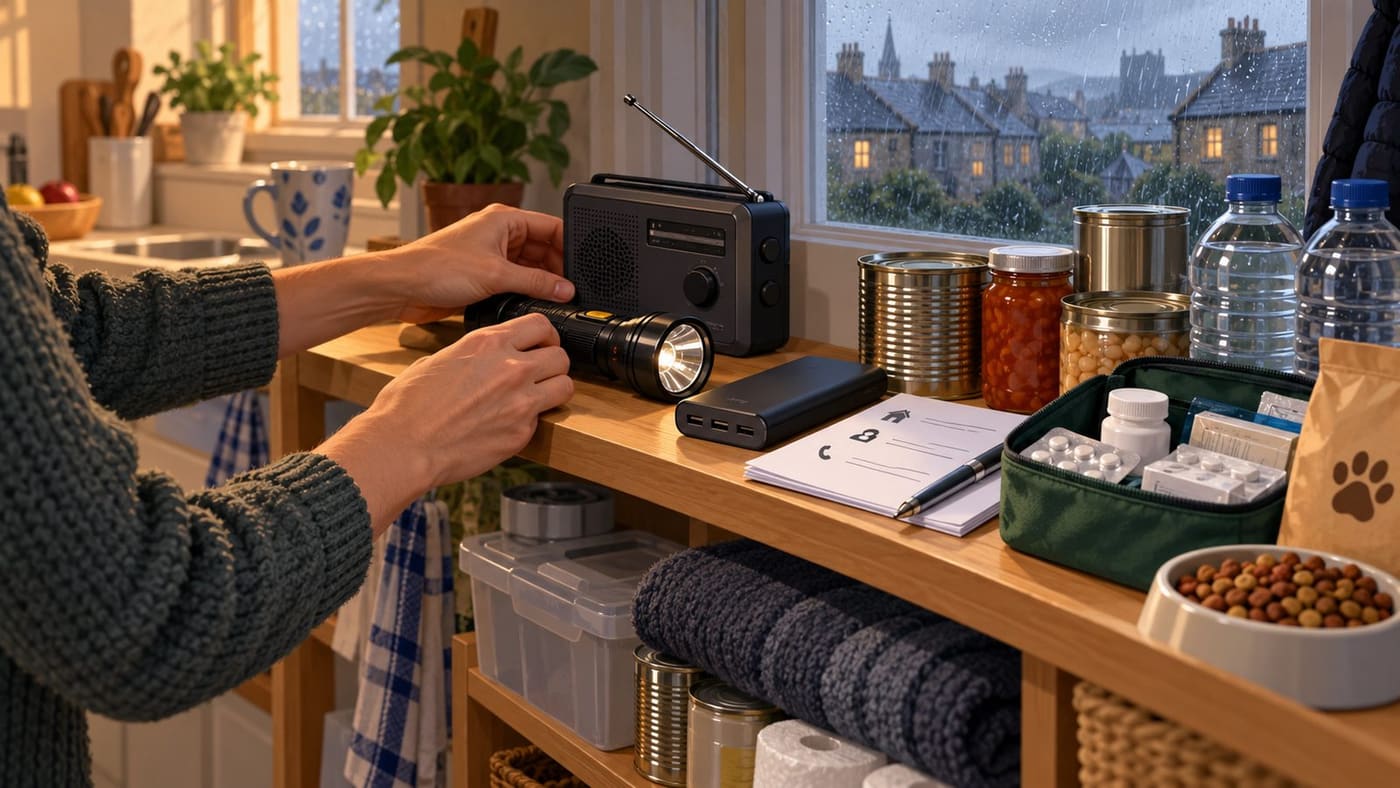
A household can own a torch, spare food and a power bank and still struggle to find them when a service stops working. The practical task is to turn scattered possessions into an arrangement people can use, then keep that arrangement current. This guide concentrates on inventory, storage, accessibility and maintenance after you have considered the basic supplies. It is a companion to our broader household planning article, not a prediction of an imminent emergency.
The UK Government’s Be Ready checklist recommends building readiness gradually, beginning with what is already at home, and reviewing supplies every six months. It frames preparation around three days and recognises that people have different circumstances. The system below is an original way to organise that review. It does not override product instructions, an individual care plan or directions from emergency responders.
Start with a map of what you already own
Walk through the normal storage places and make a short list. Record the item, where it is, whether it works and what is missing. A torch in a drawer and a power bank in a work bag are useful discoveries. Do not mark them “ready” until you know that the person who may need them can reach and operate them.
Avoid buying a second item simply because the first was not visible. A location map can reveal that the household already has suitable equipment, but nobody has agreed where to return it after use. In that case the first improvement is a storage routine, not a purchase. Where an existing item is unsuitable, record the specific limitation so the eventual replacement solves the actual problem.
For example, a fictional household finds two charging cables, neither compatible with the phone used by the person at home during the day. “Two cables” looks adequate in a count. “No compatible cable for this device” describes the gap. Inventory should capture usability rather than reward the largest pile of equipment.
Use four simple statuses
Give each item a status such as ready, needs checking, needs replacing or not applicable. These are suggested household labels, not government categories. They make it possible to distinguish something you have verified from something you merely own. Add a short reason where the status is not ready.
For a radio, the reason might be that the station has not been tuned. For a torch, it might be missing batteries. For a document folder, it could be an outdated contact number. A named problem is easier to fix than a vague entry saying “check emergency things.” Once fixed, note the date rather than relying on memory about who last inspected it.
Do not use the status system to pressure someone into tasks they cannot safely perform. If a person cannot reach a cupboard or handle a heavy container, record that as an accessibility issue for the household to solve. The item is not functionally ready for them just because another person can use it easily.
Keep storage compatible with the product
A single box is convenient, but not every essential belongs in the same conditions. Food, medicines, batteries and personal documents can have different storage and security requirements. Follow the label and manufacturer instructions. A central list can point to several appropriate locations rather than forcing everything into one unsuitable cupboard.
United Lincolnshire Hospitals’ medicine-storage guidance advises keeping medicines in their original packaging, following product-specific storage directions and asking a pharmacist when unsure. It also emphasises keeping medicines away from children and pets. Do not decant medication into an unlabelled emergency container or change treatment to simplify an inventory. A medicine that needs refrigeration requires its own professionally advised contingency.
The inventory can say where instructions are kept and whom to contact about an unresolved storage question. It does not need to reproduce a treatment plan on a cupboard door that every visitor can read. Agree what information carers need and how they can obtain it securely. Accessibility for authorised people and protection from children or casual visitors are both part of a usable arrangement.
Rotate food without confusing date labels
The Food Standards Agency distinguishes use-by dates, which concern safety, from best-before dates, which concern quality. It says not to eat food after its use-by date even if it appears or smells normal, and that storage instructions matter. Apply the product’s directions rather than assuming every long-life item follows the same rule.
For an ordinary cupboard rotation, place items you intend to use sooner where they are easy to see, and replace them during normal shopping. Choose food that the household already eats and can prepare under the conditions you are planning for. An unopened product that requires cooking may not serve the same purpose as an appropriate ready-to-eat option when the cooker is unavailable.
Keep opening instructions and any “refrigerate after opening” direction in mind. A large container may be economical in routine use but awkward if the remaining contents require refrigeration you cannot provide. Inventory is therefore about portions and preparation as well as the number of tins. This is a planning consideration, not permission to ignore storage requirements during an outage.
Turn a count into a realistic gap list
Separate the household’s chosen target from what is presently available. A simple row can contain item, target, usable quantity, gap and next action. The target should come from relevant official guidance or the household’s actual needs, not an arbitrary internet shopping bundle. Review quantities when household membership or circumstances change.
Here is a fictional non-food example: the home needs one working torch accessible upstairs and one downstairs, but only the downstairs torch works. The gap is one working light in the upstairs location. It could be solved by replacing batteries, repairing through an appropriate service or obtaining another suitable torch. Buying an expensive multi-function device is not the only possible response.
For water and other essential quantities, consult the current official checklist and any individual needs separately. This maintenance guide does not calculate a complete supply for every household. Keep the basis for your own calculation alongside the inventory so someone reviewing it later can see which people, duration and uses were included.
Check equipment in normal conditions
Use equipment in the ordinary safe way described in its manual. Check that the torch turns on, the cable fits and the radio can receive the station you intend to use. Our separate [wind-up radio guide](https://monetizearticle.com/article/wind-up-radios-in-a-uk-power-cut-what-they-can-do-and-how-to-prepare-one-c33f3d) explains a simple reception record. No household power shutdown is needed to establish whether a portable receiver works on its own battery.
Do not disconnect medical equipment, telecare or household utilities to create a realistic test. A calm conversation and ordinary device checks can reveal many problems without introducing a new hazard. Questions about essential powered equipment belong with the care team, manufacturer or relevant service provider. A generic phone power bank should not be assumed suitable for an unrelated device.
Record a limitation honestly. If a battery has not been tested, write “not checked.” If a charging lead is damaged, follow the manufacturer’s advice rather than keeping it because it occasionally works. A useful inventory makes uncertainty visible; it does not convert an untested item into a reliable backup by giving it a tick.
Make the arrangement usable for more than one person
Ask another household member to locate the key items using the written list. Do this in normal lighting and without urgency. If they cannot find something, improve the label or location. The exercise is about clarity, not speed or blame. A plan known only to the person who assembled it can fail when that person is away.
Think about legibility, reach and grip. Large print or a clear picture may be more useful than a tiny handwritten label. A familiar easy-to-reach location may work better than a high shelf. Discuss individual preferences rather than assuming that one accessibility change suits everyone. Keep exits and routes clear when choosing where supplies belong.
For shared housing, agree which items are communal and which are personal. A housemate should not discover during a disruption that the only power bank belongs to someone who has taken it to work. The answer may be a shared item, a return routine or a different arrangement. What matters is that the assumption is explicit before people rely on it.
Keep contacts current without exposing private records
A paper contact list is useful when a phone is unavailable, but it still needs maintenance. Check that the listed organisation and number remain relevant, and record when they were last reviewed. Keep a separate secure place for documents that contain sensitive identity or financial details. A general household checklist does not need to display every policy number openly.
If someone’s care provider, school contact or usual support person changes, update the relevant copies. A new number saved on one phone does not automatically update the printed page. Mark which copy is the current one so an old list in a drawer is not mistaken for the latest version.
For the wider communication and meeting arrangements, use the [three-day household planning guide](https://monetizearticle.com/article/uk-be-ready-guidance-build-a-three-day-household-plan-around-what-you-already-have-bf4a07). The inventory should reference that plan, not create a competing set of instructions. If there is an actual emergency, follow the relevant authorities’ directions; do not delay necessary action to complete a checklist or retrieve supplies.
Give each gap a manageable next action
A long shopping list can make preparation feel unaffordable. Separate tasks that cost nothing from purchases. Labelling a drawer, finding a manual, writing a known contact number or agreeing who checks the radio may solve a real gap without spending money. For purchases, identify the function needed and a realistic budget before choosing a product.
Use specific actions such as “check whether the existing charger fits” rather than “buy more technology.” If the check shows the item is already suitable, remove the purchase from the list. This avoids turning preparedness into an accumulating collection of accessories. The goal is a usable arrangement that can be maintained, not the largest possible kit.
Assign tasks by agreement. One person might update the contacts while another checks food labels. Keep specialist questions with the appropriate professional rather than asking a household member to improvise. An unresolved question about medicine storage is not equivalent to an ordinary missing cable and should not be treated as just another shopping task.
Schedule a review and respond to changes
The government’s six-month review suggestion is a useful starting point, but ordinary changes can justify an earlier check. Moving home, changing devices, a new household member or using an item from the kit can all affect readiness. Add the review to a calendar people already use, then keep the task short enough that it is likely to happen.
A review can ask five questions: is the item still suitable, is it in the recorded place, does it need replenishing, are the instructions current and can the intended person use it? This is an original review structure. It does not certify that the household can manage every possible incident or replace specialist planning for dependent people.
After using supplies, update the list before the event fades from memory. Note what was hard to find and what was unnecessary. A practical lesson might be that the torch was useful but stored behind heavy boxes, or that a contact list was clear but inaccessible to a visiting carer. Those observations can lead to small, concrete improvements.
Conclusion
An emergency kit stays useful through ordinary maintenance: knowing what is there, keeping it in suitable conditions, replacing what is used and making sure the people who need it can find it. Start with existing possessions and clear responsibilities. Follow food, medicine and equipment instructions rather than forcing everything into one box. A modest arrangement that is checked and understood is easier to rely on than an impressive pile whose contents nobody has reviewed.
Sources and research note
Checked26October2026: [UK Be Ready checklist](https://beready.campaign.gov.uk/be-ready-for-emergencies/), [government campaign announcement](https://www.gov.uk/government/news/households-encouraged-to-take-small-simple-steps-to-stay-prepared-in-an-emergency), [GOV.UK food-date guidance](https://www.gov.uk/understanding-food-labelling/best-before-and-use-by-dates) and [United Lincolnshire Hospitals medicine-storage guidance](https://www.ulh.nhs.uk/patients/patient-information-library/storing-medicines-at-home/). Inventory statuses, examples and review questions are original organisational suggestions, not official certifications. No product testing, personalised medical advice or imminent-emergency prediction is claimed. Limited phrase searches are not a comprehensive plagiarism scan. The original AI-generated image is conceptual, not a real emergency or an official campaign image. The saved UK Trends discovery is historical; this focused maintenance article is not an additional independent trend claim.