The UK Government’s Be Ready campaign asks households to think about how they would manage if essential services were disrupted for up to three days. Its checklist includes water, food, light, warmth, medicines, a charged power bank and an FM radio powered by batteries or a hand crank. The point is practical preparation—not panic buying, a prediction that a national outage is imminent, or a requirement to buy every item at once.
A saved Google Trends UK snapshot on 25 October listed “wind up radios” as a search topic; that snapshot does not establish a sustained rise in demand or sales. A radio can be useful when broadband, mains power or mobile service is unavailable, but it is only one part of a household plan. The most useful next step is to make a small, realistic arrangement: identify the information channel you can use, write down the right contacts and adapt supplies to people who live in your home.
Research checked: 25 October 2026 (Asia/Dhaka). This guide follows the UK Government’s current Be Ready and power-cut pages, plus Ofcom and Met Office guidance. The UK is not one uniform service area: local electricity operators, radio reception and devolved emergency guidance differ. Check your relevant local authority and network operator for updates.
What the three-day guidance is—and is not
The Be Ready checklist says that being ready for three days can help people manage while support reaches those most in need. It suggests keeping non-perishable food, hygiene supplies, a torch, blankets or warm clothing, an FM radio, a charged power bank, cash and relevant documents. Its water entry says three litres per person per day for drinking, with more needed for cooking and washing.
That is a planning prompt, not a prediction that every emergency will last 72 hours. The government page says people can take the steps that work for them and notes that many recommended actions cost nothing and take only a few minutes. It is not useful to spend money on a perfect kit while leaving everyday medication, contact numbers or a plan for a dependent person unresolved.
Start with a quiet inventory. A torch in a drawer, shelf-stable food you already eat, a phone battery pack, spare batteries, a paper notebook and an ordinary radio may cover part of the list. Check expiry dates and whether you can actually use each item. Add missing essentials gradually and prioritise the needs that matter in your household.
Why the radio is on the list
A broadcast radio can receive information without relying on a household broadband router or a phone’s internet connection. The Government’s power-cut advice says internet and possibly mobile service may be lost during an outage, and recommends keeping a battery-powered or wind-up radio at home. It says a car radio can also be used, but cautions that in severe weather it may be safer to stay indoors.
A radio is not a guaranteed emergency channel. Your receiver needs power, an aerial and a usable signal. The station needs to be broadcasting and its transmission network must be operating. A local outage, storm damage or wider communications disruption can affect availability. Ofcom says battery-powered, wind-up or solar radios using AM, FM or DAB can help people receive weather warnings, news and local-authority or government information; it also notes that emergency alerts to phones depend on mobile networks being available.
Use more than one route to information where possible. Agree on a trusted neighbour or family contact in case both broadcast reception and phone service fail.
A simple way to choose and prepare a radio
You do not need a model comparison to make the guidance useful. Focus on whether the radio can do the basic task in your area.
### Check the reception modes
The national Be Ready checklist calls for an FM radio, battery-powered or wind-up. Government power-cut guidance also suggests trying FM and digital modes during an outage. Ofcom mentions AM, FM and DAB as possible ways to receive information. These references describe options; they do not promise every station is available on every mode in every place.
Before you rely on a set, check which stations you can receive at home. Test it in more than one room, including the place you would use during bad weather. If the radio supports more than one mode, learn how to switch between them. Do not assume an online station or a phone app is a substitute for an over-the-air receiver when broadband and power are down.
### Understand how it is powered
A battery radio needs batteries that fit and still hold charge. Keep a compatible spare set with it and note where you stored it. A hand-crank radio can be useful when disposable batteries are unavailable, but read its instructions and practise using the crank before an emergency. Do not assume a brief turn will charge a phone for a useful amount; check the manufacturer’s specifications and test any feature you plan to rely on.
Some devices also offer solar charging, a torch, USB output or a rechargeable internal battery. Those features may be convenient, but extra functions do not automatically make a radio more useful for receiving local information. A separate, charged power bank may be a simpler phone backup. Keep its cable with it and check it periodically.
### Save station details before you need them
The Be Ready checklist suggests writing down frequencies for the national or local stations you use for news. Find the frequencies for your own area from the broadcasters’ official station information, tune them in while you have power, and write the station names and frequencies on paper. A frequency list from another town may not work where you live.
Keep the note with the radio rather than in a folder that depends on a charged phone to open. If you move house, travel or spend time somewhere else, check which local service is relevant there. Retest after changing batteries or storing the set for a long period.
Put the rest of the plan in one reachable place
A three-day plan is easier to use if the essentials are together and everyone knows where to find them. It does not have to be a branded kit or a sealed emergency bag. A labelled drawer or box can work if the items remain accessible and safe.
- Water and food: The government checklist gives a drinking-water planning figure of three litres per person per day, with extra water needed for other uses. Include food that the household already eats and can use without relying on a working oven or fridge. Follow food-safety advice if refrigeration is interrupted.
- Light and warmth: Keep a torch and the batteries it needs in the same place. The guidance says torches are safer than candles. Add blankets, sleeping bags or warm clothing suited to the people at home.
- Power and information: Keep a charged power bank, compatible lead and radio together. Write down important phone numbers and the radio stations you have tested.
- Health needs: Keep track of regular medicines and any equipment that depends on electricity. Ask the device provider, care team or electricity network operator what support or backup arrangements apply to your circumstances; do not assume a consumer radio or generic power bank can run medical equipment.
- Payments and documents: The checklist suggests keeping some cash because electronic payments or cash machines may be disrupted. The appropriate amount depends on household needs. Store essential documents securely and avoid leaving sensitive copies where visitors can access them.
For each item, ask: Who needs it? How will it be used? Does it work without mains electricity? When was it last checked? A short label or paper list can answer these questions without adding another app.
Plan for the person who depends on something specific
A general checklist cannot account for every disability, medical need, baby, older person, pet or household arrangement. Make those needs explicit in the plan. If someone uses powered medical equipment, contact the manufacturer or care provider and the local electricity distribution network operator before an outage. The Met Office likewise advises people whose medical equipment depends on electricity to contact their distribution network operator about possible priority-register support.
If someone uses a digital landline or a telecare device, check how it works during a power cut. Ofcom explains that digital landlines and home broadband need an additional power source to work during an outage. It advises customers who rely on landline service and lack a working mobile or reliable signal to tell their provider. The exact backup solution and support available depend on the provider and service.
Agree on a check-in plan with a relative, neighbour or carer. Decide who will contact whom, which route to use first, and what to do if there is no answer. The Be Ready advice suggests a backup plan for people who may need extra help, including arranging for a trusted person to visit if a call is impossible and it is safe to do so.
What to do when the power goes off
First, follow instructions from emergency services and your local operator. Do not put yourself at risk to collect supplies or get better radio reception. The Government says to report a power cut to the relevant network operator; 105 is the free number for England, Scotland and Wales, while Northern Ireland’s listed number is 03457 643643. Check the official power-cut page for current information and local arrangements.
Use the radio from a safe place and try the stations and modes you tested earlier. Keep listening for updates rather than assuming one announcement covers your street or household. The Government’s guidance recommends checking the local network operator’s website for updates when available, but internet access may also fail. A neighbour’s lights can help you work out whether the interruption is local to your home, but do not assume the operator has already been notified.
Keep hazards in mind: stay away from fallen power lines; turn off appliances that could be hazardous if power returns while unattended; keep fridge and freezer doors closed; and use safe sources of light and warmth. For a life-threatening emergency, call 999 or 112. Follow the official guidance for your nation and the instructions of emergency responders.
A low-cost preparation exercise for this week
Set aside ten minutes and walk through a pretend evening outage without turning off power or creating a hazard.
1. Ask a household member to find the torch, radio, paper contacts and power bank.
2. Check whether the radio turns on and can receive a station you recognise in the room where you would use it.
3. Write the station name and frequency on the paper card. Add your local power-cut contact number.
4. Check the power bank’s charge and whether its lead matches the phone or device it is intended to charge.
5. Identify anyone who would need a call, visit or specific support, and ask them what arrangement would actually help.
6. Note the missing item that matters most, then address that one rather than buying a pile of products in response to a headline.
This exercise tests the household’s plan, not the radio’s performance in a real emergency. Do not claim a device is reliable because it worked once in a calm room. Recheck it after storage, battery replacement or a move.
Conclusion
UK emergency guidance encourages households to have a way to receive information if ordinary services are disrupted. The radio is most useful when it is tested, suited to local reception and stored with a paper frequency note. It is less useful when it is bought in a hurry, left uncharged or treated as a guarantee that broadcasts will remain available.
A sensible three-day plan can start with things already at home: water and food the household can use, a torch, warmth, a charged power bank, key numbers on paper and a radio whose controls everyone understands. Add specific arrangements for medical equipment, digital phone service and people who may need help. Check the official government, local authority and network-operator pages for updated instructions. Preparation should make the next decision easier—not turn uncertainty into a shopping emergency.
### Sources and research notes
- UK Government Be Ready, “Be ready for emergencies”: https://beready.campaign.gov.uk/be-ready-for-emergencies/
- UK Government Be Ready, “Power cuts”: https://beready.campaign.gov.uk/be-informed-about-hazards/power-cuts/
- Ofcom, “Stay connected in severe weather”: https://www.ofcom.org.uk/phones-and-broadband/vulnerable-customers/stay-connected-in-severe-weather
- Met Office, “What to do in a power cut”: https://weather.metoffice.gov.uk/warnings-and-advice/seasonal-advice/your-home/what-to-do-in-a-power-cut
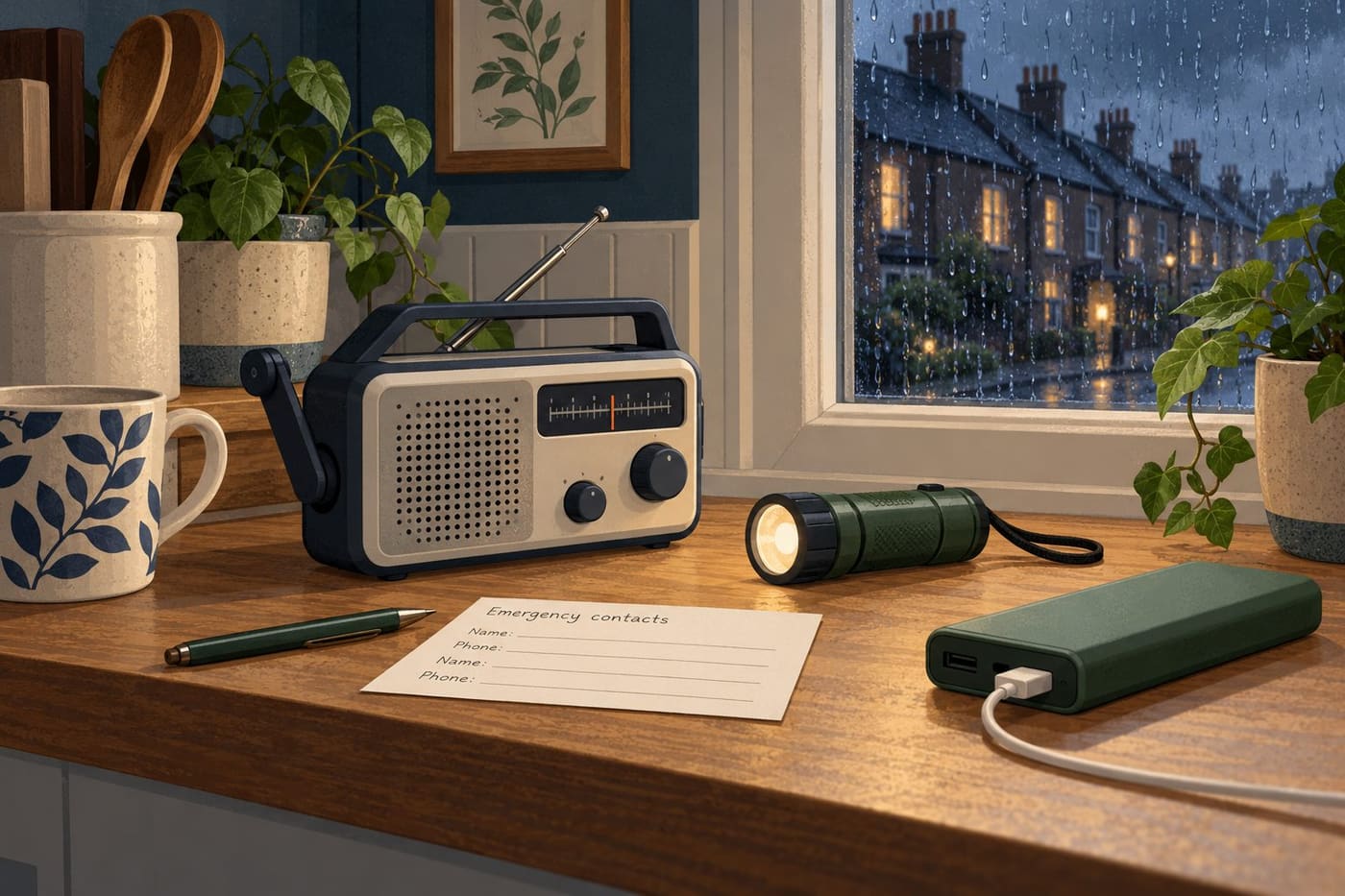
The accompanying original AI-generated illustration shows a generic radio, torch, power bank and unfilled emergency-contact form in a fictional home. It is conceptual artwork, not a real emergency, product endorsement or government notice.