Summary: A cabin announcement can make a future trip look appealing, but the booking decision still depends on the flight, the fare and the seating choices available to you. Use this guide to compare those details without paying for an assumption about an unconfirmed aircraft upgrade.
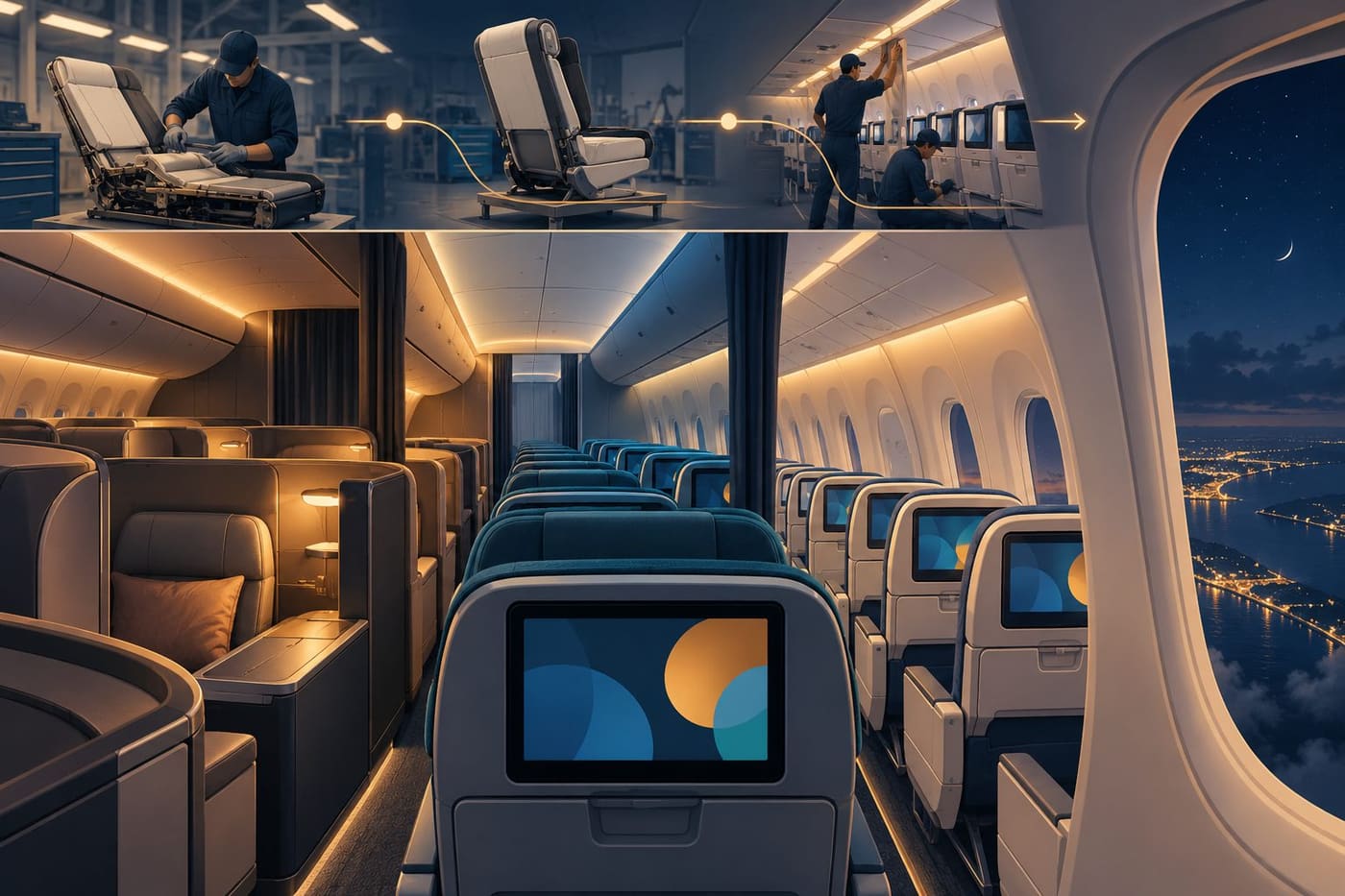
Research checked: 26 October 2026, Asia/Dhaka. This is a booking-planning explainer, not a fare quotation, legal opinion or firsthand cabin review. The original generated illustration is conceptual and does not show a verified Singapore Airlines seat design.
The refresh is a programme, not your reservation
Singapore Airlines’ November 2024 programme announcement described 34 long-haul A350s and seven ULR aircraft. Its planned layouts were 42 Business, 24 Premium Economy and 192 Economy seats on the former; four First, 70 Business and 58 Premium Economy on the latter. These are published programme configurations, not confirmation of the aircraft assigned to an individual booking.
The historical announcement also included an initial 2026 forecast for the first long-haul retrofit. Do not treat an old forecast as evidence that a particular flight now carries a completed product. Our separately verified [KrisWorld technology guide](https://monetizearticle.com/article/singapore-airlines-a350-refresh-what-passengers-can-expect-and-when-02f7ce) explains the later announcement and its aircraft-specific features. This article concentrates on choosing and documenting a trip.
That distinction is useful even if you are enthusiastic about the new cabins. You can be interested in a future product while deciding that an existing itinerary best meets your needs. A flight that arrives at a convenient time and has suitable fare conditions may serve your journey better than a more complicated itinerary chosen around an equipment expectation that has not been confirmed.
Separate the seat, cabin and fare
Start with three lines in your comparison notes: where you sit, which service class you purchased and which fare conditions apply. These can be related without being interchangeable. A seat number identifies a position. A cabin name describes a category of accommodation. A fare type controls a different set of booking conditions.
There is a concrete example on SIA’s current seat-selection page: on selected services, an Economy passenger can pay to occupy a Premium Economy seat while retaining Economy service and the original Economy fare conditions. That option is not automatically the same purchase as a Premium Economy ticket. Check the offer for your specific flight rather than inferring the whole service from the seat’s location.
Imagine two fictional offers. Offer A is an Economy ticket with a paid seat option. Offer B is a Premium Economy fare. Even if both seat maps place the traveller in a similar part of the aircraft, the comparison is incomplete until the service and fare conditions are checked. These are illustrative offers, not current prices or a claim that both are available on a named route.
The practical lesson is to record exactly what the booking screen sells. Avoid simplifying a detailed offer into upgraded when that word could mean a seat purchase, a cabin change or a different fare. A precise description makes later questions much easier to answer.
Compare the journey before comparing the upholstery
List your travel requirements first: arrival date, acceptable departure window, connection preferences and who is travelling with you. Then list the comforts you would like if the price and schedule work. This helps prevent a striking cabin image from moving a nonessential feature ahead of the reason for the trip.
For example, a traveller attending an afternoon event may prefer an earlier arrival even if another flight has a more appealing advertised cabin. A family may place sitting together above a particular row. Someone with a fixed onward appointment may value a straightforward itinerary more than an optional feature. None of these priorities is universal; the important point is to decide yours explicitly.
Write one sentence explaining why each itinerary remains on your shortlist. If the only reason is a feature you cannot confirm, recognise that weakness before paying. You do not need a complicated scoring model. A few concrete reasons can expose whether a comparison is based on actual trip needs or on a promotional detail that has become more important than intended.
Keep optional comforts in their own column. That way, if information changes, you can see whether the itinerary still works. A plan with several independent reasons to choose it is less dependent on any single cabin feature.
Read the fare conditions one segment at a time
SIA’s fare-type page says the selected fare affects matters including baggage, changes, cancellations and advance seat selection. It also distinguishes SIA-operated flights from partner-operated flights. For mixed fare types, its FAQ says the most restrictive cancellation conditions apply, while several other benefits and conditions depend on each segment’s fare.
The same page directs online purchasers to their e-ticket conditions and Manage Booking summary; travellers who bought through an agent should consult that agent. These are useful places to verify the actual purchase. A generic fare chart can orient you, but it should not replace the conditions attached to your reservation.
Create a row for each flight segment. Record the operating airline, cabin, fare name and the conditions that matter to you. If a return itinerary mixes fare types, do not copy the outbound conditions into the return row without checking. A single booking reference does not make every component identical.
When a condition is unclear, turn it into a specific question. Instead of asking whether a ticket is flexible, ask what would apply if you moved this flight to another date, whether a fare difference would also be relevant, and where the answer appears in the ticket conditions. This article does not calculate a change charge or interpret your individual contract.
Add up the whole comparison
Use the same categories for every offer: ticket amount, selected seating extras, baggage you actually require and any other optional purchase you have decided to make. Do not add hypothetical extras to one offer while leaving them out of another. The purpose is a fair comparison of the trip you intend to take.
Here is a fictional arithmetic example in arbitrary currency units. Offer A costs 900, with seating extras of 40 on each of two segments: 980 in total. Offer B costs 960 with the seating choices you need included. On those assumptions, B is 20 lower overall, although its initial ticket figure is higher. This is not a Singapore Airlines quote or a claim about any current seat fee.
Now change the requirement: suppose you do not need advance seat selection. Offer A returns to 900, and the comparison changes. This demonstrates why the correct total depends on your needs. A paid extra has value only if you would choose it; it should not be treated as compulsory merely to make another offer look better.
Keep potential future changes separate from known current costs. You can note that flexibility matters without pretending to know whether you will change the booking. Avoid turning an uncertain future event into an exact saving. Use the conditions to understand the trade-off and decide how much that option is worth to you.
Use the seat map as a decision tool
The airline’s seat-selection guidance says availability is assessed when you make the request, and Manage Booking provides the flight’s seat map. It also warns that nearby vacant seats may be occupied later. Do not read an empty neighbouring seat as a promise that you will have extra space during the journey.
Look at the actual map and its legend. A label may identify a seat category or an important restriction. If you do not understand a symbol, check its explanation before selecting. Do not import a row number from a different configuration and assume it has the same characteristics on your flight.
For your own notes, describe the benefit you want rather than only the row. Examples include easier aisle access or sitting beside a companion. If the exact position is unavailable later, that description helps you evaluate an alternative. A preference expressed only as seat 20A gives less information about the reason it mattered.
A seat map is also not a complete physical inspection. It may not answer every question about storage, movement or a particular personal requirement. If your need depends on a detail the map does not establish, ask the airline directly. We have not measured any of the seats discussed in the programme announcement.
Check eligibility before selecting extra space
SIA states that Extra Legroom seats often involve emergency-exit requirements. Read the linked eligibility conditions before selecting such a seat. Do not assume that paying a fee overrides those conditions, and do not select a restricted position as a workaround for a need the airline should assess separately.
For practical planning, distinguish more space from suitable support. A traveller may need assistance that cannot be described simply by seat pitch. A companion may need to remain nearby. Those questions require the appropriate airline process, not a generic recommendation to book the row with the largest apparent gap on a diagram.
If you are helping someone else book, ask about their preferences and requirements rather than making assumptions from age or appearance. Record only the information needed for the booking and use the airline’s designated channels for sensitive details. Do not put personal medical information into public reviews or social-media requests for seat advice.
This guide deliberately does not list a universal best seat. The best choice depends on the actual configuration, eligibility, availability and the passenger’s requirements. A ranking that ignores those conditions would be more confident than useful.
Make companion seating an explicit part of the plan
If sitting together matters, check the available positions before completing a decision that depends on them. Consider how many people need to be adjacent and whether being across an aisle would meet the same need. A clear definition avoids paying for a layout that looks close on a diagram but does not satisfy your reason for travelling together.
A fictional group of four might prefer two pairs to a single row with a separation they find awkward. Another group may prioritise one adult beside a child and be comfortable with the remaining travellers nearby. These are planning examples, not statements about a particular aircraft’s layout or the airline’s family-seating policy.
Confirm the conditions applicable to the actual booking rather than assuming a general adult seat-selection charge applies identically to every family. The current official page includes family and membership provisions, but their application should be checked against who is travelling and the flight operator. Avoid using an old fee screenshot as the basis for the whole group’s budget.
Before departure, review the current seating assignment together with the flight details. If something differs from what you recorded, contact the airline or booking agent with the booking information and the specific request. Asking another passenger to exchange seats should not be the only plan for a requirement you already know about.
Keep a compact booking record
Save the itinerary, ticket conditions and receipts for optional purchases in a place you can access when needed. Record the date you checked the seat map and the wording of any feature that influenced your decision. Keep booking references and personal details private; a public screenshot can expose more than the seat number you meant to show.
The record should be short enough to use. A folder containing hundreds of promotional screenshots may be less helpful than the ticket, the relevant conditions and a concise note of the question you asked. Distinguish the source of each statement: booking confirmation, general website information or a response about your individual reservation.
If a seat or service differs later, describe the actual change and the purchase it relates to. Ask what options apply under the relevant conditions. Do not assume that a general product announcement creates a particular refund entitlement, and do not let this article substitute for the operator’s response or applicable consumer advice about a real dispute.
This evidence-first approach is useful even when no problem occurs. It removes the need to reconstruct what you selected from memory and lets you focus on the journey rather than repeatedly searching for the same information.
Decide what would make you reconsider
Before choosing, identify the few changes that would materially affect your trip. A different departure date, inability to meet a seating requirement or a condition you cannot accept may matter more than a cosmetic cabin difference. Keep that list proportionate: not every small change deserves a new booking comparison.
If your interest in the refresh is optional, treat it as a possible benefit rather than the foundation of the trip. If it is the main reason for travelling, wait for sufficiently specific information before committing to a purchase that depends on it. This is a decision framework, not a recommendation to buy, cancel or change any particular fare.
For entertainment planning once your itinerary is settled, see our [KrisWorld watchlist guide](https://monetizearticle.com/article/singapore-airlines-new-krisworld-what-the-a350-upgrade-means-for-your-next-flight-baf55c). It addresses programme choice separately from seats, fare conditions and the trip comparison here.
Conclusion
Book the journey you can verify: the itinerary, service class, fare conditions and available seating choice. Keep future cabin plans in context and avoid filling gaps in the booking information with assumptions from a launch announcement. An appealing seat is one part of a trip, not a replacement for the rest of the decision.
Sources and research notes
- [SIA A350 retrofit programme, 4 November 2024](https://www.singaporeair.com/en_UK/lk/corporate/newsroom/press-release/2024/October-December/ne1124-241104/), historical configuration context, not proof of completed installation.
- [SIA advance seat selection](https://www.singaporeair.com/en_UK/sg/travel-info/requests/seats/), directly checked 26 October 2026. The page contains both a broad complimentary Business-seat statement and a fare/membership restriction; this guide makes no blanket promise about every Business seat being selectable.
- [SIA fare types and FAQs](https://www.singaporeair.com/en_UK/sg/flying-withus/fare-types/), directly checked 26 October. Individual ticket conditions remain necessary for a reservation-specific answer.
The comparison exercises are original examples, not live fares, measured cabin results or legal determinations. No comprehensive plagiarism clearance or guarantee of aircraft assignment is claimed. Editor: Alex Morgan. Image: original generated conceptual illustration.