Singapore’s tap water is treated for drinking and monitored from source to tap. But a glass that suddenly looks cloudy, a brownish first flush after a holiday, or a filter cartridge turning rusty can make residents wonder whether the water is safe. PUB’s guidance distinguishes harmless air bubbles and temporary mineral sediment from problems that need investigation—and explains when to contact the agency.
This guide draws on PUB’s current drinking-water information and published quality data. It is not a laboratory test of a particular home’s pipes, tank or appliance. Water quality at a building’s tap can also be affected by private service installations, so a general statement about the national supply cannot diagnose a specific incident.
What Singapore’s water monitoring covers
PUB, Singapore’s National Water Agency, says it collects samples from reservoirs, waterworks, desalination plants and distribution systems and tests them at its Water Quality Laboratory. Its published drinking-water page says the agency conducts close to 500,000 tests annually across physical, organic, inorganic, radiological and microbiological parameters. Online sensors monitor water quality at stages of treatment and at service reservoirs.
The drinking-water standards are set under Singapore’s Food Safety and Security (Non-Packaged Drinking Water) Regulations 2025. PUB says the standards are based on the World Health Organization’s Guidelines for Drinking-water Quality. A separate PUB data sheet presents laboratory results for January to December 2025 and compares listed parameters with the requirements that applied during that reporting period. Readers should not mix the old report’s regulatory headings with the current rules: the current data sheet says the 2025 regulations took effect on 28 November 2025, after the previous regulations applied through 27 November.
Those figures describe a monitored public supply, not every tap in every flat at every moment. A building’s storage tank, internal pipework, tap fittings or hot-water appliance can change how water looks at the point of use. That is why PUB’s advice for unusual water begins with observing where and when the problem occurs, rather than assuming every colour change has the same cause.
If tap water looks cloudy or milky
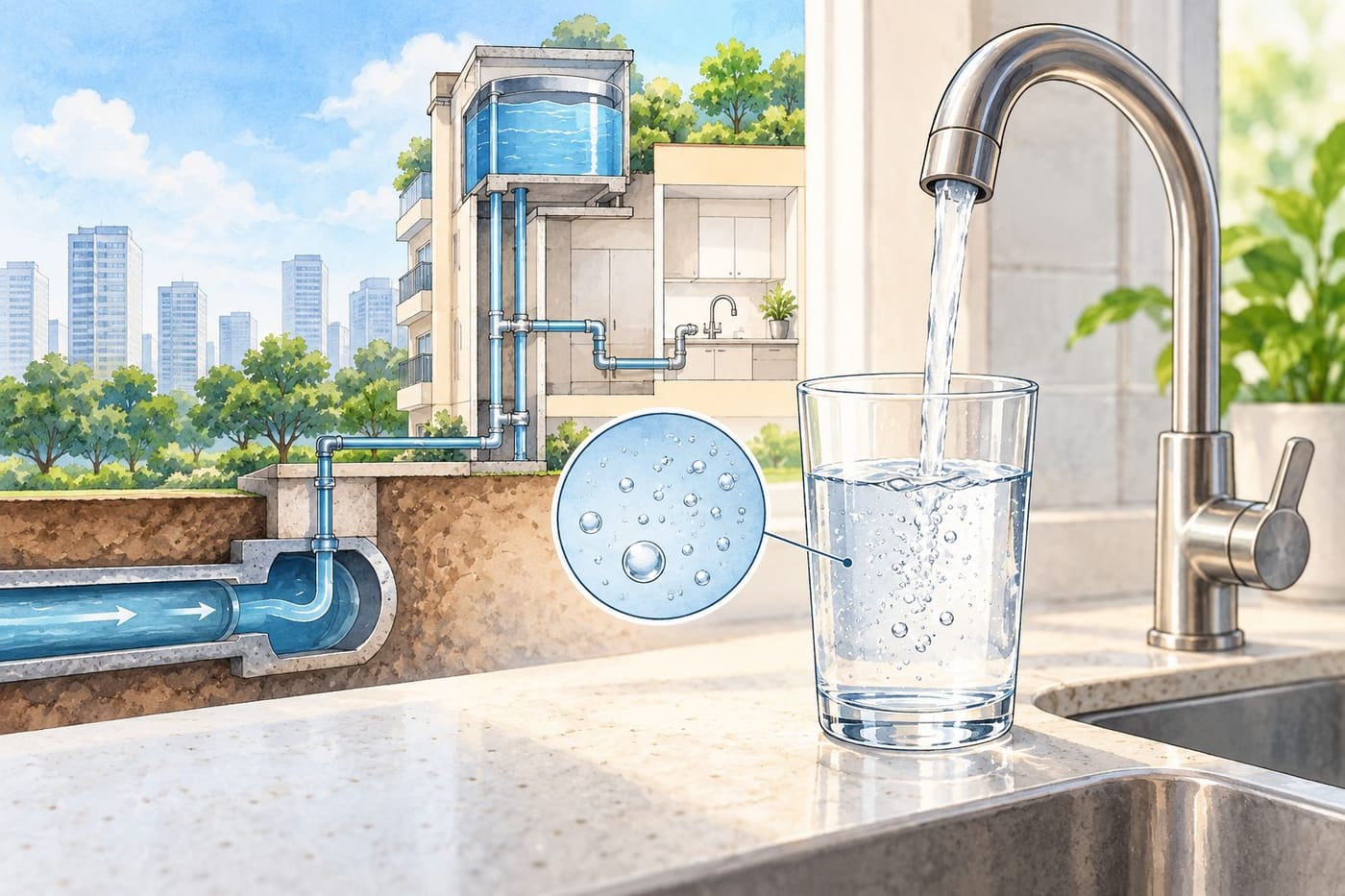
PUB says that, in rare cases, tiny dissolved-air bubbles can make water look milky or cloudy. The bubbles should disappear after a few minutes, much as bubbles in a fizzy drink rise and clear. According to the agency, water that looks cloudy for this reason remains safe to consume.
A simple observation can help distinguish this appearance from persistent discolouration: draw a glass and let it stand. If the cloudiness disappears after a few minutes, that observation is consistent with PUB’s air-bubble explanation. This is not a home safety test, however. Do not rely on appearance alone if there is an unusual smell, visible material, a continuing change, or a separate health concern.
PUB advises customers to call its hotline if the cloudiness persists. It is more useful to report what you actually observe—whether it is at one tap or several, whether it clears, and when it began—than to label it a particular contaminant without evidence.
If water is brown, yellow or contains particles
PUB says water is normally clear but may occasionally become discoloured or contain particles. Its listed possible causes include maintenance such as cleaning water tanks or flushing service pipes, tests of fire hydrants, mineral sediment disturbed in water mains, corrosion in a building’s service pipes or fittings, and a corroded storage-type water heater. Water that has remained in pipes during a long period of non-use can also look different when it first flows.
These possibilities matter because the cause may be inside a building rather than in the public main. For example, if discolouration appears only from a hot-water tap or one appliance, PUB says that may point to the heater or appliance. If several cold taps are affected, that is a different observation to share with the agency or building manager. Neither pattern by itself proves the source; it helps direct an investigation.
PUB’s customer guidance includes running affected taps until clear. Any work on shared storage tanks belongs with the responsible building management team and its licensed plumber. It advises avoiding laundry and other uses while flushing. The agency’s pages give slightly different time markers in different answers: one says contact PUB if water has not cleared after 10 to 15 minutes, while another says to call after 5 to 10 minutes. Rather than treating the longer window as permission to drink discoloured water, follow the more cautious practical course: do not drink visibly discoloured water; if it does not clear promptly, contact PUB and ask what to do for the specific incident.
The Ministry of Sustainability and the Environment’s 12 November 2024 parliamentary reply assigns common-property tanks and pipes in HDB estates to Town Councils. It says storage tanks must be inspected, cleaned and disinfected annually by a licensed plumber. Homeowners are responsible for pipes and fittings inside their own units. This division helps you contact the responsible party rather than attempting work on shared infrastructure.
For a suspected issue in a private tank, heater or pipe, contact the building’s Town Council or management team, landlord, or a licensed plumber as appropriate. PUB says it works with Town Councils and building maintenance teams to investigate, but repairs to customer-side installations may be the customer’s responsibility.
A practical sequence for a household
When a change appears, these steps help you record the problem without guessing at a diagnosis:
1. Pause drinking from the affected outlet. If the water is visibly coloured or contains particles, use a known safe alternative while you seek guidance. Do not use the affected water for laundry if the colour could stain fabric.
2. Check the pattern. Note whether the issue affects one tap, hot water only, several outlets, or neighbouring homes. Do not dismantle fittings or storage tanks yourself.
3. Observe a sample. If it is cloudy, note whether it clears after standing. Record colour, particles, smell, time and whether it followed maintenance, a holiday or a plumbing change. A photo can document appearance, but cannot identify a contaminant.
4. Flush cautiously where appropriate. PUB’s advice includes running affected taps until clear, while avoiding other uses. Shared tanks belong with the building management team and its licensed plumber; do not attempt tank flushing or cleaning yourself. If it remains discoloured after a short flush, stop and call PUB for case-specific instructions rather than extending the flush indefinitely.
5. Report the details. PUB lists its hotline as 1800-CALL-PUB (1800-2255-782). Mention the building, affected outlets, when the issue began and what flushing changed. Follow any current incident notice or instructions from PUB or the building manager.
6. Keep the response record. Write down the time of your call and any reference or follow-up steps. If the issue appears limited to a heater, tank or private fitting, arrange inspection through the responsible building contact or a licensed plumber.
This list is a communication aid, not a substitute for PUB’s instructions during a supply incident. If an official notice gives different directions, follow that notice.
Why a filter turning brown does not prove the water is unsafe
PUB notes that brown deposits in filters can come from minute amounts of minerals in the water that are absorbed and oxidised over time. Sediment can also be stirred during maintenance or after a change in flow. A filter’s appearance, therefore, does not identify a particular contaminant or show that the incoming tap water is unsafe.
The device itself needs maintenance. PUB cautions that filters may become a breeding ground for bacteria if they are not cleaned or replaced regularly. Anyone who uses one should follow the manufacturer’s replacement interval and cleaning instructions. A filter marketed as an extra precaution is not automatically a necessary treatment step, and a neglected filter can create its own hygiene problem.
PUB’s clarification page says Singapore tap water is safe to drink directly and does not need point-of-use treatment or filtering to make it safe. That general position should not be stretched into a claim that no household ever needs to investigate a local plumbing issue. National monitoring and a specific building’s internal plumbing are different questions.
Chlorine, monochloramine and fluoride: what the official material says
Disinfectants are used to protect water during treatment and distribution. PUB says chlorine is used in treatment and that a residual amount is present as monochloramine in the network. Its clarification says the levels meet the applicable requirements and are within WHO drinking-water guidelines. The presence of a disinfectant residual is not, by itself, evidence that tap water is unsafe.
PUB also says it has fluoridated drinking water since 1957 at the Ministry of Health’s direction to help prevent dental cavities. Its current drinking-water page states that levels are below the 0.7 milligrams-per-litre maximum specified in the 2025 regulations and below the WHO guideline value of 1.5 milligrams per litre. These are the agency’s published statements about its regulated supply; anyone with an individual medical question should consult a qualified health professional rather than infer a personal risk from a general water page.
What the published numbers can—and cannot—tell you
PUB’s online 2025 quality sheet reports a selection of averages and ranges for samples taken during that year. For example, it lists an average turbidity value of 0.15 NTU and a range from below 0.05 to 0.48, within the sheet’s listed regulatory limit of 5 NTU. It reports pH averaging 8.0, with a range from 7.5 to 8.9, within the listed 6.5 to 9.5 range. It also lists E. coli results below one colony-forming unit per 100 millilitres.
These figures are useful context about the dataset PUB published. They do not constitute a test of a particular household sample, and the 2025 sheet is historical data. Its heading covers both regulatory frameworks that applied during 2025. For a current incident, use PUB’s current page and direct instructions, not a single past average as a guarantee about a particular outlet.
Pink marks in a bathroom are usually a surface issue
PUB’s FAQ says pink stains on surfaces such as sink drains, toilet bowls and bathroom tiles are typically caused by naturally occurring environmental bacteria called Serratia, rather than by water or water mains. The agency says the organism thrives in moist or dusty conditions and that regular cleaning and keeping surfaces dry can help control the stains.
That explanation is about common surface staining, not a laboratory identification of every pink mark. If a stain is unusual, persistent, or accompanied by a separate water-quality concern, report the actual observation and ask for advice rather than assuming the cause.
A concise decision guide
- Cloudy for a few minutes, then clear: PUB says tiny air bubbles can cause this and that water remains safe when this is the cause. If it persists, contact PUB.
- Brownish water that clears quickly: PUB identifies disturbed mineral sediment and maintenance as possible causes. Do not drink it while visibly discoloured; follow current flushing guidance.
- Discolouration limited to hot water or one fixture: note that pattern and ask the building manager or a qualified plumber to check the appliance or installation.
- Discolouration across multiple outlets or homes: report it to PUB, giving the location and timing. Follow any official supply notice.
- A filter cartridge with brown deposits: the colour alone does not identify a hazard. Maintain the device as directed and use PUB’s guidance for concerns about incoming tap water.
Conclusion
Singapore’s public tap-water supply is monitored and regulated, but an unusual glass at home still deserves a sensible response. PUB distinguishes temporary cloudiness caused by tiny air bubbles from discolouration that may involve sediment, maintenance or private plumbing. Observe the pattern, do not drink visibly discoloured water, follow current official instructions, and contact PUB if the water does not clear or the cause is uncertain. A filter’s colour is not a test result, and routine national monitoring cannot diagnose an individual building’s fittings. Clear observations and the right contact help identify whether the next step belongs to PUB or the property’s maintenance team.
Sources and research note
Research checked 25–26 October 2026. Historical Google Trends Singapore discovery is documented in the original trends.json snapshot retrieved on 24 October 2026 at 20:09 UTC (25 October 02:09 Asia/Dhaka). It listed tap water; this is a discovery signal, not a current trend measurement. PUB’s drinking-water quality and FAQ page was checked for monitoring, current regulation, appearance, flushing and filter guidance. PUB’s 2025 drinking-water quality table was checked for the historical turbidity, pH and microbiological examples above. PUB’s clarification page and Ministry of Sustainability and the Environment parliamentary reply were checked for direct-drinking and maintenance context.
- PUB, Drinking Water Quality: https://www.pub.gov.sg/Public/WaterLoop/Water-Quality/Drinking-Water
- PUB, Singapore Drinking Water Quality (January–December 2025): https://www.pub.gov.sg/-/media/PUB/PDF/SG-Drinking-Water-Quality.pdf
- PUB, Clarifications on drinking-water claims: https://www.pub.gov.sg/Resources/News-Room/Clarifications
- Ministry of Sustainability and the Environment, Written Reply on Maintenance Checks on Water Pipes: https://www.mse.gov.sg/latest-news/written-reply-maintenance-checks-water-pipes/
The cover is an original AI-generated conceptual illustration of a household tap, drinking glass and water-system cues. It does not depict a real PUB test, official equipment or a specific building. Limited exact-phrase web searches were used to look for matching passages; this is not a comprehensive plagiarism scan or originality certification.