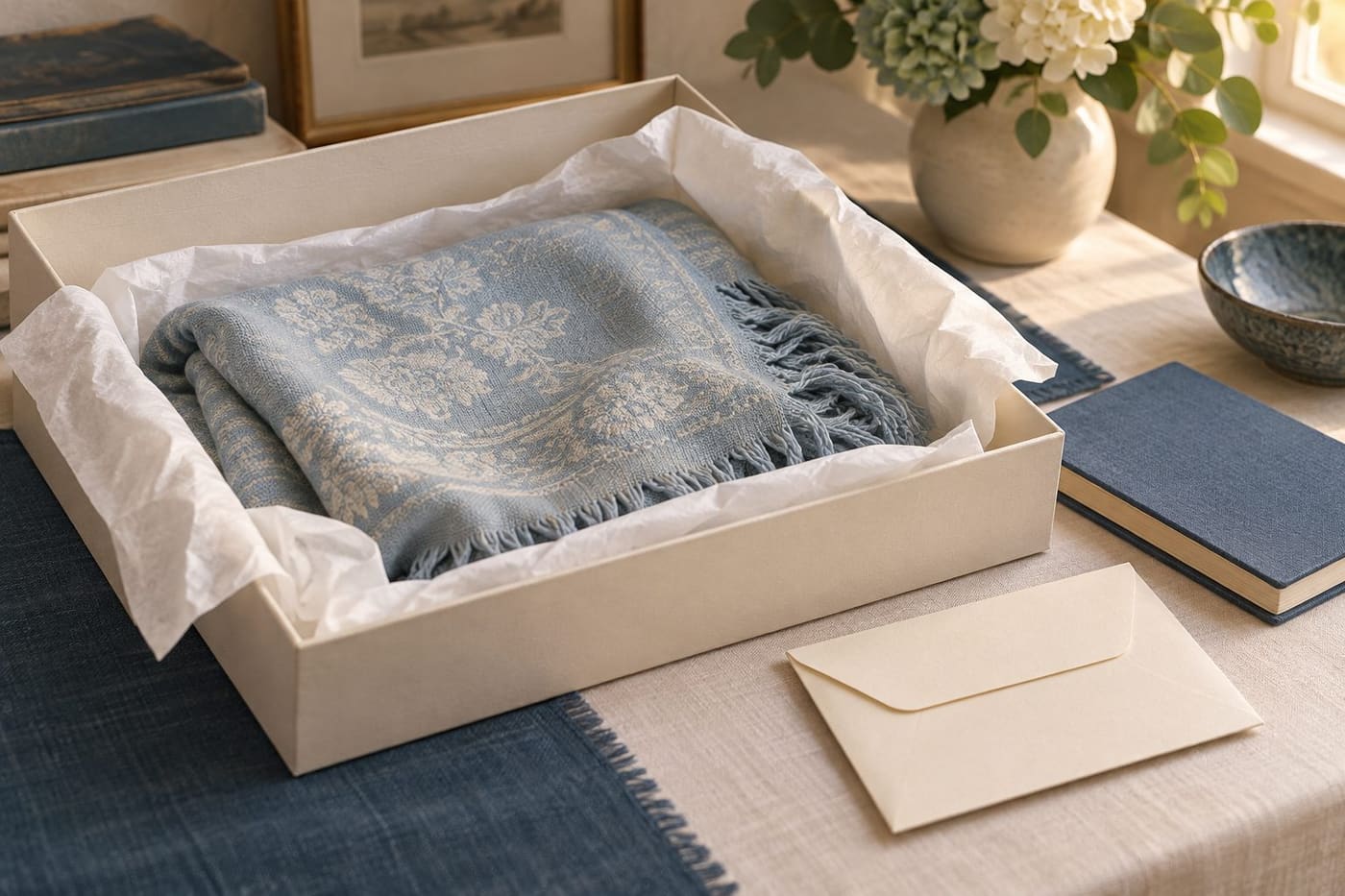
A wedding garment, a hand-stitched quilt, or a shawl inherited from a relative can carry more than a family story. It also has a physical condition: seams, folds, decoration, and fibres that may respond poorly to an ordinary wardrobe routine. A useful storage plan respects both parts. It helps people understand the object while reducing unnecessary handling and avoiding decisions based only on how attractive a box or hanger looks.
This guide uses Canadian Conservation Institute guidance checked on October 28, 2026, together with original fictional planning exercises. The institutional sources concern collection care; a household can use their preventive principles while recognizing that fragile historic objects may need individual assessment. The guide does not provide restoration, mould treatment, pesticide, or specialist cleaning instructions. Its focus is organizing a careful decision before moving a valued textile.
Decide what keeping the object means
Begin by describing the intention. Is the garment still part of an everyday wardrobe? Is it retained primarily as an heirloom? Does the family hope to display it occasionally, or simply preserve its story? These purposes may lead to different practical decisions. Leaving the purpose unstated can create conflict when one person expects continued use and another expects minimal handling.
In a fictional family, two siblings inherit a decorated wedding outfit. One wants photographs for a family-history project; the other imagines a future relative wearing it. They should record those wishes before treating either as an agreed plan. A discussion about meaning can happen without repeatedly unfolding or trying on the garment.
Write a short intention statement and identify who is responsible for the next decision. “Keep the outfit as a family object, document its history, and obtain advice before considering wear” is a clearer starting point than “put it somewhere safe.” The statement can change later, but it gives today's handling a purpose.
Observe before reorganizing
The Canadian Conservation Institute explains that textiles are flexible and often need support to retain their shape. It distinguishes the care of museum textiles from familiar everyday treatment and identifies physical stress, unsuitable environments, light, and poor handling among potential sources of damage. Source: https://www.canada.ca/en/conservation-institute/services/preventive-conservation/guidelines-collections/textiles-costumes.html
Make a simple observation record without trying to diagnose the object. Note visible tears, loose decoration, existing folds, stains, and anything that looks different from an earlier photograph. Describe what you see rather than assigning a cause. “Loose threads along the lower edge” is an observation; “damage caused by the previous owner” adds an unsupported explanation.
If moving the textile would require lifting a heavy or unstable item, pause and plan suitable help or professional assessment. A record can begin with the object in its current location. Completing a form is not a reason to force open a fold, pull at a seam, or manipulate an area that appears fragile.
Prepare the destination first
CCI's basic-care guidance emphasizes careful handling, support during movement, and an appropriate clean, dry storage setting. It discusses suitable materials such as acid-free tissue and prepared cotton fabric, and warns that ordinary packaging or unsuitable storage arrangements can introduce problems. These principles are a reason to check the destination before handling the object. Source: https://www.canada.ca/en/conservation-institute/services/care-objects/textiles-costumes/basic-care-textiles.html
Clear a space large enough for the intended task. Remove unrelated items that could snag or soil the textile. Decide where supporting materials and records will go, and make sure the planned route is manageable. The aim is to avoid holding a delicate object while searching for somewhere to place it.
For a household planning exercise, sketch the route from the current cupboard to the prepared work area and then to storage. Identify narrow doorways, crowded surfaces, or a container that cannot open fully. Solving those ordinary problems in advance can reduce unnecessary movements and rushed decisions.
Choose support according to condition
CCI's hanging-storage note says structurally sound garments can be suitable for hanging, but fragile, heavily decorated, knitted, bias-cut, or weak-shouldered pieces may need flat storage. It describes adapting padded supports to the garment rather than assuming a standard thin hanger is sufficient. This is a selection principle, not a claim that every heirloom should hang. Source: https://www.canada.ca/en/conservation-institute/services/conservation-preservation-publications/canadian-conservation-institute-notes/hanging-storage-costumes.html
Use a decision note with three questions: what will carry the weight, where will pressure concentrate, and how will the object be retrieved? If you cannot answer these comfortably, seek advice before settling on a method. A storage choice should make sense for the actual piece, including any decoration or areas of weakness.
Avoid choosing by category name alone. Two objects both called dresses may differ greatly in construction and condition. Likewise, “it has always been on this hanger” describes history, not proof that the arrangement is suitable. Record the current setup and assess it rather than automatically preserving every previous storage habit.
Flat storage has a space trade-off
CCI's flat-storage note explains that supporting the whole textile reduces the stress of supporting its own weight. It recommends minimizing folds and describes appropriate lining and support materials. It also recognizes the extra space needed and suggests prioritizing pieces for which flat support is especially important. Source: https://www.canada.ca/content/dam/cci-icc/documents/services/conservation-preservation-publications/canadian-conservation-institute-notes/13-2-eng.pdf
Measure the available storage space before selecting a container. A box that technically closes may still require an unsuitable arrangement inside. Consider how it opens, how the supported textile would enter and leave, and whether another object would have to be moved every time someone wants to inspect it.
In the fictional family exercise, a shallow drawer is available but too small for the proposed arrangement. That is a planning constraint to resolve, not an invitation to compress the garment until it fits. The family can change the location, obtain advice about an appropriate arrangement, or delay moving the object while preparing a better option.
Keep the story separate from uncertain attribution
Write down who supplied the history and when. A relative might remember that a shawl belonged to a grandmother, while another believes it was made by an earlier generation. Both accounts can be recorded with attribution. A careful family record does not need to settle every disagreement immediately.
Separate direct evidence from interpretation. An inscription, receipt, photograph, or remembered conversation can each contribute different information. “Photographed with this person in this dated image” is narrower than “made for that person's wedding.” Keep the narrower statement when the available evidence supports only that much.
Preserve links between the textile and related records without attaching unsuitable new labels directly to the fabric. A separate reference number on the storage record can connect photographs, notes, and location information. The practical goal is that another family member can understand the association without relying entirely on the current keeper's memory.
A fictional shawl decision
Imagine a shawl stored with an old note naming its owner. The family wants a photograph and a short history. The first task is to document the note and the current arrangement. If the shawl appears fragile, the photograph should not become a reason to spread it out without an appropriate handling plan.
The family creates two records: an object description and a source note for the remembered history. They record the shawl's location and the date of the observation. They leave material identification unresolved because nobody has reliable evidence about its fibre. A guess written confidently today could become a false fact in a later family account.
Their next action is specific: ask a qualified textile conservator what handling and support would be suitable for the piece. Meanwhile, the family can work on transcribing the old note and identifying related photographs. Progress on the story does not require repeated manipulation of the object itself.
A fictional quilt decision
Now consider a quilt that several relatives want to see at a reunion. The discussion should include who will handle it, what condition information is available, and whether the intended display has been assessed. The social importance of the occasion does not answer those practical questions.
One option for the family to consider is sharing existing photographs and the quilt's story while obtaining advice about future display. This can preserve the purpose of the gathering without making an immediate physical arrangement the only acceptable outcome. The right choice still depends on the actual object and the family's priorities.
The written plan records what was agreed and what remains unresolved. It distinguishes a proposed display from an approved handling arrangement. If the plan changes, update the record rather than allowing different relatives to work from conflicting assumptions about who promised what.
Avoid turning a storage project into a cleaning experiment
A desire to make an heirloom look fresh can lead to decisions that deserve separate assessment. Everyday laundry habits do not establish an appropriate treatment for an old object with unknown dyes, decoration, repairs, or areas of weakness. Keep cleaning decisions outside a simple storage reorganization unless the item's needs have been properly established.
Do not test household products on a valued textile merely because an online suggestion sounds gentle. Words such as natural, mild, or traditional do not identify a treatment's suitability for this particular object. Record the concern and consult an appropriate specialist where cleaning, stain removal, or repair is being considered.
If you suspect an active pest or mould problem, stop routine handling and obtain suitable advice about the object and surrounding storage. This article does not supply a treatment protocol. A concern should remain clearly flagged so that another person does not unknowingly include the item in an ordinary sorting session.
Make a retrieval plan
Storage is easier to maintain when someone can find the object without opening every box. Record a plain description, reference number, location, and an existing photograph where available. Put the information somewhere the responsible family members can access, while keeping personal details private where necessary.
Describe how the storage arrangement is intended to be used. If an object requires help or specialist handling, make that visible in the record. Do not assume that a future keeper will infer the reason for a particular support or know which layer can safely be moved.
For a related approach to keeping people, dates, and uncertainty connected to family material, see our family-photo archive guide: https://monetizearticle.com/article/how-to-start-a-family-photo-archive-without-losing-the-stories-behind-the-pictures-121e4c. A textile record and a photo record can refer to one another, helping the family understand the story without repeatedly taking every original object out of storage.
Review the arrangement with a clear purpose
A review should answer a question rather than become repeated handling for its own sake. Has the storage location changed? Is there a new concern about the surroundings? Does an existing photograph show a visible change? Record the date and reason for the review so that observations can be compared sensibly.
Use consistent language. If a later note says the item is worse, explain what was observed and what earlier record provides the comparison. Avoid diagnosing a cause from a single visual difference. Changes in lighting or photography can also affect appearances, so preserve the limits of the comparison.
Assign follow-up responsibility. A note saying “ask someone about the loose decoration” can remain unresolved for years. A more useful action identifies who will seek advice, which object is involved, what information will be shared, and when the family will revisit the decision. This is ordinary organization applied to a sentimental possession.
Spend on a defined need
Before buying storage products, describe the required function and dimensions. A product called archival may still require checking its actual materials and suitability. Use the institutional guidance and, where needed, object-specific professional advice to inform the choice. Appearance and marketing language should not substitute for that assessment.
Avoid buying a whole system before understanding the collection. Begin with an inventory of what is being kept, its intended use, and the constraints of the available space. A family may have one unusually fragile piece needing particular attention alongside ordinary modern clothes that belong in a different routine.
The useful outcome is a manageable arrangement that people understand. A large collection of boxes with incomplete labels can be harder to maintain than a smaller, well-documented plan. Connect each purchase or change to an identified need, and leave uncertain choices open until the necessary information is available.
Conclusion
Keeping a family textile involves decisions about purpose, condition, support, storage, and documentation. Begin with observation, prepare the destination, and choose handling and storage methods according to the object rather than a familiar wardrobe habit. Preserve uncertainty about both its physical needs and its family history.
A careful plan does not promise that an object will last forever. It gives the next keeper something useful: a record of what is known, an understandable storage arrangement, and a clear account of decisions still requiring advice. That can help preserve the textile's story while reducing avoidable disruption to the object carrying it.
Sources and research note
Research date: October 28, 2026. Four linked Canadian Conservation Institute resources support the preventive-care principles. The flat-storage note was originally published in 1986 and revised in 1993 and 2008; retrieval today does not make it a newly issued document. All family scenarios and planning exercises are fictional. No object has been physically assessed. The original AI-generated conceptual illustration shows generic textile storage, not a real heirloom or a certified conservation treatment.