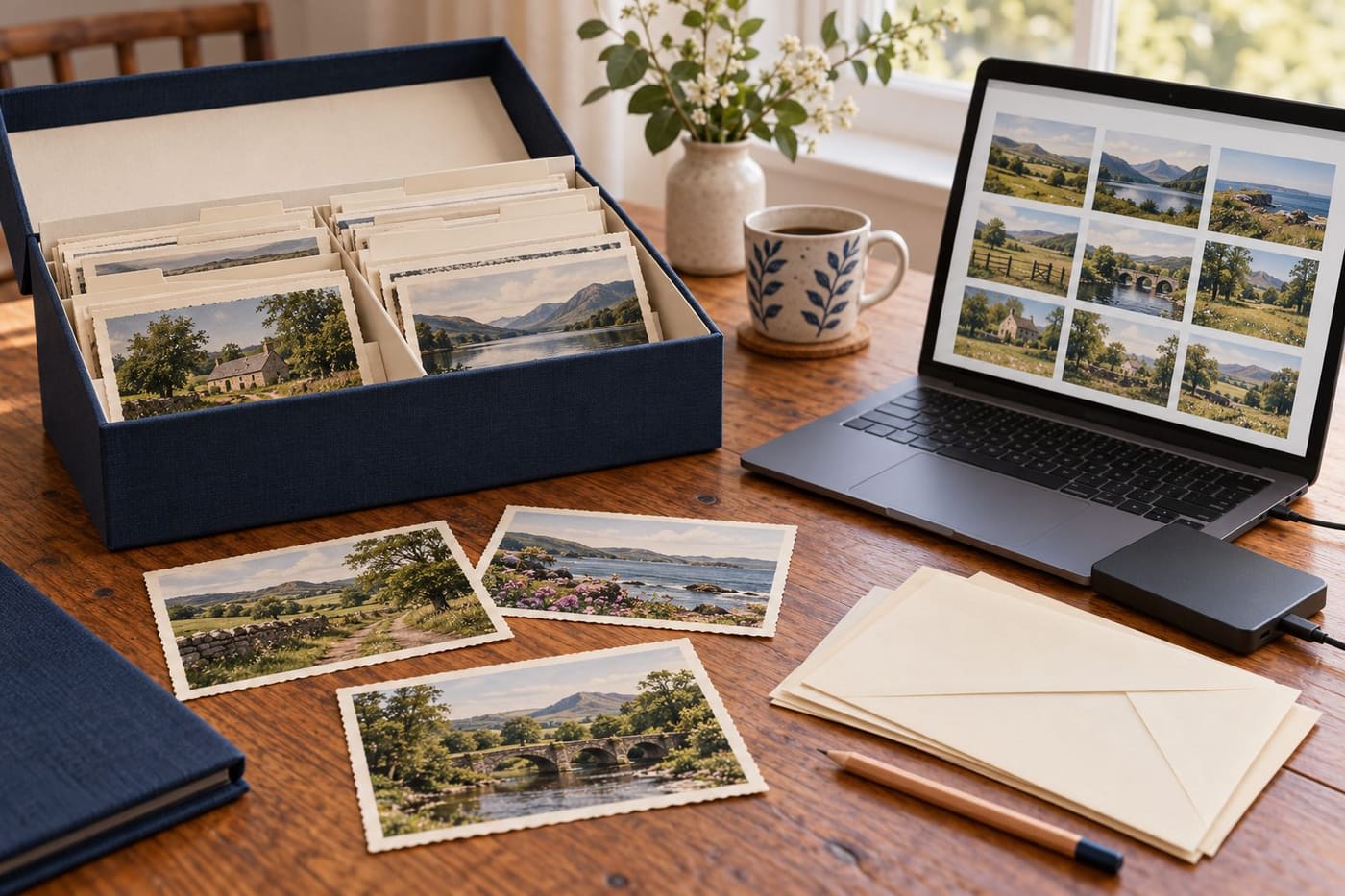
A family photograph can survive in a drawer for decades while the names, place and occasion become harder to recover. A digital picture can be easy to share today and difficult to find next year. Building a useful family archive means caring for both the images and the information that makes them meaningful.
You do not need to organise every photograph in one weekend. A manageable first project is to select a small group, preserve what you already have, record the context you know and make copies that you can actually find and open. This guide explains that process without recommending a particular storage subscription or pretending that any one device will keep files safe forever.
The preservation guidance below draws on the Library of Congress and the U.S. National Archives, checked on October 27, 2026. The household examples are hypothetical. This is a practical organisation guide, not a conservation treatment manual for damaged or fragile originals.
Begin with one collection that matters
Choose a group with a recognisable boundary: one holiday, one album, a grandparent’s envelopes or a year of photographs from a phone. A limited starting point helps you learn how much description and organisation you can maintain. It also gives you a realistic chance to finish a useful piece of work instead of creating several new unfinished folders.
Write a simple project note before moving files or separating prints. Describe where the photographs came from, who currently holds them and what you intend to do. If an envelope already has writing on it, treat that writing as part of the context worth recording. The order of pictures in an album may also tell you something that would disappear if everything were rearranged immediately.
For a first session, resist the urge to resolve every uncertain name. Create a place for unanswered questions and continue with what you can establish. A photograph labelled with a known location and an uncertain date is already more understandable than an unlabelled file. The aim is useful progress without converting guesses into family history.
Locate the versions before choosing one
The Library of Congress recommends locating digital photographs across devices and online storage, selecting important images, organising them and keeping copies in different places. Its guidance also encourages descriptive information and periodic checks that files remain readable. [Library of Congress personal photo archiving guidance](https://digitalpreservation.gov/personalarchiving/photos.html).
In a household, the same image might appear as an original file, a cropped social-media version and a copy sent through a message. Before treating them as interchangeable, note where each came from. A version with a useful caption may carry context even if another file is preferable as the image source. You can preserve the caption separately without assuming the captioned copy is the best master image.
Avoid starting with mass deletion. Put uncertain duplicates into a review group while you establish what they contain. Two files with similar thumbnails might differ in framing, annotation or editing. A careful first pass can identify obvious relationships while leaving the final decision for later. Storage tidiness should not come at the expense of material you have not understood.
Keep the original and the working copy distinct
The National Archives advises keeping physical originals after digitisation because digital files have preservation risks of their own. It also warns against forcing books flat or using automatic-feed scanners for fragile or valuable material. Its digitising guide includes basic descriptive metadata and the three-copies, two-media, one-off-site approach to backup. [National Archives digitisation guidance](https://www.archives.gov/preservation/family-archives/digitizing).
For your project, give the untouched source and any edited version clearly different roles. One is the record you received or captured; the other is a copy prepared for a purpose such as sharing, printing or a slideshow. This arrangement lets you return to the earlier version if a crop, colour adjustment or caption later proves unhelpful.
If you experiment with automated restoration, keep the result separate and label what was done. An attractive reconstructed detail is not new evidence about the original scene. A family archive should make it possible to distinguish a historical photograph from a later interpretation. That distinction can be recorded in a short note rather than left to someone else to discover years later.
Give each item a simple identity
A short identifier can connect a physical photograph, its digital copy and its descriptive note. For example, a hypothetical collection might use FAMILY01_001, FAMILY01_002 and so on. The particular pattern is less important than using it consistently and explaining it in a readme file. Avoid designing a numbering system so complicated that nobody else can continue it.
Do not try to squeeze the entire story into the filename. A short recognisable name can help you navigate, while a separate description holds longer information. If you change the name later, maintain the connection to the original identifier. Otherwise, notes from an earlier session may refer to a file that appears to have vanished even though it is still present under another name.
Keep the folder structure shallow enough to understand. A collection folder containing originals, working copies and notes may be sufficient for a small project. These are suggested editorial labels, not an archival standard. Choose names that explain the role of the files to your family, and write down the meaning if there is any chance of confusion.
Record who, where and when without inventing certainty
Descriptions become more trustworthy when they show how the information was obtained. A note might say that a name was written on the original envelope, that a relative identified the place during a conversation, or that the date is an estimate based on another item. Those are different kinds of evidence and should remain distinguishable.
Use plain uncertainty markers. “Probably summer 1988” is more honest than assigning a precise date because the folder requires one. If two relatives disagree, record both accounts with attribution rather than silently choosing the more confident speaker. The disagreement may be resolved later, and preserving it allows someone to understand why the description changed.
A useful description can include the people shown, the place, the occasion and a short account of what makes the image significant. It should not add private details merely because they are available. Consider whether the archive is for close family, a wider community or eventual public sharing. The appropriate description and access level may differ for each audience.
Make conversations easy for the person helping
When asking someone about photographs, bring a small selection and allow them to set the pace. You might begin with an open question such as what they recognise or remember about the scene. Avoid presenting your own guess as an established fact and then asking them to agree. A familiar-looking building can lead an enthusiastic organiser in the wrong direction.
Take notes that preserve the speaker’s meaning without turning every uncertain memory into a formal claim. Ask whether they are comfortable with the information being recorded and shared with the intended audience. If recording audio or video, obtain their permission and explain where it will be kept. The archive should respect the people whose stories give it value.
At the end, review the main identifications together if practical. This can catch misunderstandings such as two people with the same first name or a location that changed names. Do not push for an answer when the person does not remember. An explicit unknown is a legitimate part of a careful family record.
Check a digital copy before calling it finished
After creating a copy, open it and inspect what it actually contains. Is the whole intended image visible? Is important writing on the back or on the surrounding page also recorded where relevant? Does the file correspond to the identifier in your notes? These are basic completeness checks that can prevent a large batch of mismatched or incomplete copies.
Work in small groups so mistakes remain easy to trace. If you discover that a sequence was misnumbered, it is simpler to correct ten connected items than several hundred. Keep a brief record of what has been copied and what still needs attention. A folder full of files can look complete while important reverse sides or captions are missing.
For damaged, stuck or unusually fragile material, stop before attempting an improvised repair. This article does not establish a safe method for detaching a print, flattening a binding or treating deterioration. Consult appropriate preservation guidance or a qualified conservator for the material involved. A digital project should not create physical damage in the effort to move faster.
A copy count is only part of a backup plan
The National Archives’ three-two-one guidance offers a useful starting point, but a household still needs to identify the actual copies and locations. Write down what exists rather than relying on the number of icons visible on a computer. Several shortcuts to the same folder do not represent several independent copies of its contents.
Clarify what your chosen storage service does when a file is changed or deleted. Synchronisation and a recoverable backup may have different behaviours. Read the current provider instructions rather than assuming an old version will always remain available. This guide does not test a particular service, retention period or recovery promise.
Once a copy is made, verify that you can open a selection from the intended destination. Record the date and any problem encountered. For a small important collection, a complete readability check may be practical. For a larger one, be clear about the scope of the check instead of calling the whole archive verified after opening a single convenient file.
Plan sharing as a separate activity
A family archive and a public gallery serve different purposes. You may want to preserve a complete record privately while sharing only selected copies. Keeping those decisions separate makes it easier to respect requests from people in the photographs and avoid exposing personal information embedded in captions, surrounding documents or location details.
Before sharing, check the actual copy you intend to send. A file chosen for a public album may reveal more than the photograph itself if its description contains addresses or private family circumstances. Review both the image and the accompanying text. Do not assume that a photo being old means every person affected would be comfortable with unrestricted publication.
For shared family folders, decide who can add or edit material and who maintains the reference collection. Clear roles can prevent well-intentioned changes from becoming confusing. An edited sharing copy can be welcome without replacing the preserved source. Explain that distinction in ordinary language so relatives know where to contribute descriptions or corrections.
A small hypothetical archive from start to finish
Imagine two siblings find an envelope of twenty photographs from a family trip. They first record the envelope’s wording and the order of the prints. They assign a simple collection identifier, then create a note for each picture. Several places are known, but the exact year remains uncertain. They retain that uncertainty rather than using a guessed date as fact.
One sibling makes digital copies while the other checks identifiers and notes. They discover that two prints have writing on the reverse and record those sides too. A relative later identifies a person in one image but disagrees about the year. The siblings add the identification and preserve the competing date account with its source.
They keep the physical photographs, retain the unedited digital copies and create a separate set for sharing. They document where the additional copies are stored and check that the files open there. The result is a modest, understandable collection with a clear boundary. It is not a claim that the family’s entire photographic history has now been preserved.
Leave instructions someone else can follow
An archive is more resilient when another trusted person can understand its organisation. Add a short readme explaining the folder names, identifier pattern, description file and the location of physical originals. Include what remains unfinished. A future organiser should not have to infer whether an empty field means unknown, not yet checked or deliberately private.
Keep account-access arrangements separate from a general catalogue. A document that explains the archive should not casually expose passwords or other credentials. Instead, use an appropriate secure arrangement for the people who need access. If access depends on one person or one device, recognise that dependency and plan for it without publishing sensitive information in the archive itself.
Choose a manageable review habit. The Library of Congress recommends checking readability at least annually. During your review, also consider whether the storage arrangement, responsible person or file descriptions have changed. A small maintenance note can be enough to show what was checked and what still needs work. Preservation is an ongoing responsibility rather than a one-time upload.
Conclusion: preserve an image and an understandable record
A good first family photo archive has a clear scope, identifiable items, honest descriptions and copies whose locations are known. It preserves the source while allowing working versions for sharing. It records uncertainty instead of manufacturing a confident story, and it leaves enough explanation for another person to continue the work.
Start with a collection you can handle carefully. Finish its descriptions and copy checks before expanding the project. The achievement is not simply a larger digital folder. It is a group of photographs that your family can find, understand and care for with fewer unanswered questions about where the images came from and what has been done to them.
Sources and research note
Checked October 27, 2026: [Library of Congress personal archiving](https://digitalpreservation.gov/personalarchiving/photos.html) and [National Archives digitisation guidance](https://www.archives.gov/preservation/family-archives/digitizing), whose page states a May 2021 review date. Brief preservation recommendations are attributed; the household workflow and sibling example are original explanatory material. No actual family collection was inspected. The original conceptual illustration uses invented landscape photographs and does not reproduce a real family’s private archive.