A laundry pile can look like one task while containing several different jobs. One item can go through the available wash cycle, another needs a different drying method, and a third has an instruction nobody has checked. Treating the pile as a single decision makes it easy for an exception to disappear.
The useful habit is to read the entire care instruction before choosing the process. Then make the exceptions visible to whoever handles the clothes next. This guide combines brief explanations from primary care-label sources with an original household workflow. It is about everyday washable clothing, not disinfecting contaminated textiles, treating historic collections or diagnosing a skin condition.
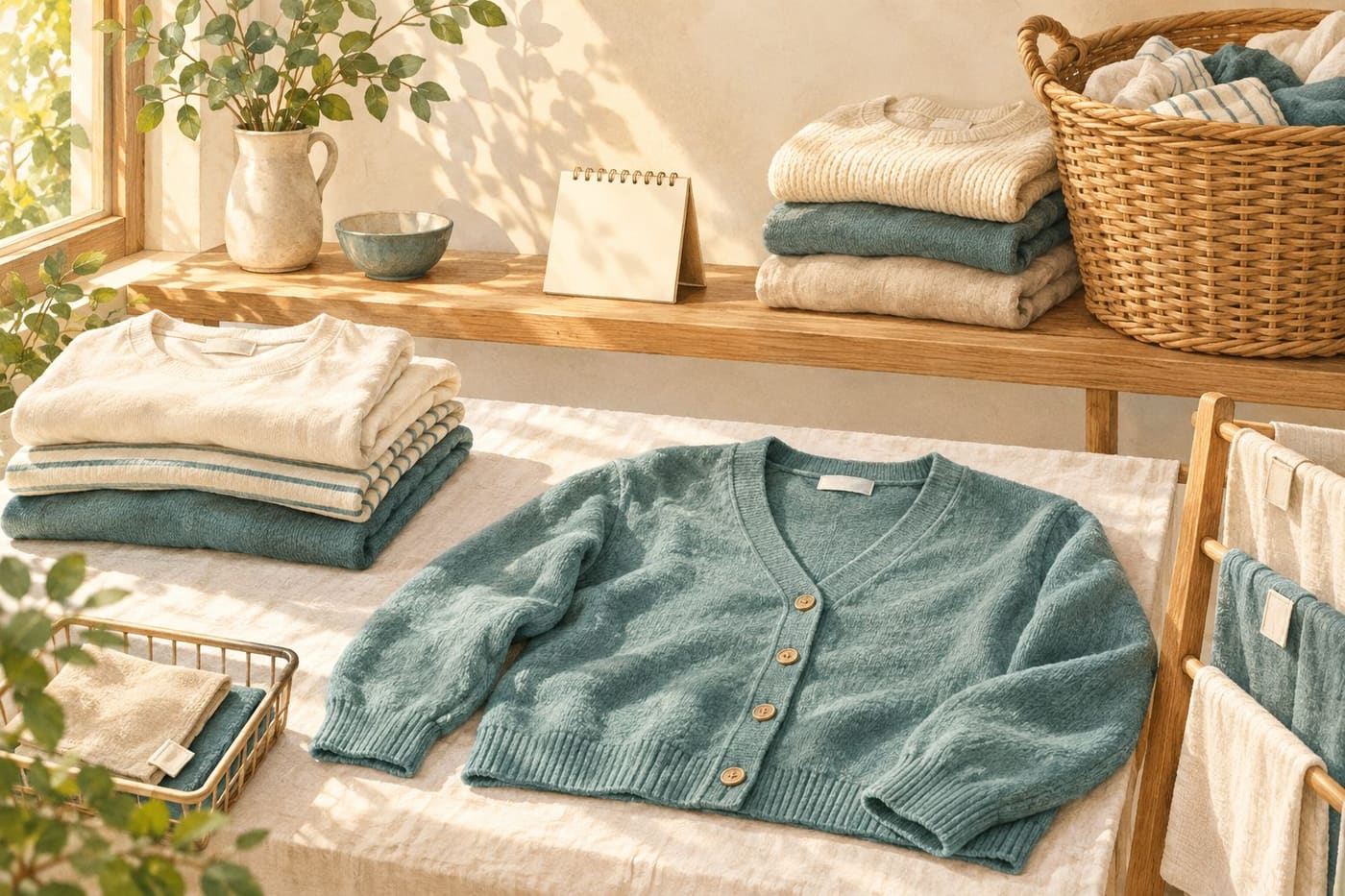
The example household and garments below are fictional. No fabric testing, wash trial or product comparison was performed for this article. The image is original conceptual artwork showing a generic laundry workspace; it is not a certified care-symbol chart or a photograph of tested products.
Treat the label as several linked instructions
GINETEX's current care-symbol guide separates washing, bleaching, drying, ironing and professional textile care. In its system, a wash-tub number specifies a maximum Celsius temperature, bars below it indicate a milder process, and a crossed treatment symbol means that treatment is not permitted. A square containing a circle refers to tumble drying; other square variants describe natural drying. Source: https://www.ginetex.net/gb/labelling/care-symbols.asp
That compact explanation is a starting point, not a substitute for reading a specific garment's complete label. Do not identify one familiar mark and stop. Written qualifications, the rest of the symbols and any attached instructions still matter. If you cannot identify the system or read the label clearly, keep the item out of the planned load until you have reliable guidance.
In the fictional example, housemates Leena and Sam share a washing machine. Sam sorts a pile by colour, while Leena checks the instructions. They discover that their first group is not yet a usable load: one item has a separate drying requirement. They have not made a mistake by finding an exception. They have caught a decision that needed to happen before the cycle began.
Their solution is not a wall covered in unfamiliar symbols. It is a short written note for each exceptional item, kept beside its readable original instruction. The note identifies the next action and the point where somebody needs to pause.
Read the whole garment rather than guessing from fibre
The US Federal Trade Commission's business guidance explains that care instructions need to account for a garment's components, including relevant linings, trims and fastenings. It also distinguishes a “Dryclean only” instruction from a bare “Dryclean” instruction under its US rule. Those are jurisdiction-specific explanations, not a claim that every country uses identical labeling requirements. Source: https://www.ftc.gov/business-guidance/resources/clothes-captioning-complying-care-labeling-rule
For a household reader, the practical implication is to avoid replacing the actual instruction with a general belief about a fabric. “Most of my shirts are easy to wash” does not answer the question for this shirt. Nor does a familiar fibre name explain every component attached to it.
Leena and Sam find a garment with a trim they had not noticed. Their worksheet does not assign a new washing method. It says, “Read attached instruction together with main label; do not add to today's load until checked.” That is a completed sorting decision even though the item has not been cleaned.
They also distinguish uncertainty from prohibition. “I cannot read this instruction” describes a gap in their information. “The label forbids this process” describes an instruction they can read. Combining both under a vague word such as “delicate” would make the handover less useful.
Turn a mixed pile into compatible work
Whirlpool's sorting guidance considers colour, fabric type, soil level and care-label compatibility. It recommends separating incompatible items rather than relying on detergent to remove the need for sorting. Its mixed-load advice follows the more conservative care instruction, but that does not turn an expressly prohibited process into a permitted one. Source: https://www.whirlpool.com/blog/washers-and-dryers/how-to-sort-separate-laundry.html
Leena makes three temporary groups for this particular laundry session: ready for the selected process, requires a different process, and awaiting clarification. These are original workflow labels, not standardized textile categories. They do not replace the original labels or authorize a treatment.
Sam begins with the ready group. Before loading it, he checks that the planned washing and drying steps fit all the included items. If they do not, the group changes. The sorting work is successful when the selected process and the included garments agree, not when every item has been squeezed into one basket.
The awaiting-clarification group stays physically separate. A note saying “check later” is easy to lose if the item remains inside the ready basket. A clearly separate place and a named next action make the distinction visible. Neither housemate has to remember which item was discussed earlier.
Plan drying before pressing start
Washing is only one stage of the task. A household plan also needs to say where each item goes afterward. If an instruction requires a drying arrangement that is not available today, noticing that before washing gives you more options than noticing it while holding wet clothes.
GINETEX distinguishes flat drying, line drying and other natural-drying variants, including shade instructions. It also explains that professional wet-cleaning requirements are not equivalent to selecting a household washing-machine cycle. Refer to the actual symbol and wording instead of treating all air drying or all wet processes as interchangeable.
In the invented session, Leena's cardigan has a readable instruction to dry flat. The housemates have not yet prepared a suitable place. They decide to leave that item for another session. The decision is a scheduling adjustment based on the garment's instruction; it is not a claim that their room or equipment has been tested for textile care.
For the current load, Sam writes the next destination before he starts. The note is short enough to use while unloading. It identifies any item that must leave the main group at that point. The aim is to prevent an agreed exception from disappearing when another person takes over.
Keep appliance settings and garment instructions together
A machine's programme name and a garment's care instruction are different pieces of information. Read the machine's own instructions to understand the available settings, and check them against the garment's requirements. This article cannot tell you that a button with a reassuring name is suitable for an unidentified item.
Leena and Sam do not create a universal “gentle clothes” setting for everything uncertain. When they cannot establish compatibility, they stop that item's journey through the process and seek the missing information. This takes longer than guessing at the button, but it avoids turning a knowledge gap into an irreversible experiment on somebody else's clothes.
Their handover records the chosen setting only after the check. It does not record a preferred setting and then reinterpret the labels to fit. The order matters: establish the requirements, understand the available process, and decide what belongs in it.
They keep the appliance manual available without copying its entire contents into their household note. If the machine changes or a different programme is selected, the old note is no longer automatic authorization. It is a record of a particular decision under particular conditions.
Make a handover that does not depend on memory
A useful handover answers four questions: which items are included, what process was selected, what must happen next and what has deliberately been held back. These are organizational prompts created for this guide. They are not additional care instructions from a manufacturer.
For their fictional load, Sam records: “Everyday group checked against selected wash. Unload to the agreed drying group. Cardigan not included; flat-drying arrangement not ready. Trimmed item not included; attached instruction needs checking.” There is no invented temperature or stain-treatment recipe in the note.
Leena can now take over without inferring that an item sitting nearby belongs in the machine. She can also see that two items remain unfinished, with reasons. A truthful handover is more useful than a tidy statement saying “laundry done” while unexplained exceptions remain in the room.
For a shared household, identify an exceptional item clearly enough that the other person can recognize it. Avoid a label such as “the blue thing” if there are several blue garments. A private photo of the garment and its care instruction can be useful if everyone involved agrees, but it should stay with the relevant record rather than becoming a public post.
Give stains and missing labels their own decision
A care instruction does not require you to improvise a remedy for every mark. If you do not know what produced a stain or whether a proposed product is compatible with the garment, that uncertainty belongs in the plan. Read the garment's instruction and the cleaning product's directions; do not assume a familiar household mixture is an approved substitute.
This guide does not provide chemical combinations, concentration advice or a universal stain-removal treatment. Its workflow can end with an item set aside for the maker's advice or an appropriate professional. That is a practical outcome when the available information does not justify a home treatment.
A missing label creates a similar information problem. Check whether the manufacturer can identify the specific product and supply its instructions. A page describing a vaguely similar garment is not necessarily the instruction for yours. Record what you have actually confirmed, and keep assumptions separate.
In Leena and Sam's example, the trimmed garment remains outside the ready group. They write the maker's product reference in their private note and identify the question they need answered. They do not claim the item is ruined, washable or safe for dry-cleaning merely because they have run out of time that evening.
Keep everyday care separate from preservation
An everyday laundry routine is not a preservation plan for an heirloom, an embellished ceremonial garment or a fragile historical textile. Our separate family-textile guide discusses storage and recording an item's story: https://monetizearticle.com/article/keeping-family-textiles-a-careful-storage-plan-for-clothes-quilts-and-their-stories-80c029 . That context does not authorize washing an object whose treatment needs specialist assessment.
Leena finds a family garment beside the ordinary pile. Instead of borrowing instructions from an everyday shirt, she moves it out of the routine and records why it is different. The household's immediate task is to protect the decision boundary, not to complete every possible cleaning job that day.
The same boundary helps when borrowing clothing. A borrower should not silently replace the owner's agreed care arrangement with a convenient process. If the arrangement is unclear, ask before acting. A clear return plan can be useful even when no cleaning is undertaken by the borrower.
These examples are about responsibility and communication. They do not establish conservation methods, insurance obligations or legal liability. The useful result is that the person handling the garment knows what they may proceed with and what needs further information.
Review the routine without inventing a guarantee
After the fictional session, the housemates review whether the handover worked. Did the held-back items stay separate? Could the next person identify the drying arrangement? Was an instruction unreadable? They record those observations rather than awarding the routine a made-up fabric-protection score.
If a note was confusing, they improve its wording. If a product instruction changed or a garment was repaired, they check the actual current information before reusing an old decision. Their small household record stays useful because it describes specific items and actions, not because it claims one setting will always work.
No workflow can promise that every garment will remain unchanged. What this one can do is make the choices visible before treatment and preserve the exceptions through a handover. That is a modest, observable improvement a household can assess without pretending to have conducted a textile study.
Conclusion: finish the decision before starting the process
Read all the care information, check that the planned process fits the included items, and decide the drying arrangement before the load starts. Keep uncertain or incompatible items separate, with a specific next action. When someone else takes over, hand over the exceptions as well as the basket.
The task is complete when the record honestly reflects what happened and what remains. Clear instructions are more useful than a fast routine built around an assumption nobody can trace.
Sources and research note
Primary guidance checked on 29 October 2026: GINETEX's current care-symbol page, the FTC's US care-labeling guidance and Whirlpool's manufacturer sorting guide, linked above. Brief source explanations support the label distinctions; the household, garments, groups and handover exercise are original fictional examples. The FTC source is used for its limited US explanations, not penalty figures or a worldwide legal claim. Older and newer symbol systems can differ; consult the applicable current guide for the actual garment.
No protected symbol chart, manufacturer image, cleaning test or product endorsement is reproduced. A guessed FTC consumer URL was unavailable and the American Cleaning Institute page returned an access restriction; neither is relied on as a read source. No medical, disinfection or conservation treatment is supplied.