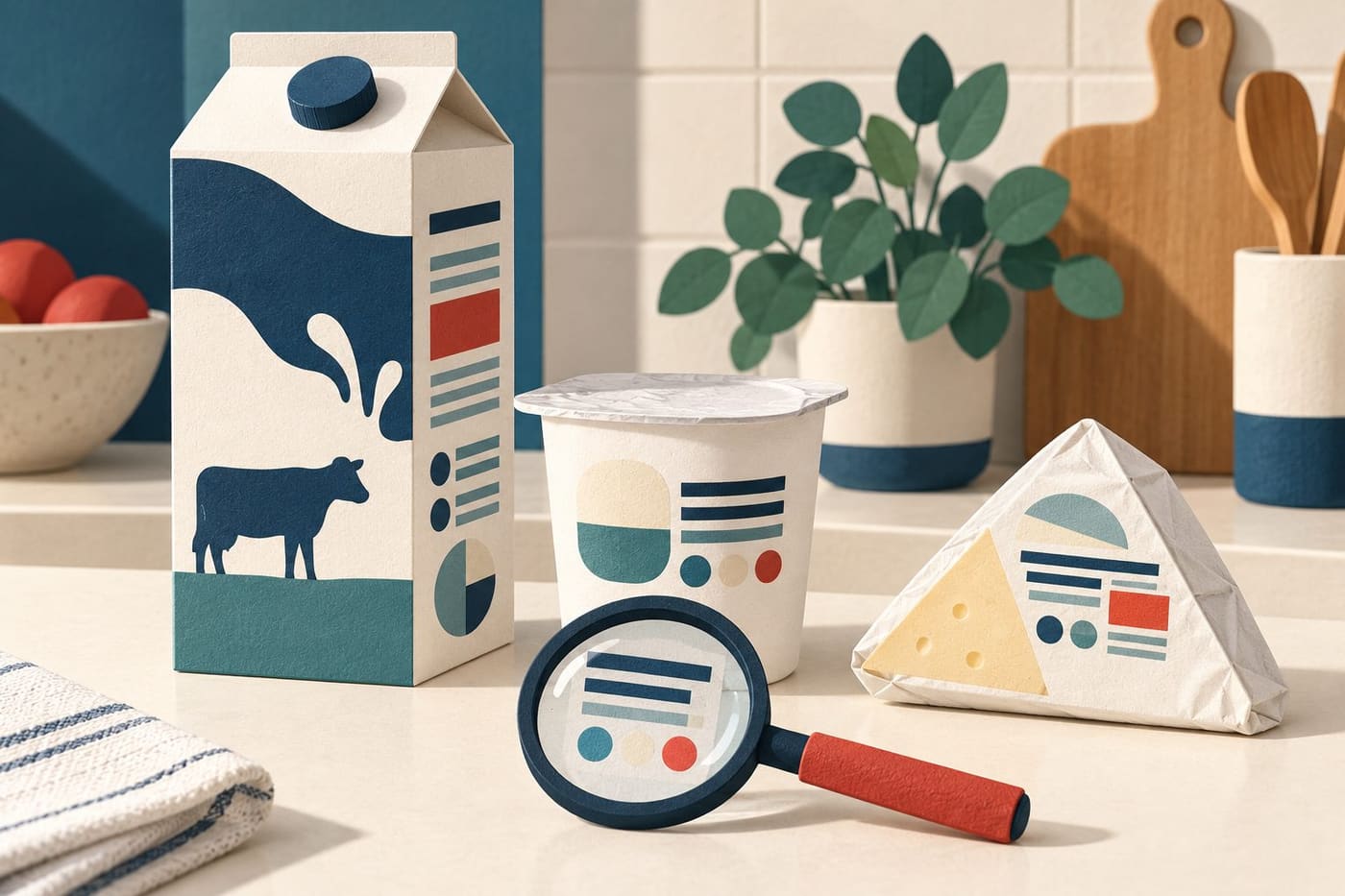
A cheese wrapper can tell several different stories at once: where a food was made, where an ingredient came from, which production specification it follows and what a serving contains. Those statements are useful only when they are read as answers to different questions. A familiar brand name or an attractive landscape should not have to carry the meaning of every detail on the pack.
Interest in dairy imports makes this distinction timely. On 26 October 2026, the French Google Trends Food and Drink view included an ended search spike for “importation”, with related reporting about dairy trade. This article uses that discovery to examine the food label in front of the shopper. It does not reproduce unverified import-market figures or suggest that a particular dairy product is unsafe because it crosses a border.
Start with the product, then identify the claim
Before interpreting a national or regional reference, establish exactly what you are buying. A plain yogurt, a fruit dessert, a block of cheese and a prepared dish containing cheese are different products. A statement about the milk in one of them does not automatically describe the fruit, sugar or other ingredients in another.
An original reading method is to divide the package into three questions: “What is this food?”, “What geographic claim is being made?” and “Which part of production does that claim describe?” Write down the actual wording if the answer matters to your purchase. That small step is more reliable than remembering the overall impression of the front panel.
For example, compare a statement about milk collection with one about manufacturing. Both may provide useful information, but they describe different stages. A third statement about a company's address should be recorded as an address, rather than silently promoted into an answer about every ingredient's origin.
There is no single origin rule for every food
The DGCCRF's [food-origin guidance](https://www.economie.gouv.fr/dgccrf/les-fiches-pratiques/lindication-de-lorigine-des-produits-alimentaires) explains that France and the European Union do not impose one general country-of-origin marking requirement on all products. Specific food categories and circumstances have requirements. Geographic claims must be supportable and must not mislead shoppers.
The guidance also describes a distinction between the origin of a finished food and that of its primary ingredient. Where a food's origin is stated and the primary ingredient comes from elsewhere, the applicable ingredient-origin information becomes important. This is why looking only for a country name can be insufficient: the surrounding words tell you what the country name applies to.
Do not use the absence of one preferred phrase as proof that a food is unlawfully labelled. Equally, do not assume that a decorative national cue answers every provenance question. If the wording is unclear, ask the seller or manufacturer about the specific product and claim. This article is a consumer reading guide, not a legal compliance ruling on an unseen package.
Why an old milk-labelling article can mislead
Search results still surface French government material describing the experiment introduced in 2017 for mandatory milk-origin labelling. That historical material should not be treated as a complete statement of the rules in 2026.
In its [March 2021 explanation](https://www.conseil-etat.fr/site/actualites/apres-un-arret-de-la-cjue-le-conseil-d-etat-annule-l-obligation-d-etiquetage-de-l-origine-du-lait-en-l-absence-de-lien-avere-avec-ses-proprietes), the Conseil d'État describes the annulment of the challenged milk-origin obligation following the Court of Justice's interpretation of European law. The court distinguished consumers' interest in knowing origin from the separate requirement for a demonstrated link between origin and properties. The administration had not established that link for the contested obligation.
The practical lesson is about checking dates and legal context. An official page can accurately describe an earlier measure while no longer providing the current answer to a shopping question. Use newer guidance and the relevant product specification instead of copying a historical threshold into a universal claim about today's dairy shelves.
This does not mean that voluntary origin statements are meaningless or that misleading claims are permitted. It means the old experiment and today's broader information rules must not be collapsed into one sentence.
AOP is a defined geographical production link
For cheese, an AOP designation provides a more specific kind of information than a generic national image. The Agriculture Ministry's [2026 explanation of AOP cheeses](https://agriculture.gouv.fr/les-fromages-aop-le-savoir-faire-des-terroirs) describes production from the milk stage through maturation within the defined area, following recognised know-how and a product specification.
The useful object to look for is the protected product name and its specification, rather than an assumption that any cheese associated with a famous place must have that status. A brand and a protected denomination are not interchangeable pieces of information. If you want to understand a production condition, read the document attached to the denomination concerned.
That specificity also limits what the label can answer. A shopper might value a defined production area, while another needs information about ingredients or portion size. Reading the AOP information does not remove the need to read those other parts of the pack. Nor does this article rank cheeses by taste, make a nutrition recommendation or claim to have inspected a producer's compliance.
IGP should not be read as another spelling of AOP
INAO's [applicant guidance](https://www.inao.gouv.fr/sites/default/files/2024-11/201711_guideAOPIGP.pdf) explains the geographical distinction: all relevant production stages belong within the specified area for an AOP, while an IGP requires at least one stage there. The specification sets out the product's particular conditions and link to the area.
For a consumer, that means asking which stages the designation actually covers. Do not infer a milk-collection location merely from seeing a regional name on a food carrying a different type of designation. Look at the rules for that named product rather than relying on a general memory of what a similar-looking logo meant on another package.
INAO's [description of specifications](https://inao.gouv.fr/aop-aoc-igp-ig-boisson-spiritueuse/reconnaissance/cahier-des-charges) identifies the production rules and geographical elements among the material used to define a protected product. This is a useful route when your question is detailed, such as which stages must occur in the area. It is more precise than treating an entire country as one uniform production system.
Origin'Info adds information but is voluntary
The Economy Ministry's [2026 consumer guidance](https://www.economie.gouv.fr/particuliers/mes-droits-conso/alimentation/quelle-reglementation-pour-lorigine-geographique-des-produits-alimentaires) describes Origin'Info as a voluntary approach to providing agricultural raw-material origin information for processed foods. Participating brands may present information on the package or through a QR code. It is therefore not present on every processed product.
Read the information at the level it actually describes: the agricultural raw material behind a named ingredient. Do not expand a statement about one ingredient into a promise that every component comes from one farm or one country. A precise, limited answer is more useful than a broad assumption based on the scheme's name.
If you use a digital label, check that the information corresponds to the product you are holding. Similar packaging, another flavour or a different format can make a generic product page an imperfect match for your question. Record any information you cannot match as unresolved; do not fill the gap with the origin shown for a neighbouring product.
Absence of the voluntary scheme is not, by itself, evidence of wrongdoing. Its presence is also not a replacement for the food's other information. Treat it as an additional way to answer a defined provenance question.
Keep ingredients, nutrition and provenance in different columns
The DGCCRF's [July 2026 labelling guidance](https://www.economie.gouv.fr/dgccrf/les-fiches-pratiques/etiquetage-des-denrees-alimentaires-les-regles-connaitre) describes the information provided for prepacked foods, including the food's designation, ingredients, nutrition information, net quantity and relevant date information. It also distinguishes prepacked foods from products sold without that packaging and explains the information required for distance sales.
An original comparison sheet can use separate columns for product name, relevant ingredients, stated origin, geographical designation, pack size and price. This prevents a strong answer in one column from being mistaken for an answer in all the others. A clear origin claim, for instance, does not tell you the price per kilogram until you also know the pack's weight and price.
Where dietary suitability is important, check the actual product information and obtain appropriate advice for your circumstances. A geographical label is not a personalised dietary assessment. This guide does not infer allergy suitability, nutritional superiority or microbiological safety from a country name.
Compare like quantities before comparing value
Consider two fictional cheese packs. Pack A costs €3 for 200 grams; Pack B costs €4 for 250 grams. Converting to the same quantity gives €15 per kilogram for A and €16 per kilogram for B. These invented prices demonstrate arithmetic, not current supermarket offers.
That calculation answers a price question only. It does not prove that the cheeses have equivalent ingredients, production methods, flavour or intended use. If your purpose is to buy a particular protected denomination, compare products that actually meet that requirement before deciding whether the small unit-price difference matters to you.
The amount you expect to use is another separate consideration. A lower unit price does not automatically make a larger pack the better household purchase if it is poorly matched to your needs. Follow the product's storage and use instructions; do not improvise a longer usable period from the fact that the pack was economical.
A useful shopping note therefore records the unit price alongside the reason for choosing the product. “Lower price per kilogram” and “specified geographical production link” are two different reasons, and either can be stated honestly without turning it into a universal quality ranking.
Ask a question that a seller can answer
Instead of asking whether a product is “really French”, identify what you want to know. You might ask where the milk was collected, which statement describes the finished food, or where to find the specification for a protected name. These narrower questions reduce the chance of receiving a technically accurate answer to a different question.
For a packaged product, include the product name and relevant identifying information when contacting the manufacturer through its normal channel. Quote the wording that prompted the question. Keep photographs private unless you deliberately choose to share them; a public accusation is not needed to obtain clarification.
For cheese sold at a counter, ask to see the applicable product and allergen information and request clarification of any origin claim you consider important. Do not assume that a salesperson's broad description applies to every item in the display. If the answer remains uncertain, it is reasonable to leave that point unresolved rather than invent a certainty from appearance.
Avoid turning a trade headline into a product verdict
An import story and a retail label operate at different levels. A national trade discussion cannot identify the provenance of the particular yogurt pot in your basket. Conversely, one clearly labelled product cannot establish the composition of an entire country's dairy market.
This article makes no estimate of the import share of French dairy sales, no forecast of retail prices and no claim that a specific brand has changed suppliers. Those conclusions would require separate evidence about definitions, periods and products. The Trends signal explains why the topic was selected; it is not a substitute for that evidence.
If your interest is supporting a particular production area, use the claim and specification that actually address it. If your interest is choosing an ingredient for a recipe, examine the product description and cooking purpose. Keeping the question clear makes the answer useful without requiring a simplistic domestic-versus-imported verdict.
A final label-reading routine
Read the exact product name first. Then identify the origin wording and what it refers to. Check any protected denomination against its own specification, and treat voluntary additional information within its stated scope. Finally, compare the practical details you need for the purchase, including quantity, price and product instructions.
This routine leaves room for personal preferences while keeping factual claims disciplined. You can prefer a geographical production link without claiming that every alternative is inferior. You can buy an imported product without assuming that a familiar-looking package explains its entire supply chain. The goal is a purchase based on information the label actually provides.
Sources and research note
Researched on 26 October 2026. The observed French Google Trends “importation” row showed 100+ searches, a 200% increase, a start about two hours earlier and a one-hour duration; the spike had ended. Its related-news panel concerned dairy imports. This is a dated discovery signal, not a market-size statistic.
Current DGCCRF guidance, Agriculture Ministry material and the Conseil d'État explanation were retrieved directly. INAO's 2017 applicant guide was retrieved as background; its separate specification page was available in indexed text but returned an error on direct retrieval. Origin'Info is described through the current ministry guidance; a failed older specification link was not retained as evidence. No individual commercial product or producer was certified by this review. Historical milk-origin requirements are expressly separated from the current guidance. Examples and the comparison routine are original editorial aids; no tasting, laboratory test or retailer survey was performed. The original conceptual illustration shows generic dairy packaging and contains no genuine certification or brand endorsement.