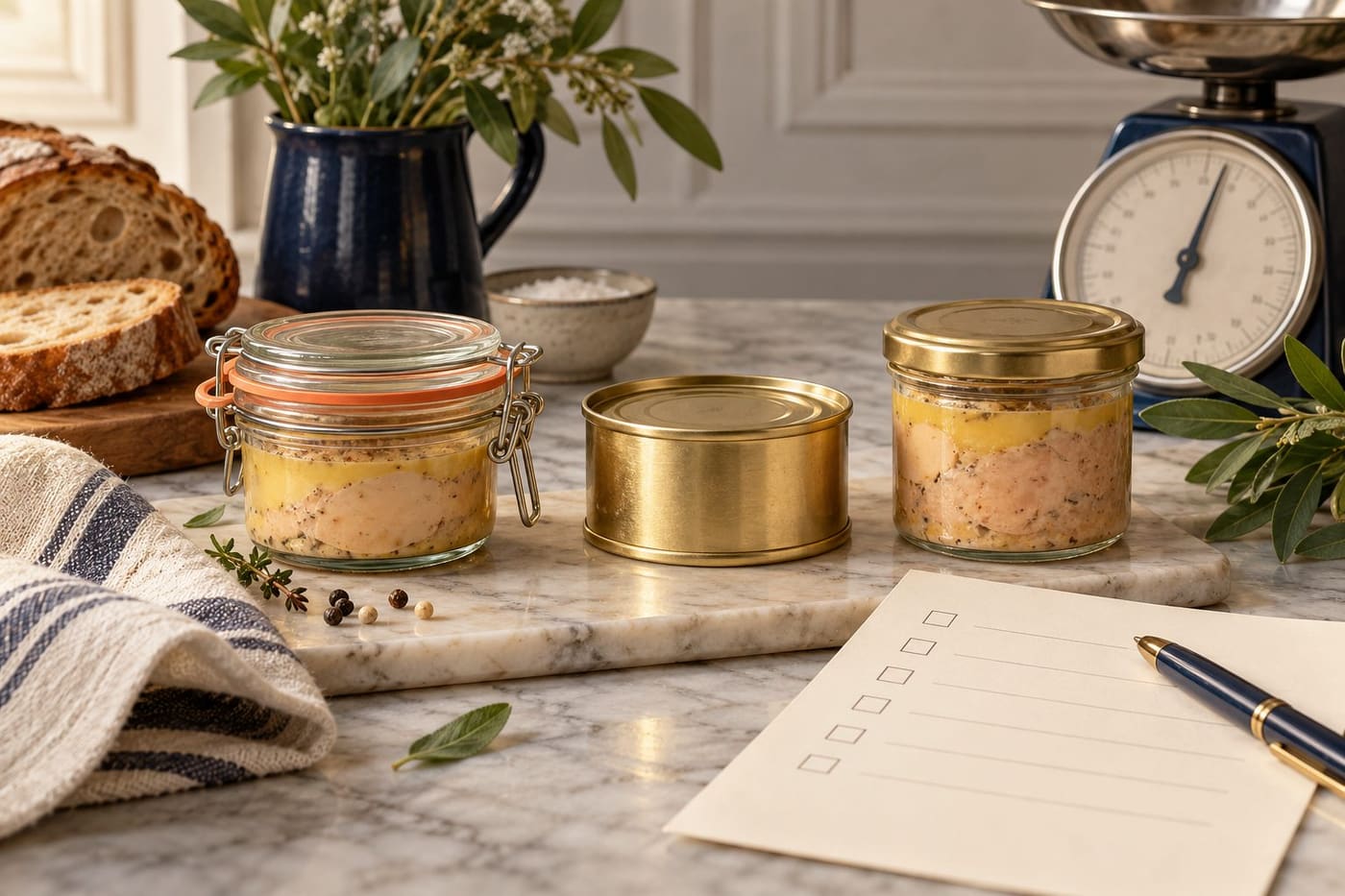
A small jar can carry a large number of promises: a regional name, a festive photograph, a quality symbol and a price that appears attractive until you notice the weight. For an English-speaking shopper in France, the most useful starting point is the precise product name. It tells you what you are comparing before packaging, presentation or a promotion influences the decision.
This guide explains a practical reading order for foie gras labels. It is designed for someone comparing a few products for a meal or gift, rather than looking for a brand ranking. No products were bought, tasted or laboratory-tested for this article. The examples are invented calculations, clearly separated from current shop prices.
Research was checked on 26 October 2026. Google Trends in France showed an ended seven-day discovery cluster for “foie gras”: 2,000+ searches, a 500% increase, starting three days earlier and lasting seven hours. Related news included a local public-gift debate. That discovery prompted this consumer guide; it does not establish the truth of those reports, a nationwide sales increase or a change in food rules.
Start with the name that describes the food
The French consumer authority, DGCCRF, distinguishes three principal preparations. “Foie gras entier” uses a whole liver or one or more lobes with seasoning. “Foie gras” uses assembled pieces of lobes with seasoning. “Bloc de foie gras” is a reconstituted preparation with seasoning. These are composition descriptions, not interchangeable decorative phrases. DGCCRF also explains that a bloc advertised with pieces must contain at least 30% pieces by product weight. Its guidance sets a 10% ceiling on added water in the final bloc preparation, counting direct and indirect additions.
Those points come from the authority’s December 2025 consumer guidance, consulted for this article. They are a starting vocabulary for reading a French label, not a laboratory method that lets a shopper prove compliance by looking at a jar.
Write down the complete name rather than remembering one prominent word. If one pack says “entier” and another says “bloc,” the two prices describe different preparations. Either could suit a particular meal, but a cheaper ticket alone does not show that the second is a discounted version of the first.
A useful comparison note has separate spaces for product name, animal species, net weight and price. Keeping these fields separate prevents an easy mistake: reading the attractive regional wording as if it were the composition description. The front and back of the package may answer different questions.
Notice when the product is a mixed preparation
The Ministry of Economy’s consumer explanation also distinguishes preparations combining foie gras with other ingredients. It gives “parfait” as a preparation containing at least 75% foie gras, while specified mousses, galantines and medallion or pâté preparations have a minimum of 50%. The applicable designation and stated proportion matter. A reference to foie gras somewhere on a pack is not enough to treat the whole product as equivalent to an entier or a bloc.
For shopping purposes, avoid building a private ranking from these percentages alone. A percentage describes composition; it does not tell you whether you like the recipe or whether it meets your guest’s preferences. The relevant question is whether the product you are buying matches the meal you intend to serve.
Consider a hypothetical host who wants a simple sliced preparation and another who wants a spread for small toasts. They may reasonably choose different products. Neither needs to describe the other choice as fraudulent or inferior. The comparison becomes misleading only when the names and recipes are ignored and all packages are presented as the same food.
If the name is unfamiliar, copy it exactly and ask the retailer what it denotes. A specific question such as “Is this the product name or a serving suggestion?” is more useful than asking whether the jar is “good.” It gives the seller a concrete point to clarify.
Keep composition, origin and certification separate
An origin claim answers a different question from a preparation name. A product can have a particular texture or composition and also carry information about where it comes from. Neither field replaces the other.
DGCCRF’s overview of official food signs explains that an IGP connects a product’s characteristic or reputation with geographical origin. It lists the protected southwest duck designation among its examples. The protected name and the corresponding European logo should be read together. A landscape picture, a village-style brand name or a handwritten-looking typeface is not itself the same evidence as an official geographical designation.
The Ministry of Agriculture describes Label Rouge as a French sign of superior quality relative to comparable ordinary products, supported by a specification and certification controls. It is not restricted to French geographical origin, and a product may combine Label Rouge with an IGP. Accordingly, seeing one sign does not justify assuming the presence of the other.
A practical method is to ask three separate questions: What is the preparation? What origin is actually claimed? What certified characteristics are actually stated? If only one answer is clear, leave the others open rather than filling them in from the package’s visual style.
This article has not checked the certification of an individual jar or manufacturer. A consumer guide can explain the meaning of a sign; it cannot authenticate a specific pack from a generic illustration. If a claim materially affects your choice, consult the named specification or ask the seller for a clear reference before purchasing.
Compare the same quantity, then decide how much you need
Service Public’s price-display guidance says that most prepacked food products require both a selling price and a unit price, such as a price per kilogram, together with net quantity. The unit price helps you compare different pack sizes. It does not remove the need to compare equivalent products.
Here is an invented example, not a market quotation. Jar A contains 180 grams and costs €18. Dividing €18 by 0.18 kilograms gives €100 per kilogram. Jar B contains 120 grams and costs €14.40. Dividing €14.40 by 0.12 kilograms gives €120 per kilogram. Jar B has the lower checkout price but the higher price per kilogram.
Now add a second question: will you use 180 grams? If the smaller jar fits the occasion and the larger one leaves food you will not use, the unit-price comparison is only part of the purchasing decision. The larger pack does not become a saving merely because a division produces a lower number.
The arithmetic also needs a fair starting point. Do not compare an entier with a mixed preparation and describe the difference as a straightforward bargain. First group similar products, then compare weights and prices inside that group. After that, consider whether changing the type of product would still meet your needs.
For a gift box containing several foods, separate the bundle price from the value you assign to its main item. A ribbon, wooden box or accompanying preserve may be desirable, but those features make it harder to compare the total price with a single plain jar. Buy the presentation deliberately if you want it, rather than treating it as evidence about the food’s composition.
Read the date and storage instructions as one set
DGCCRF distinguishes a use-by date, DLC, from a best-before date, DDM. A DLC is a limit that should not be exceeded; the stated storage conditions must also be respected. A DDM concerns retained quality and does not have the same meaning as a DLC. The authority stresses that opening a package changes the situation: follow the separate instructions for storage and consumption after opening. Damaged or swollen tins are a reason to avoid consuming their contents when there is doubt.
For this guide, the practical implication is narrow: do not infer storage requirements from the appearance of a tin, jar or decorative box. Read the actual product label. This article does not provide a universal refrigerator temperature, cooking method or number of days after opening for every foie gras preparation.
Before choosing a product, decide when it will be used and where it will be stored. A purchase intended for tonight and a gift to be carried for several days involve different logistical questions. If the label requires conditions you cannot maintain during the journey, choose another option or arrange suitable transport rather than assuming attractive packaging solves the problem.
Keep the original label with a gift. Transferring a product into a decorative container can separate the recipient from the instructions they need. If you add wrapping, make sure it can be removed without losing the product identification and storage information.
Treat online photographs as a starting point
Online shopping introduces a simple evidence problem: the photograph may show the attractive front of the package while the information you need is on another panel. A clear product name, net weight, ingredients and storage information are more useful for comparison than a large lifestyle photograph.
Before placing an order, make a short record of the listing you intend to buy. Include its exact title, pack size, quantity and the price including the delivery option you selected. This is an organisational suggestion, not a claim about the legal outcome of any later dispute.
If the listing and photograph seem inconsistent, ask for clarification before deciding. For example, a title describing a single jar alongside a photograph of a gift set needs an explanation. There may be an innocent reason, such as a presentation image, but the uncertainty still matters to your purchase.
Do not resolve ambiguity by choosing whichever interpretation gives you more food. A shopper’s optimistic assumption does not confirm what the seller will deliver. A short written answer identifying the actual contents is more useful than guessing from scale or camera angle.
When the order arrives, compare the actual product with the description you saved. Check the name, size and condition before discarding the outer packaging. If something differs, document the difference accurately and contact the seller; avoid turning an unexplained mismatch into a public accusation before the facts are established.
Use past enforcement reports carefully
DGCCRF published an investigation report in April 2022 describing composition and labelling problems found during targeted checks. These included misleading information, excessive water in some preparations and misuse of quality signs. That report shows why precise labels and traceability matter. It is historical enforcement evidence, not a survey proving the proportion of products on shelves that are non-compliant today.
The distinction matters when an alarming number circulates online. An inspection sample, a selected set of establishments and an entire national market are different populations. This article therefore does not turn the report’s findings into a current probability that a particular jar is misleading.
A sensible consumer response is to improve the information you check, not to assume that every unfamiliar manufacturer is untrustworthy. Read the designation, preserve the label and receipt, and seek an explanation when an explicit claim appears inconsistent. Those actions remain useful without exaggerating what an older investigation can establish.
Equally, a reassuring brand image is not independent proof of compliance. The point is to apply the same questions consistently, whether the packaging looks luxurious, traditional or inexpensive.
Make room for guests’ preferences without guessing
A host’s purchasing decision also involves the people at the table. Ask whether guests want this food rather than assuming a festive tradition is universally welcome. Preferences about animal products, production methods and the kind of meal being served can differ.
This guide does not claim that a composition term or quality sign resolves every ethical concern. A certification has a defined scope; it should not be stretched into an answer to a question it was not designed to answer. Someone who chooses not to eat foie gras does not need to debate the unit price before making that choice.
For a mixed group, separate the purchasing decision from the hospitality decision. You can decide whether to serve the product, offer a clearly identified alternative, and avoid presenting either choice as compulsory. Do not describe an alternative as equivalent in ingredients or nutrition unless that has actually been established.
The same care applies to gifts. A smaller, suitable item is more thoughtful than an expensive product the recipient will not use. Ask a simple preference question when uncertain, and keep the product’s original information available to them.
A short checklist to use beside the shelf
Before buying, check these points in order:
- Copy the full preparation name, including words such as entier or bloc.
- Identify the species and distinguish the product from a mixed preparation.
- Read origin and certification claims separately from the brand’s design.
- Compare net weights and unit prices among comparable products.
- Choose a quantity suited to the occasion rather than the largest discount sign.
- Read the date type, storage conditions and instructions after opening.
- Keep the label and receipt, especially when buying a gift or ordering online.
You do not need to complete a lengthy investigation for every meal. The aim is to stop the biggest comparison errors before paying. If one essential detail is absent or contradictory, pause that purchase and ask a focused question. Another product with clearer information may be easier to choose.
Conclusion: choose with a clear comparison
A useful foie gras comparison starts with the food’s precise name and ends with whether the quantity, price and handling requirements suit your occasion. Origin and quality signs add information, but each should be understood within its own scope. Packaging can make a product attractive without answering those questions.
The most practical habit is to compare like with like, then make your own choice about taste, budget and preferences. That approach avoids both uncritical luxury claims and unsupported suspicion. It also leaves room to decide that another food is the better fit.
Sources and research note
Research date: 26 October 2026. Primary guidance consulted: [DGCCRF on foie gras preparations](https://www.economie.gouv.fr/dgccrf/les-fiches-pratiques/le-foie-gras-acheter-un-produit-de-qualite), [Ministry of Economy consumer overview](https://www.economie.gouv.fr/particuliers/mes-droits-conso/alimentation/comment-choisir-votre-foie-gras), [official quality and origin signs](https://www.economie.gouv.fr/dgccrf/les-fiches-pratiques/les-signes-officiels-de-la-qualite-et-de-lorigine-des-produits-alimentaires), [Ministry of Agriculture on Label Rouge](https://agriculture.gouv.fr/le-label-rouge-signe-de-qualite-superieure), [Service Public price display guidance](https://www.service-public.gouv.fr/particuliers/vosdroits/F34344), [DGCCRF date and storage guidance](https://www.economie.gouv.fr/dgccrf/les-fiches-pratiques/date-limite-de-consommation-et-date-de-durabilite-minimale-ce-que-vous-devez-savoir), and [the dated 2022 enforcement report](https://www.economie.gouv.fr/dgccrf/laction-de-la-dgccrf/les-enquetes/etiquetage-et-composition-des-blocs-de-foie-gras-et-autres).
Discovery used the visible France Google Trends seven-day Food and Drink table. The trend had ended; related local political reports were not independently established and are not retold here. This is a consumer-information article, not an individual legal ruling, product endorsement or safety assessment. Illustrative calculations are original examples. The accompanying image is an original AI-generated conceptual illustration, not a photograph of tested products or a certification record.