
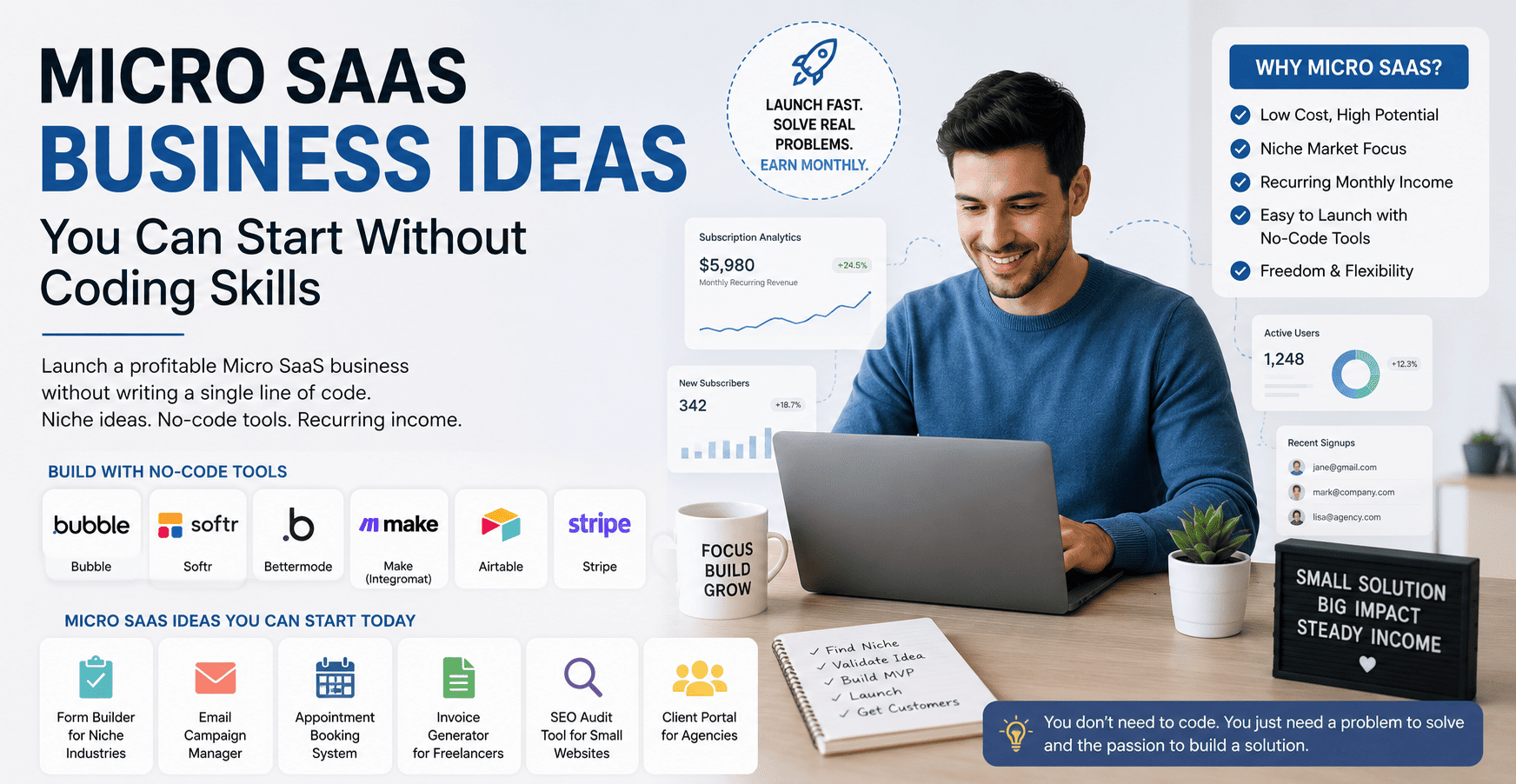
 What Is a Micro SaaS Business?
A Micro SaaS business is a small software company that offers a specialized service to a targeted audience. It typically operates on a subscription model, allowing business owners to earn recurring revenue every month.
Micro SaaS businesses are attractive because they offer:
- Low startup costs.
- Recurring income.
- Flexible work arrangements.
- High scalability.
- Minimal maintenance.
- Small customer support requirements.
Rather than competing with large technology companies, Micro SaaS entrepreneurs focus on solving small but important problems.
Why Micro SaaS Is Growing in 2026
Several trends are driving the growth of Micro SaaS businesses:
- Increased demand for niche software solutions.
- The rise of remote work.
- Affordable no-code development tools.
- AI-powered automation.
- Growing subscription-based business models.
- Lower barriers to entry for entrepreneurs.
Today, building software products no longer requires years of technical training.
Micro SaaS Business Ideas You Can Start Today
1. AI Content Planner for Social Media
Many small businesses struggle to create consistent social media content.
You can build a subscription-based platform that provides:
- Monthly content calendars.
- AI-generated captions.
- Hashtag recommendations.
- Posting schedules.
- Content ideas for different industries.
Potential customers include:
- Small businesses.
- Digital marketers.
- Freelancers.
- Content creators.
2. Resume and CV Builder
Job seekers are constantly looking for professional resume templates.
Your Micro SaaS platform could offer:
- ATS-friendly CV templates.
- AI resume suggestions.
- Cover letter generation.
- LinkedIn profile optimization.
- Downloadable PDF formats.
A monthly subscription or pay-per-download model can generate recurring revenue.
3. AI-Powered Blog Title Generator
Bloggers and website owners always need engaging content ideas.
Your tool could provide:
- SEO-friendly blog titles.
- Keyword suggestions.
- Meta descriptions.
- Content outlines.
- Trending topic recommendations.
This type of niche software can easily be built using no-code tools and AI integrations.
4. Small Business Invoice Generator
Freelancers and entrepreneurs need simple invoicing solutions.
Features may include:
- Invoice templates.
- Payment tracking.
- Client management.
- Tax calculations.
- Automatic reminders.
This business model works particularly well in developing markets where affordable tools are in high demand.
5. Online Appointment Booking System
Many small businesses still manage appointments manually.
Potential customers include:
- Tutors.
- Coaches.
- Consultants.
- Beauty salons.
- Fitness trainers.
Your software can offer:
- Appointment scheduling.
- Calendar integrations.
- Automated email reminders.
- Payment collection.
6. Digital Product Delivery Platform
Creators who sell:
- E-books.
- Templates.
- Courses.
- Guides.
- Printable products.
often need simple delivery systems.
Your Micro SaaS solution could provide:
- Secure download links.
- Automated delivery.
- Payment integrations.
- Customer dashboards.
7. Subscription-Based Meal Planner
Health-conscious individuals increasingly seek personalized meal plans.
Your platform could offer:
- Weekly meal plans.
- Grocery lists.
- Calorie calculations.
- Fitness-based recommendations.
- Vegetarian and vegan options.
You can target:
- Fitness enthusiasts.
- Busy professionals.
- Students.
- Families.
8. AI Email Writing Assistant
Many professionals struggle with writing business emails.
Your software could generate:
- Sales emails.
- Customer support replies.
- Follow-up messages.
- Professional proposals.
- Marketing campaigns.
AI-powered writing tools continue to experience strong market demand.
9. Freelancer Productivity Dashboard
Freelancers often manage multiple clients and projects simultaneously.
Useful features include:
- Project tracking.
- Income reports.
- Time management tools.
- Monthly goals.
- Productivity analytics.
A niche productivity tool can attract loyal subscribers.
10. Local Business Review Management Tool
Small businesses care deeply about their online reputation.
Your platform could help users:
- Monitor customer reviews.
- Collect testimonials.
- Request feedback.
- Track ratings.
- Improve customer satisfaction.
This service is particularly useful for local businesses and agencies.
No-Code Tools You Can Use
Building a Micro SaaS business is easier than ever thanks to modern no-code platforms.
Popular no-code tools include:
- Bubble
- Glide
- Softr
- Airtable
- Zapier
- Make
- Tally
- Notion
- Stripe
- ChatGPT APIs and AI integrations
These platforms allow entrepreneurs to create professional software products without traditional programming skills.
How to Validate Your Idea
Before building your product, ask yourself:
- Does this solve a real problem?
- Are people already paying for similar solutions?
- Can I target a specific niche?
- Will customers pay monthly for this service?
You can validate your idea by:
- Joining online communities.
- Running surveys.
- Offering early access plans.
- Building a landing page.
- Collecting feedback from potential users.
Validation can save both time and money.
Pricing Your Micro SaaS Product
Common pricing models include:
| Plan | Monthly Price |
|---|---|
| Basic | $5 - $9 |
| Standard | $15 - $29 |
| Premium | $49 - $99 |
Micro SaaS businesses succeed by attracting loyal niche customers rather than massive audiences.
For example:
- 100 customers paying $10 per month = $1,000 monthly revenue.
- 500 customers paying $15 per month = $7,500 monthly revenue.
- 1,000 customers paying $20 per month = $20,000 monthly recurring revenue.
Small subscription numbers can create impressive income over time.
Benefits of Starting a Micro SaaS Business
Micro SaaS offers several advantages:
- Low operational costs.
- Recurring revenue.
- Global customer reach.
- Minimal inventory requirements.
- High automation potential.
- Flexible work schedules.
- Excellent scalability.
Many successful founders operate profitable Micro SaaS businesses entirely on their own.
Common Mistakes to Avoid
Avoid these common mistakes when starting:
- Building before validating your idea.
- Targeting too broad an audience.
- Overcomplicating your product.
- Ignoring customer feedback.
- Spending too much on unnecessary features.
The simplest solutions often become the most profitable.
Conclusion
Micro SaaS is one of the most accessible online business opportunities in 2026. Thanks to no-code tools and AI-powered platforms, entrepreneurs no longer need programming skills to launch software products that generate recurring income.
The key to success lies in identifying a specific problem, targeting a niche audience, and creating a simple yet valuable solution. Whether you build an AI writing assistant, a productivity dashboard, or a digital product delivery platform, there has never been a better time to start a Micro SaaS business without coding skills.
Sometimes, a small idea that solves one problem exceptionally well can become a highly profitable and sustainable online business.

You must be logged in to post a comment.