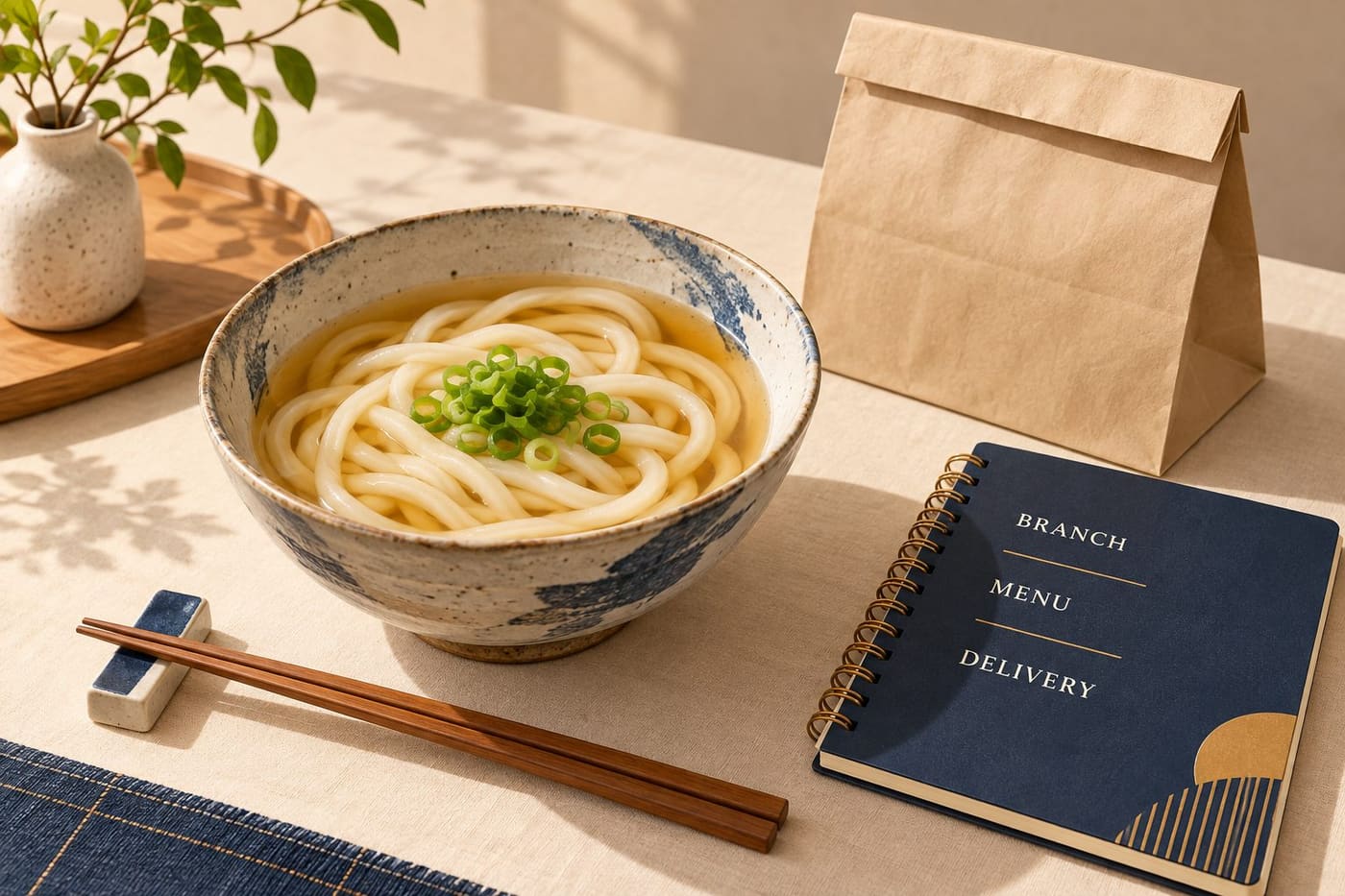
Searching for Sukesan Udon can lead to several different questions. You might want a meal at a particular branch, a delivery order, a limited menu item or an explanation of a company notice. Those needs share a brand name, but they should not share one unqualified answer.
This guide separates the useful official sources available on 31 October 2026. It explains how to turn a broad search into a practical decision while keeping branch details, dated announcements and personal-information concerns within their actual scope. It is not a restaurant visit, a taste review or a test order.
Start with the question you need answered
Before comparing search results, write one sentence about your next action. “I want to eat at a branch near my hotel tonight” requires a location and current operating information. “I want delivery to this address” requires a service's actual address-based availability. “Does this notice concern me?” requires the notice's audience and latest update.
Trying to answer all three from a restaurant photograph or a short headline is likely to leave something important unresolved. A famous dish does not confirm today's opening hours. A delivery expansion does not establish that a courier will serve your building. A company announcement addressed to employees should not silently become a claim about every customer's information.
Create a small note with three headings: question, official source and unresolved detail. Keep the unresolved field visible. A blank delivery estimate is not zero minutes, and an unverified menu price is not permission to reuse one from an old blog post.
Find the exact branch before using its hours
The [official Sukesan Udon store finder](https://www.sukesanudon.com/map/) supports searches by store name or address and displays branch-specific information. Its retrieved listings included different opening patterns: some branches listed 24-hour service, while others had narrower hours and separate order-stop times. The page also provided delivery-service and parking filters.
That variation is the useful point. Do not carry a 24-hour label from one listing to every restaurant in the chain. Open the intended branch's detail page and match its name and address with the destination in your plan. Similar place names can be easy to confuse when switching between a map, a translated article and a travel itinerary.
For a hypothetical visitor, Emi, a branch near a station and another near her hotel might both seem convenient. She records each full branch name before comparing the journey. If she later changes her hotel, she revisits the location choice rather than assuming the earlier branch remains the nearest option.
Keep the original Japanese branch name alongside any translation. It can help when matching a sign, searching again or showing the destination to someone assisting you. A translated nickname is less useful if it does not correspond clearly to the official listing.
Opening time and last orders answer different questions
A closing time identifies the end of a stated operating period. An order-stop time can arrive earlier. If the listing presents both, preserve both in your note instead of reducing them to a single late-night number.
Consider a fictional restaurant listing that says 22:00 closing and 21:30 last orders. A traveller planning to arrive at 21:45 should not treat “open until 22:00” as confirmation that a new meal order will be accepted. This example is an illustration of reading the fields, not a promised schedule for a particular Sukesan branch.
Allow room for the journey you actually need to make. Walking time from a station entrance, finding the correct building and a queue can matter more than the distance shown in a search result. This article has not measured those conditions or checked live queues. Where timing is tight, use the branch's current information and an alternative plan rather than a confident guess.
For a group, agree on the destination before everyone starts travelling. Sharing a link to the exact branch is clearer than sending only the brand name and “the one near the station.” It reduces an avoidable coordination problem without requiring anyone to disclose unnecessary personal details publicly.
Read the training-closure notice alongside ordinary hours
The company's [20 October training notice](https://www.sukesanudon.com/news/news-8000/) says that, from 26 October, store training can involve temporary closure periods, announced beforehand at the store. It also says training will be carried out monthly with the dates communicated in the same way.
That notice does not provide a universal closure timetable for every location. It is a reason to check relevant branch notices, not a reason to announce that the entire chain is closed. Equally, ordinary listed hours alone should not be used to dismiss a specific temporary closure notice.
An effective travel note distinguishes the normal schedule from exceptions. Put ordinary hours on one line and the dated exception below. If you cannot establish whether an exception affects the intended visit, mark it unresolved. Do not fill the gap with an assumption that every branch follows the same training slot.
This method also works for future changes. An announcement may remain searchable after the date it describes. The publication date, effective period and named location should all be read before turning it into an instruction for today's journey.
Use the branch's own menu route
The [official menu page](https://www.sukesanudon.com/menu/) directs readers through the store finder to the individual store detail page and then the store's menu. Follow that route when the decision concerns a specific location. A general photograph or a popular-item description is not a complete branch price list.
Record the item name, version and relevant serving details together. A standalone bowl and a set containing another item are not automatically comparable purchases. If you are planning for several people, count the actual portions needed before comparing totals.
Here is an original budgeting example, not a quote from the restaurant. Suppose two people plan a fictional order with meals priced at 700 and 850 currency units, plus an optional 200-unit addition. The meal subtotal is 1,550; choosing the addition brings it to 1,750. If another necessary charge is unknown, the total remains incomplete. Do not report 1,750 as the confirmed final cost until the relevant charges are known.
Keep payment acceptance separate from the budget. This research has not tested cards, cashless services, foreign-issued cards or a transaction at any branch. A method shown at another restaurant is not evidence for the one you selected.
Limited items need a location and a period
The [21 October Napolitan udon announcement](https://www.sukesanudon.com/news/news-8002/) describes a limited-time launch from 22 October at 25 selected branches: ten in Kansai and fifteen in Kanto. That is a defined participating set, not an all-branch menu promise.
If a particular item is the reason for a special trip, confirm the relevant branch and current availability before building the rest of the outing around it. A launch announcement can explain what began; it does not guarantee that every portion remains available at every later moment.
Avoid letting a search thumbnail become a substitute for the participation conditions. A photograph may be accurate while the location you intend to visit is outside the offer. Read the limiting words with the same attention as the product name.
The company's [first-visit introduction](https://www.sukesanudon.com/hajimete/) provides a different kind of help: it introduces suggested orders such as meat-and-burdock-tempura udon, oden and botamochi. Use it for orientation, not as a current inventory check or an independent verdict on taste. No dish was ordered, tasted or evaluated for this article.
Delivery expansion is a network announcement
[Demae-can's 29 October release](https://corporate.demae-can.co.jp/pr/news/20261029_sukesanudon.html) announced 25 additional Sukesan Udon locations on its service, taking the participating total to 94. The company described the additions as focused mainly on Kanto and Kansai.
The number refers to participating stores in that announcement. It is not a promise of nationwide delivery, a count of couriers ready now or confirmation that any selected household can order. The release itself notes that information reflects its publication time and may change.
Treat the announcement as a reason to check the actual service, not as a completed availability check. For a real order, the relevant destination, selected restaurant, ordering time and available items need to fit together. This article has not entered a delivery address, opened an account, placed an order or paid a provider.
An invented example makes the distinction clear. Emi sees news of a larger network and hopes to order to her hotel. Until the service identifies an available branch for that destination, the headline remains general information. Even an eligible address would not guarantee a particular dish, final delivery time or total charge before the order details are displayed.
Compare dine-in, takeaway and delivery separately
These are different ways to obtain a meal, and their conditions should be recorded in separate columns. Do not assume the same selection, packaging, final price or timing applies across all three. Verify each channel's displayed terms rather than copying a restaurant menu into a delivery budget.
For planning, list what each option must accomplish. Dining in requires reaching a suitable branch in time. Takeaway requires collection arrangements and a workable onward journey. Delivery requires service to the destination and an order that meets the platform's current conditions.
The cheapest-looking item price may not settle the comparison. A group travelling separately, for example, may value a clear meeting place more than a small apparent price difference. That is a personal planning judgement; it is not a claim about measured convenience or savings at this restaurant.
If an option cannot be verified, keep an alternative that does not depend on it. A backup meal plan is more practical than treating a press-release total as a reservation or an accepted delivery order.
Keep the employee-information notices accurately scoped
The company's [27 October notice](https://www.sukesanudon.com/news/news-8014/) concerns a possible exposure involving a contractor-managed server and current or former employees who worked for the company during the stated October 2021–October 2026 period. It asks affected readers to be cautious about unexpected calls or SMS impersonating the company or related organisations.
The [29 October second report](https://www.sukesanudon.com/news/news-8023/) says an investigation continued. The company reported that the data storage area required separate authentication and that it had found no actual leakage or alteration at that point. It also explicitly said technical limits prevented completely ruling out possible exposure. It said bank-account information was not included and clarified that retirement reasons were internal numeric categories rather than detailed personal accounts.
These are dated company statements, not an independent security clearance by this publication. Neither “confirmed theft of every customer's data” nor “no possibility remains” accurately reflects the scope and caveat above. Read the latest official update if this is the reason for your search.
Choose the right next step for your situation
A diner checking dinner plans and a former employee checking a personal-information notice need different next steps. The diner can concentrate on branch, menu and operating information. Someone who may fall within the notice's audience should read the complete official wording and use the contact route published there for their own circumstances.
Do not post employment records, identity documents, wage details or screenshots containing private information in a public discussion to ask strangers whether you are affected. A broad search query is not an assessment of an individual's records. This article has not examined any affected database or contacted the company about a person.
For suspicious communications, avoid treating the sender's claimed affiliation as proof. The company specifically warned about impersonation calls and SMS. Reach the official notice through the known company website and consult the contact information there rather than relying solely on instructions in an unexpected message.
Keep a dated record of the official information you read. If a later update changes the scope or available action, revisit the specific unresolved question. Restaurant opening information should not be used to infer security findings, just as a security notice should not be rewritten as an unsupported all-store closure announcement.
A compact checklist before you decide
For a visit, keep the full branch name, address, ordinary hours, last-order information and any relevant exception together. For a menu-led trip, add the exact item and participating location. For delivery, check destination-based availability and the actual order details. For an employee notice, preserve the audience, date, company findings and remaining uncertainty.
Our guide to [food date labels and instructions](https://monetizearticle.com/article/food-date-labels-read-the-whole-instruction-before-planning-dinner-777900) discusses a separate food-planning question. It is background reading, not restaurant-specific storage advice or evidence that a delivered dish has a particular safety history.
Conclusion
Sukesan Udon's broad search interest is best approached through the question you actually need answered. Match branch information to the intended location, read menu and delivery conditions in their own channels and keep dated employee notices within their stated scope.
That approach produces a usable plan without inventing a visit, guaranteeing availability or turning an ongoing investigation into a conclusion it has not established.
Sources and research note
Research checked 31 October 2026 using the canonical sukesanudon.com store finder, menu instructions, first-visit introduction and dated October notices, plus Demae-can's official 29 October expansion release. No reliance on lookalike .mom or .pro domains, unverified menu-price aggregators or an inaccessible FAQ page. The mail-order store timed out and is not treated as inspected. No live checkout, payment, food tasting or independent security investigation occurred.
Google Trends Japan, retrieved at 05:42:18 UTC, displayed “資さんうどん” first in Past 24 hours, All categories, All trends, sorted by search volume descending: 50K+, 1,000% growth, Active, started 20 hours earlier. No substitution was needed. The guide addresses documented developments without claiming one particular announcement caused that search interest.
Emi, all budgets and travel scenarios are original hypothetical examples. The builtin AI-generated conceptual illustration is an unbranded planning still life, not the company's food, premises or notice. Limited exact-title and phrase searches found related material without an exact matching article observed; no exhaustive similarity, human-authorship, restaurant-quality or search-performance guarantee is made.