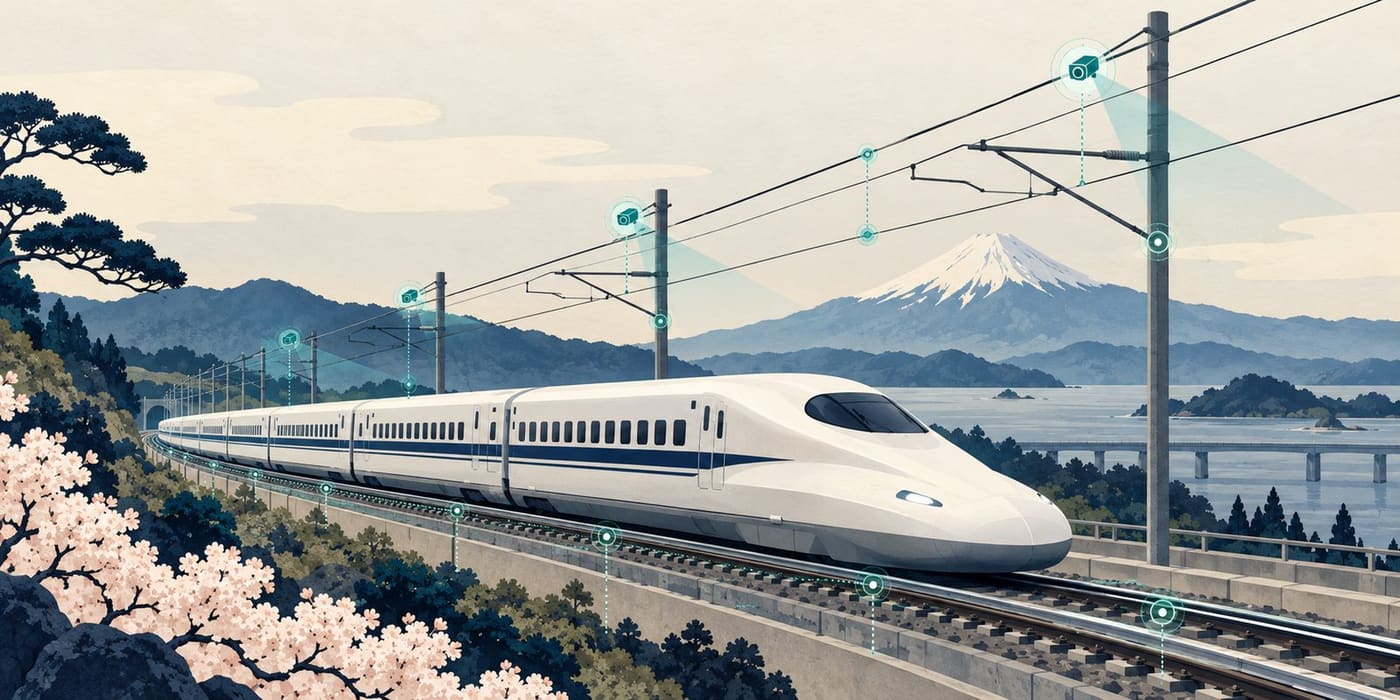
Doctor S is attracting attention because it brings railway inspection equipment into a passenger train. The useful question is not simply whether the new Shinkansen has started running. It is which part of the project has started: carrying passengers, checking equipment, or using that equipment for regular infrastructure inspection.
JR Central's April 2026 announcement separated those milestones. It planned passenger operation for October 2026, followed by trials and confirmation tests, with inspection equipment operation planned for January 2027. That distinction matters when reading launch coverage. A train can enter passenger service while its additional inspection role is still being prepared. [JR Central announcement](https://jr-central.co.jp/news/release/_pdf/000045513.pdf).
On 26 October, Nagoya broadcaster Me-Tele reported the first passenger service and described its own coverage at Nagoya Station. Its report identified the Tokyo-to-Hakata Nozomi 7 as the debut train. That is the broadcaster's account of the day's operation; the primary operator document reviewed for this article establishes the planned sequence, rather than independently confirming that specific departure. [Me-Tele's launch report](https://www.nagoyatv.com/news/?id=037721).
For travellers, enthusiasts and readers following the technology, the distinction offers a better starting point than treating a debut photograph as proof that every planned function is already in routine use.
What the Doctor S name identifies
The operator applies Doctor S to inspection-equipped N700S trains. Its April announcement specifies four sets of sixteen cars, with identifying logos on the end cars and odd-numbered cars. It also describes recycled aluminium from the T4 Doctor Yellow train being used in parts of the new trains' roofs and sides. These are specific design and identity details, not claims that the entire train is made from recycled material.
The naming announcement connects Doctor S with Doctor Yellow's inspection role. That connection can explain the public interest without turning the new train into a replica of the older one. A railway can preserve a function while changing the vehicle that carries it, the equipment packaging and the way information reaches maintenance teams.
There are three different things to keep separate when looking at a picture:
- The train family describes the underlying passenger vehicle.
- The Doctor S identification denotes the inspection-equipped version described by the operator.
- The status of the inspection programme tells you whether its additional equipment is undergoing checks or performing its intended regular role.
A visible badge answers an identity question. It does not, by itself, answer the operational-status question. This is especially important during an introduction period, when photographs and older planning documents can circulate together without their dates.
Why passenger trains can be useful observation platforms
JR Central's technology overview describes systems for observing track materials and overhead electrical equipment while a passenger train moves at speed. Cameras and sensors produce images and height-related point data; the systems extract information relevant to maintenance. The company also describes measurements of overhead-wire relationships and detection of problems with electrical fittings. [JR Central technology overview](https://company.jr-central.co.jp/company/technology/growth/).
The analytical attraction is straightforward: a journey that already has a transport purpose can also become an opportunity to observe infrastructure. The value comes from the observations being useful and comparable, not merely from having a camera aboard.
Consider an imaginary maintenance example, not a reported Doctor S finding. An inspector has a clear image of a fastening on Monday and another on Thursday. If the location, viewpoint and measurement conditions can be reconciled, the pair may help establish whether something changed. Two unlabelled photographs, even if both are sharp, may be much less useful.
That example shows why the information surrounding a measurement matters. Where was it taken? Which component does it show? What did an earlier observation look like? Does the apparent difference represent a physical change or a change in how the observation was made? These questions connect a moving sensor to a maintenance decision.
Speed makes measurement an engineering problem
The operator's June 2024 technical report describes equipment developed for measurement at 285 kilometres per hour. It discusses compact underfloor equipment, restricted installation space and the need to position cameras and lighting carefully. Its test examples include images and point measurements taken at 300 kilometres per hour on an N700S test train. Those are reported test conditions, not a new passenger timetable or a claim that all services run at that speed. [JR Central technical report](https://company.jr-central.co.jp/company/technology/_pdf/report_04.pdf).
An elementary calculation helps explain the challenge. At 285 kilometres per hour, a vehicle moves approximately 79 metres in one second. This is simply 285,000 metres divided by 3,600 seconds. A component beside or beneath a moving train does not remain in the same place in a camera's view for long.
That arithmetic is an illustration of the measurement problem, not an independent performance test. It does not tell us a particular camera's exposure, accuracy or coverage. Those require equipment specifications and test results. It does explain why saying that a train has cameras leaves most of the engineering story untold.
Useful evaluation questions therefore concern whether equipment can see the relevant parts, obtain interpretable measurements and maintain the relationship between an observation and a physical location. A spectacular image of a train passing a platform cannot answer those questions, however compelling the launch itself may be.
Pictures and point data answer different questions
A photograph and a set of measured points are different representations of an object. As a simple original analogy, imagine looking at a chair. A photograph may show a mark on its surface. A collection of points describing its shape may help you compare the heights of its corners. Neither representation automatically supplies the explanation for what you see.
Applied carefully, that analogy helps explain why a monitoring system might combine different kinds of evidence. It is not a reconstruction of JR Central's software or a claim about how any particular alert is decided. The operator's published overview establishes that images and point data are part of the approach; the chair example only clarifies the distinction for a general reader.
The same caution applies to colour. A coloured technical illustration might use different colours to represent height or another measured quantity. It should not be read as an ordinary photograph unless its caption says that it is one. Before interpreting a diagram, read the legend, units and description of the measurement.
This habit is useful beyond railway coverage. Many technology announcements combine photographs, diagrams and processed data in one presentation. Each has a different evidential role. Identifying that role is more informative than assuming that every attractive visual shows the system working under everyday conditions.
Collecting information is only part of the job
The 2024 technical report also discusses the volume of information produced and the need to process data aboard the train so that relevant maintenance information can be transmitted. It describes further transmission testing as a planned step at the time of publication. That historical wording should not be silently converted into a current statement that testing is either unfinished or complete.
For a reader assessing a monitoring programme, it helps to imagine an information chain: observation, interpretation, communication, assessment and action. This is an explanatory framework, not a published Doctor S operating procedure. A weakness at any point could make the preceding work less useful, even when the original measurement is excellent.
For example, a hypothetical alert that identifies a possible change but lacks a usable location would be difficult to investigate. An alert with a precise location but no explanation of its uncertainty could be misunderstood. A well-organised review process would need to consider both the signal and its limitations.
None of those hypothetical shortcomings is being alleged here. They illustrate what outcome reporting would need to establish before a reader could move from a promising technical design to a quantified claim about maintenance improvement. More observations and better decisions are connected goals, but they are not interchangeable measurements.
Read the development timeline in order
The June 2024 fleet announcement planned seventeen additional N700S sets across fiscal years 2026 to 2028. It specified that some would carry infrastructure inspection equipment. The fleet programme and the inspection-equipped subset should therefore not be treated as identical totals. [JR Central fleet announcement](https://jr-central.co.jp/news/release/_pdf/000043624.pdf).
That earlier document provides development context. The later naming announcement provides the Doctor S identity and planned introduction sequence. Launch reporting then describes a specific day's passenger operation. Reading the documents in that order prevents an older future-tense statement from being mistaken for a report of something that has already happened.
One practical way to keep notes is to record four fields for each claim: document date, author, milestone and status. For example, a statement might be an operator's plan, a technical test result or a reporter's observation. Those labels help preserve the difference between intention, evidence from a controlled activity and an event witnessed in public.
Dates also need their original context. A fiscal-year programme is not a promise that every listed vehicle appears on the first day of a calendar year. A target month is not necessarily a booking date. When a more precise date matters to your journey, look for a current passenger notice rather than calculating one from a development schedule.
What travellers should and should not infer
The launch story can make an ordinary journey feel connected to a larger engineering project. But a report identifying one debut service does not establish a permanent assignment for that train number. This article has not verified a future Doctor S operating roster or a booking method that guarantees a particular set.
If you are planning travel, use the operator's current passenger information for the service, reservation and journey details you actually need. Treat an enthusiast sighting as a dated observation unless an official notice provides a broader commitment. Do not change an essential journey solely on the assumption that a vehicle photographed today will operate the same service tomorrow.
For anyone photographing trains, the practical priority remains following station instructions and staying within permitted public areas. A special train identity does not change the need to keep routes clear for other passengers. This is general travel guidance, not a claim about a particular station's photography arrangements.
It is also worth separating curiosity about the train from concern about a journey. The staged introduction of additional monitoring equipment does not, by itself, establish that a passenger service lacks its normal safety arrangements. Equally, the presence of monitoring equipment is not a guarantee that disruption or equipment problems can never occur.
What would demonstrate progress after the launch?
The next useful information would address operational milestones and measured outcomes. Readers should distinguish a notice that equipment has entered its intended service from a report showing what that operation has achieved over time. Both would be valuable, but they answer different questions.
Useful questions for future public reporting include:
- Has the operator confirmed that the planned inspection phase has begun?
- What scope does the announcement cover, and are any functions still in trials?
- Are reported improvements measured results or expectations?
- What period, comparison and definition support any numerical claim?
- Does a fleet figure describe all passenger trains or only the equipped subset?
These are questions to apply to future evidence, not a list of missing regulatory requirements or a judgement that the project has failed. Public launch material is often designed to explain a development clearly, while detailed operational evaluation may answer a narrower technical question.
The environmental aspect deserves the same care. Reusing material is a specific and understandable feature. A claim about the total environmental effect of an entire fleet would require a wider accounting boundary. This article does not calculate emissions savings or infer a whole-train footprint from one material-reuse detail.
Conclusion: follow the function as well as the train
Doctor S offers a useful example of how a familiar passenger vehicle can take on an additional infrastructure role. The launch is easy to see; the more consequential story concerns how observations become dependable information for maintenance.
Read passenger operation, commissioning and regular inspection as separate milestones. Keep the source and date attached to each claim, and treat future performance figures as evidence to examine rather than outcomes already established by the debut. That approach preserves the interest of the new train while giving its engineering programme the precision it deserves.
Sources and research note
Research date: 26 October 2026. Japan Google Trends showed the query ドクターs 新幹線 with 10K+ search volume, an 800% increase and active status when checked; this identifies search interest, not its cause or passenger demand. JR Central's announcements, technical report and technology overview were read directly. Me-Tele's first-hand launch account was available through indexed search text; direct retrieval failed, so the exact departure is explicitly attributed to that broadcaster. No independent inspection-performance audit or future train roster was verified. Examples and calculations are explanatory, not observed maintenance incidents. The accompanying original AI-generated conceptual illustration is not a photograph of the actual train or its equipment.