A restaurant changing its beverage supplier sounds like a simple swap: one cola leaves the menu and another takes its place. For someone ordering lunch, however, the useful questions are more specific. When will the local restaurant change? Which drink will be included in a meal? Will a familiar flavour still be available? And which nutrition information describes the cup actually being served?
KFC’s announced U.S. partnership with Coca-Cola makes those questions timely. The company announcement is dated 15 October 2026. It describes a transition beginning in January 2027, with Coca-Cola products expected across U.S. restaurants by spring. That is a future rollout, not evidence that every restaurant has already changed its drinks on 26 October.
This guide separates that confirmed announcement from practical ordering questions that remain local or unresolved. It also explains how to compare drinks without treating a supplier’s brand name as a substitute for serving size, ingredients or the price of the meal you actually want.
What the official announcement confirms
The Coca-Cola Company’s announcement identifies a new beverage partnership with KFC in the United States. It describes a network of approximately 3,600 restaurants and a phased introduction starting in January 2027. Spring 2027 is the stated expected point for availability across the U.S. system.
Those are the core facts supported by the release. It does not provide a restaurant-by-restaurant conversion calendar, a complete list of drinks and sizes, a price schedule or a nutritional comparison between the outgoing and incoming choices. Promotional statements about improving the customer experience should be read as the companies’ expectations, not independently measured results.
For a diner, the useful distinction is between the national plan and today’s local menu. A headline can accurately describe the partnership while still being insufficient to tell you what a particular restaurant will pour at lunchtime. The remainder of this guide concerns how to close that information gap before ordering.
Three dates that answer different questions
Keep the announcement date, the start of the rollout and your visit date separate. The announcement tells you when the plan became public. The rollout window tells you when changes are expected to begin. Your visit determines which local information you need.
Consider a hypothetical customer buying lunch in December 2026. The future partnership is relevant background, but it is not a reason to assume the restaurant has already switched. Another customer visiting in February 2027 would be inside the announced transition period. They should check that restaurant’s current menu rather than assume every location moved on the first day of January.
A saved news screenshot is particularly weak evidence for a later visit. It may correctly record the original plan while missing an updated schedule or a local availability notice. If the drink matters to your choice of restaurant, consult the current ordering page or ask the restaurant before travelling. No individual restaurant’s changeover date was verified for this article.
Keep the country attached to the headline
The announcement concerns KFC’s U.S. restaurants. It should not be expanded into a claim about every KFC worldwide. A traveller searching from Britain, Japan or Australia may encounter the same U.S. story even though they are planning to order in another market.
That distinction also matters when looking up ingredients. A search result containing the restaurant’s name and the word “nutrition” can lead to another country’s menu. The logo may look familiar, but that does not establish that the product, portion or recipe matches the drink in front of you.
Start with the country of purchase, then the restaurant, then the exact item. If you share the news with someone abroad, retain “U.S.” in the description. That small detail prevents a national supply announcement from becoming an unsupported worldwide promise. This guide does not infer changes at other restaurant chains from KFC’s announcement either.
A beverage portfolio is not a final menu
A supplier may sell many different drinks. A partnership announcement does not establish that every one of them will appear on each restaurant’s menu. Avoid building a future order around a flavour simply because it belongs to the incoming company.
The same caution applies to a favourite outgoing drink. The release reviewed for this article does not settle every product’s future, including speciality flavours or alternatives at unusual restaurant formats. An unanswered question is not evidence of either permanent disappearance or guaranteed continuation.
For now, organise your preference around what matters to you. Is it a particular taste, a caffeine-free option, a drink without sugar, a sealed bottle, or simply water with the meal? Knowing that priority makes it easier to evaluate the actual options when the restaurant publishes them. It also avoids turning a broad brand preference into an accidental order for a product with different characteristics.
Read the complete drink name and serving size
The brand on a fountain or menu is only the beginning of the description. Record the exact variety and size when comparing two choices. Do not combine the nutrient number for one product with the portion size of another.
Imagine two hypothetical menus. One lists a small drink with a meal; the other shows a price beside a larger cup. Comparing only the two displayed prices would not compare the same purchase. Likewise, a nutrition figure for a sealed bottle may not describe the fountain serving selected in an ordering screen.
The practical order is straightforward:
- Identify the drink’s full name, including any variety wording.
- Identify the portion associated with the displayed information.
- Check whether the meal price includes that portion or requires an upgrade.
- Read the final order summary after making substitutions.
These are comparison steps, not claims about KFC’s future menu. The new U.S. product-by-product nutrition table was not available in the material retrieved for this review, so this article does not invent one.
What menu calorie information can and cannot tell you
The FDA explains that covered U.S. restaurant chains display calorie information for standard menu items and provide additional written nutrition information on request. Its consumer guidance also describes how menus can use a slash for two options or a range when several variations are available.
A range should therefore prompt a question about your selection. It should not automatically be read as the number for every possible meal. Similarly, the lowest figure displayed for a set of options does not necessarily belong to the drink you chose.
Ask for the information that matches the order: the specific beverage, the relevant size and any combination selected. Calories are one piece of that information. They do not identify every ingredient or answer every dietary question. This article offers no personalised dietary target and makes no claim that one supplier’s whole portfolio is nutritionally better than another’s.
Use arithmetic only after the serving is clear
Simple arithmetic can expose a misleading comparison, but only if the starting numbers describe the correct items. As an illustration, suppose a menu lists a beverage serving at 120 calories and a second identical serving is consumed later. Together those two stated servings would total 240 calories. These are invented teaching numbers, not values for a KFC or Coca-Cola product.
The point is that a displayed serving is not automatically a record of everything consumed. Extra servings need their own accounting. Conversely, do not add two different figures if one already describes the whole combined order. First establish whether the number refers to the beverage alone or to a meal including it.
For more precise questions about fountain servings, use the restaurant’s stated basis rather than estimating from cup appearance. The FDA’s detailed menu-labelling guidance distinguishes circumstances involving cup volume and standard beverage or ice fills. A cup’s visible height alone cannot supply those details.
Compare the price of the order you want
A drink change may lead you to reconsider a usual meal combination. Compare the final payable price for the same set of items rather than assuming that a bundle is always cheaper or that an upgrade offers value to everyone.
Here is a hypothetical example. A meal with a drink costs $11, while the food you want without that drink costs $10. If you would otherwise choose the food alone, the relevant difference is $1. If the meal also contains a side you want, however, the food-only comparison is incomplete. You need to include that side in both alternatives before drawing a conclusion.
There is no verified KFC price claim in those figures. They demonstrate a method: write down the items, match the quantities and compare the final totals. Include any displayed charges that apply to your chosen ordering channel. Do not assume that an in-store price, a delivery listing and an old promotional screenshot describe an identical transaction.
Make substitutions explicit when ordering for others
A family or group order adds a different problem: the person placing it may know everyone’s food choice but not their drink preference. A supplier transition is a useful moment to confirm those preferences instead of automatically substituting whatever seems closest.
For example, “a cola” may be sufficient for one person but too vague for someone who requested a particular variety. Write the requested drink beside the person’s meal and agree on an acceptable alternative before submitting the order. If no suitable alternative is available, leave that question unresolved rather than silently deciding on someone else’s behalf.
The same approach helps with pickup. Compare the receipt or order summary with what was requested and raise an obvious mismatch before leaving. This is a practical checking routine, not a guarantee that packaging alone can confirm every ingredient. Where an ingredient restriction matters, seek the current product information and restaurant assistance.
Ingredient questions deserve product-specific answers
A change of supplier is not enough information to resolve a food allergy, sensitivity or other individual dietary requirement. Familiar colours, a zero-sugar description or a previous order do not replace an ingredient check for the current product.
Use the restaurant’s current U.S. information for the drink being sold. If the available page belongs to another country, do not substitute its answer merely because it is easier to find. For a sealed product, read its own packaging as well. If necessary information remains unclear, ask the restaurant rather than treating this general guide as clearance to consume it.
The KFC U.S. nutrition page did not expose a usable product table through the research tool used for this article. That limitation is why no allergen-free claim, caffeine quantity, sugar value or exact product comparison appears here. The absence of a retrieved table is not evidence that such information is unavailable through every customer channel.
Separate personal taste from evidence about the change
Someone may prefer one cola with fried chicken, another may choose an alternative drink, and a third may care more about the food than the beverage supplier. Those preferences do not need to be turned into claims that the partnership will improve every meal or damage every restaurant.
The announcement also does not establish why any particular customer buys lunch, how sales will change, or what financial terms were negotiated. A consumer guide can acknowledge interest in the switch without inventing those explanations. The relevant test for your next order is more modest: are the available items, information and price suitable for what you want?
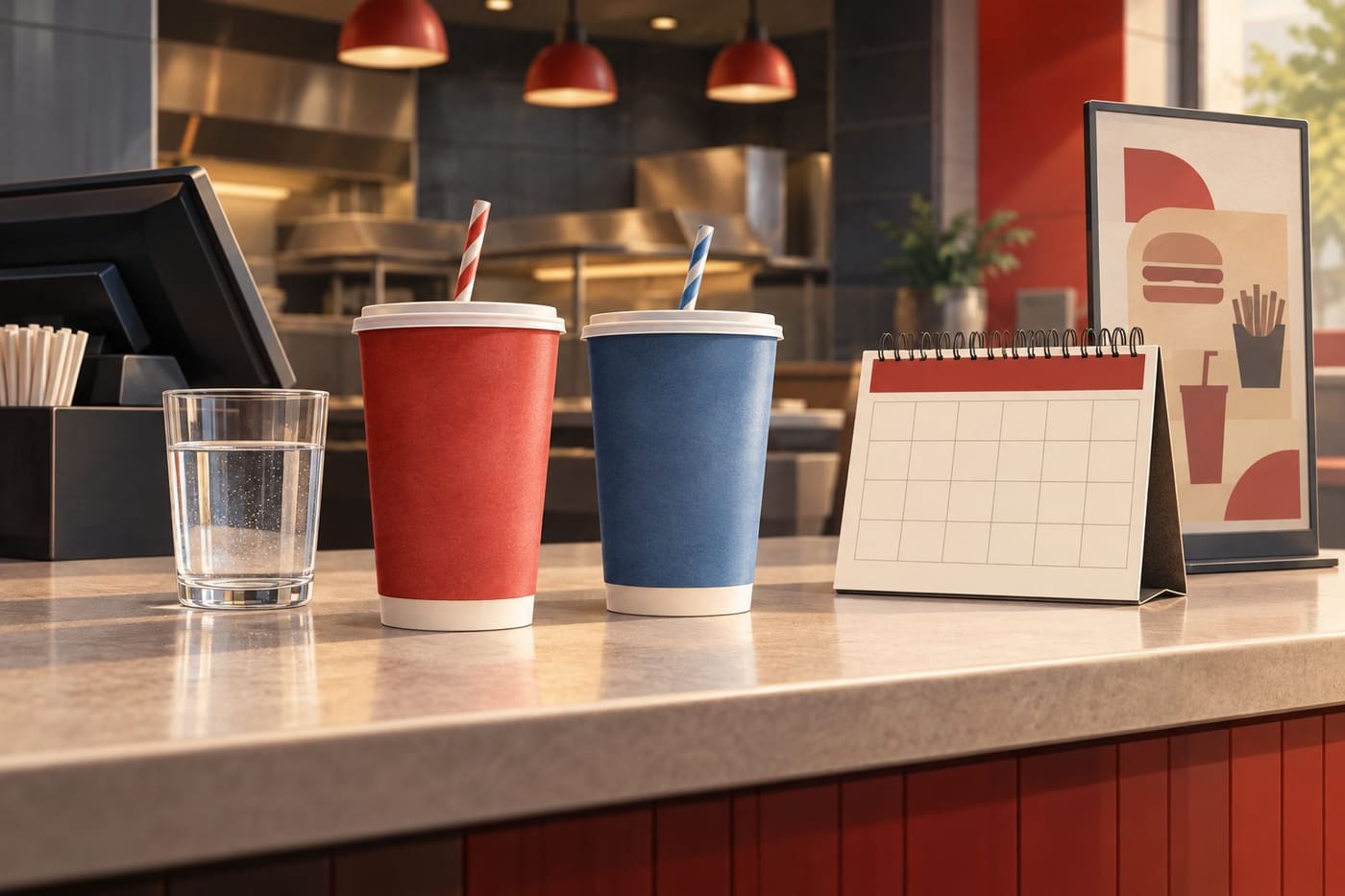
There is no firsthand tasting comparison in this article. The illustration is an original conceptual scene with unbranded cups and a calendar, not a photograph of a KFC location, a new drink dispenser or a confirmed future menu.
A short check before your next visit
When the transition reaches the period relevant to your visit, use a compact checklist:
- Confirm that you are reading information for the United States and the correct restaurant.
- Check the current menu rather than relying on the announcement alone.
- Match the drink name, size and any nutrition figure to the actual selection.
- Compare complete orders if deciding between a meal combination and separate items.
- Agree on substitutions before ordering for another person.
- Ask about unresolved ingredient or availability questions before paying.
The partnership provides a reason to look again at a familiar order. It does not require anyone to turn lunch into a brand debate. A clear product description, a current local menu and an accurate final total are more useful than an assumption based on a headline.
Conclusion
KFC’s U.S. beverage change is an announced 2027 transition, with January as the planned starting point and spring as the expected system-wide availability window. The most useful response is to keep that timeline separate from current restaurant availability. Check the specific drink and serving, ask for relevant information and compare the order you intend to buy. Details that have not yet been confirmed should remain open questions.
Sources and research note
Researched 26 October 2026. Google Trends’ U.S. Food and Drink view showed “pepsico loses kfc partnership” at 100+ searches, up 50%, with a 50-minute trend that had ended within the displayed 24-hour window. This is discovery evidence, not a claim that the announcement was made today or that search interest measures customer approval.
- [Coca-Cola’s dated U.S. KFC partnership announcement](https://www.coca-colacompany.com/media-center/coca-cola-kfc-us-beverage-partnership).
- [FDA consumer guide to calories on menus](https://www.fda.gov/food/nutrition-education-resources-materials/calories-menu).
- [FDA detailed menu-labelling guidance](https://www.fda.gov/files/food/published/Guidance-for-Industry--A-Labeling-Guide-for-Restaurants-and-Retail-Establishments-Selling-Away-From-Home-Foods-%E2%80%93-Part-II-%28Menu-Labeling-Requirements-in-Accordance-with-21-CFR-101.11%29-PDF.pdf).
- [KFC U.S. nutrition entry point](https://www.kfc.com/nutrition), provided for readers; its product table could not be retrieved in this review and is not presented as directly verified.
Examples and ordering comparisons are original editorial explanations, with hypothetical numbers explicitly labelled. No local menu, future price or complete product list has been independently verified. The image is an original AI-generated conceptual illustration.