A photograph of gold raises several different questions. Is the object a loose nugget or gold still attached to rock? How much of its weight is actually gold? And what evidence explains how that particular piece formed? Those questions need different answers. A striking appearance cannot settle all three.
Australian Google Trends discovery on 26 October 2026 included a query about an outback gold nugget find. That prompted this science explainer. The linked contemporary discovery report could not be directly retrieved during research, so this article does not authenticate the reported find, its value, weight, finder or location. Instead, it examines the geological evidence that can help readers understand such stories without turning an unverified headline into a scientific conclusion.
The useful starting point is concentration. Gold dispersed through a geological system must collect somewhere before it becomes a visible piece. Underground fluids, fractures, later erosion and changes near the surface can contribute at different stages. Research also investigates why gold sometimes accumulates into substantial masses within quartz. There is no need to choose one dramatic explanation and apply it to every specimen.
Start with what the object actually is
The Perth Mint provides a particularly clear example of the difference between the mass of an object and the gold it contains. Its King Henry display is a 93-kilogram rock containing approximately 45 kilograms of gold, discovered at the Beta Hunt underground mine in Western Australia in 2018. The Mint classifies it as a gold specimen rather than a nugget because the gold remains associated with material from an underground lode. Those are historical facts about that named display, not details of the current discovery headline. [The Perth Mint](https://www.perthmint.com/visit/attractions/gold-and-silver-nuggets/)
For readers, the practical lesson is to keep the description attached to the measurement. “The specimen weighs” and “the specimen contains” introduce different quantities. Removing either phrase can make a perfectly accurate number misleading. A report should also explain whether gold content was measured, estimated or simply repeated from an earlier account.
Consider a fictional museum label describing a ten-kilogram rock with an estimated two kilograms of gold. Calling it “ten kilograms of gold” would multiply the claimed metal content fivefold. Calling the two-kilogram figure a laboratory result would introduce a second error if the label only described an estimate. Neither mistake requires an invented number; both can happen by dropping the words that tell readers what a number measures.
How gold becomes concentrated underground
Geoscience Australia describes a common route to gold deposits through hot fluids circulating within the crust. Fluids can dissolve gold from rocks over a broad area. Cooling or reactions with surrounding rocks can then cause the dissolved gold to leave the fluid and accumulate in fractures. Quartz may be deposited alongside it. This describes geological redistribution and concentration, rather than the creation of new gold by an ordinary rock reaction. [Geoscience Australia](https://www.ga.gov.au/education/minerals-energy/australian-mineral-facts/gold)
Resources Victoria gives a regional example: much of Victoria's primary gold occurs in quartz veins associated with fractures opened during deformation of older sandstone and mudstone. Its account distinguishes these primary deposits from gold subsequently released and redeposited through weathering and erosion. The regional setting matters; a description of Victorian deposits should not automatically become the history of an unidentified object from somewhere else. [Resources Victoria](https://resources.vic.gov.au/geology-and-data/geological-survey-victoria/150-years/gold-fever)
When assessing an explanation, separate the source, the route and the place of accumulation. A scientific account might establish where gold-bearing fluid travelled without identifying exactly why one small section became unusually rich. Conversely, a mechanism explaining local accumulation does not identify the original source of all the metal. These are related research questions, not interchangeable answers.
A useful reading exercise is to draw three empty boxes labelled “material available,” “transport” and “deposition.” Add a statement only when the source supplies evidence for it. An empty box identifies something the article has not explained. Filling it with an appealing assumption makes a story smoother but does not make it better supported.
What the earthquake and quartz research found
A 2024 study led by Christopher Voisey investigated whether electrical effects in stressed quartz could help explain large gold accumulations. The university's research record describes deformation experiments and modelling. Stress generated sufficient electrical potential for gold to deposit from solution and for gold nanoparticles to accumulate. Existing gold grains became preferred sites for further growth. The authors proposed that this mechanism could help explain large nuggets and connected gold structures within quartz fractures. [Monash University research record](https://research.monash.edu/en/publications/gold-nugget-formation-from-earthquake-induced-piezoelectricity-in/)
Monash's accompanying explanation describes quartz as piezoelectric: mechanical stress can produce electrical charge. In the reported experiment, researchers stressed quartz in gold-bearing fluid and examined the resulting deposits. The proposed connection to earthquakes concerns repeated stressing in an appropriate geological environment. It is a possible mechanism supported by experiments, not evidence that any recent earthquake produced a newly reported nugget. [Monash University science report](https://www.monash.edu/science/news-events/news/2024/electricity-generated-by-earthquakes-might-be-the-secret-behind-giant-gold-nuggets)
That distinction changes how a headline should be read. “A mechanism can operate” is a claim about physical possibility under tested conditions. “This specimen formed through that mechanism” is a claim about the history of a particular object. The second needs evidence connecting the object and its geological setting to the process. The first does not supply that connection by itself.
It also matters when the research was published. This study appeared in 2024. Renewed interest in gold discoveries in October 2026 does not make it a new 2026 result. A responsible explainer can revisit older research while giving its actual date and avoiding language suggesting that a laboratory announcement happened today.
What a laboratory result cannot tell us on its own
Imagine a fictional research summary saying that a process worked in a controlled experiment. Before extending it to a natural setting, ask what conditions were selected, what was measured and what alternatives were considered. A demonstration may be important even when it cannot answer every question about a landscape or specimen.
For a nugget story, the distinction can be made concrete with four checks:
- Does the report describe an experiment, an observation of a natural sample, or both?
- Is the proposed mechanism explicitly linked to the reported specimen?
- Are the experimental conditions described well enough to understand the scope of the result?
- Does the conclusion retain qualifications such as “can help explain,” or has a later headline removed them?
These checks do not require readers to repeat the experiment. They help preserve the authors' actual claim. A university announcement is useful for understanding a study, but a simplified announcement should not be treated as every detail of its methods. Here, the Monash research record and institutional explanation were accessible; the journal's full article could not be opened directly through the research tool. This article therefore does not claim an independent audit of the complete experimental dataset.
The unanswered questions are part of the result's meaning. If the available account does not establish how long a particular natural nugget took to form, supplying a precise age would create false certainty. The same applies to estimating how many earthquakes affected an individual piece. A general mechanism cannot serve as a personal geological birth certificate.
A nugget can have a history after its first deposit
The University of Otago's geological account shows why a single origin story can be incomplete. In Otago, uplift and erosion released gold from older rocks, while later sedimentary recycling and chemical processes altered particles. Its discussion describes dissolution and redeposition that can increase particle size, alongside changes associated with transport and recycling. Most Otago gold is fine grained, and its regional history should not be presented as the universal history of every nugget. [University of Otago](https://www.otago.ac.nz/geology/research/gold/otago-gold-background)
This gives readers a useful distinction between initial deposition and subsequent history. Ask whether an explanation concerns the first concentration of gold, its release from surrounding material, its movement, or changes after that movement. Several stages can appear in the same account without contradicting one another.
For example, a caption might discuss a specimen's present surface while an accompanying article discusses the age of its host rocks. Those observations are not automatically dates for the same event. The reader should ask what was dated or examined, rather than treating every age mentioned near a specimen as the age of the specimen itself.
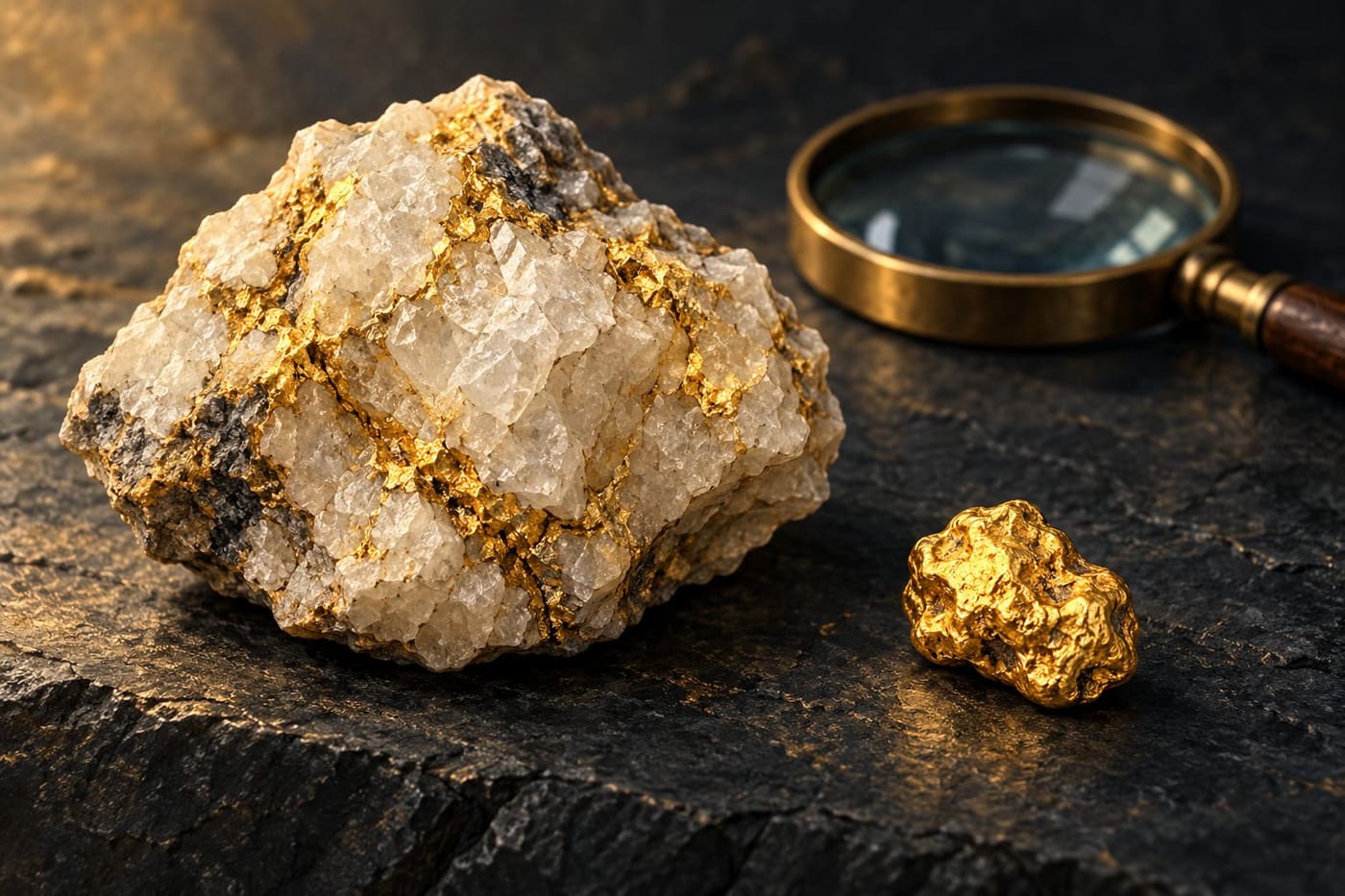
The same discipline helps with photographs. A close-up can document visible features at a particular scale, but it cannot by itself provide a complete timeline. A polished illustration is even more limited: it communicates an idea chosen by an illustrator. Our lead image is an original generated conceptual illustration of quartz and gold, not a photograph of a discovery, a specific museum object or a measured scientific reconstruction.
Read a discovery claim as a set of separate checks
A useful discovery report should make it possible to distinguish identification, measurement, location, date and interpretation. Confidence in one item should not automatically transfer to the others. A clear photograph, for instance, does not establish a sale price, and a reported price does not explain a geological mechanism.
Use a short evidence list when comparing accounts:
- Identity: What is the object called, and who identified it?
- Quantity: Does a weight refer to the whole specimen or its gold content?
- Timing: Is the date the discovery date, publication date or date of a later announcement?
- Origin: Is the location documented, approximately described or deliberately withheld?
- Explanation: Is a formation process demonstrated for this object, or offered as general context?
Do not treat a missing detail as permission to guess. A report may legitimately omit an exact location. That omission does not justify reconstructing a private site from photographs or social posts. For a science reader, the relevant issue is whether the published geological context supports the interpretation being offered.
Also examine whether apparently independent accounts share one original report. Three articles repeating the same statement are not necessarily three separate confirmations. Trace the claim to the source that actually performed the measurement, examined the object or made the announcement. If that source is inaccessible, describe the limitation rather than converting repetition into verification.
How to compare two apparently conflicting explanations
Suppose one article focuses on fluids depositing gold underground and another discusses processes affecting gold near the surface. The first question is not which article sounds more exciting. It is whether they are explaining the same stage, location and specimen. Different scopes can produce different descriptions without either account being wrong.
Next, compare the type of evidence. A regional geological overview, a laboratory experiment and a museum catalogue serve different purposes. The overview supplies context, the experiment tests a mechanism, and the catalogue identifies a particular object. A strong explainer makes those roles visible instead of blending them into an undifferentiated claim that “scientists say” something happened.
Finally, compare the wording of the conclusion with the evidence presented. A hypothetical claim that a process “always” creates large nuggets would need much broader support than a claim that it “can contribute” under particular conditions. Readers should be especially cautious when a secondary headline uses stronger language than the institution or paper it cites.
This approach also helps editors decide what to leave out. A dramatic valuation may be irrelevant to a geological explanation, particularly when its basis cannot be checked. Removing it can improve the article by keeping attention on the evidence that answers the reader's actual question: how can gold become concentrated into a visible natural object?
Conclusion: keep the geological question precise
Understanding gold nuggets begins with asking what evidence belongs to which claim. Identify the object, distinguish total mass from metal content, and keep a general formation mechanism separate from a demonstrated history of one specimen. Those steps make both spectacular discovery reports and technical research easier to read accurately.
The sources reviewed here support a layered account of deposition, possible local growth mechanisms and subsequent geological change. They do not authenticate the inaccessible October discovery story. A useful science explanation can acknowledge that boundary and still give readers practical tools for judging the next gold headline they encounter.
Sources and research note
Researched 26 October 2026. Topic discovery came from the Australian Google Trends feed, query “australia outback gold nugget find,” listed with 500+ traffic and a 05:00 UTC start timestamp. A Trends listing indicates search interest, not confirmation of a discovery. The linked ABC contemporary report was unavailable for direct retrieval; no weight, value, finder or location from that report is asserted here.
Primary institutional sources are linked beside their relevant sections: Geoscience Australia, Resources Victoria, Monash University, the University of Otago and The Perth Mint. The 2024 study's bibliographic identifier is [DOI 10.1038/s41561-024-01514-1](https://doi.org/10.1038/s41561-024-01514-1); direct full-journal access failed, so the accessible university research record and explanation were used with the scope stated above. Examples explicitly described as fictional are explanatory exercises, not reports of additional discoveries.