A dinosaur skeleton can stop a visitor in their tracks, but its size is only the beginning of the story. At Frick in the Swiss canton of Aargau, fossils connect a local landscape with animals that lived more than 200 million years ago. Understanding that connection means looking at the bones, the rock around them and the work that turns an excavation into a scientific interpretation.
It also means separating three places that can easily blur together in a travel plan: the museum, the professional excavation area and the designated public fossil-search area. They serve different purposes and have different access arrangements. A news story about discoveries is not an invitation to enter a quarry.
This guide uses museum and university information checked on 26 October 2026. It explains how to approach the collection as evidence, then sets out the practical questions to resolve before travelling. The suggested observation exercises are original editorial activities, not a museum programme or a report of a visit we made.
Why Frick is in the news
In a [report published on 25 October](https://www.srf.ch/news/schweiz/dinosaurier-im-fricktal-schweizer-dino-hotspot-noch-vieles-schlummert-im-boden), Swiss broadcaster SRF described changes at the clay pit associated with Frick's dinosaur discoveries. According to the report, commercial clay extraction has ended and part of the pit is being filled, while excavation can continue in a corner. Researchers and volunteers consequently need to look increasingly at other locations.
That is a report about changing opportunities for excavation, not evidence that the museum is closing or that every part of the site has become unavailable. SRF interviewed museum director and geologist Andrea Oettl; this article has not independently inspected the quarry or obtained an operator's access notice. Treat the dated report as the news context and use the museum's current visitor instructions for a trip.
The distinction matters because a headline can answer one question while leaving another untouched. “Where can research continue?” and “Where may my family go on Sunday?” need different evidence. Keeping those questions separate avoids turning a scientific or industrial development into an inaccurate travel recommendation.
Discoveries become a collection over time
The museum's [discovery history](https://sauriermuseum-frick.ch/ausstellung/plateosaurus/entdeckungsgeschichte/) dates its first scientific excavation to 1976 and the discovery of a complete Plateosaurus skeleton to 1985. It describes a shift from recovering a striking skeleton towards investigating how so many bones came to be accumulated and deposited. It also records finds outside the principal clay pit, including during construction work.
This is a useful change in emphasis for visitors. A collection is not only a set of impressive objects; it can support questions about relationships between objects. Where did a bone lie? Was it connected to other bones? What material surrounded it? A display may show the result of that work without showing every field record or intermediate stage.
An original way to read a discovery timeline is to draw three parallel lines: discovery, study and exhibition. Put a date on the appropriate line only when a label or source supplies it. Do not move a discovery date into the exhibition column simply because the object is now visible. This exercise makes the time between finding something and explaining it much easier to appreciate.
Look for the period as well as the animal
The [museum's collection description](https://sauriermuseum-frick.ch/ueber-uns/museum/) distinguishes Late Triassic land animals on the lower exhibition level from Early Jurassic marine fossils in the gallery. It relates that arrangement to the sequence of rocks in the clay pit. These exhibits therefore should not all be imagined as a single scene in which every animal lived together.
Before comparing two objects, read their period and locality information. If a label gives a geological period rather than an exact numerical age, retain that level of precision in your notes. An approximate age is not improved by adding an invented exact date. Equally, a broad statement about the collection should not silently replace the more specific description of an individual specimen.
For a family activity, ask each person to choose one land-animal exhibit and one marine exhibit. Write down what the labels actually establish about them. Then list what would need another source: their exact relationship in time, their environments or how the remains reached the rocks. The unanswered questions are part of a useful visit, rather than evidence that the activity failed.
Separate the object from the interpretation
Try organising observations under three headings: what is visible, what the label explains and what a reconstruction adds. This is a suggested reading method, not a formal scientific classification. Its value is that it prevents a confident-looking model from making every detail seem equally certain.
Under “visible”, record a feature you can point to without assigning a cause: a broken edge, a difference between two sides or the arrangement of displayed bones. Under “explained”, note the museum's interpretation and its wording. Under “reconstructed”, identify features of a model or illustration that help you imagine the animal. If you do not know which display components are original, ask rather than deciding from their colour.
A short example might be: “The right and left sides look different; the label gives an explanation; I want to know which comparison supports it.” That is a stronger question than immediately announcing an injury, a disease or a behaviour on the basis of appearance alone. Visitors are learning how evidence is presented, not diagnosing a specimen through glass.
A shoulder provides a specific case study
A [University of Zurich release from September 2020](https://www.news.uzh.ch/en/articles/2020/Dinosaur.html) describes a nearly eight-metre Plateosaurus excavated at Frick in 2018 and prepared over the following two years. The release highlights substantial bone growth on its right shoulder. Researchers interpreted the animal's survival with a badly affected forelimb as evidence supporting movement on the hind legs.
The useful lesson is the chain of reasoning: an anatomical feature, its interpretation and a proposed implication for movement. The release also describes a life-sized reconstruction incorporating the abnormal shoulder. That makes it a dated example of an interpretation informing a museum model, not a claim that every aspect of an animal's appearance is preserved in the bones.
This guide does not use that 2020 announcement to guarantee the specimen's current exhibition location or opening arrangements. Nor should the case be expanded into a claim that one shoulder settles every question about every Plateosaurus. When reading a scientific explanation, keep the scope of the evidence attached to the conclusion it supports.
The arrangement of bones matters
The Frick museum's [fossil-formation explanation](https://sauriermuseum-frick.ch/ausstellung/plateosaurus/entstehung-der-fossilien/) distinguishes connected skeletons from scattered bones. It discusses rapid burial, transport by muddy flows and later damage or flattening under accumulating sediment. These processes help explain why a fossil is more than a clean anatomical object waiting to be lifted intact from the ground.
In your notes, avoid treating the displayed pose as an uncomplicated photograph of a living animal. Ask whether the arrangement represents the position of discovery, a mounted interpretation or another form of presentation. The answer changes what you can reasonably infer from it. A museum can use each approach effectively, provided the visitor understands which one is being shown.
One helpful comparison is between a field photograph or excavation drawing and a finished display, if both are available. Look for the information each communicates. The first may emphasise position and surroundings; the second may make anatomy easier to follow. You do not need to rank one as more interesting. They can answer different questions about the same material.
Preparation and research are part of the story
The museum's [research page](https://sauriermuseum-frick.ch/forschung-2/) identifies university work on the Frick material, including Plateosaurus and other fossil groups. Its emphasis on anatomy and reconstruction is a reminder that collecting a specimen and understanding it are separate achievements. A new find does not automatically arrive with a finished identity, explanation and exhibition label.
When a story calls a discovery “new”, ask what is new: the moment of excavation, a published identification or the public display. Those dates can differ. A short article may understandably focus on one of them, but a reader can preserve the distinction when sharing it. That reduces the chance of describing an old excavation as something that happened this week.
For a school notebook, make a small vocabulary list from the actual labels encountered. Add a plain-language explanation only after checking it. It is better to understand a handful of terms accurately than to copy an impressive paragraph nobody in the group can explain. Keep any unresolved definition as a question for a guide or a reliable reference.
Plan around the published opening arrangements
As checked on 26 October, the museum's [opening-hours page](https://sauriermuseum-frick.ch/ausstellung/plateosaurus/oeffnungszeiten/) lists ordinary opening on Sundays from 13:00 to 17:00, with Monday through Saturday closed. Group visits and tours outside ordinary hours are by arrangement. The page also says that both the museum and the Saurierhalle have stair access and are not wheelchair accessible.
Those accessibility details deserve attention before tickets, transport or a group timetable are organised. Contact the museum about your party's specific needs rather than assuming that a separate hall provides step-free access. This article has not made a booking or confirmed a special opening. A published weekly schedule should be rechecked before departure, particularly when planning well ahead.
A practical planning note can contain:
- The intended date and the opening information checked for that date.
- Whether the visit is individual or requires a group arrangement.
- Access requirements that still need a direct answer.
- Which location each part of the visit involves.
- A realistic alternative if an outdoor activity or booking is unavailable.
Do not build the plan around an old event listing simply because it remains searchable. Save the current page or confirmation you actually used, and distinguish a requested arrangement from one the museum has accepted.
The public fossil area is not a dinosaur excavation
The museum's [Klopfplatz information](https://sauriermuseum-frick.ch/ausstellung/plateosaurus/klopfplatz/) describes a designated public area supplied with fossil-bearing limestone. It lists marine finds such as ammonites and shells. That activity is different from joining the professional dinosaur excavation. The page explicitly prohibits unauthorised entry into the clay pit, including fenced areas.
It also describes a steep gravel approach with limited suitability for pushchairs, requires visitors to bring suitable hand tools, prohibits powered excavation equipment and instructs visitors to follow authorised staff. The page advertises free access to the designated area, but check current arrangements before travelling in light of the reported site changes. The assisted summer dates listed for 2026 have already passed; they are not a promise of help on your next visit.
For your itinerary, label this as a separate optional activity with its own conditions. Do not promise a child a dinosaur bone, a particular fossil or a staffed session. An outdoor search can produce questions and observations without producing a specimen to take home. The museum visit should still have a purpose if the outdoor part is unsuitable for your group.
Leave with a clear account of what you learned
Afterwards, choose one exhibit and write a short account in your own words. Include its name as labelled, the period given, one visible feature and one interpretation supplied by the museum. Add the question you would investigate next. This is a more useful record than a list of animals with no indication of what drew your attention.
If sharing a photograph, follow the venue's photography rules and describe the image accurately. A model, a cast, a displayed original and an excavation image should not all be captioned as though they are the same thing. If the label does not settle which you photographed, retain that uncertainty rather than guessing for a more dramatic caption.
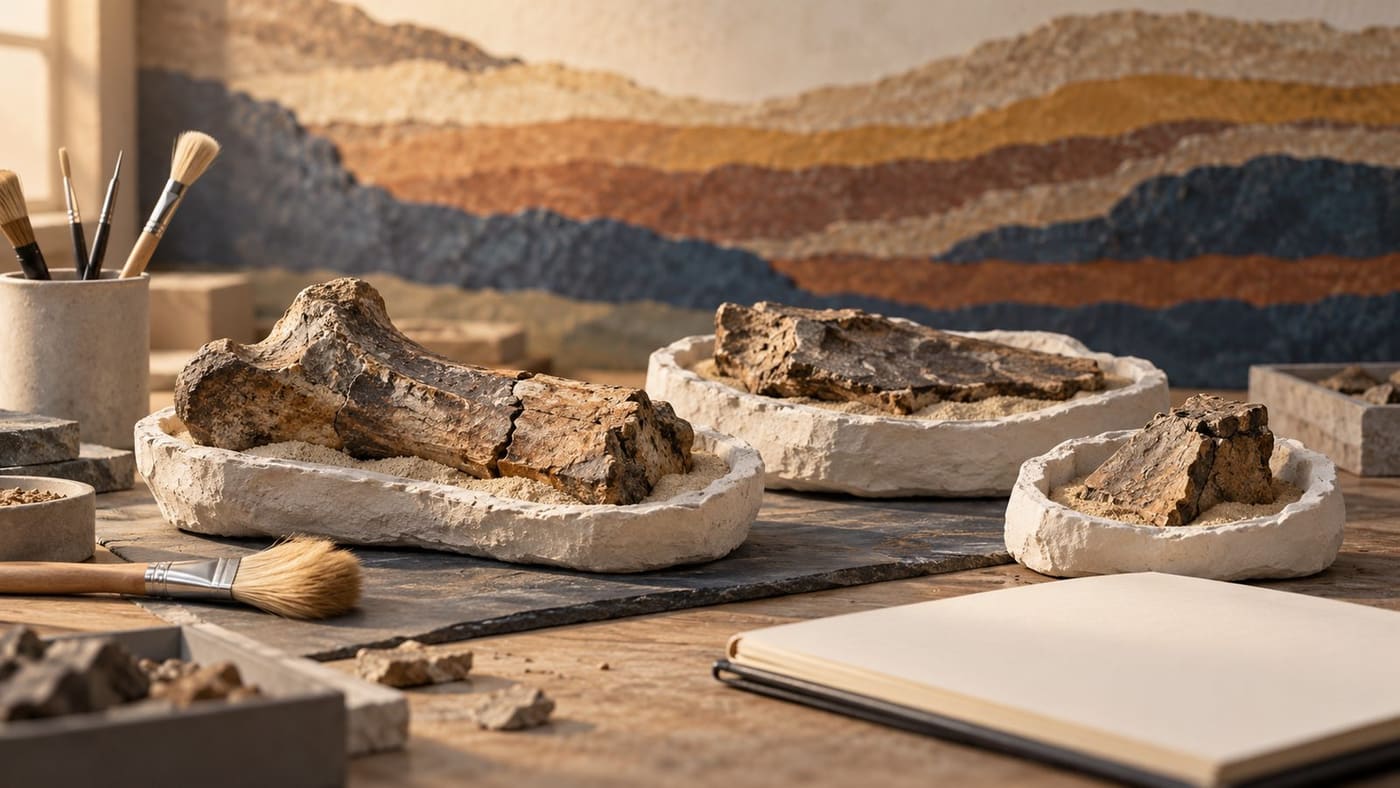
The same discipline applies to an illustrated article such as this one. A conceptual image can introduce the topic without documenting a real specimen. Readers should be able to recognise that boundary immediately, instead of having to infer it from the style of the picture.
Conclusion
Frick offers a way to connect local discoveries with the patient work of interpreting fossils. Read the period and specimen information, distinguish observations from explanations, and treat reconstructions as presentations built from evidence. For a visit, check the museum and outdoor arrangements separately. The most rewarding question is often not simply how large a dinosaur was, but how we know what we are being told about it.
Sources and research note
Sources were checked on 26 October 2026. Museum pages supply collection, research and visitor information; the University of Zurich's 2020 release is a historical case study. The current quarry-change report is attributed to SRF and was not independently confirmed through a site inspection. No interview, visit, booking or special access was conducted for this guide. The observation exercises are original editorial suggestions.
The original AI-generated conceptual illustration depicts imagined fossil-like fragments, tools and a notebook on a preparation bench. It is not a photograph of Frick, a real specimen or an anatomical reconstruction. Limited web-search similarity checking does not constitute a comprehensive plagiarism scan or a guarantee of uniqueness.