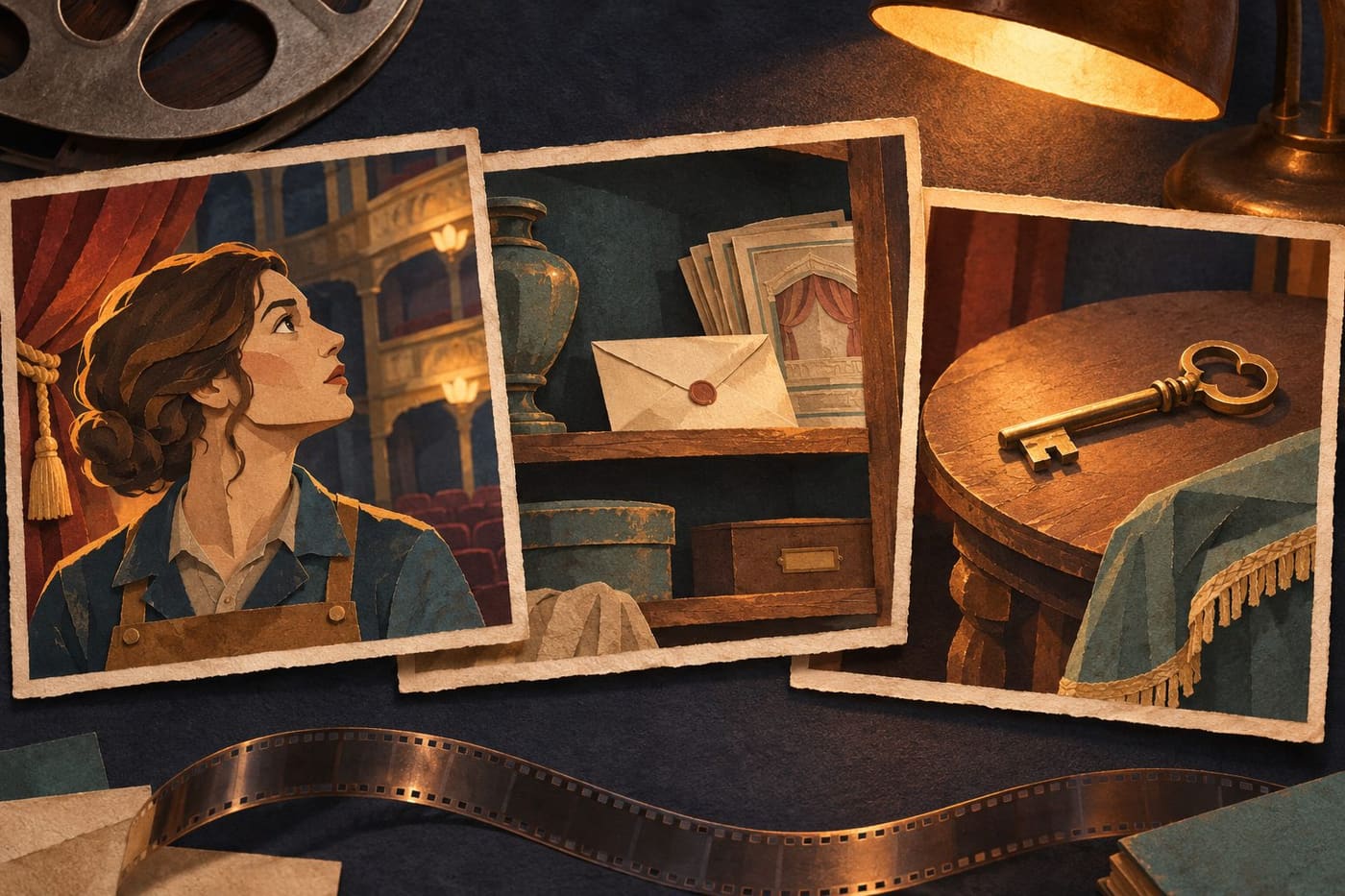
A character turns toward the edge of the frame. The next shot shows a sealed envelope on a shelf. Even without dialogue, you may understand that the character has noticed the envelope. That connection is partly built by the edit: one image supplies a look, another supplies a possible object of that look.
This is a useful place to begin watching continuity editing. Instead of treating every cut as a missing piece of footage, ask what relationship the two shots invite you to construct. Direction, height, distance, timing and the surrounding scene can make that relationship clear, uncertain or deliberately misleading. The fictional examples below offer a way to examine those choices without needing to memorize a film's plot.
Start with the look and the following image
Columbia University's Film Language Glossary defines an eye-line match as a continuity-editing method that links a character's look in one shot to an object in another. The character and object need not appear together in either of those two images. The cut creates a suggested connection across the space between them.
Imagine an original scene set in a closed community theatre. Mara, the caretaker, stands by a doorway. In a medium shot she stops polishing a key and looks toward a shelf. A closer shot then reveals an envelope among folded programmes. Return to Mara and show her putting the key down. Those three images can make the envelope seem important before anyone opens it.
The connection remains an interpretation of the sequence. A shot of the envelope alone establishes that it is there within the film's presentation. The preceding look encourages us to connect it to Mara's attention. Her next action can strengthen that reading, but the edit does not turn the sequence into a literal record of one uninterrupted view.
On a first viewing, notice the moment your understanding changes. Did you identify the envelope as her target immediately? Did the next reaction settle the matter? Asking that small question is more useful than counting how many close-ups appear. It identifies what the cut contributes to the scene's information.
Separate screen direction from a floor plan
The left and right edges of an image belong to the screen. The locations of a doorway, shelf and actor belong to the imagined room. A cut has to help the audience relate those two arrangements. A character looking right in one composition is a directional cue, rather than a complete map of the set.
Columbia's explanation of the 180-degree convention describes keeping cameras on one side of an axis of action so that screen positions and opposing looks remain consistent. Crossing that axis can make positions appear reversed. The glossary also discusses purposeful departures from the convention; it is a storytelling practice, not a law of physical space.
For the theatre exercise, draw Mara and the shelf as two points on paper. Draw a line between them. Now place two imaginary cameras on the same side of that line, one facing Mara and the other facing the shelf. Compare the resulting views before moving a camera across the line. This sketch helps explain why a change of camera position can change apparent direction.
Do not use the sketch as a promise that every real scene uses only two points or two camera positions. People move, new objects become relevant and compositions can establish a different relationship. Its purpose is to isolate one problem: whether the next view supports the spatial inference invited by the previous look.
Check the height as well as the side
Suppose Mara lifts her eyes above her usual forward gaze. The next image shows the envelope on a high shelf. That pairing gives the look a plausible vertical destination in our invented scene. If the next image instead shows an object near the floor, the audience may need another cue to understand the relationship.
Try a second version in which she looks down at a scuffed floorboard. Cut to the floorboard, then to her hand lowering the key. The meaning differs even if her facial expression is unchanged. The cut directs attention toward a place where something may be hidden, rather than toward the visible envelope.
Height alone cannot establish a precise camera position or tell us the dimensions of the room. The viewer combines the look with other information, including earlier views and later action. A high-angle image of an object is not automatically a character's exact optical viewpoint. The sequence needs to establish whose attention or perspective it represents.
When discussing a scene, describe the evidence before naming the intention. You might say that Mara looks upward and the cut reveals the shelf, making the envelope a likely target of her attention. That description leaves room for an alternative interpretation if a later shot reveals another person standing beside it.
Watch what the edit withholds
The same fictional ingredients can support a small surprise. Show Mara looking toward the shelf, then show the envelope, then show her hesitating. A viewer might infer that she wants to read it. A later wide shot could reveal that she was watching a leaking pipe above the shelf and worrying about water damage.
That is a proposed exercise, not an account of an existing film. It demonstrates why an apparently clear eye-line connection can still leave room for withheld information. The later image changes how we interpret the earlier arrangement without requiring the envelope to disappear or the caretaker to move impossibly.
Compare a version that includes the pipe from the beginning. Now the hesitation may read as a practical decision about protecting the programmes. The difference lies in the timing of the information. The object shot can guide a viewer toward a question while leaving the final answer available for a later moment.
A useful viewing note separates observation from inference: look toward shelf; envelope shown; hesitation; pipe revealed. Then write the interpretation underneath. This protects your account from turning a tentative inference into something the film explicitly states. It also makes a discussion of suspense more precise than saying that the editing simply feels mysterious.
Distinguish an eye-line connection from a reaction shot
A look toward an object and a reaction to information are related possibilities, but they answer different questions. In the theatre example, the shelf shot helps identify what Mara might be attending to. Her expression afterward can suggest how she responds. Neither function requires every sequence to use the same three-shot pattern.
Try omitting the return to her face. End on the unopened envelope and move to another scene. The audience is left with the object and a question. Now restore the reaction but make her smile. Finally, imagine a neutral expression and a long pause before she resumes polishing. These are alternative creative choices, not rules predicting one universal audience response.
The distinction also helps when two people are present. If another caretaker speaks and the cut shows Mara listening, the image may invite us to watch her response to the speech. It need not establish a new object of sight. What matters is the relation made available by the sequence, rather than the fact that a face fills the frame.
For a closer comparison, keep a short record of what changes between your imagined versions. Changing the object, changing the reaction and changing the duration are separate interventions. If you change all three at once, it becomes harder to explain which choice produced the interpretation you are describing.
Remember that usable connections begin during filming
Continuity work is not limited to discovering errors after a film is finished. The Harry Ransom Center's account of a script supervisor's annotated script describes records of takes, framing, action and costume details. Its archive example shows how recorded material and the shots ultimately selected for the film can differ.
For our invented theatre scene, a simple continuity note could record Mara's starting position, the key in her right hand, the direction of the shelf and whether she has already set the key down. These details would help someone compare alternate takes. They do not decide the scene's emotional emphasis or replace the editor's choice of performance.
Imagine one take in which Mara lowers the key before looking and another in which she lowers it afterward. Both performances could be useful. Combining pieces without noticing the difference might make the movement confusing. Alternatively, selecting a consistent pair could preserve the action while allowing the cut to emphasize the envelope.
A viewer cannot reliably identify the production cause of a mismatch from the final image alone. A difference might reflect a deliberate choice, unavailable coverage or another circumstance. It is reasonable to describe the visible change. Assigning blame to a particular crew member requires evidence beyond the two shots on the screen.
Give the editor credit for selection and timing
ScreenSkills describes a picture editor's work as assembling material that often arrives outside story order and refining scenes with the director. Its account emphasizes story, performance and communication as well as technical organization. An edit is therefore more than a mechanical join between two camera files.
In our example, the available footage might contain several looks of different lengths. One begins as a distraction; another seems like a deliberate search. The editor's selection changes the possible reading before the shelf image even appears. Holding the object shot longer can also give viewers more opportunity to notice details, although it does not guarantee that everyone notices the same thing.
You can explore that difference without making claims about a real production. Read a three-line description aloud: Mara looks; the envelope appears; Mara reaches for it. Then insert a pause after the second line. The pause creates room for expectation in the exercise. It is a rough demonstration of information timing, not a substitute for studying an actual moving image.
Avoid equating rapid cutting with skill or a long unbroken shot with the absence of construction. Each approach can organize attention differently. The more useful question for this scene is whether the selected images make Mara's discovery, uncertainty or decision legible in the way the story needs.
Use sound as another clue without confusing the roles
A sound can direct attention before an object appears. Suppose a small tapping begins while Mara studies the key. She looks up and the next shot shows rain striking the leaking pipe. Here the sound, look and revealed object work together in the invented sequence. Removing the sound would change the available clues.
That does not mean the sound was necessarily captured during the same take as the image. Our earlier guide to why movie footsteps are recorded again examines a different part of constructing a film's sound. Keep the story connection separate from an unsupported guess about how a particular recording was made.
Try watching a short scene normally before using any viewing controls. On a later pass, if your player permits it, compare the images with the sound lowered. The exercise can reveal which clues come from the visual sequence. It cannot prove what every other viewer understood, and it should not replace the full audiovisual version when discussing the finished scene.
Make any accessibility needs part of the exercise. Captions and audio description may provide information through different channels. Record which version you used, especially if discussing whether a detail was easy to identify. Your viewing conditions are relevant evidence about your interpretation, rather than a measure of another person's attentiveness.
End with a specific account of the connection
A short viewing analysis can answer four questions in ordinary language. Who looks? What appears after the cut? Which spatial and timing cues connect the images? What remains uncertain until a later shot? Those questions provide a clear account without turning a scene into a vocabulary test.
Columbia's broader editing overview places continuity editing within a wider range of ways to organize shots, time and meaning. The approach examined here is one convention among those possibilities. A film may make the connection effortless, draw attention to it or invite the audience to reconsider it.
For the theatre scene, the most precise conclusion might be that an upward look, a shelf image and a subsequent reach make the envelope a plausible focus of Mara's attention. If the pipe is revealed later, the description can explain the revised interpretation. It does not need to declare the earlier cut either invisible perfection or a mistake.
Learning to notice an eye-line match changes a small moment of viewing into a useful question about storytelling. The cut can place an object in a character's attention while leaving it outside the character's original frame. Following that connection, and checking how the next shot develops it, shows how a film builds space and expectation from separate images.
Sources consulted 5 November 2026. The theatre scene, characters, alternate edits and viewing exercises are original hypothetical examples. No particular film's production decisions or universal audience reactions are asserted.