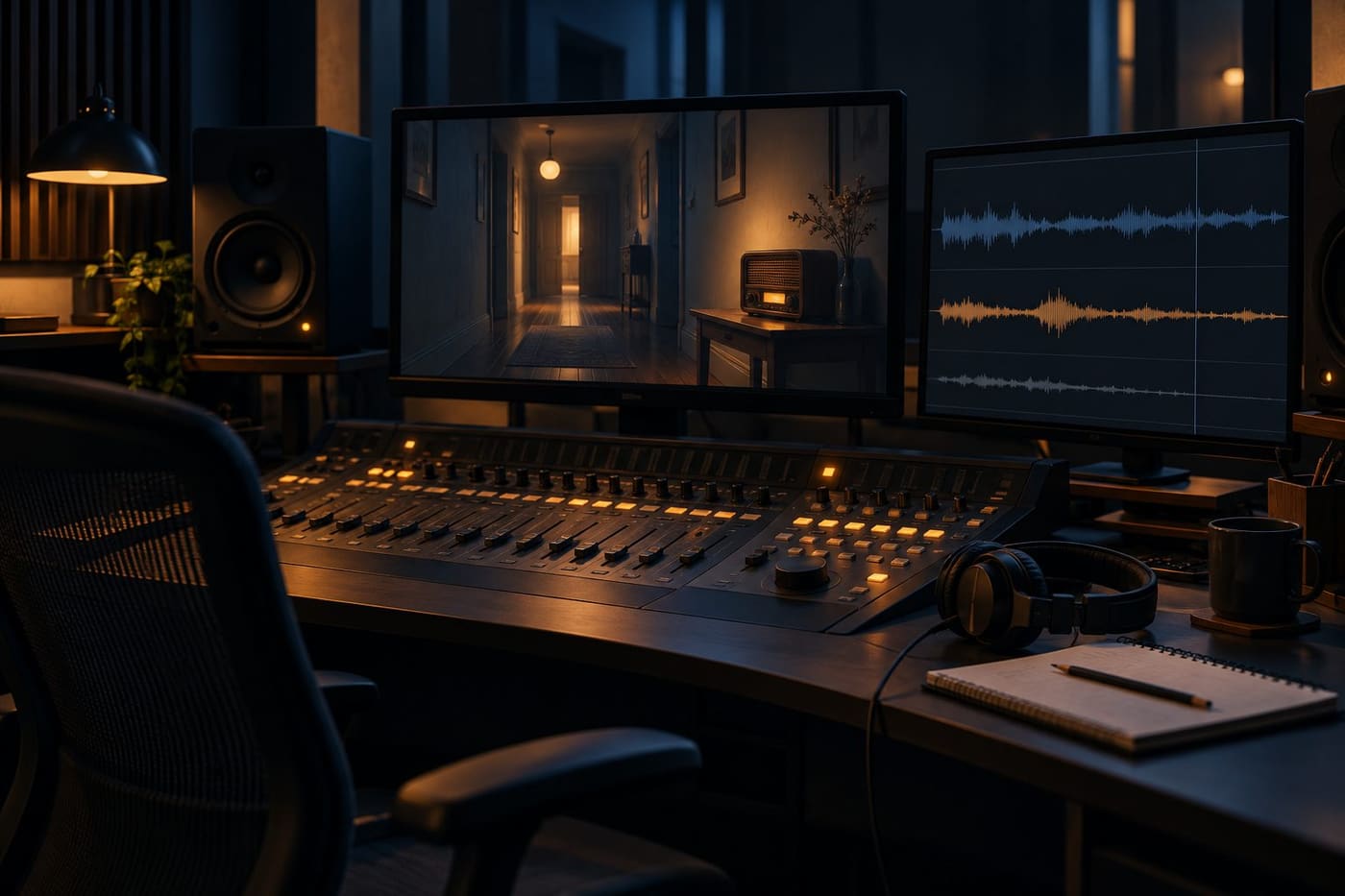
A door closes somewhere beyond the edge of a shot. A character stops writing and looks towards the hallway. You have not seen the door, but the sound has already suggested a space beyond the image and given the character a reason to react. Film sound can do that without becoming louder, more elaborate or easier to identify as a technical achievement.
One useful distinction is between where a sound belongs in the story and how the filmmakers produced it. These are different questions. A footstep recreated after filming can still represent a footstep in the character's world. Music recorded by real musicians can accompany a scene without being music that its characters hear. Keeping those questions separate makes a soundtrack easier to discuss.
The examples in this guide are invented scenes, not descriptions of a film we claim to have watched or made. They offer a small vocabulary for noticing sound and explaining an interpretation with evidence. You do not need to identify every recording technique or buy special equipment to make the distinction useful.
The story world is the first question
Columbia University's Film Language Glossary defines diegetic sound through its origin in the film's narrative world. Its companion entry describes non-diegetic sound as originating outside that world. The terms describe a relationship with the story, rather than dividing sounds into real and artificial recordings.
Imagine a fictional scene in a closed bookshop. A worker folds a paper bag, a clock ticks and a delivery driver calls through the door. If these sounds are presented as events within that setting, they belong to the story world. Their source need not occupy the centre of the picture or even be visible in the current shot.
Now imagine a sustained musical note added for the audience while the worker notices an envelope. If the scene presents no musical source within its world, you might understand that note as non-diegetic accompaniment. The distinction is not that music always belongs outside the story. It depends on how this particular scene presents the music's source.
Offscreen does not mean outside the story
Return to the unseen door. The image may show only a desk and the person sitting at it, while the sound suggests someone entering the hallway. A sound can belong to the story without its source appearing in the shot. The camera's frame is a boundary of the image, not necessarily the boundary of the imagined location.
A useful note would say that a closing door is heard before its source is shown, followed by the character's glance towards the hall. That records the available cues. Calling the sound non-diegetic solely because you cannot see the door would confuse two different ideas: whether the source is onscreen and whether it belongs to the narrative world.
There can still be uncertainty. A strange sound may not yet have an identifiable source, and a film may deliberately delay the answer. You can write that the source remains unclear at this point. A vocabulary should help you describe uncertainty precisely, rather than force an immediate label onto an intentionally ambiguous moment.
Music needs the same source question
In another invented version of the bookshop scene, a small radio plays behind the counter. The worker reaches across and lowers its volume before answering the driver. That action provides evidence that the music is part of the scene's world. The audience and the worker are being presented as hearing a source within the same setting.
Compare a version in which the radio is absent and a melody accompanies a close-up of the envelope. The music may be functioning as a score heard by the audience. Describe the evidence rather than making music itself the deciding factor. A radio can play music within a story, while an orchestral passage can exist outside it.
A soundtrack may also complicate the boundary as a scene develops. Do not assume the first interpretation must remain correct for an entire sequence. If later information changes your understanding of a sound, note when that happens. The interesting observation may be how the film manages the reveal, rather than whether you guessed the category immediately.
Recording history is a separate investigation
Hearing a convincing footstep does not establish that it was captured during the photographed performance. Production methods require evidence beyond the finished effect. In a first-hand interview with the sound editors of A Quiet Place, The Credits records their account of extensive post-production work, including Foley footsteps and small clothing movements. That is evidence about that production, not a universal claim about every film.
The distinction matters because viewers sometimes call a sound non-diegetic when they mean it was added later. A recreated step can still stand for a character stepping on a floor. Its represented source is inside the story even if its recorded source was a different performance made during post-production. The two descriptions can both be accurate.
If you want to discuss how a real soundtrack was made, look for credited filmmakers' interviews, production material or other reliable first-hand documentation. If you have only listened to the finished film, say what you noticed there. Do not invent a studio technique because it seems like a plausible explanation for an effective sound.
Follow the order in which the audience learns things
Consider a fictional visitor waiting at a small station. The picture holds on a closed ticket window. A rolling suitcase is heard, then a person carrying one enters the frame. Before the person appears, the sound gives the audience an expectation. The later image can confirm or complicate what the listener imagined.
Write the order clearly: sound first, visible source later. Then describe the effect as your interpretation. Perhaps the unseen approach makes the otherwise empty space feel occupied. Perhaps it directs attention towards an entrance. Those are more useful observations than saying that the sound makes the scene better without explaining what changed for the viewer.
Try a different invented version. A suitcase appears, but the expected rolling sound is absent while another sound dominates. That does not automatically mean the film made a mistake. It gives you another question about attention and emphasis. Keep the observation smaller than the theory until the scene supports it: what is present, what is reduced and what the image asks you to follow.
Describe relative emphasis without claiming a measurement
A soundtrack can make a small object seem important by bringing its sound forward in relation to other sounds. In the fictional bookshop, the paper bag might be unobtrusive during a conversation but conspicuous after the dialogue stops. You can describe that change without claiming the audio level rose by a measured number of decibels.
Use relative language tied to the passage: the paper sound becomes easier to notice after the speech ends, or the clock remains audible underneath the conversation. Do not report a technical measurement from an impression. Similarly, quiet is not necessarily the complete absence of every sound. Say which elements remain rather than assuming the soundtrack has reached literal silence.
Playback conditions also belong in your notes when they affect what you can observe. A phone speaker in a busy room and a quiet viewing space may reveal different details. You do not need to turn the volume to an uncomfortable level to investigate a faint sound. If a detail is unclear, leave it uncertain and revisit it under suitable conditions if useful.
Make an observation and interpretation pair
A short two-part note can keep a discussion grounded. First describe the audible event and its relationship to the image. Then explain what you think it does. For example: a delivery bell is heard while the worker remains turned away; the sound lets the audience anticipate an interruption before the worker responds.
The first part is an observation within the invented scene. The second is an interpretation that another viewer could discuss. It is not a claim about the director's private intention. If a filmmaker has explained an intention in a reliable interview, attribute it. Otherwise, use language that makes clear you are offering a reading supported by the scene.
This also helps when viewers disagree. One person may find an unseen sound reassuring because it suggests company, while another finds it unsettling because its source is unknown. Compare the timing, image and other cues each person noticed. You do not have to settle every response into one officially correct emotion to have a precise conversation.
Use a small listening exercise rather than a catalogue of terms
Choose a short passage from a film you can lawfully access and first watch it normally. Then, if useful, revisit it with one question: which sounds seem to come from the story's world, and what evidence identifies them? Keep the task limited enough that you can remember the sequence without turning the evening into transcription work.
On another pass, focus on one relationship, such as a source being revealed after it is heard or music changing when a character touches a radio. Record the moment in your own words. Do not distribute copied film clips or extracted soundtracks as part of the exercise without the necessary rights. Notes can describe a pattern without reproducing the audiovisual material.
Our guide to watching one scene again covers the broader habit of linking an interpretation to specific evidence. Here, the narrower aim is to separate a sound's place in the narrative from assumptions about its production. A few well-supported observations are more useful than a long list of technical labels used uncertainly.
Keep access features and the soundtrack distinct
If captions or audio description help you follow a film, use the edition and features that work for you. A caption identifying a distant bell can be useful information, while an audio-description track has its own purpose. Record which version you used when making detailed notes, particularly if the available tracks differ.
Do not treat an access feature as a flaw in the film or assume that every viewer will encounter the same soundtrack in the same way. Equally, a caption label does not establish exactly how a sound was recorded. It can identify a represented event without documenting the studio process behind it. Those are still separate kinds of evidence.
If you compare editions or language tracks, check which track is actually playing before attributing a difference to the original mix. This article does not claim to have tested specific releases or access tools. The practical point is to name the version you observed, so that another reader understands the scope of your comments.
A short model paragraph about an invented scene
Here is one way to bring the distinctions together: In the bookshop scene, a bell sounds while the camera stays on the worker's hands. The worker looks towards the entrance before the driver appears. The bell seems to belong to the shop's world, although its source is initially outside the frame. Its timing makes the interruption audible before the image reveals the visitor.
That paragraph makes no claim about the bell's recording session or the filmmaker's undocumented intention. It names the sound, its timing and a possible effect. If the next shot showed a different source, you could revise the interpretation without discarding the original observation that the sound preceded the visible arrival.
You could add a separate production sentence only if reliable documentation supported it. Keeping those layers distinct gives a reader a fair chance to assess the argument. It also respects the difference between attentive viewing and access to the people, recordings and decisions that created the soundtrack.
Conclusion: listen for the relationship
Diegetic and non-diegetic describe where sound belongs relative to the narrative world. Onscreen and offscreen concern what the image shows. Recording during filming or in post-production concerns how the track was made. These questions connect, but one answer does not automatically supply the others.
Begin with a small event you can describe clearly: an unseen door, a radio adjustment or a sound that arrives before its source. Explain what the scene supports and leave room for uncertainty. That approach makes film sound easier to discuss while preserving the pleasure of watching a story unfold.
Sources and research note
Research checked on 2 November 2026 using Columbia University's glossary entries for sound within the narrative world and sound outside the narrative world, plus The Credits' 2019 first-hand sound-editor interview. All bookshop and station examples are original fictional teaching scenes. No film clip, soundtrack or third-party production image was downloaded or reused. No personal production experience, actual scene-viewing session or audio measurement is claimed. The image is an original conceptual studio illustration.