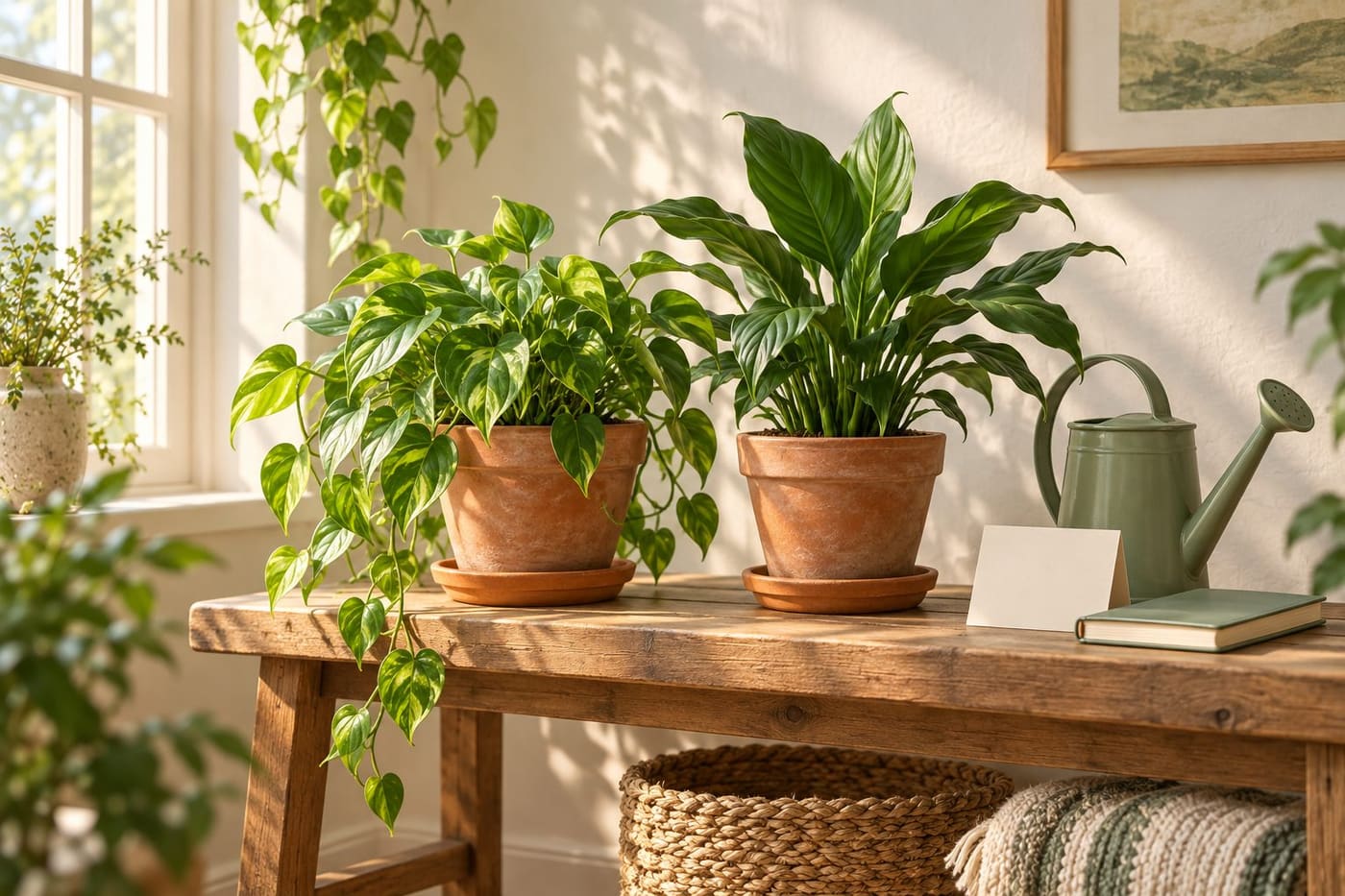
A reminder to check the plants can be useful. A reminder that automatically means pour water into every pot is a different thing. In a room with several houseplants, the plants, containers and positions may differ enough that one identical action is a poor substitute for paying attention. The aim is a routine that makes checking easy while leaving room for the answer to be not yet.
That need not turn a pleasant corner of the home into a laboratory. For a small collection, the most useful starting points are knowing which plant you have, understanding its care guidance and seeing how its pot actually drains. A simple routine should help you notice those things rather than make you feel responsible for completing a complicated daily chart.
This guide was researched on 1 November 2026 using horticultural guidance from the Royal Horticultural Society and university extension services. It offers a general approach to organising care, not a prescription for every species or a diagnosis of a plant from a photograph. Examples are invented, and the accompanying illustration is conceptual.
Begin with the plant's identity and requirements
The RHS houseplant growing guide recommends checking a plant's growing requirements and whether the home can provide them. Its watering advice also distinguishes checking need from watering routinely. Those two ideas belong together: the question is not simply whether a pot looks due for attention, but what this plant needs in these conditions.
Keep the original label if you have it. If the identity is uncertain, avoid replacing uncertainty with a confident care schedule copied from a vaguely similar photograph. A useful first task may be to establish what the plant is through a reliable identification route before adopting detailed instructions.
A label saying easy care is a starting description, not a complete watering plan. Look for guidance about the identified plant rather than expecting an attractive display card to answer every question. You can keep a short note or bookmark to the relevant source; there is no need to remember every instruction from memory.
Look at the container that holds the roots
A decorative outer container can make it difficult to see what is happening around the pot inside. Before deciding how to organise watering, understand which part holds the growing medium and where excess water can leave. A beautiful pot is still part of the care arrangement, not merely part of the room's colour scheme.
Illinois Extension's houseplant container guidance stresses adequate drainage and explains the risk of waterlogged conditions in containers without drainage holes. It also warns against putting a small plant in an unnecessarily large pot. These are reasons to check the actual setup rather than assume that adding more growing medium always makes care easier.
This article does not give a universal repotting size or tell you to drill a container. If the existing setup is unclear, identify the pot and plant requirements before making an irreversible change. For an ordinary watering routine, knowing how the current pot drains is more immediately useful than buying another decorative container.
Schedule a check, then make a separate decision
A recurring check can fit naturally beside another household task. The important wording is check the plants, rather than water all plants. Checking gives you a chance to notice whether a particular pot needs attention, while a fixed pouring instruction bypasses that decision.
Imagine an invented household with two plants. One sits near a bright window; the other occupies a different position and has different care requirements. The resident checks both during the same visit but does not assume that both need the same treatment. The routine is shared; the decision remains individual.
If reminders help, name the task so another person understands this distinction. Plant check is clearer than plant day if plant day has become shorthand for watering everything. A reminder should bring your attention to the plants, not announce a conclusion before you have looked at them. Skipping unnecessary watering can be the correct completion of the check.
Use the care guidance to interpret what you observe
Look at the growing medium and the plant in the way appropriate to the identified species and pot. Keep the guidance nearby while learning, rather than treating a single sign as a complete diagnosis. A dry-looking surface, a change in weight or a leaf symptom needs context.
The RHS guide to leaf damage on houseplants describes several kinds of damage and a range of possible growing-condition problems. It also notes that older leaves can naturally brown and die as a healthy plant matures. One discoloured leaf is therefore not enough to prescribe a particular remedy for every plant.
Write down what you can actually see if a problem is developing: which leaves changed, when you first noticed it and whether the pot's position or care recently changed. That gives a knowledgeable helper a clearer starting point than the claim that the plant must be thirsty. Do not add water simply to feel that you have done something.
Include drainage in the watering task
Where the plant's guidance calls for watering, plan the whole task, including what happens afterwards. The RHS explains allowing pots to drain and emptying water-filled saucers. Watering is not complete merely because the watering can has been put back on its shelf.
A practical arrangement might be a suitable stable place where a manageable pot can drain without damaging household surfaces. Use a setup that works for your space and ability to handle the plant safely. A heavy pot does not need to be carried across the home just because an online example uses a sink.
Check the outer container or saucer as part of the routine where relevant. The purpose is to avoid losing track of the water after it leaves the growing medium. This article does not recommend a fixed soaking period, a universal volume or a special household mixture. Follow the requirements of the plant and pot instead of improvising an extra treatment.
Do not turn a seasonal headline into a local rule
Horticultural advice often describes a particular climate or season. The University of Minnesota Extension's winter houseplant guidance discusses indoor conditions, drainage and repotting in its context. A reader in another region should not assume that the word winter describes the same room conditions at home.
The practical question is what has changed where the plant actually stands. Has the room arrangement changed? Is the plant now in a different position? Has somebody begun using a different container or care method? Record a relevant change rather than assuming the calendar alone explains the plant's behaviour.
Seasonal guidance can help you ask those questions, but it should not erase species-specific requirements. Avoid rewriting a regional article into a rigid worldwide instruction such as every plant now needs half as much water. A general article is most useful when its location and scope remain visible to the reader.
A care handover should leave less room for guessing
If someone else will care for the plants, show them the actual setup before you leave if possible. Point out which pot matches which note and where the drainage arrangement belongs. A written instruction is easier to follow when the person has seen what it refers to.
A short handover might identify the plant, its position, the relevant care source, how to check need and what to do after watering when required. Include any task the helper should leave to you. That is more useful than a broad instruction to give everything a generous drink while you are away.
Keep the request proportionate. Someone checking two familiar plants should not need to complete a long form after every visit. A brief note of an unusual change or an action taken may be enough. The aim is to prevent a second person from watering again because the first person's action was invisible, rather than to create paperwork for its own sake.
A worked example of a routine becoming clearer
Consider an invented pair of housemates, Farah and Ben. Farah normally looks after two established plants. Ben agrees to check them while she is away. Their first instruction is simply water on Sunday. When they review it together, they realise it does not say which plant, how to assess need or what happens to water collected in the outer pot.
They replace the instruction with two plant-specific care notes based on guidance Farah has already checked for those plants. Ben can match each note to the actual pot. The Sunday reminder becomes a check rather than an automatic watering order. They also agree that an unfamiliar symptom should be recorded and discussed through their usual contact arrangement rather than treated with an improvised product.
In the example's ending, Ben checks the plants, follows the relevant instructions where watering is needed and notes the action so Farah does not repeat it on returning. This is a fictional handover, not evidence of a plant-care trial or a guarantee that the plants improved. The improvement demonstrated is clarity in the shared task: neither person needs to guess what the other has done.
Keep new purchases separate from problem solving
A struggling plant can make a shelf of attractive accessories look like a solution. Before buying a device, another pot or a product, write down the question it would answer. If you do not know the plant's identity or whether the existing pot drains, a purchase may leave the main uncertainty unchanged.
Start with the information already available: the label, a relevant horticultural source and an inspection of the actual arrangement. A tool may have a useful role, but the article's method does not depend on buying one. A notebook is optional too; a short, accessible note can do the same organisational job for a small collection.
Do not apply a fertiliser, pesticide or household remedy merely because it is described as a plant booster. This guide supplies no treatment recipe. A problem that remains unclear should be investigated through appropriate plant-specific guidance rather than answered with several simultaneous changes whose effects become impossible to separate.
Make the routine fit the people using the room
A plant-care arrangement also has to work as part of a lived-in home. Keep the place for checking or draining stable and practical, with household surfaces protected appropriately. Position notes where the person doing the task can find them, rather than hiding the only instructions in someone else's private app.
If a pot is awkward to reach or move, revise the care arrangement rather than expecting another household member to manage it in the same way. The decorative layout should not make ordinary care an unnecessarily difficult task. You can ask what would make the existing routine easier before expanding the collection.
For households reorganising a room or moving home, our guide to preparing the first evening before packing the last box offers a related approach to keeping essential tasks usable. Plant care benefits from the same ordinary clarity: the right information and equipment should be available when needed, with no assumption that everyone remembers the previous arrangement.
Review what has changed, without promising a cure
If you adjust the routine, note the specific change and observe what happens over an appropriate period for the plant. Changing the position, pot, watering approach and several products at once makes it harder to understand which change mattered. Avoid declaring success from a single attractive photograph taken immediately afterwards.
A useful review might conclude that the handover is clearer or that people are no longer duplicating watering. Those are changes you can establish from the household's actions. Whether a plant has a disease, needs repotting or is recovering is a different question that requires the relevant horticultural evidence.
Allow a modest conclusion. We now know which plant was checked and what was done is useful progress even when a symptom remains unresolved. A reliable routine should make unresolved questions easier to identify, rather than cover them with a promise that every plant will thrive once the calendar is followed.
Conclusion
Build a houseplant routine around identification, relevant care guidance and the actual pot. Use reminders to prompt a check, then decide what that plant needs. When watering is appropriate, include drainage and the final condition of the saucer or outer container in the task.
Keep shared instructions short and specific, and read seasonal advice in its original context. You do not need a complicated tracking system or a new set of accessories to begin. A little clarity about the plant, the setting and the last action is a practical foundation for more attentive care.
Sources and research note
Research date: 1 November 2026. Primary horticultural guidance linked above comprises the RHS houseplant growing and leaf-damage guides, Illinois Extension's container guidance and University of Minnesota Extension's winter houseplant article. Relevant sections were read for brief attributed principles. Different pages give different detailed repotting advice; this article deliberately does not invent one universal pot-size or watering interval.
The housemates and their care handover are invented teaching examples, not interviews or evidence of measured plant recovery. The original conceptual illustration does not identify a species or prescribe treatment. No source photographs are reproduced, no household products are recommended and no plant-health diagnosis is made from the artwork.