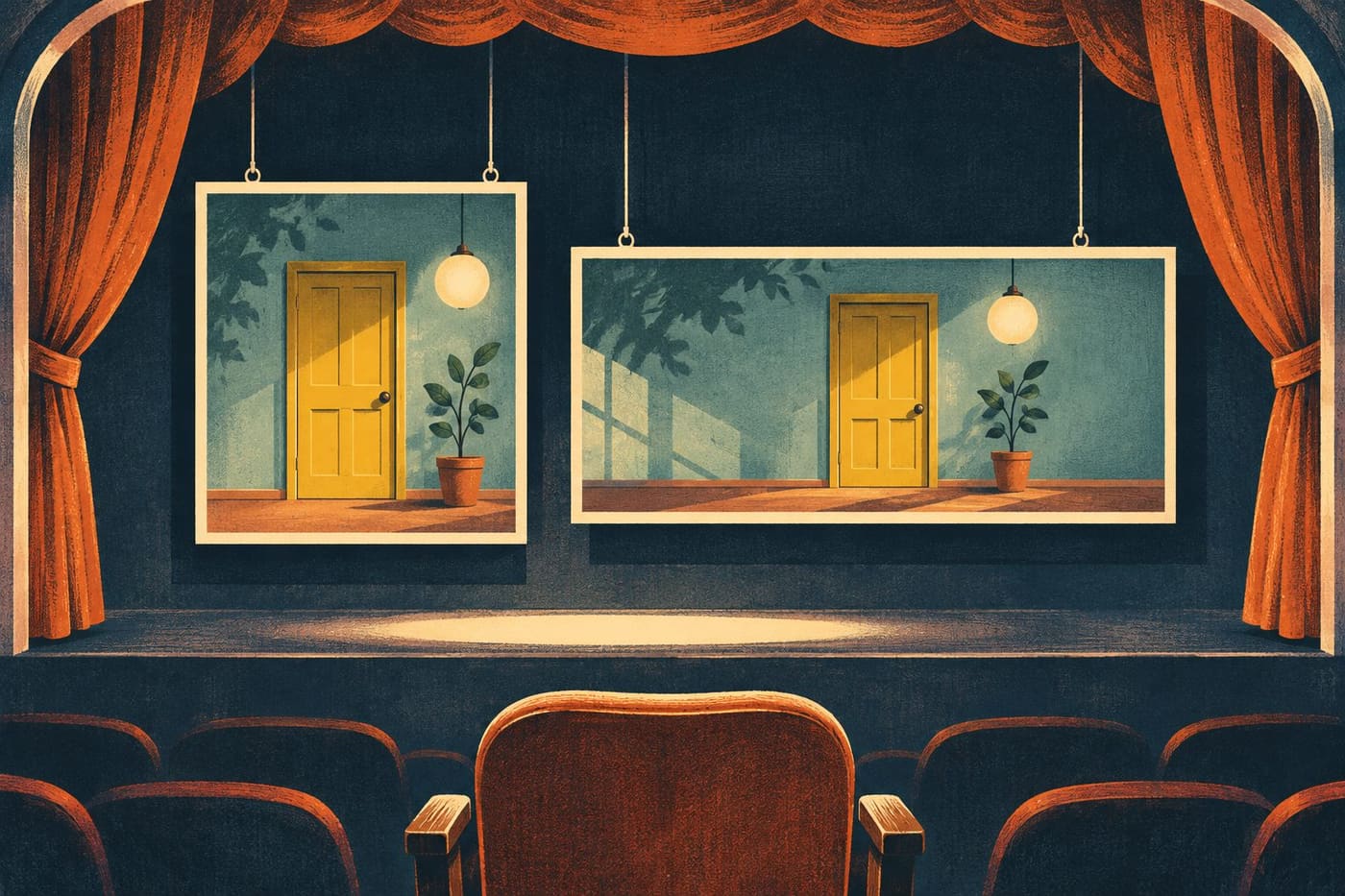
A film can occupy less than the whole television screen without anything being missing from its picture. The empty area around an image and the content inside the image are different things. Filling every corner of a display can therefore be a poor first goal when you are trying to see a film's composition clearly.
Begin with the shape of the picture. Then ask how that picture has been placed within the available screen. A border may be part of a presentation that preserves the image's proportions. A zoom that removes the border may also remove part of the scene. Those are different outcomes, even if the second one initially looks bigger.
This guide explains selected aspect-ratio concepts through original, invented viewing and arithmetic examples. No film screening, television, streaming service or player was tested for this article. The examples are not reports about a particular release, and the illustration is conceptual artwork rather than a frame from an existing film.
Read the ratio as width in relation to height
The National Film and Sound Archive of Australia's Australian Screen explanation defines aspect ratio through the relationship between a picture's width and height. A ratio describes a shape. It does not, by itself, tell you the size of the television, the quality of the transfer or how interesting a film will be.
For an invented drawing, a rectangle 16 centimetres wide and nine centimetres high has a 16:9 ratio. A rectangle 32 centimetres wide and 18 centimetres high has the same ratio. Both dimensions doubled, so the shape remained the same even though the second drawing is larger. Neither measurement describes the diagonal advertised for a television.
A ratio written as 1.85:1 means that width is 1.85 times height. In a purely mathematical model with height 20 units, width would be 37 units. Units cancel when you compare the sides, so centimetres and imaginary drawing units can demonstrate the same relationship. Keep the ordering consistent: reversing width and height describes a different, upright shape.
Separate the image from the display around it
Think of an invented photograph of a doorway placed on a noticeboard. You can retain the whole photograph while leaving board visible around it. You can also enlarge the photograph until it covers the board and then cut off the overhanging parts. Covering the board completely does not prove that the whole photograph remains visible.
The same distinction is useful when discussing a film image and a screen. Record two observations separately: the shape of the visible picture, and the shape of the area that contains it. Do not count the dark border as part of a character's room or treat the television's edge as automatically identical to the intended frame.
For a simple notebook exercise, draw an outer rectangle and a smaller inner rectangle. Mark the inner one as the picture. Describe what lies inside it before discussing the surrounding space. This is an original explanatory exercise, not a technical test or a way to determine an unknown film's intended ratio from memory. Exact presentation information still requires evidence about the specific edition.
Distinguish fitting, cropping and stretching
Microsoft's picture-aspect-ratio documentation distinguishes proportional fitting, cropping and stretching when picture and display shapes differ. In proportional fitting, the picture retains its shape while fitting inside the available area. Cropping excludes some image content. Stretching along one direction changes the proportions of the displayed picture.
Imagine a fictional composition with a person beside a circular clock. If width alone is increased, the circle becomes an oval in this simplified example. If the picture is enlarged proportionally and its edges are cut away, the circle can remain circular while a person near the edge disappears. These changes solve different geometric problems and produce different viewing results.
Describe which change you mean instead of saying only that the picture is larger. A useful observation is, "The clock still looks round, but the doorway at the left is no longer visible." It identifies possible cropping without claiming that a real device has been diagnosed. A differently shaped prop, lens effect or source image would need separate consideration in an actual film.
Understand borders before trying to remove them
Microsoft describes letterboxing with a wider image fitted inside a narrower display shape, leaving horizontal areas above and below. It also discusses pillarboxing for the reverse kind of mismatch, with areas at the sides. These terms explain how pictures can be accommodated without forcing their proportions to match the containing rectangle.
Use an invented 16-by-nine display area and a 4:3 picture fitted to its full height. At a height of nine units, that picture is 12 units wide. Four units of horizontal space remain, or two units on each side if the picture is centred. The side spaces are a consequence of this model's fit, not evidence that the picture has lost four units of original content.
For another model, fit a 2:1 picture across the same 16-unit width. Its height is eight units, leaving one unit vertically, split into half a unit above and below if centred. These deliberately simple numbers illustrate geometry only. They do not identify a film format, reproduce a real television interface or establish whether a particular stream contains additional embedded borders.
Keep the frame's edge in your description
The edge of a composition determines which details are visible together. In an invented scene, put a yellow door at the far left, a seated figure in the centre and an empty chair at the far right. A crop that retains only the centre changes the information available to the viewer, even if the seated figure becomes easier to see.
You might initially describe the wider composition as a person waiting between two possible places of arrival. After the crop, the image might support only the narrower observation that someone is sitting. Those are interpretations of an invented arrangement, not claims that a particular ratio always creates a particular emotion. Performance, editing, lighting and the surrounding story would matter too.
When discussing an actual film, distinguish what you observed from the reason you propose for it. "The second chair is visible throughout this shot" is an observation. "The director wants us to expect another person" is an interpretation requiring support. Aspect ratio gives you a way to discuss the boundaries of a composition without making every visual choice into a universal rule.
Do not use a squarer frame as a date stamp
Ratios have histories, but a picture's shape alone is not a reliable release-date label. The BFI's 2015 selection of modern films using Academy ratio offers examples of filmmakers returning to a comparatively squarer format. Its discussion concerns particular films and choices, rather than a rule that modern filmmaking must always use a broad rectangle.
An invented film made this year could choose a narrow frame. A restored older film could be presented on a very recent screen. The production date, the date of the edition and the shape of the display are separate pieces of information. One does not automatically reveal the others.
Be precise with numbers as well. A 4:3 shape and a 1.37:1 shape are close, but they are not mathematically identical. Australian Screen distinguishes its Academy figure while describing related historical formats. For a specific release, retain the actual stated ratio instead of rounding every relatively square picture to the same label. This guide does not reconstruct the full history of film-format standards.
Check which edition the information describes
The Library of Congress moving-image format recommendations include the original production aspect ratio among their preferred motion-picture characteristics. That institutional preservation context underscores why a release's shape can be meaningful. It is not a guarantee that every commercial edition carries the same presentation or that a viewer can identify the correct version from a thumbnail.
For an invented comparison, label two listings "Edition A" and "Edition B" and record their publisher descriptions separately. If one supplies aspect-ratio information and the other does not, write "not stated" for the second. Do not transfer the first listing's specifications to a different product merely because both display the same film title.
Keep the film title, edition information and source of the specification together. An online image used to advertise a release may have its own crop and should not replace release documentation. This is a method for organising evidence, not an assertion that any currently available disc or service is incorrectly framed. No commercial release was compared in preparing this article.
Keep pixel dimensions and picture shape distinct
Microsoft separately discusses pixel aspect ratio and display aspect ratio. Its documentation explains that pixels need not always be square, so stored pixel dimensions alone do not universally establish the intended displayed shape. That distinction matters when a technical specification and a visible picture seem difficult to reconcile.
In a deliberately limited square-pixel model, a 1,600-by-900 image has a width-to-height ratio of 16:9. A 3,200-by-1,800 image has the same ratio. The second contains more pixel positions, but neither the shared shape nor those dimensions alone establish the quality of a particular film transfer. The source, processing and actual presentation would require additional evidence.
Do not extend that square-pixel exercise to every historical video format. If the material's technical description specifies non-square pixels or a display aperture, preserve that information rather than forcing a simple division to settle the question. This article supplies no encoding recipe, media-file inspection or player-compatibility test. The practical distinction is between describing picture shape and making a broader claim about image quality.
Make a useful viewing note without diagnosing a device
Suppose the fictional viewer Mina notices a dark area above and below a picture. Her first note might record the title, the edition information she actually has, the device and the visible borders. That description is more useful than immediately declaring that the film is broken or that every border must be removed.
If Mina chooses to compare picture modes, she can describe one change at a time and retain the original setting so that the comparison is reversible. The relevant device's genuine instructions are needed for its controls; names and behaviour should not be assumed to be identical across products. For example, Sony's BRAVIA 6 screen guide distinguishes several modes and notes input or format restrictions. That is documentation for its stated product, not an instruction for every television. This guide does not prescribe a universal button sequence or recommend changing a shared venue's projection settings.
Her next observation could focus on a stable feature at the edge of the scene, rather than a moving person who may simply have walked out of view. She should also distinguish her comparison from a definitive judgement about the intended edition. A screenshot or a single unusual shot is not automatically sufficient evidence of a playback fault. When uncertainty remains, preserve it in the note.
For a comparison record, Mina could use four short fields: what stayed visible, what disappeared, what changed shape and what remains unknown. If she cannot compare the same moment reliably, that limitation belongs beside the observation. She should avoid using an unrelated promotional still as a supposedly exact reference for the shot. The exercise becomes useful through the specificity of its evidence, not through the confidence of its verdict. It remains an invented method of note-taking rather than a completed test.
Finish by describing what the presentation preserves
A productive film conversation can begin with three connected statements: the picture is relatively wide or narrow; it has been fitted within a differently shaped display; and its visible edges include particular details. Those statements make the composition discussable without treating screen coverage as the only measure of a successful presentation.
Return to the invented door, clock and chair. Ask whether all three remain visible, whether their proportions have changed and what evidence identifies the intended frame. These are separate questions. Keeping them separate helps you explain a viewing difference without claiming that one ratio makes all films superior or that a larger displayed figure always means a better transfer.
More viewing explainers are available in our Entertainment section. Sources consulted 6 November 2026: the selected Australian Screen, Microsoft, BFI, Library of Congress and Sony pages linked above. All numerical models and viewing scenarios are invented, and no real release or device was tested. Begin with the image's shape, preserve the distinction between its content and its surroundings, and use edition-specific evidence before deciding what should change.