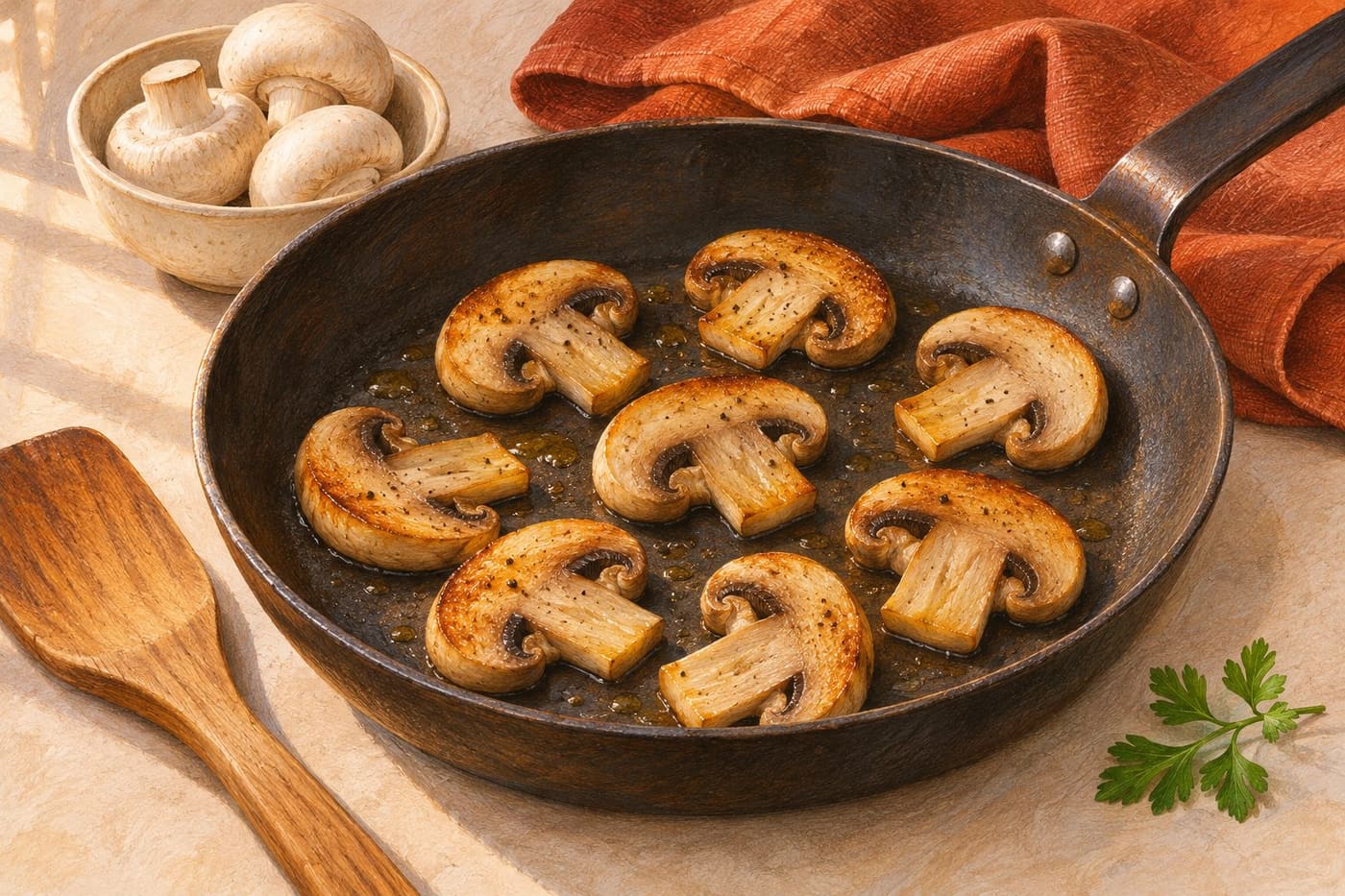
A pan of mushrooms can pass through an unpromising-looking stage: the pieces soften, liquid collects and little seems to be browning. That moment is easy to misread. Adding several more ingredients, turning the burner to its highest setting or pouring in extra oil may complicate a dinner that mainly needs a clearer sequence.
For an uncomplicated starting point, use ordinary shop-bought button or cremini mushrooms and decide what you want them to become. Golden pieces for toast, finely chopped mushrooms for a filling and mushrooms simmered in a sauce are different jobs. This guide concentrates on the first: recognisable pieces with browned surfaces, prepared as one component of a meal.
The approach below combines brief references to published cooking guidance with original planning and troubleshooting examples. It is not a report of a personal kitchen trial, a wild-mushroom identification guide or a promise of one cooking time for every pan. The original illustration is conceptual food art rather than a photograph of a tested batch.
Start by deciding where the mushrooms will go
Before opening the packet, finish one sentence: “These mushrooms are for...” That answer determines how much flexibility you have at the end. A toast topping needs the toast ready near serving time. A bowl of rice needs the rice prepared on its own schedule. A sauce has a separate liquid stage after the mushroom cooking.
For a simple first meal, choose one destination rather than trying to prepare several variations in the same pan. Put out the serving plate and the utensil that will move the mushrooms onto it. If you plan to cook in batches, also set out a clean holding plate before the first batch begins.
Keep the mushrooms separate from additions until you have read the complete recipe you intend to follow. A bowl of pre-mixed mushrooms, chopped onion, garlic and sauce commits every ingredient to the same starting time. Separate bowls leave room to follow a sequence instead.
This is particularly helpful when the mushrooms are the part you are learning. You can see their condition and judge the result without wondering which of several ingredients supplied the liquid or darkened first. Once the basic process feels familiar, a more complicated recipe becomes easier to interpret.
Clean the mushrooms without turning preparation into a ritual
Health Canada's mushroom guidance advises choosing fresh, firm mushrooms, discarding spoiled ones, cleaning hands and equipment, and washing mushrooms only when ready to use them. It allows a gentle wipe or brush, or a rinse under cool running water followed by drying. Water is sufficient; produce cleansers are unnecessary. Source: https://www.canada.ca/en/health-canada/services/food-safety-fruits-vegetables/mushrooms.html
The Mushroom Council similarly describes a brief rinse followed by patting dry as an option and recommends trimming a tough stem. This makes “never let a mushroom touch water” an unhelpful absolute for the ordinary cultivated mushrooms discussed here. Source: https://www.mushroomcouncil.org/all-about-mushrooms/tips-tricks/
Set the cleaned mushrooms on a clean surface before cutting. Keep the unprepared packet away from the board so that you can see which pieces have already been dealt with. The point is a clear preparation sequence, not an elaborate inspection ceremony.
Do not apply these cooking notes to mushrooms collected outdoors or an unidentified specimen. Use mushrooms sold as food from a reliable source, and follow any specific handling instructions on the product. A familiar-looking cap in a drawing or photograph is not an identification method.
Choose a cut that suits the meal
For a topping, slices give you broad visible faces and pieces that sit easily on bread. Halves or quarters make a chunkier result. A fine chop produces a different eating experience and is harder to compare with a photograph showing large browned slices.
Pick one cut for the first attempt and keep it reasonably consistent. This is a practical suggestion for seeing what the method does, not a requirement that every piece have identical dimensions. If a packet contains noticeably different sizes, think about the resulting pieces rather than making the same number of cuts through every mushroom.
Imagine a preparation board with thin fragments at one end and large quarters at the other. Mixing them immediately makes later comparisons less informative. Keeping the groups identifiable lets you decide whether they belong in the same batch or whether you should use a more consistent cut next time.
For a meal where the mushrooms will eventually be chopped, browning large pieces and chopping afterward is another recipe choice, not an automatic improvement. Follow the method you selected. Avoid changing the cut, quantity, fat and pan all at once if the purpose of this attempt is to learn one dependable setup.
Match the amount to the cooking surface
A USDA VegU recipe adapted from the Mushroom Council uses sliced mushrooms in a large skillet and specifies a single layer for browning. Its small-batch example is useful because it attaches the quantity to a method rather than treating a whole packet as one inevitable panful. Source: https://content.govdelivery.com/attachments/USDAAMS/2020/10/13/file_attachments/1569393/vegu-recipe-october-15-simple-sauteed-mushrooms.pdf
Before heating, look at the pan's flat cooking area. A wide rim does not necessarily mean an equally wide base. The relevant space is where the pieces can meet the cooking surface, not the distance between the two outermost edges of the pan.
Here is a hypothetical planning example, not a tested capacity rule. Suppose your prepared mushrooms comfortably cover the base in two separate groups. Plan two batches and a place for the first batch to go. Do not assume that forcing both groups into the pan will take half the work and produce the same result.
Likewise, doubling the mushrooms in a recipe does not double the pan's area. You may need more batches, a different suitable pan or a different cooking method. The arithmetic of ingredient quantities is easy; the arrangement of the food still needs a physical check.
Read the cooking method as a sequence
Great British Chefs describes an oil-first method: distribute sliced mushrooms in a pan, allow them to release moisture, work in batches if needed, and continue after most water has evaporated, adding butter and seasoning as directed. Its method looks for golden surfaces rather than treating the first appearance of liquid as failure. Source: https://www.greatbritishchefs.com/how-to-cook/how-to-cook-mushrooms
Use the full linked method for its quantities and steps. This article's planning suggestions do not replace the recipe with a new universal formula. Follow your cookware's heating and utensil instructions as well; a method written for one pan should not override the instructions for another.
At the stove, separate the question “What stage am I at?” from “How long has this taken?” A timer can prompt an inspection. It cannot tell you that your particular batch now resembles the recipe's stated endpoint.
In a practice note, describe the stage in ordinary words: liquid visible between pieces, little free liquid remaining, or browned faces visible when turned. Such descriptions are more useful than writing only “done after six minutes,” especially if the next batch differs in size.
A wetter method is not automatically a mistake
There are also deliberate steam-then-brown methods. Serious Eats publishes one that begins with covered cooking to release liquid, then removes the lid and continues toward browning. Its sequence includes early salt. This is a different complete method, not evidence that every pan must always remain dry or that salt must always be withheld until the end. Source: https://www.seriouseats.com/sauteed-mushrooms-recipe-7972096
The practical lesson is to choose a method before interpreting its middle. If you begin with an uncovered small-batch recipe, judge progress against that recipe. If you choose a covered method, do not abandon it merely because the expected liquid appears.
A confusing hybrid can result when the quantity comes from one recipe, the lid instruction from a second and the short cooking time from a third. None of the authors necessarily tested that combination. Keep the source recipe together while you learn what its sequence is trying to accomplish.
You can compare methods later, using the same kind of mushrooms and a clear note of the differences. That comparison may help you find a routine you enjoy. It does not need to produce a claim that one approach is the only correct way to cook mushrooms.
Diagnose the pan before adding something
When a batch looks different from what you expected, pause the urge to fix it with another ingredient. Ask what you can actually see. Is there a pool of liquid? Are pieces stacked? Are only a few edges becoming very dark? Has a sauce already been added?
For the small-batch browning approach, a deeply piled pan suggests that the starting quantity needs attention. A hypothetical cook who changes only the batch size next time will learn more than one who also replaces the pan, changes the cut and adds a different sauce.
If the mushrooms are tender but paler than intended, compare that observation with the endpoint of the chosen recipe. Tenderness and a browned face are separate features. Calling the batch a total failure hides information that can help with the next attempt.
If the food or fat is scorching, do not keep increasing the heat to chase colour. Reduce the heat or move the pan away from the burner as appropriate for the cookware. Browning is not a request for smoke, and an unattended pan is not part of the method.
A photograph can be helpful for your own notes, but it is not a reliable universal colour standard. Lighting changes the appearance of food. Use the recipe's texture and appearance cues together instead of trying to reproduce an illustration pixel for pixel.
Keep the finishing choices deliberate
Decide whether the finished mushrooms should remain relatively plain or become part of a sauced dish. If you want to learn their browned flavour and texture, begin with restrained additions. You can taste a safely cooled sample with a clean utensil before deciding what the meal still needs.
Keep a note of any prepared sauce already used. Adding salt by habit before remembering a salty sauce makes it harder to understand the final seasoning. Ingredient labels and the requirements of the people eating the meal should guide substitutions.
For a toast supper, one possible serving plan is browned mushrooms, a chosen spread and chopped herbs, assembled at the table. This is an original meal idea, not a tested recipe with established quantities. The spread and herbs are choices to make before cooking, including any dairy or other dietary restrictions.
For a grain bowl, treat the mushrooms as one separately prepared component. Arrange the grain, vegetables and dressing according to their own recipes. You do not need to solve every part of the bowl inside the mushroom pan.
If you want a creamy mushroom dish, choose a recipe designed for that result. Adding cream changes the task from presenting browned pieces to making a sauce around them. That may be exactly what you want; it simply deserves an intentional next step.
Plan two batches without losing the meal
A two-batch plan needs three places: uncooked prepared mushrooms, the pan and the clean plate for the first cooked batch. Arrange them so you can tell which is which without thinking. Use suitable utensils and keep raw meat or its equipment out of the preparation area.
The first batch also gives you feedback. Was the quantity manageable? Could you turn the pieces comfortably? Did the cut suit the intended serving? Use those observations to make a small adjustment rather than treating the second batch as a chance to try every new idea at once.
Have the rest of the meal close to ready before the final batch finishes. If the dish requires extended holding, cooling or storage, use an appropriate food-safety plan rather than leaving food on the counter while other tasks begin. A short cooking tutorial is not a complete storage protocol.
Our vegetable stir-fry preparation guide offers a broader example of arranging ingredients and serving equipment before cooking: https://monetizearticle.com/article/prepare-a-vegetable-stir-fry-before-you-heat-the-pan-047076. The mushroom lesson here is narrower: preserve enough control over the batch to recognise the stage you are actually cooking.
End with one change worth remembering
After dinner, write one useful sentence rather than a verdict on your cooking ability. “The first batch was too crowded for easy turning” suggests a specific change. “The slices worked better on toast than the large quarters” records a preference. Neither requires an invented scientific explanation.
A dependable mushroom routine grows from a few connected decisions: choose the destination, prepare a consistent cut, match the batch to the pan and follow a complete method through its moisture and browning stages. Keep the finishing ingredients ready, but let them enter when the chosen recipe calls for them.
The goal is a meal you can repeat with understanding. A watery middle does not have to derail it, and a browned surface does not require a dramatic burst of heat. Give the selected method its proper sequence, then judge the result on the plate.
Sources consulted 18 November 2026
Health Canada, mushroom handling and preparation: https://www.canada.ca/en/health-canada/services/food-safety-fruits-vegetables/mushrooms.html
Mushroom Council, preparation tips: https://www.mushroomcouncil.org/all-about-mushrooms/tips-tricks/
USDA VegU, Simple Sautéed Mushrooms: https://content.govdelivery.com/attachments/USDAAMS/2020/10/13/file_attachments/1569393/vegu-recipe-october-15-simple-sauteed-mushrooms.pdf
Great British Chefs, mushroom cooking guide: https://www.greatbritishchefs.com/how-to-cook/how-to-cook-mushrooms
Serious Eats, an alternative covered-then-browned method: https://www.seriouseats.com/sauteed-mushrooms-recipe-7972096
Planning examples and meal arrangements are original editorial suggestions. No personal cooking test, nutritional analysis or universal cooking time is claimed.