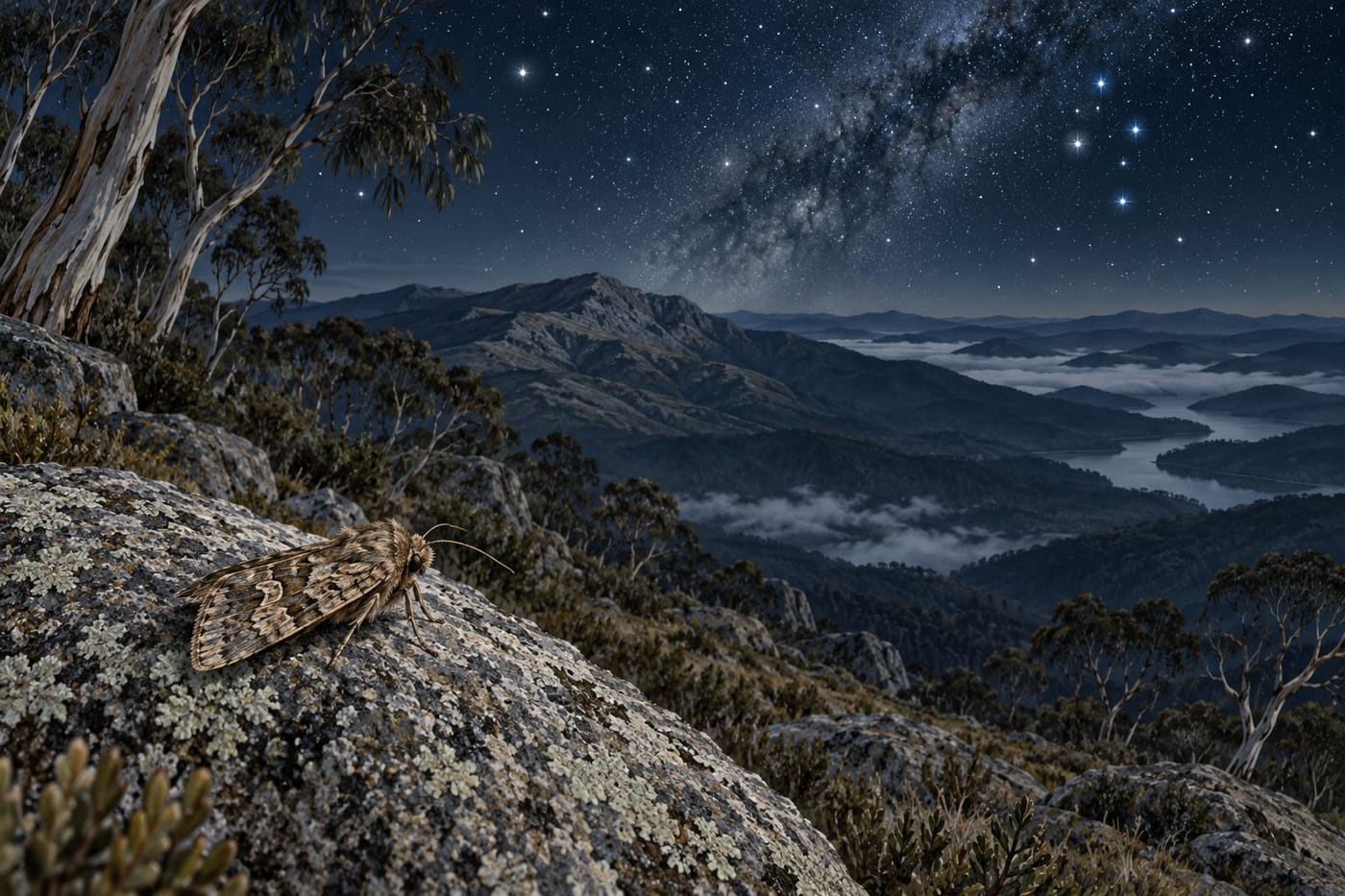
A brown moth resting beside a doorway can seem an unlikely subject for a story about mountains, astronomy and conservation. Yet the Bogong moth connects all three. Its seasonal movements link lowland breeding areas with alpine summer refuges, and its arrival matters to animals that feed on it. Looking at that journey changes the meaning of an insect encountered near a building: the place where a person notices it may be only a stop along a much longer route.
This is an explanation of that migration and how to observe it responsibly. It is not a forecast of moth numbers in a particular suburb, nor a declaration that the species has recovered. The distinction matters during a conspicuous migration season. A cluster around one light is visible; the condition of a population spread across a landscape is much harder to establish.
A seasonal journey rather than a permanent invasion
The Australian Museum identifies the Bogong moth as Agrotis infusa, a native Australian species in the family Noctuidae. Its account describes winter caterpillars feeding inland and spring adults travelling towards high country in the southern Great Dividing Range. There, moths spend the warmer months in a state of reduced activity called aestivation. The museum also explains that wind can take moths towards the coast and that lights may attract them into buildings. [Australian Museum](https://australian.museum/learn/animals/insects/bogong-moth/)
These details offer a useful way to interpret an encounter. A moth on an apartment wall does not necessarily belong to a population established inside the apartment. Nor does its presence tell an observer where it hatched or where it will finish its journey. Location is evidence of where an animal was seen, not a complete biography.
Think of a migration map as a sequence of questions: where do the animals begin, which places do they pass through, where do they spend summer, and which survive to return? A photograph can help with one small part of that sequence. It cannot answer all of it, but that does not make the observation unimportant.
Why the mountains matter
Alpine Resorts Victoria describes movement from warm inland plains to cooler alpine areas in spring, followed by a return to inland breeding areas in autumn. It identifies Bogong moths as an important part of alpine food webs and notes that nectar feeding also connects them with plants. Its conservation account includes drought, habitat loss, pesticides, introduced predators and light pollution among the pressures associated with decline. [Alpine Resorts Victoria](https://www.alpineresorts.vic.gov.au/the-resorts/environment/threatened-species-management/bogong-moth)
The broader lesson is that protecting a migratory animal involves more than protecting its most recognisable destination. A mountain refuge and a breeding landscape are parts of the same life cycle. Success in one place does not automatically cancel a problem in another.
Imagine evaluating a railway solely by inspecting its final station. A clean platform would say little about whether the line leading to it remains usable. That is an analogy, not a model of moth behaviour, but it helps explain why conservation stories need geographic breadth. The alpine caves are memorable; the less photogenic places between them also deserve attention.
The caterpillar and the adult tell different stories
Museums Victoria describes the larvae as cutworms, which feed on plants, including crops. Adults emerge after pupation, fly at night and feed on nectar. Its natural-history account explains how stored reserves support the moths during summer and how surviving adults return towards breeding grounds. [Museums Victoria](https://museumsvictoria.com.au/melbournemuseum/resources/wild/alps/bogong-moth/)
That change in life stage creates an important tension for public discussion. An animal can be unwelcome in one agricultural context and valuable in an ecological one. Calling it simply a pest or simply a mountain food source removes part of the story. Land-management decisions need the relevant expertise and local circumstances, rather than a slogan borrowed from a photograph.
For a reader, keeping the life stages separate also prevents practical confusion. Advice about observing a migrating adult at a house is not automatically advice about managing crop damage. If the concern is agricultural, use appropriate local agricultural guidance. If the encounter is a resting adult on a wall, begin with identification and the current wildlife advice for that location.
A small insect with a remarkable compass
A study published in Nature in June 2025 tested how migrating Bogong moths orient themselves. In flight-simulator experiments, researchers removed the normal magnetic-field cue and presented night-sky information. Moths oriented in seasonally appropriate directions under a naturalistic sky, while disruption of the stellar pattern disrupted their orientation. The work supports the conclusion that a stellar compass can guide these moths. [Original research](https://www.nature.com/articles/s41586-025-09135-3)
This is a striking finding without adding imagined abilities to it. It does not mean moths recognise constellations as people do, read a map, or consciously select a named mountain. Those are human interpretations, not observations established by the experiment.
The experiment is also a useful introduction to scientific reasoning. Researchers try to distinguish possible explanations by changing a cue and measuring a response. A compelling story is therefore not merely that an insect travels far. It is that a proposed explanation can be tested against alternatives. The uncertainty that remains is part of the research, rather than a flaw to hide in an exciting headline.
Why a moth arrival matters to a possum
Zoos Victoria explains that Mountain Pygmy-possums emerge from hibernation in spring and feed on nutritious Bogong moths. It describes reduced moth arrivals as a conservation concern for the possums as well as for the moths themselves. Its Moth Tracker programme invites public photographs so sightings can be checked and used to improve understanding of migration. [Zoos Victoria](https://www.zoo.org.au/moth-tracker/)
This relationship makes the story larger than the number of insects around a streetlamp. Food webs connect an arrival in one season with opportunities for other animals. The moth is worth understanding on its own terms, but it also reveals how an apparently small organism can matter beyond the place where people most often notice it.
Avoid turning that connection into an improvised rescue plan. Observing and reporting are different from collecting, transporting or feeding wildlife. The sensible next step for a member of the public is to follow the relevant conservation programme's instructions, not to assume that moving moths to a mountain would help.
More sightings are encouraging, but what do they measure?
Bogong Watch, an initiative of Invertebrates Australia, brings together observers to help map migration. Its project page describes recent recovery in numbers while also identifying continuing concerns about summer habitat and gaps in knowledge about distribution and flight paths. That combination is more informative than choosing only the optimistic or pessimistic half. [Bogong Watch](https://www.bogong.org/)
There are several different quantities a headline might blur together:
- The number of photographs submitted to a website.
- The number of submissions verified as the correct species.
- The number of individual moths represented by those submissions.
- An estimate of the population across a region.
- The condition of the species over several years.
These quantities are related, but they are not interchangeable. More photographs may reflect more observers, greater public interest, more visible moths, or a combination. A photograph of several insects and several photographs of one insect also describe different observations. This is a general measurement problem, not a claim that any particular monitoring project has made an error.
A useful response to a recovery headline is curiosity about the evidence. Ask which area was measured, over what period, with what method, and compared with which baseline. Those questions make a positive result more meaningful; they do not require dismissing it.
A practical approach when a moth visits
Georges River Council's migration notice encourages residents to avoid harming Bogong moths, leave them undisturbed where possible and avoid insecticide sprays. For a moth indoors, it describes gently moving it outside with a glass and paper or cardboard. The notice also encourages reducing unnecessary outdoor lighting and wildlife-friendly native planting. [Council guidance](https://www.georgesriver.nsw.gov.au/Council/Public-Notices/Help-Protect-Bogong-Moths-During-Their-Annual-Migration)
Before acting, consider whether anything needs to be done. A moth resting outside in a safe place may simply be left alone. A photograph taken without disturbing it can be more useful than repeated handling. If access is unsafe, do not climb, lean out of windows or enter restricted areas for an image.
At a workplace, ask the person responsible for the building before changing lights or attempting to move an animal from equipment. Wildlife care and human safety do not need to become competing improvisations. If a situation is unusual, seek advice from the appropriate local service rather than extending a simple household suggestion to every setting.
Make a sighting useful without making it complicated
The following is an editorial observation checklist, not a substitute for the submission requirements of a monitoring programme. Follow the programme's own fields and privacy guidance when you upload.
- Keep the original photograph rather than a heavily edited version.
- Note the date and approximate time while they are easy to remember.
- Record the location accurately enough to be useful, without publishing someone else's private details.
- Distinguish what you saw from what you inferred.
- Say when identification is uncertain instead of presenting a guess as confirmation.
For example, “one brown moth resting on the exterior wall beside the entrance” is an observation. “The entire local population has returned” is an inference far beyond it. Good records do not need dramatic language.
If several people photograph the same insect, avoid pretending those are independent sightings of different individuals. If you return later and see another moth, record the new observation without claiming certainty that it is a different individual. Honest uncertainty is more useful than artificial precision.
A small lighting review is a sensible starting point
The Australian Government's National Light Pollution Guidelines discuss reducing unnecessary outdoor lighting during important wildlife periods, including moth migration. The central practical distinction is between lighting that serves a necessary purpose and illumination that can be avoided. [National guidelines](https://www.dcceew.gov.au/sites/default/files/documents/national-light-pollution-guidelines-wildlife.pdf)
For a household or a small business, a simple review can begin with questions rather than new purchases. Which lights are left on after they are needed? Who controls them? Are any required for a safe entrance, accessible route or emergency function? Can a responsible person review the arrangement without compromising those needs?
Do not switch off essential safety lighting because a short article mentions light pollution. Equally, do not assume every decorative light is essential merely because it is familiar. The useful outcome is a considered decision about a particular place. No expensive gadget is required to ask whether an unused light needs to stay on all night.
An accessible way to explore the story with children
A family or classroom can turn the migration into a short observation exercise without catching an insect. Draw three boxes labelled “what we noticed”, “what a source explains” and “what we still wonder”. Put a description of a photograph in the first box, a sourced life-cycle fact in the second, and an unanswered question in the third.
This separates observation, explanation and uncertainty in a visible way. It also leaves room for imagination without confusing it with evidence. A child can draw a moth crossing a night sky and still understand that the drawing does not document a tracked journey.
For older learners, compare two sources with different purposes: a natural-history page and a current conservation programme. Ask what each is designed to explain. A species profile may describe a life cycle; a monitoring programme may ask for observations. Neither needs to answer every question to be useful. Check dates and avoid treating an older conservation-status label as a current assessment.
The journey is the story
Bogong moth migration brings distant places into the same conversation. The insect outside a building, the research into navigation and the alpine food web are connected, but each deserves its own evidence. Appreciating that connection does not require claiming a complete recovery or turning every sighting into a crisis.
For most readers, the useful response is modest: observe carefully, avoid unnecessary disturbance, follow local guidance and contribute a clear record if appropriate. A migration becomes easier to care about when its ordinary encounters are treated as part of a larger living system.
Editorial notes and further reading
Research checked on 25 October 2026. This Australia-focused environment explainer follows a Bogong-moth news item associated with the Canberra-weather keyword in our Trends snapshot. It does not establish why that keyword trended, provide a weather forecast, or independently measure the 2026 population. Follow the linked primary organisations for updated guidance.
The cover is an original AI-generated editorial illustration of a moth and an alpine night landscape. It is not a field photograph, an identification plate or a map of a real migration route. Natural-history and conservation claims are linked above; observation examples and learning activities are editorial suggestions. Any advertisement spaces on this staging page are separated placeholders, not wildlife advice or links to monitoring services.