A story about Steve Irwin can begin with a familiar face and end with a less familiar question: what does it take to give an injured wild animal a chance of returning to its habitat? The Australia Zoo Wildlife Hospital offers a way into that question. Its public history connects a family commitment to wildlife with a facility, professional care and a wider conservation network.
The hospital appeared among stories associated with Steve Irwin in Ireland's Google Trends feed checked on 25 October 2026. That identifies the editorial starting point, not an Irish location or evidence that every search concerned the hospital. The facility is in Beerwah, Queensland, Australia. For readers arriving through a headline, the most useful next step is to distinguish its history from its current workload, and an admission from a successful release.
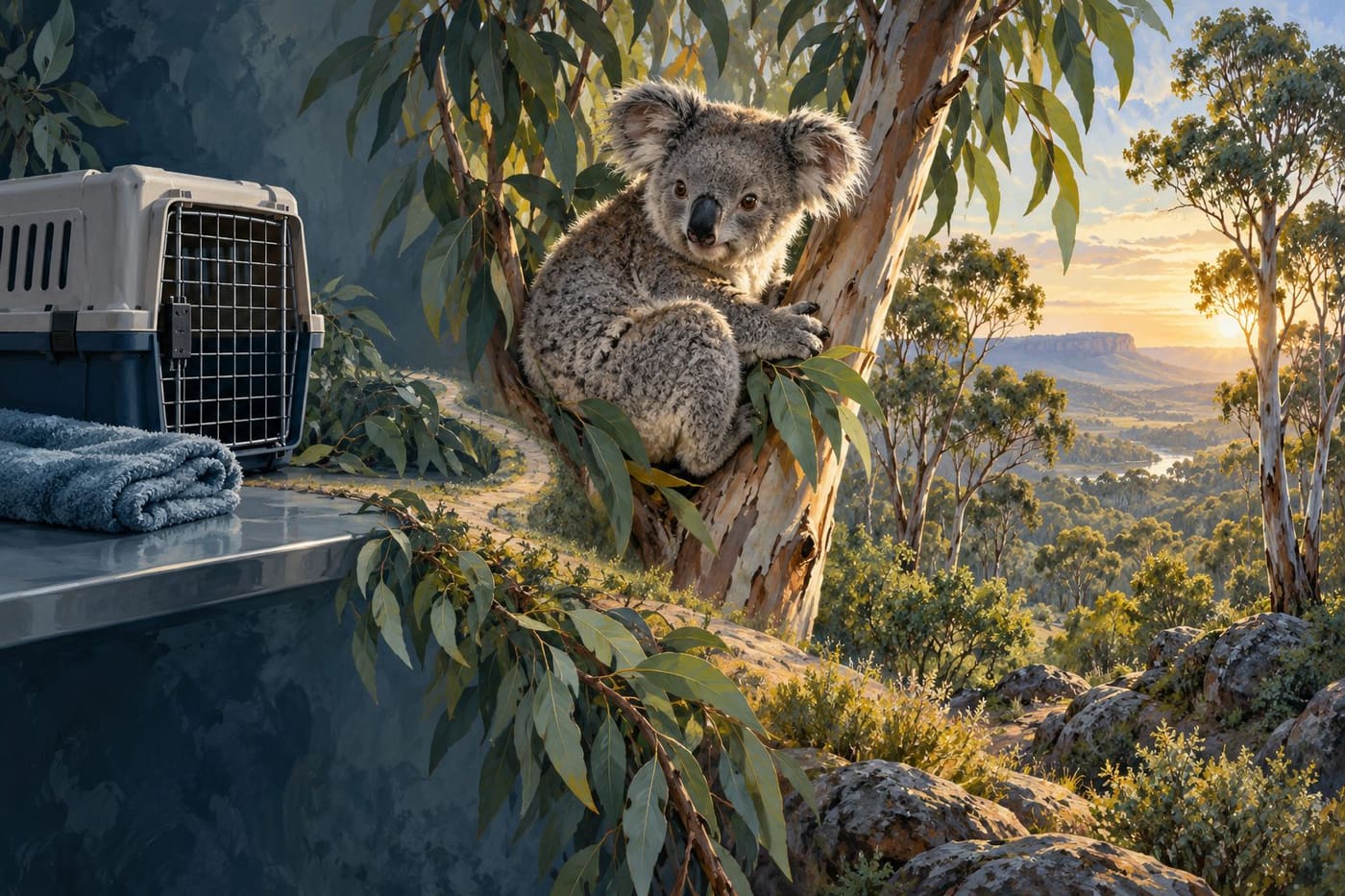
This guide explains the verified background, then offers a practical framework for reading wildlife-care stories. It does not assess individual patients, prescribe treatment or claim that every rescued animal survives. The accompanying image is an original conceptual illustration, not a photograph of the hospital or a documented rescue.
The history, with the dates left attached
Wildlife Warriors describes the hospital's origins as a tribute to Lyn Irwin, Steve's mother, and her interest in wildlife rehabilitation. Steve and Terri Irwin converted an avocado packing shed into a hospital. The organisation dates the opening of the larger facility to 15 November 2008. Its project page identifies Beerwah and displays a cumulative admission figure of more than 136,000 under the period 2004–2024. Those dates belong with the number. [Wildlife Warriors hospital history](https://wildlifewarriors.org.au/conservation-projects/australia-zoo-wildlife-hospital/).
A cumulative total is easy to repeat without its time window. Once detached, it can sound like a current annual workload or a count of animals released. Neither follows from the label. The figure is evidence of admissions across the stated historical period; it is not a verified total through October 2026.
There is a second reason to resist a neat current workload claim. The project page describes 9,000–10,000 animals in a twelve-month period, while a separate donation page says more than 13,000 annually. The pages do not provide a common reporting period that resolves the difference. We therefore do not choose one as a definitive 2026 count. [Wildlife Warriors donation information](https://wildlifewarriors.org.au/donate/wildlife-hospital-donations/).
This is not a reason to dismiss the organisation's work. It is a reason to describe the evidence accurately. A dated report or direct clarification would be needed to reconcile the figures. Repetition across several news stories would not do that job if they all ultimately relied on the same undated statement.
Four different questions hidden inside a rescue headline
When a headline says animals have been helped, ask what the underlying record measures. Four questions make a useful starting point:
- How many animals entered care during a defined period?
- What treatment or rehabilitation did they receive?
- How many were released, transferred or still receiving care?
- What evidence exists about their lives after release?
These questions are related, but their answers are not interchangeable. An admission measures an arrival. A transfer records a change in responsibility. Release records a later event. Longer-term survival would require additional information. A single dramatic photograph cannot establish all four.
Consider a hypothetical annual report that lists 100 admissions and 30 animals still in care at the reporting date. It would be wrong to assume that the remaining 70 were all released. Some might have been transferred, some might have died, and the report might use categories that need explanation. These invented numbers illustrate a reading problem; they are not hospital statistics.
A fair reader should also avoid the reverse mistake: treating a large caseload as proof that an organisation is ineffective. Increased admissions might reflect changing reporting, expanded access or greater need. Without comparable definitions and context, neither praise nor criticism can be calculated from the headline total alone.
Care is a sequence, not one moment
A useful comparison comes from RSPCA Queensland, a separate organisation. It describes examination and diagnostic assessment, followed where appropriate by stabilisation, care or transfer to a rehabilitator. Its explanation connects veterinary services, carers and other facilities. This is context for understanding wildlife care, not evidence that every Australia Zoo patient follows the same detailed pathway. [RSPCA Queensland hospital services](https://www.rspcaqld.org.au/our-services/wildlife-services/rspca-wildlife-hospital).
For an interested reader, that sequence changes what counts as a complete story. A rescue video may show the beginning. A treatment update may describe one decision. A release announcement may provide an ending to the public account, while leaving questions about subsequent monitoring unanswered. Each can be valuable without representing the whole process.
Read the verbs carefully. “Assessed” does not mean “recovered”; “transferred” does not mean “released”; “scheduled for release” does not mean the release has happened. Small distinctions protect an animal's story from becoming more certain as it passes from a hospital update into a social caption and then into a headline.
The same care applies to photographs. A picture of a healthy animal can accompany an explanation without documenting a particular patient. Good presentation should tell readers which it is. Our illustration deliberately avoids pretending to show a clinical encounter, named patient or real treatment room.
What a patient story can tell you
An individual story can make a difficult subject understandable. A named patient, a documented reason for admission and a dated update give readers something concrete to follow. Yet a memorable case remains one case. It cannot by itself establish a hospital-wide recovery rate or the condition of a species across Australia.
Try reading a patient update with a short note beside it. Record the species, the date of admission if given, the reason for care as stated by the organisation, and the latest confirmed stage. Leave a blank where the information is absent. A blank is more honest than completing the account from expectation.
Then separate description from interpretation. “The animal was transferred” is a reported event. “The animal will thrive” is a prediction unless supported by later evidence. An uplifting tone is understandable, but it should not erase uncertainty about an individual outcome.
There is also value in noticing whose work appears in the account. A celebrity connection may bring attention to the story, while the actual care involves people whose names never enter the headline. Asking about the roles involved can broaden appreciation without inventing staff biographies, claiming access to the facility or presenting publicity material as independent inspection.
Wildlife health information has another purpose
Wildlife Health Australia lists the Australia Zoo Wildlife Hospital among participants in its zoo-based surveillance network. It describes a wider Sentinel Surveillance Program involving zoos, veterinary clinics and universities. Participating coordinators select wildlife disease cases for entry into the eWHIS information system. The programme is intended to improve understanding of wildlife health and related threats. [Wildlife Health Australia sentinel surveillance](https://wildlifehealthaustralia.com.au/Our-Work/Surveillance/Sentinel-Surveillance).
This gives a second lens for thinking about care. A clinical encounter concerns an individual animal; a useful record may also contribute to a larger picture. Those two functions should not be collapsed into a claim that every hospital admission becomes a surveillance entry or that a cluster of cases proves an outbreak.
For example, imagine several reports involving the same species. Before interpreting a pattern, an analyst would need to know whether the records describe comparable circumstances, whether reporting practices changed and whether further investigation supports a shared explanation. This is an illustrative reasoning exercise, not a report of an actual cluster at the hospital.
The reader's question becomes more precise: what was observed, what was recorded and what conclusion has the responsible organisation actually published? That approach makes room for scientific uncertainty without treating uncertainty as a failure. Sometimes the most responsible update is that investigation continues.
Rehabilitation and habitat answer different questions
A hospital story focuses attention on an animal in need. A conservation story also asks what conditions exist beyond the place of care. These are complementary questions. Treating an individual does not, by itself, demonstrate that the wider pressures affecting a population have been removed.
This distinction matters when language shifts from “helped an animal” to “saved a species.” The latter is a much larger claim. A reader would want evidence about the population, its threats and the relevant conservation programme before repeating it as a measured result. An organisation's mission statement should not be mistaken for a completed population assessment.
One practical reading exercise is to make two columns. In the first, list what the story establishes about the individual. In the second, list what it establishes about habitat or population conditions. If the second column remains empty, the story may still be worthwhile. It simply answers a narrower question.
This prevents an unnecessary competition between immediate care and prevention. Readers do not have to decide that only one deserves attention. They can recognise the value of treatment while asking what other work is needed, and they can support habitat efforts without overlooking the needs of animals already injured.
Supporting the work without assuming what it needs
The Wildlife Warriors donation page lists both equipment and recurring supplies. That is a useful reminder that support is not limited to a highly visible building project. Before responding to a specific appeal, check the official organisation's current information and whether the requested item or campaign is still active.
A sensible support checklist is straightforward:
- Confirm the organisation and destination through its own website.
- Read whether an appeal is general or restricted to a stated purpose.
- Check dates before sharing a particular price, target or urgent request.
- Ask before sending physical goods that were not requested.
- Keep the confirmation of any contribution for your own records.
These are practical checks, not an endorsement of an individual fundraising page or a promise about how a particular gift will be used. This article does not collect donations or receive a referral payment for directing readers to the sources.
If your available contribution is time rather than money, look for a published volunteer route and its requirements. Do not assume that enthusiasm creates permission to handle wildlife or enter a care area. A clearly defined role can make it easier to contribute something useful while respecting the people responsible for the animals.
If you encounter an animal in distress
The appropriate response depends on location and species. Contact a local wildlife rescue service or veterinarian and follow their instructions. RSPCA Queensland explicitly cautions against trying to care for injured wildlife at home. It also says not to handle bats and to seek urgent medical attention after a bat bite or scratch. [RSPCA Queensland wildlife guidance](https://www.rspcaqld.org.au/our-services/wildlife-services/rspca-wildlife-hospital).
For readers outside Australia, an Australian hospital feature is not a substitute for local emergency arrangements. Find the appropriate service where you are. Do not use a distant article to improvise capture, feeding, medication or transport instructions. Keep yourself out of traffic and other hazards while seeking help.
A useful contribution may be an accurate location and a description given from a safe distance. Let the responding professional decide what further information or action is appropriate. Recording a dramatic video should never take priority over safety or professional assistance.
A better way to share the story
Before reposting a hospital headline, write a one-sentence version that preserves its limits. For this feature, a defensible summary is that the Australia Zoo Wildlife Hospital has a documented history connected to the Irwin family and participates in a wider wildlife-health network. The historical admission figure needs its stated dates.
Avoid adding “all saved,” “all released” or a current annual count unless the source actually supports those words. Do not turn an old milestone into breaking news. If a post uses a generated illustration, keep that description with it rather than allowing the image to become apparent evidence of a rescue.
For a classroom discussion or a family conversation, three questions can move the subject beyond celebrity recognition: what does the number count, what happened after the rescue, and what would we need to know about the habitat? Those questions invite curiosity without requiring children or other readers to pretend to have veterinary expertise.
The legacy worth examining
The strongest reason to look beyond a familiar name is that the practical work becomes more interesting, not less. A hospital's history leads to questions about care, records, rehabilitation and the circumstances in which animals live. Clear dates and careful outcome language help that work remain visible without exaggeration.
Steve Irwin's name may bring someone to the subject. Staying with it means paying attention to what the evidence establishes and what remains unknown. That is a more durable form of interest than sharing the largest number in a headline and moving on.
Editorial and source note
Researched on 25 October 2026 using the linked organisational sources. The Ireland trend observation guided topic selection; it does not establish the reason for every search. This is an independently prepared explanatory article, not a hospital visit, veterinary assessment or audited impact report. Current annual admission totals were not reconciled, and no survival or release percentage is claimed. The original generated image is illustrative. Private-staging ad spaces are layout placeholders, separate from the editorial text.