

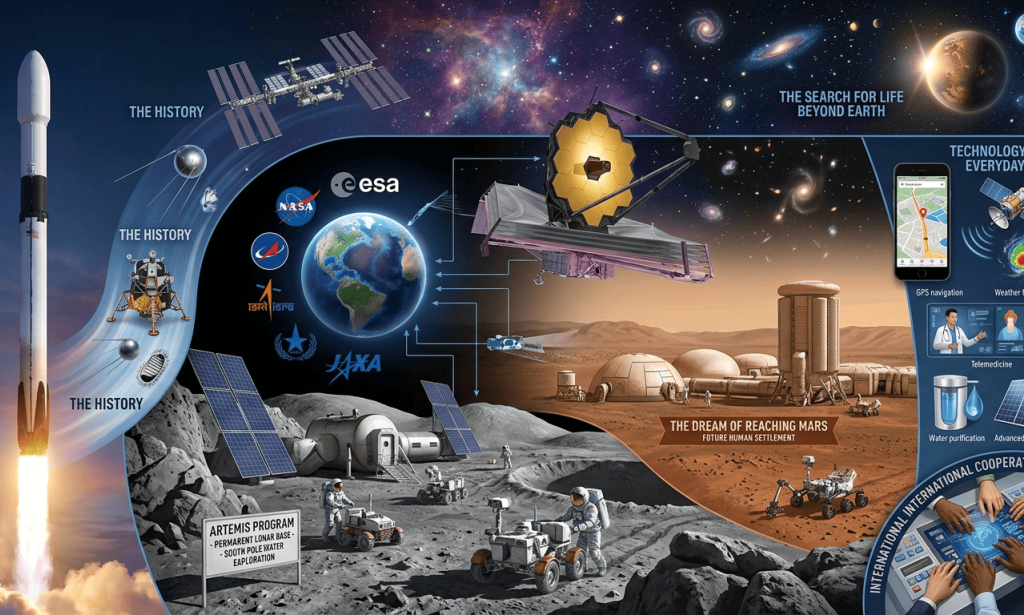

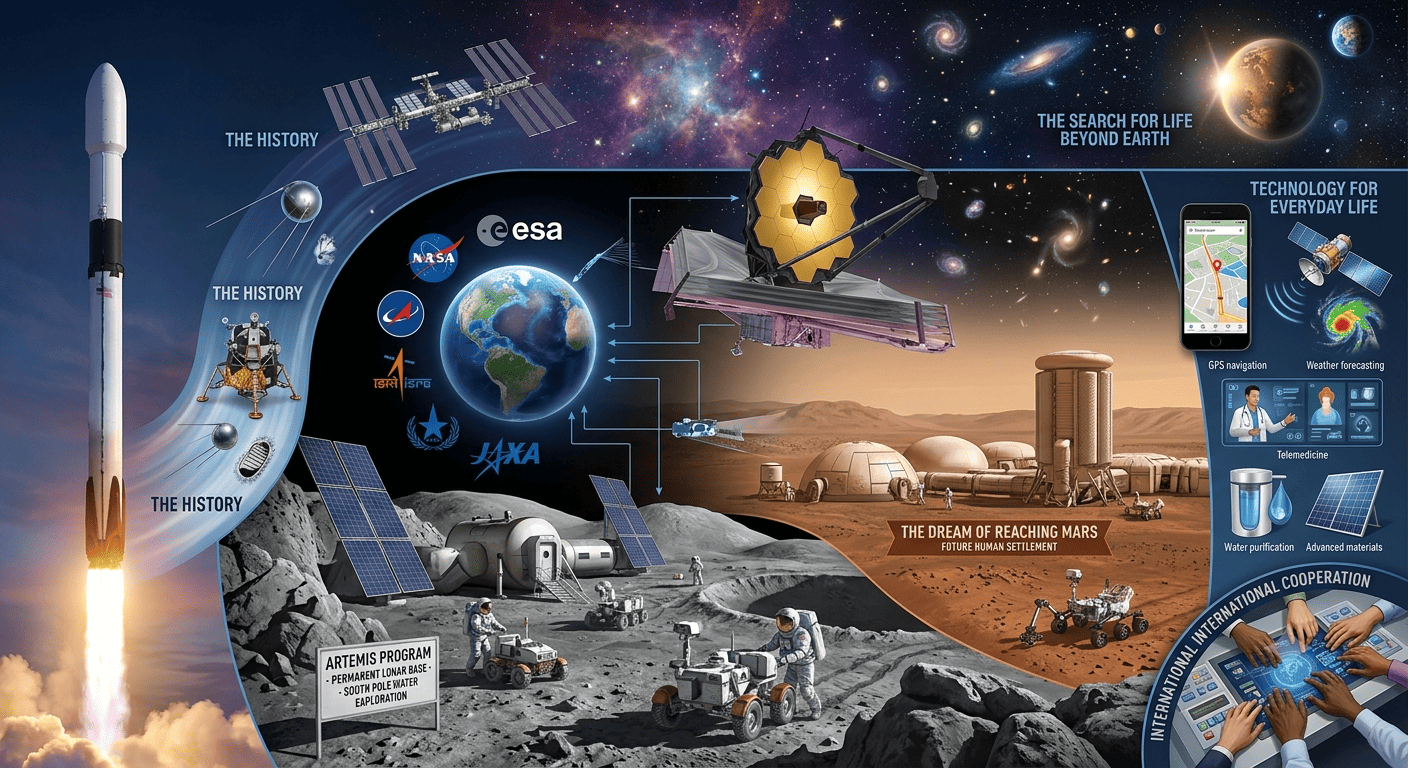
Space Exploration in the 21st Century: Humanity's Journey Beyond Earth
Introduction
For thousands of years, humans have looked up at the night sky with curiosity and wonder. Ancient civilizations studied the stars to understand seasons, navigation, and the mysteries of the universe. Today, space exploration has become one of the greatest scientific achievements in human history. Modern technology has enabled spacecraft to travel millions of kilometers, robots to explore distant planets, and telescopes to observe galaxies billions of light-years away.
The 21st century has marked a new chapter in space exploration. Governments, research institutions, and private companies are investing heavily in missions that aim to expand humanity's knowledge of the universe. From returning astronauts to the Moon to preparing future missions to Mars, space exploration continues to inspire innovation and international cooperation.
This article explores the evolution of space exploration, recent achievements, major challenges, and the exciting future awaiting humanity beyond Earth.
The History of Space Exploration
Modern space exploration began during the mid-20th century with the Space Race between the United States and the Soviet Union.
Important milestones include:
- 1957: Sputnik 1 became the first artificial satellite to orbit Earth.
- 1961: Yuri Gagarin became the first human to travel into space.
- 1969: Apollo 11 successfully landed astronauts Neil Armstrong and Buzz Aldrin on the Moon.
- 1977: Voyager 1 and Voyager 2 began exploring the outer Solar System.
- 1998: Construction of the International Space Station (ISS) began.
These historic missions laid the foundation for today's advanced space programs.
The Role of Space Agencies
Several organizations lead scientific exploration beyond Earth.
Major space agencies include:
- NASA (United States)
- ESA (European Space Agency)
- Roscosmos (Russia)
- ISRO (India)
- JAXA (Japan)
- CNSA (China)
- CSA (Canada)
These agencies collaborate on international missions that improve scientific understanding while sharing knowledge and technology.
Their work includes satellite launches, planetary exploration, astronomy, Earth observation, and astronaut training.
Private Companies Are Changing Space Exploration
One of the biggest developments of the 21st century is the rise of private aerospace companies.
Companies such as:
- SpaceX
- Blue Origin
- Rocket Lab
- Axiom Space
have introduced new ideas and technologies that reduce launch costs and increase access to space.
Reusable rockets have dramatically lowered the cost of launching satellites and scientific equipment into orbit.
Private companies are also developing commercial space stations and future space tourism opportunities.
Returning to the Moon
More than fifty years after the Apollo missions, humanity is preparing to return to the Moon.
NASA's Artemis Program aims to:
- Land astronauts near the Moon's south pole.
- Establish a long-term human presence.
- Test technologies for future Mars missions.
- Encourage international cooperation.
Scientists believe the Moon may contain water ice that could support future human settlements by providing drinking water, oxygen, and rocket fuel.
The Moon will likely become an important stepping stone for deeper space exploration.
The Dream of Reaching Mars
Mars remains one of humanity's greatest exploration goals.
Scientists are interested in Mars because:
- It once had rivers and lakes.
- Water ice exists beneath its surface.
- It may have supported microbial life in the past.
- It offers opportunities for future human settlements.
Robotic missions such as NASA's Perseverance Rover continue studying the planet's geology and searching for evidence of ancient life.
Future human missions to Mars will require advanced life-support systems, reliable spacecraft, and international cooperation.
Powerful Space Telescopes
Space telescopes allow scientists to observe the universe without interference from Earth's atmosphere.
Important observatories include:
- Hubble Space Telescope
- James Webb Space Telescope (JWST)
The James Webb Space Telescope has captured stunning images of distant galaxies, star-forming regions, and exoplanets.
These discoveries help scientists better understand the origins of the universe and the formation of stars and planetary systems.
Satellites and Everyday Life
Space technology affects daily life more than many people realize.
Satellites provide:
- GPS navigation
- Weather forecasting
- Internet communication
- Television broadcasting
- Disaster monitoring
- Environmental research
Without satellites, many modern technologies would not function as efficiently.
Space exploration has created innovations that benefit billions of people worldwide.
The Search for Life Beyond Earth
One of the biggest scientific questions is whether life exists elsewhere in the universe.
Scientists search for life by studying:
- Mars
- Europa (a moon of Jupiter)
- Enceladus (a moon of Saturn)
- Exoplanets orbiting distant stars
Advanced telescopes analyze planetary atmospheres for gases that may indicate biological activity.
Although no confirmed evidence of extraterrestrial life has been discovered, research continues at an unprecedented pace.
Challenges of Space Exploration
Exploring space presents many technical and human challenges.
Major difficulties include:
- Extreme temperatures
- Cosmic radiation
- Long travel times
- Limited resources
- Equipment failures
- Communication delays
- High mission costs
Engineers and scientists continuously develop new technologies to overcome these obstacles.
Space Technology Benefits Earth
Many technologies originally developed for space missions now improve everyday life.
Examples include:
- Advanced medical imaging
- Water purification systems
- Lightweight materials
- Solar panels
- Memory foam
- Satellite communications
- Fire-resistant materials
These innovations demonstrate that investment in space exploration often produces practical benefits on Earth.
International Cooperation
Space exploration increasingly depends on global partnerships.
Countries collaborate through:
- Scientific research
- Shared technology
- Joint missions
- Astronaut training
- Planetary defense projects
The International Space Station remains one of the greatest examples of peaceful international cooperation.
Future missions to the Moon and Mars will likely involve multiple nations working together.
The Future of Space Exploration
The coming decades promise extraordinary discoveries.
Future developments may include:
- Permanent lunar bases
- Human missions to Mars
- Space mining
- Commercial space stations
- Nuclear-powered spacecraft
- Advanced robotics
- AI-assisted exploration
- Deep-space telescopes
These innovations will expand humanity's understanding of the universe while opening new opportunities for scientific discovery.
Why Space Exploration Matters
Space exploration inspires curiosity, innovation, and education.
It encourages young people to pursue careers in:
- Science
- Engineering
- Technology
- Mathematics
- Astronomy
- Robotics
By pushing the limits of human knowledge, space exploration strengthens international cooperation and drives technological progress that benefits society as a whole.

You must be logged in to post a comment.