
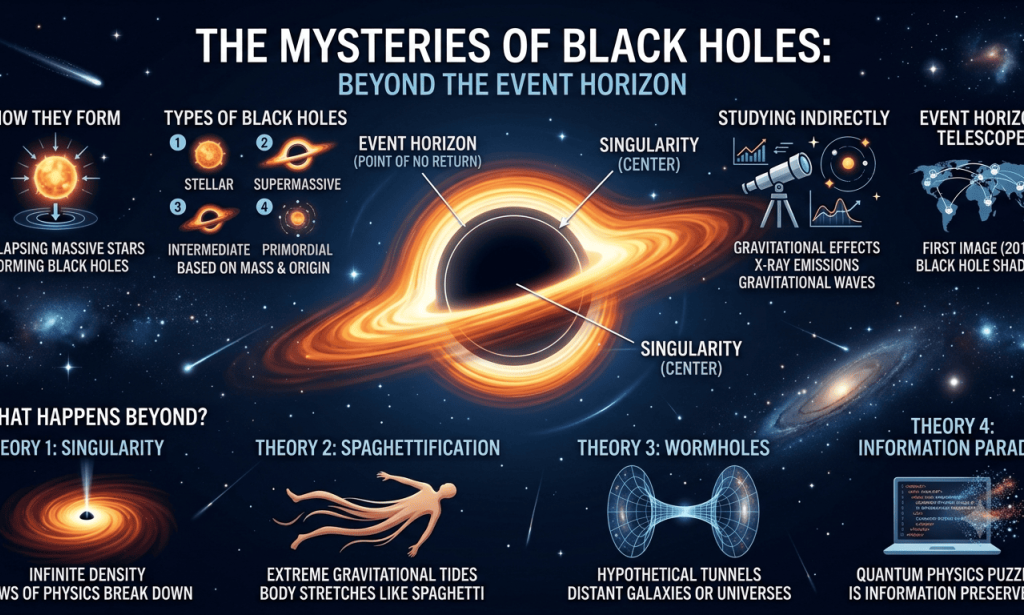
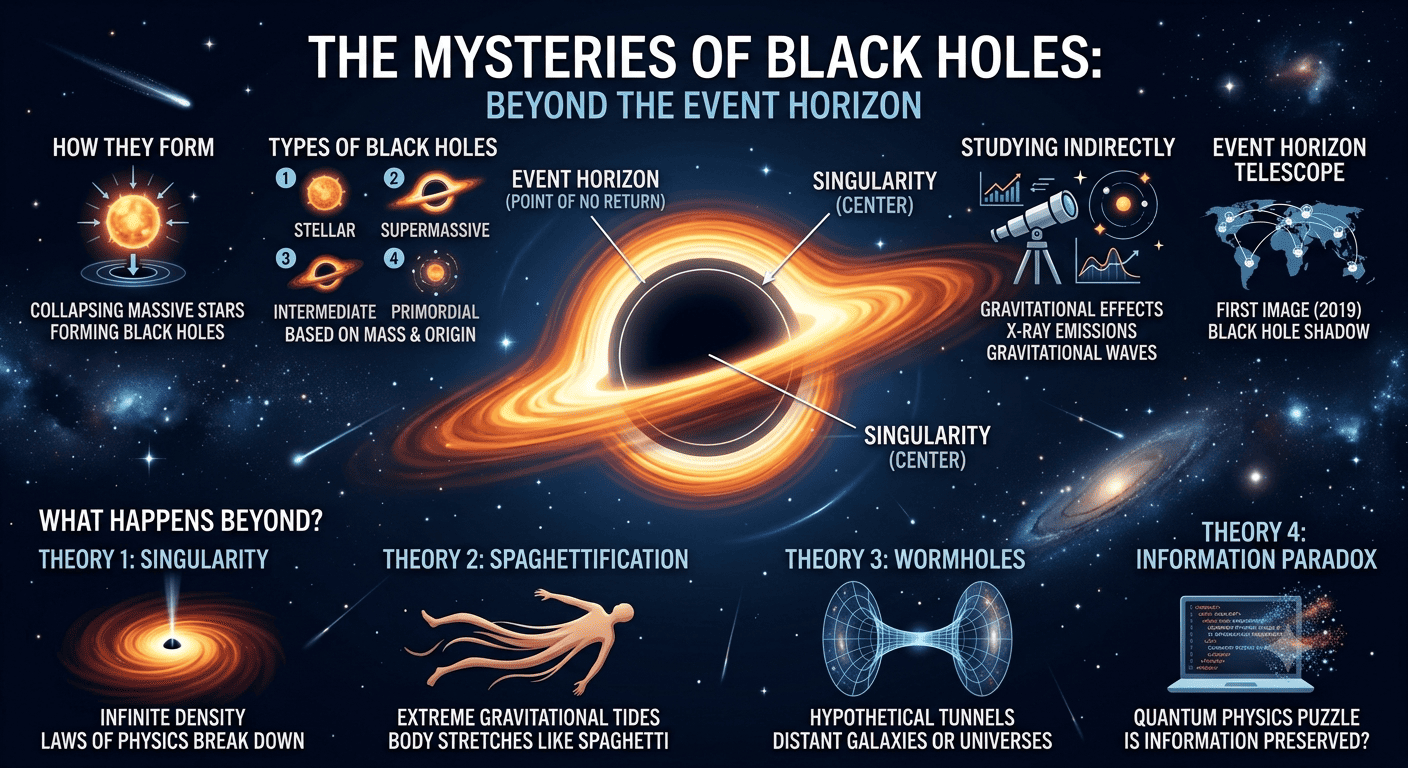
 The Mysteries of Black Holes: What Happens Beyond the Event Horizon?
Introduction
The universe is filled with incredible wonders, from shining stars and colorful galaxies to mysterious dark matter and distant planets. Yet few cosmic objects capture our imagination like black holes. These invisible giants bend space and time with such extraordinary force that even light cannot escape their gravity.
For centuries, black holes existed only as theoretical ideas. Today, they are accepted as real objects thanks to decades of scientific research and remarkable observations. In 2019, scientists even captured the first image of a black hole’s shadow, confirming predictions made by Albert Einstein's theory of General Relativity over a century ago.
Despite these achievements, one question continues to fascinate scientists and space enthusiasts alike:
What really happens beyond the event horizon?
Although no human—or information—has ever returned from inside a black hole, physicists continue to develop theories that may eventually reveal the answer.
What Is a Black Hole?
A black hole is a region of space where gravity is so powerful that nothing can escape from it once it gets too close.
Unlike planets or stars, black holes do not have a solid surface. Instead, they contain an enormous amount of mass compressed into an incredibly tiny area. This creates a gravitational field so strong that it warps the very fabric of space and time.
Black holes are invisible because they emit no light. Scientists detect them by observing how nearby stars, gas clouds, and light behave under their immense gravitational influence.
How Do Black Holes Form?
Most black holes are created when massive stars reach the end of their lives.
A star spends millions or even billions of years producing energy through nuclear fusion. Eventually, it runs out of fuel.
Without the outward pressure generated by fusion, gravity causes the star to collapse inward.
If the remaining core is extremely massive, it continues collapsing until it becomes a black hole.
However, not all black holes are formed this way.
Scientists classify black holes into several categories:
1. Stellar Black Holes
Created from collapsing massive stars.
2. Supermassive Black Holes
Found at the centers of galaxies, including our Milky Way.
These giants can contain millions or even billions of times the mass of our Sun.
3. Intermediate Black Holes
Much rarer and believed to bridge the gap between stellar and supermassive black holes.
4. Primordial Black Holes
A hypothetical type that may have formed shortly after the Big Bang.
Understanding the Event Horizon
The event horizon is often described as the "point of no return."
It forms an invisible boundary surrounding every black hole.
Once anything crosses this boundary—including light—it can never escape.
Imagine standing near a giant waterfall.
As long as you're far enough away, you can swim back.
But once you pass a certain point, the current becomes too powerful.
The event horizon works similarly.
Outside the event horizon, escape is possible.
Inside it, escape becomes impossible according to our current understanding of physics.
This invisible boundary is one of the most mysterious features of black holes.
What Happens Beyond the Event Horizon?
This is one of the greatest unanswered questions in modern science.
Because no information can escape from beyond the event horizon, scientists rely on mathematics and theoretical physics.
Several ideas have been proposed.
Theory 1: The Singularity
According to Einstein's General Relativity, everything falling into a black hole eventually reaches a point called the singularity.
A singularity is believed to have:
Infinite density
Infinite gravity
Zero volume
At this point, the known laws of physics completely break down.
Scientists believe a future theory combining quantum mechanics and gravity will be needed to explain what truly exists there.
Theory 2: Spaghettification
One of the strangest predictions involves something called spaghettification.
Gravity near a black hole becomes dramatically stronger the closer you get.
If a person fell toward a stellar black hole, their feet would experience much stronger gravity than their head.
The body would stretch into a long, thin shape resembling spaghetti.
Eventually, the extreme forces would tear every atom apart.
While this sounds terrifying, it is considered a genuine prediction of Einstein's equations.
Theory 3: Wormholes
Some scientists speculate that black holes may connect distant parts of the universe.
These hypothetical tunnels are known as wormholes.
If wormholes exist and remain stable, they could theoretically allow travel between galaxies—or even different universes.
However, there is currently no experimental evidence proving their existence.
Theory 4: Information Is Never Lost
A famous scientific puzzle called the Black Hole Information Paradox asks:
What happens to the information contained in objects that fall into a black hole?
Quantum physics suggests information can never truly disappear.
Stephen Hawking originally proposed that information might be destroyed.
Later research suggested that information may somehow be preserved on the event horizon or encoded in Hawking radiation.
This debate continues today.
How Scientists Study Black Holes
Since black holes cannot be observed directly, scientists use indirect methods.
Gravitational Effects
Nearby stars often orbit invisible objects.
By measuring these orbits, astronomers can calculate the hidden object's mass.
If the mass is enormous and invisible, it is likely a black hole.
X-ray Emissions
When gas falls toward a black hole, it heats to millions of degrees.
This produces intense X-rays that telescopes detect from space.
Gravitational Waves
In 2015, scientists detected gravitational waves produced by two merging black holes.
These tiny ripples in space-time confirmed another prediction made by Einstein.
Today, gravitational wave observatories continue discovering new black hole collisions.
Black Hole Imaging
In 2019, the Event Horizon Telescope released the first image showing the shadow of a black hole.
In 2022, scientists also captured an image of Sagittarius A*, the supermassive black hole at the center of our Milky Way galaxy.
These achievements marked historic milestones in astronomy.
Do Black Holes Die?
Surprisingly, scientists believe black holes slowly lose energy.
Stephen Hawking proposed that black holes emit tiny amounts of radiation known as Hawking Radiation.
Over unimaginable lengths of time, this radiation could cause black holes to shrink and eventually disappear.
For massive black holes, however, this process would take far longer than the current age of the universe.
Can Earth Fall Into a Black Hole?
Fortunately, the answer is almost certainly no.
There are no known black holes close enough to threaten Earth.
The nearest known black holes are many light-years away.
Even the supermassive black hole at the center of our galaxy is approximately 26,000 light-years from Earth.
Its gravity affects the galaxy as a whole but poses no danger to our Solar System.
Why Black Holes Matter
Black holes are not merely cosmic curiosities.
Studying them helps scientists answer some of the biggest questions in physics.
Research into black holes improves our understanding of:
Gravity
Space-time
Quantum mechanics
Galaxy formation
Dark matter
The evolution of the universe
Many physicists believe solving the mysteries of black holes could eventually lead to a unified theory of everything.
The Future of Black Hole Research
The coming decades promise exciting discoveries.
More powerful telescopes, improved computer simulations, advanced space missions, and better gravitational-wave detectors will allow scientists to observe black holes in greater detail than ever before.
Future research may reveal:
What lies inside a singularity
Whether wormholes exist
How gravity behaves under extreme conditions
Whether information truly survives inside black holes
New laws of physics beyond Einstein's theories
Every new discovery brings humanity one step closer to understanding the deepest mysteries of the cosmos.

You must be logged in to post a comment.