BOOK PREVIEWS · First five content pages · Purchases not yet available
TrendWindow

← Book Library · Five-page preview

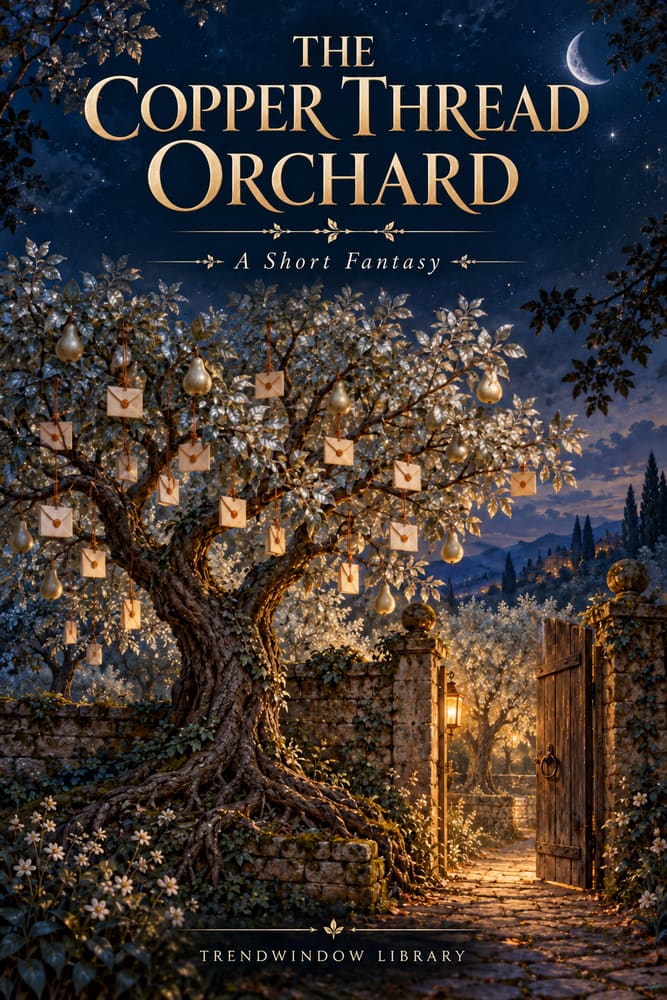
Front cover of The Copper Thread Orchard

Fantasy & Science Fiction

The Copper Thread Orchard

By TrendWindow Library

A complete original short fantasy about Juno, an inherited orchard that keeps deliberately unsent words, an approaching storm and the difference between saving a secret and honouring a promise.

First five fixed content pages only. Full-book access and purchases are not available.

1 The Envelope in the Pear Tree

The first thing Juno inherited was a ladder with one short leg. The second was an orchard full of envelopes. The house, according to her aunt's note, could wait until she had learned the ladder.

She put a flat stone under the short leg and climbed. A cream envelope hung among the silver leaves, tied to a branch with copper thread. On its face was her own name, written by her own hand at seventeen.

She was twenty-seven now. She remembered the ink stain on her finger, the anger that had made her press so hard. She did not remember giving the letter away.

Below her, the new gatekeeper cleared his throat.

“That one will come down for you,” he said. “Pull the thread, not the branch.”

His name was Pell. He had worked with Aunt Iris for three winters and looked too young to have acquired her expression of patient disapproval.

Juno pulled. The knot loosened without breaking. The envelope settled into her palm with the weight of something that had been waiting without expecting.

“Do they all have letters inside?”

“All the ones you can see.”

“And the ones I can't?”

“Still belong to someone else.”

Iris had died eleven days earlier. Juno had come home for the funeral and stayed because a key, a house and an impossible orchard were difficult things to leave with a neighbour. She repaired painted signs for a living. Trees were not her trade, magical or otherwise.

On the envelope, her younger self had written another name beneath her own.

For Theo. Not yet.

Her father lived across the bridge. They had not spoken since the winter her brother left.

Juno slipped the envelope into her coat. It was the first thing in the orchard that felt dangerous.

2 Instructions for Keeping

Iris had left three notebooks. One described the house drains. One recorded purchases of tea, lamp oil and ridiculous quantities of string. The third began: THE ORCHARD DOES NOT KNOW WHAT IS TRUE.

Juno read the line twice.

Beneath it, Iris had written that the trees held only words willingly entrusted to them. They could not steal a thought, invent an answer or turn a lie into a fact. A writer sealed a message, tied its token to a branch and chose whether to keep it, reclaim it or release it to an agreed recipient.

“A token?” Juno asked.

Pell showed her a plain copper disc. One side bore a leaf; the other had a mark the writer chose. No address. No name unless the writer wanted one.

“The trees recognise the person who deposited it. The mark helps us find the branch. It isn't a key for strangers.”

“What if the writer dies?”

“The original choice remains. Some asked Iris to return a letter after death. Some asked for it to be destroyed. Some asked it to stay sealed until the roots let it go.”

“That sounds inconvenient.”

“Iris used to say convenience is a poor reason to open somebody else's grief.”

At the back of the notebook was a list of tasks: mend the gate, clear the upper channel, inspect the split in the oldest tree. Beside the last, Iris had drawn a hard square.

Juno went outside. The old tree stood at the orchard's lowest corner, below a steep bank. A black line ran down its trunk. She could put two fingers inside it.

Across the valley, clouds gathered along the ridge. Pell followed her gaze.

“If the bank comes down, it will take the tree.”

Juno looked at the branches. Envelopes hung among the leaves like pale fruit.

“Then we move them.”

Pell did not answer quickly enough.

3 The Man at the Gate

Theo came that afternoon with a wooden box of tools. Juno saw him through the kitchen window and put her own envelope beneath the notebook.

Her father had grown a narrow white beard. She disliked how surprised she was that his face had continued without her.

“Pell said the old tree is splitting.”

“Pell should have asked me before inviting you.”

“He did. You said to find somebody who understood the bank.”

She had. She had been thinking of somebody without a history.

Theo set down the box but stayed outside the threshold. “I can look. You don't have to talk to me.”

They walked to the tree. He examined the bank and the channel above it, then the trunk. He did not pretend a piece of timber could persuade the hillside to be kind.

“A support might buy time. Not a promise.”

“How much time?”

“Depends on the rain. We should keep people out of the lower corner while we work.”

She heard the old carefulness in his voice. Before Ash left, she had called it steadiness. Afterwards she had called it evasion.

Her brother had gone to the coast at nineteen. Their father had refused to give him the money he asked for. Juno had heard the argument from the stairs, heard Theo say, Not with my help. By morning Ash was gone. He wrote to Juno, rarely to anyone else. She had made a whole explanation from the part she heard.

Theo took a copper disc from his pocket.

“Iris said this token was here. I came to ask for it back.”

On the disc was the outline of a little boat.

Juno looked towards the old tree before she could stop herself.

“You left a letter here?”

“Yes.”

“To Ash?”

“That's mine to tell him.”

She hated the answer most because the notebook had already told her it was right.

4 Fruit That Would Not Travel

They tried one envelope from a branch the notebook marked as available for routine care. Pell wound its thread around a small nursery tree. The envelope became translucent, like paper held above a flame.

Juno moved it back. It grew solid again.

“Iris tried that,” Pell said. “The older trees carry their own promises. A new root can't take one without the writer's choice.”

“Why didn't you tell me?”

“You'd already said we would move them. I hoped you'd know something she hadn't.”

The admission was so plain that her anger had nowhere comfortable to land.

They searched the notebooks together. There was no emergency spell in the margin, no hidden command that made other people's choices smaller than her need to save the tree. Iris had recorded failed experiments carefully. Cutting a branch did not preserve its messages. Copying a sealed envelope produced a blank sheet. Reading aloud from an unopened letter was impossible; silence came out of the reader's mouth.

One entry described a storm forty years earlier. Writers had been asked to come and reclaim their messages. Those who chose to return them later could entrust them to a healthy tree.

“And the people who couldn't come?” Juno asked.

The entry ended: We saved what we were allowed to carry. We mourned what we could not.

She closed the book.

“That is a terrible instruction.”

Pell looked at the closed cover. “It might still be the instruction.”

By evening they had fastened a rope across the lower path. Theo built a temporary brace from sound timber, working from the safe side of the split. Juno painted a sign at the gate. She made the letters broad and plain.

OLD TREE AT RISK. TOKEN HOLDERS: PLEASE ASK AT THE HOUSE.

She did not write a single owner's name.

5 The Woman Who Kept the Letter

The first visitor was a baker named Nera. She arrived with flour on her sleeve and a token marked with three dots.

Juno expected a hurried retrieval. Instead, Nera sat at the kitchen table and asked for tea.

“Is it still there?”

“We can check. You don't need to tell me what it says.”

“Good. I wasn't going to.”

Pell went with her to the safe edge of the old tree. A low branch bent towards Nera as if recognising a familiar weight. She untied the thread. For a moment she held the envelope against her apron.

“I wrote it to my sister,” she told Juno later. “Not because I wanted to send it. Because I needed to stop carrying every sentence in my head.”

“Will you send it now?”

“No.”

The answer unsettled Juno more than she wanted to admit.

Nera took the envelope home. A man with a wheatsheaf token asked to destroy his. Pell placed a bowl on the table. The man tore the paper himself; it became dry petals before it reached the bowl. No one read a word.

Another visitor reclaimed a message, read it alone and asked for a clean sheet to write something different.

By afternoon Juno understood that the orchard was not a room full of conversations waiting to happen. Some letters were pauses. Some were endings. Some had done their work without ever reaching the person named inside.

Her own envelope pressed against her ribs when she bent to refill the kettle. She had not opened it. That refusal began to feel less like caution and more like an order she was still obeying from her seventeen-year-old self.

Outside, the first rain darkened the threshold. Nera returned with bread. She left it without asking whether Juno had found a way to save everything.

Explore more book previews →