BOOK PREVIEWS · First five content pages · Purchases not yet available
TrendWindow

← Book Library · Five-page preview

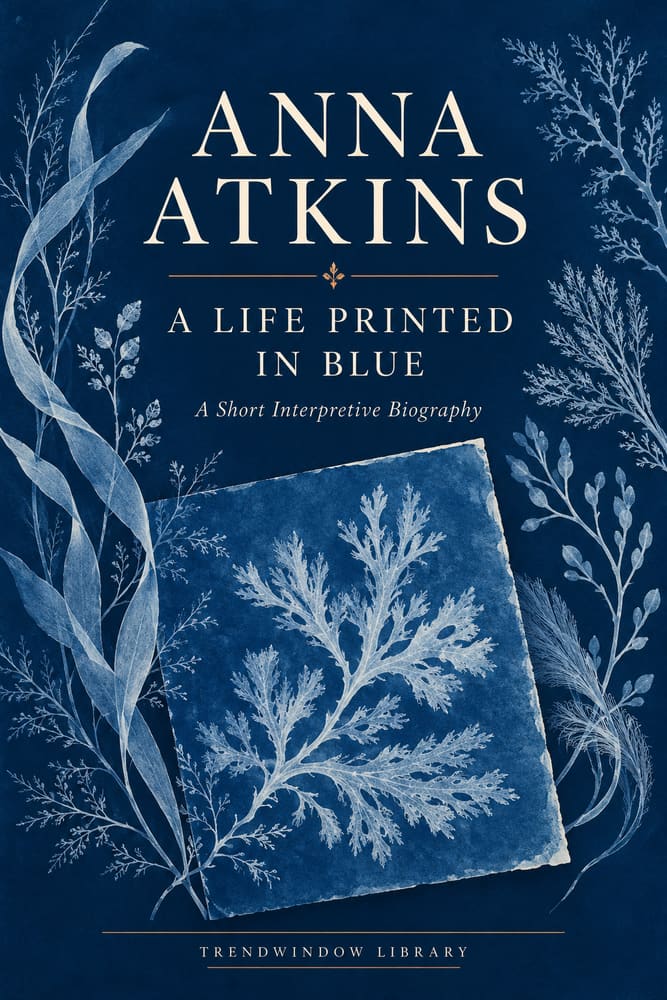
Front cover of Anna Atkins: A Life Printed in Blue

Biography & Memoir

Anna Atkins: A Life Printed in Blue

By TrendWindow Library

A complete short interpretive biography of Anna Atkins, following a documented life through botanical illustration, photographic publication, collaboration and the survival of books, with sources and clear limits on inference.

First five fixed content pages only. Full-book access and purchases are not available.

1 Begin with the Work, Not an Invented Room

A biography can make a room feel occupied by adding a desk, a particular morning and a private thought. None of those details becomes historical evidence merely because the paragraph is vivid. This book begins instead with a documented person and the work that survives under her name. Its subject is Anna Atkins, whose life joins botanical observation, photographic experiment and the making of books.

The National Gallery of Art identifies Atkins as British, 1799–1871. [S1]

Those dates define a life, but they do not explain it. A useful short biography needs a thread through the record rather than a promise to reconstruct every day. Here the thread is the transformation of a specimen into a page, and of a succession of pages into something another person can read, preserve and examine.

The chapters distinguish a sourced fact from an interpretation. The latter is an argument made by this book, not a sentence secretly attributed to Atkins. There are no invented conversations, diary entries or reconstructed private emotions. Where the record does not settle a question, the question stays open.

The title describes the photographic work, not the colour of her life as she experienced it. Nor does it suggest that an image contains an entire person. A surviving object is an entry into a biography, not a transparent window through which we can see everything its maker knew or wanted.

Read with that boundary in mind. We can take the work seriously without borrowing a voice that the evidence has not supplied.

2 A Scientific Family and an Uneven Starting Point

Born in Kent, Atkins was raised by scientist John George Children, her father, who worked at the British Museum. [S2]

Family connection belongs in a biography because achievement and access are different questions. One concerns what a person made; the other concerns how learning, materials, introductions and time became available. Acknowledging an advantageous starting point does not perform the work on someone's behalf. Ignoring it makes individual effort seem independent of the conditions that allowed it.

This is an interpretive distinction, not a claim to know a particular lesson or conversation in the household. We cannot fill an undocumented afternoon with a conveniently inspiring father-daughter scene. The documented relationship is enough to ask how a person enters a field and what kinds of support a finished object may leave out of view.

A name on a title page should not become an excuse to erase the infrastructure of making. Yet a network should not become an excuse to dissolve the maker into her contacts. Both shortcuts avoid the harder task: describing an individual's choices while keeping the conditions of choice visible.

For this biography, that means resisting the familiar story of a solitary genius arriving from nowhere. It also means not treating every later decision as a mechanical consequence of family. The record supplies connections. The work supplies evidence of sustained decisions. Their relationship needs explanation rather than a slogan about either privilege or perseverance.

3 Before the Blue Pages

The Science Museum Group records her shell illustrations for her father's Lamarck translation in 1823 and Botanical Society of London election in 1839. [S3]

These two points place illustration and participation before the publication at the centre of this book. They complicate the idea of a complete beginner who suddenly discovers a medium. A new technique can be new to a practitioner while the problem it helps address is already familiar.

Consider the difference between acquiring a tool and acquiring a question. A tool supplies a way of doing something. A question gives that action a purpose. The distinction does not prove which thoughts Atkins held at a particular moment. It lets us read a sequence of documented activities without compressing them into one dramatic instant of invention.

Illustration also asks for selection. A page cannot contain every condition of an organism's existence. It needs decisions about what to include, how to arrange it and what a reader needs to identify it. Photography does not abolish those decisions merely by introducing a different way to make an image.

In a biography concerned with working methods, such continuity matters. The later result is not less innovative because earlier skills remain relevant. Innovation may occur in the relationship between an established task and a newly available method. That is an interpretation of the sequence, not a claim that the historical maker used our present vocabulary to describe herself.

4 A Book Begins in Parts

The Met dates the work 1843–53 and calls it the first photographically printed and illustrated book. [S4]

The distinction matters: first in this specified form is not the same as inventing photography, discovering all its chemistry or being the first person ever to make a photograph. A narrow achievement does not need a broader, unsupported superlative to be consequential.

A book may be recognised by its finished binding, but publication can also be a process unfolding through parts. That changes the questions a biographer asks. What looks like one object on a shelf may represent decisions made over time. A beginning and a completed sequence are not interchangeable dates.

We should therefore avoid presenting a long publication as one afternoon of inspiration. Equally, duration alone does not tell us how every working day was organised. This book makes no claim about her daily hours, exact production rate or private response to delays. Such details would require their own evidence.

The documented publication gives a more interesting basis for attention: a technique became a continuing commitment to pages. An experiment can succeed once. A book requires relationships among its components. Its maker must consider not just whether an image exists, but how images become an intelligible work for someone else.

That is the point at which this biography turns from the fact of a new medium to the labour of publication.

5 The Specimen and the Image Are Different Things

The Rijksmuseum describes handmade exposures with algae on sensitised paper, sunlight and rinsing, rather than a camera-made view. [S5]

This brief account explains the kind of image being discussed, not a chemical recipe. The book gives no mixing instructions or invitation to handle photographic chemicals. Readers should use suitable supervised guidance if they later choose to study the practical process.

An impression is a record made under conditions. It can preserve a relation of shape and contact without preserving every property of the living subject. A page is not a specimen's entire environment, behaviour or history. Recognising the difference strengthens careful looking; it does not reduce the image to an imperfect substitute for something else.

There is also a difference between a record produced by physical contact and a record free from human choice. Selecting a subject, positioning it and deciding what counts as a usable page remain choices. A method can constrain some decisions while leaving others open.

These are analytical questions about representation. They do not license us to identify an organism from a modern conceptual cover or to assign present-day taxonomy to every historical label. In this edition, the artwork is newly generated illustration, not an identification plate and not a reproduction of Atkins's own work.

The subject of the biography remains the historical practice. The modern cover provides an entrance to reading, not additional evidence about what happened.

Explore more book previews →