BOOK PREVIEWS · First five content pages · Purchases not yet available
TrendWindow

← Book Library · Five-page preview

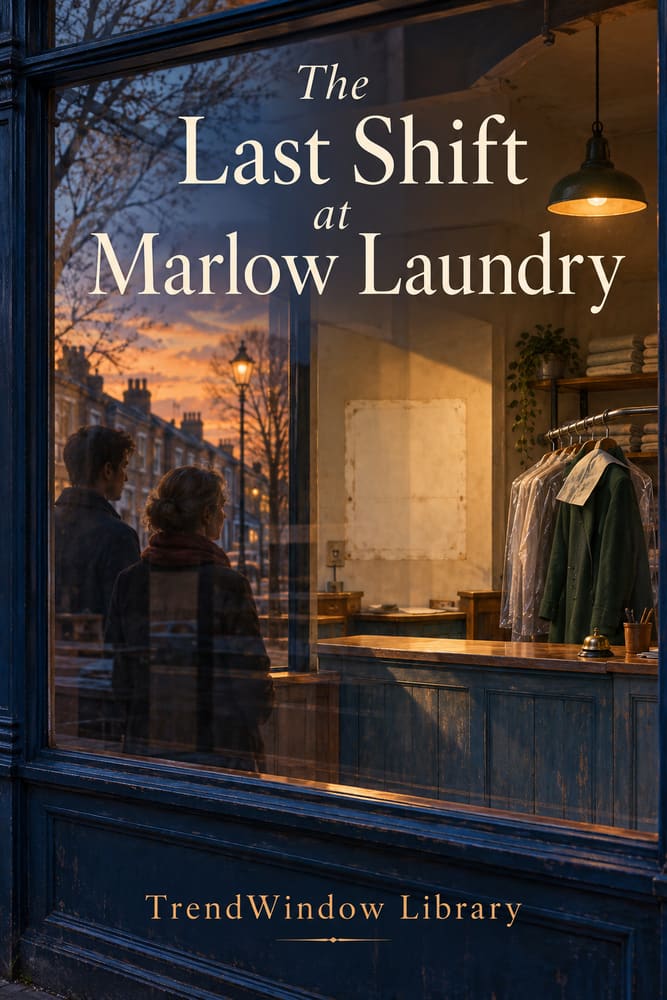
Front cover of The Last Shift at Marlow Laundry

Contemporary & Literary Fiction

The Last Shift at Marlow Laundry

By TrendWindow Library

On the final day of a family laundry, Ruth and her adult son must return seven remaining orders and decide what to carry away. A complete original short work of contemporary fiction about work, memory and an ending that leaves room to live.

First five fixed content pages only. Full-book access and purchases are not available.

1. The Card in the Window

At seven on Friday morning, Ruth turned the card from CLOSED to OPEN for the last time. The card was older than her son. Its corners had softened until the two words seemed less like opposites than stages of the same long argument.

Marlow Laundry would close at six. The lease had ended, the machines belonged to a buyer, and Ruth had a job beginning Monday in the linen room of a small hotel across town. These were the facts she could say without stopping halfway through a sentence.

On the counter she laid the final collection list. Seven orders remained. Beside each name she had written a telephone number and, in pencil, the last conversation: after lunch; neighbour may collect; call again. Her father would have disliked the pencil. He had believed that a completed decision deserved ink.

He had also believed the laundry would outlive him. For nineteen years it had, which Ruth thought should count as keeping part of a promise.

Sam came through the back door with two coffees and no sugar in hers. He was twenty-six, worked in a bicycle repair shop, and had taken the day off without asking whether she needed him.

“You can go if it gets boring,” she said.

“I've brought a book.”

He had brought gloves, packing tape and sandwiches too. She pretended not to see those. Beyond the window, the number eleven bus stopped, released three people and carried the others away.

2. The Unclaimed Coat

Order forty-three was a dark green coat. It had been cleaned in February and remained beneath its paper shoulder cover through a spring of telephone calls. The owner, Mrs Vale, had answered once to say she would come when her sister could bring her. After that the number rang without an answer.

Ruth had not thrown the coat away. She was less proud of this than she might have been: keeping it had required no decision. Disposing of it would have required one.

“Is there another contact?” Sam asked.

“There was an address. Before the shop changed the forms.”

“Which change?”

She remembered a supplier's box of new tickets and her father's pleasure at not having to write the shop name each time. The address lines had vanished with the convenience. Neither of them had noticed until much later.

The old order books were upstairs. Ruth had labelled their carton ACCOUNTS, although it contained other things she had not wanted to sort: two broken staplers, the photograph of a staff picnic, an envelope of spare buttons.

Sam carried the carton down. He did not ask why she had kept it. Together they searched backwards through pages that made ordinary visits look like records of an expedition.

At last, beneath a stain shaped like an island, they found Mrs Vale's name and an address on Rowan Street. Ruth wrote it on a separate sheet, then folded the coat carefully back into its cover. Finding a place was not the same as finding a person.

3. A Photograph Without Everyone

At half past nine, Anwar arrived for the table linen from his café. He had brought a packet of warm rolls and a photograph taken outside the laundry thirty years earlier. Four people stood beneath an awning Ruth had forgotten was striped.

“My father had this,” he said. “I thought you might want it.”

Her father occupied the middle of the picture, hands on his hips. Ruth stood beside him at seventeen, looking furious at the camera. On the other side was Mrs Bell, who had done the pressing. At the edge, partly cut off, was the elbow of someone carrying a basket.

“That's your mother,” Anwar said.

Ruth knew the sleeve. A small square had been patched with cloth from another blouse. She could remember touching the patch while her mother counted change, but she could not remember anyone taking this photograph.

“Was there another copy?” she asked.

“This is all I found.”

She thanked him. After he left, she put the photograph beside the till, then moved it to the windowsill, then laid it face down.

Sam picked it up only when she nodded.

“We could put everyone's names on the back.”

“They aren't all in it.”

“We can still name who's there.”

Ruth found a pencil. She wrote three names, then a fourth: Elsie Marlow, carrying the basket, mostly outside the frame. It was a small repair. It did not make the photograph larger, but it stopped the edge from pretending to be the end.

4. The Space Behind the Dryer

The machine buyer arrived at eleven with a trolley and a man called Pete. Ruth had expected the taking-away to be quick. Instead, they examined doorways, measured a turn and argued pleasantly about which dryer could leave first.

She had already arranged for the machines to be disconnected by the appropriate tradespeople. Nobody asked Sam to attempt it. He held doors and carried loose shelves while Ruth checked the buyer's inventory against her copy.

When the first dryer moved, it revealed a rectangle of pale paint and a child's drawing caught behind a pipe. A house, two people and a row of enormous yellow circles.

“Suns?” Pete suggested.

“Washing machines,” Sam said.

His name was on the corner, with a backward letter. He had drawn himself taller than Ruth. They were both holding something that might have been a cake.

“I don't remember that,” she said.

“I remember doing it. You were busy.”

She waited for him to add an accusation. He rolled the picture loosely and put it on the clean counter.

“I was here a lot,” he said.

“Too much.”

“Sometimes. There were good afternoons too.”

The buyer asked her to sign for the first machine. She read the description, checked its number and signed. The dryer went through the door that had once seemed too narrow for any change. Behind it, dust marked a shape they would have to sweep rather than remember.

5. Rowan Street

Ruth wanted to deliver the coat herself. She also wanted not to leave the shop. At noon Sam solved neither problem for her; he offered to go and waited while she decided.

“Take the bus. Don't leave it on a doorstep.”

“I'll bring it back if nobody's there.”

She wrote a note for Mrs Vale, giving the shop's closing time and the café's number only after Anwar agreed to take a message. He had not agreed to store clothes or become a replacement laundry. Ruth crossed out a sentence that might have suggested otherwise.

While Sam was gone, three customers arrived. A man collected six shirts, counted them twice and admitted he had expected seven. Ruth showed him the ticket. He found the seventh at home when he called his wife. They laughed, though neither had been amused before the call.

A woman came for curtains and asked whether the new owner would keep the name. Ruth explained that the machines had a buyer, but the premises did not have a new laundry business waiting inside them.

“Oh,” the woman said. “I thought it would carry on.”

Ruth had let several people think that. She had used the word change when she meant end. It had made conversations easier and this one harder.

After the woman left, she wrote a clear notice for the door: Marlow Laundry closes today. No replacement service is being arranged by us. Thank you for thirty-eight years. She read it twice before taping it beneath the collection hours.

Explore more book previews →