BOOK PREVIEWS · First five content pages · Purchases not yet available
TrendWindow

← Book Library · Five-page preview

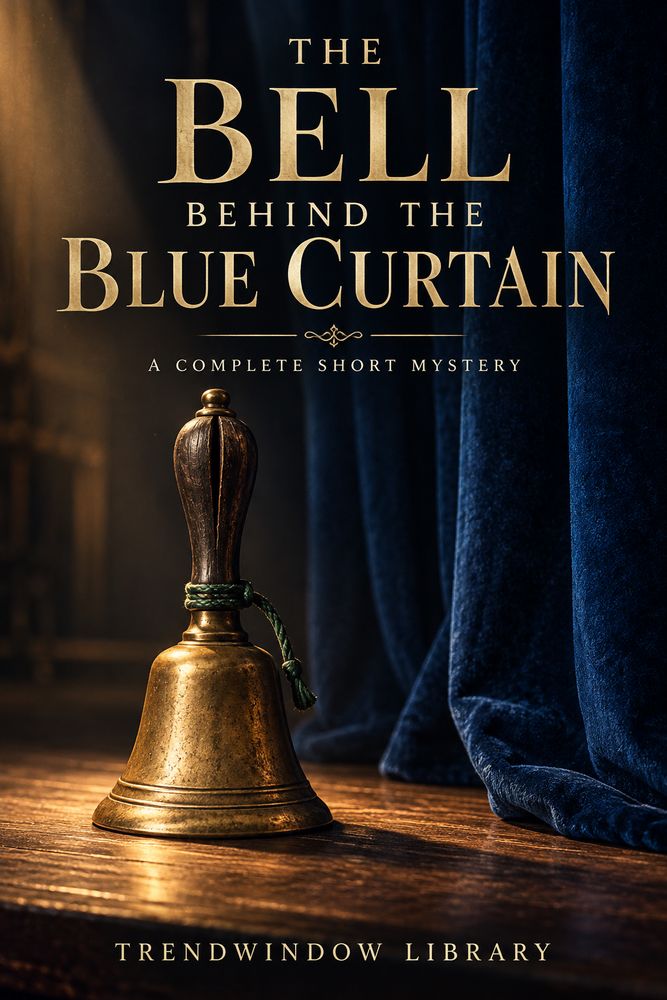
Front cover of The Bell Behind the Blue Curtain

Mystery, Crime & Thriller

The Bell Behind the Blue Curtain

By TrendWindow Library

A complete short mystery set at a theatre exhibition: a missing handbell, a familiar recording and an unfair suspicion force Ruth Vale to separate what people heard from what they actually know.

First five fixed content pages only. Full-book access and purchases are not available.

1. Three Rings

At twenty minutes to seven, the old bell rang behind the blue curtain, and Ruth Vale put down her screwdriver.

Three rings. A pause between the second and third. Then something small and flat struck the floor.

“There,” Eda said from the other end of the hall. “It still knows how to get everybody's attention.”

She was standing on a chair to straighten the auction banner. Ruth held the chair while she climbed down. Through the glass doors, the first guests waited beneath umbrellas. It was the last evening of the Cresswell Players' exhibition, and every room smelled of damp coats and flowers beginning to tire.

Ruth had agreed to repair a loose microphone stand. She had not agreed to supervise history. Nevertheless, half an hour earlier she had found herself holding the theatre's brass handbell while Tomas photographed the split in its dark wooden handle.

“Don't polish that out,” Nessa had told him. “Marin dropped it the night the roof leaked. We heard the crack from the stage.”

Marin Holt had called the company to rehearsal for thirty years. After his death, his family gave the bell to the Players. Tonight it was to be auctioned for their new rehearsal room. Nessa disapproved of selling it, though not enough to stop folding programmes.

Tomas had recorded the bell too. Three measured rings, then Ruth's chair scraped, and she sneezed into her sleeve.

“A distinguished performance,” he said.

“Keep my name off the credits.”

His little player was still on the shelf beside the curtain, connected to a speaker no larger than a biscuit tin. A strip of white tape said EXHIBITION SOUND. Ruth had watched him show Nessa the large play button before he packed his camera.

At ten to seven, Eda came looking for the bell.

Ruth pulled the curtain aside. The square table was empty except for a wooden stand and the auction card.

“Nessa?” Eda called.

No answer. At the front desk, programmes fluttered through the opening doors.

Eda picked up the card, as though the bell might be written underneath it.

“It was here,” she said. “We heard it.”

2. The Green Cloth

They found Owen in the small kitchen, wrapping mugs in a green cloth.

“That belongs with the bell,” Eda said.

Owen looked down at his hands. He was the hall caretaker, a broad man whose shirts always seemed newly washed and imperfectly ironed. His daughter had made the bell's wrapping from a length of stage fabric, with a frayed white seam along one edge.

“You said to put spare cloths away.”

“Not that one.”

“You said everything on the packing chair.”

Eda's face tightened. She had spent the afternoon making decisions while walking between rooms; apparently some had continued walking without her.

“When did you take it?”

“Half past. Around then.”

“And the bell?”

Owen set the mugs down carefully. “I didn't take any bell.”

The silence that followed was worse than an accusation. Behind them, someone in the hall laughed at something neither of them could hear.

“Let's keep the door open,” Ruth said.

Eda moved away from it. Owen had not tried to leave, but he straightened a little when the way was clear.

Ruth asked him to show them the packing chair. It stood near the kitchen entrance, several steps from the blue curtain. There were two empty picture cartons underneath it and a coil of display cord on the seat.

“The green cloth was here. Folded,” Owen said. “I shook it out. Nothing in it.”

“Tomas was working beside that chair,” Eda said. “He took the bell off the table for a close photograph. I told him he could.”

“When?”

“About quarter past six. Perhaps later.”

Tomas had left carrying his grey camera case. Ruth remembered holding the side door for him. He said he needed a cable from his car, and returned after the three rings.

Eda remembered him leaving too.

“Before the bell sounded. So he can't have taken it then.”

Ruth looked towards the curtain. There had been a noise after the rings. A flat scrape, oddly familiar.

“Maybe,” she said. “But first we should ask what we heard.”

3. A Noise That Happened Twice

The player lay face up, its small screen dimmed. Ruth did not touch its folders. She asked Eda to fetch Tomas, who was helping a guest hang a wet coat near the entrance.

He came with a smile ready for a minor equipment problem. It disappeared when Eda mentioned the missing bell.

“I put it back.”

“On the stand?” Ruth asked.

“By the curtain. Yes.”

“Could you play the recording you made?”

“Now?”

“Just the bell.”

He pressed the large button. Three rings filled the little space. Between the second and third was the same patient pause. A chair scraped. Then, unmistakably, Ruth sneezed.

Eda stared at her.

“Was that in the earlier sound?”

“I heard the scrape. I wasn't listening for myself.”

Tomas stopped the player. “It doesn't mean the bell wasn't there. Somebody could have rung it.”

“It doesn't mean it was there either.”

The distinction seemed thin, set beside an object solid enough to dent a table. Ruth wished she had a more impressive discovery. A fingerprint. A witness who had watched every door. Instead, she had a sneeze and a sentence they needed to stop repeating.

Eda drew a line through the words on her pocket list: bell here at 6.40.

“We know we heard a bell sound,” Ruth said. “We don't yet know whether it was this recording.”

Tomas nodded too quickly. “Exactly. No way to tell.”

“We can ask Nessa.”

He glanced towards the front desk. “She's busy.”

So was everybody. Ruth had learned, doing small repair jobs for people who worked in borrowed rooms, how often “busy” meant a thing would remain broken until somebody became less agreeable.

She went to the desk and asked a guest to wait while she spoke to Nessa. It was an awkward thirty seconds. It was also possible.

4. Nessa's Rehearsal

Nessa listened without interrupting. Then she covered her mouth with one hand.

“Oh,” she said. “That was me.”

They moved into the passage, where Eda joined them. Nessa's programme stack was held down by a chipped blue vase.

“I wanted to try the introduction,” she said. “I thought I'd ring the bell, say a few words about Marin. But it wasn't on the stand. I assumed you'd put it somewhere safe before the auction.”

“You didn't ask?” Eda said.

“You were up a chair, there were people at the door, and Tomas had shown me the recording. I pressed play. Then I came back here.”

She looked from one woman to the other.

“I didn't know it was missing.”

“Neither did we,” Ruth said. “Not then.”

Nessa's rehearsal had given them a false certainty without requiring her to tell a lie. The recording had sounded like the bell because it was the bell, captured earlier. They had supplied the rest: a person behind the curtain, a hand on the handle, the object still present.

Eda pressed her list flat against the wall.

“So before half past it was already gone.”

“Before Nessa went to rehearse,” Ruth said. “Not necessarily half past. We shouldn't make another exact time out of an approximate one.”

Nessa said it was a little before the sound, no more precisely than that.

Eda was quiet. Then she went back to the kitchen and told Owen what they had learned.

“I shouldn't have looked at you like that,” she said.

He continued drying a mug.

“No,” he said. “You shouldn't.”

Ruth left them the space for whatever would follow. Finding a better explanation did not oblige Owen to make the first one painless for everyone else.

In the hall, the auctioneer tapped his watch. Eda asked him to begin with the costume drawings. The bell lot would wait.

5. The Picture at the Window

Tomas stood at the side door with the grey case by his feet.

“I need to move the car,” he said. “I'm blocking someone.”

“I'll come,” Eda said.

“You don't have to.”

“I need a moment outside.”

It was not an order. He could have refused. Instead, he picked up the case and followed her into the covered yard. Ruth stayed in the open doorway.

Beyond them, rain ran from the gutter in one clear stream. A woman in a red car waved and then drove out; she had not been blocked after all, only uncertain where the exit was.

Eda asked Tomas when he had put the bell back.

“Before I left.”

“Who was there?”

“I don't know. Nobody watching me.”

Ruth thought of the green cloth, folded on the chair. “You photographed the handle by the window?”

“Yes.”

“Could we look at the last picture you took of it?”

He said there was no need. Then he said the camera battery was low. Neither answer showed what was in his case. Neither was evidence of theft. Ruth made herself remember that while Eda waited.

Finally he set down the case and took out the camera. He opened the images himself, turning the screen towards them.

The bell stood on a window ledge. Its split handle faced the glass. A narrow green cord tied beneath the handle trailed to the right; Nessa had added it years earlier to distinguish the Players' bell from a borrowed prop.

The next photograph showed the auction card alone.

“That's good,” Eda said. “But it doesn't show you returning it.”

Tomas closed the screen.

Ruth was looking at the case. A short loop of green cord had caught beside its zip. A colour and a glimpse were not enough. A dozen things in a theatre were tied with cord.

“There's something green at the edge,” she said. “Would you open that compartment?”

He put his hand over it.

Explore more book previews →