BOOK PREVIEWS · First five content pages · Purchases not yet available
TrendWindow

← Book Library · Five-page preview

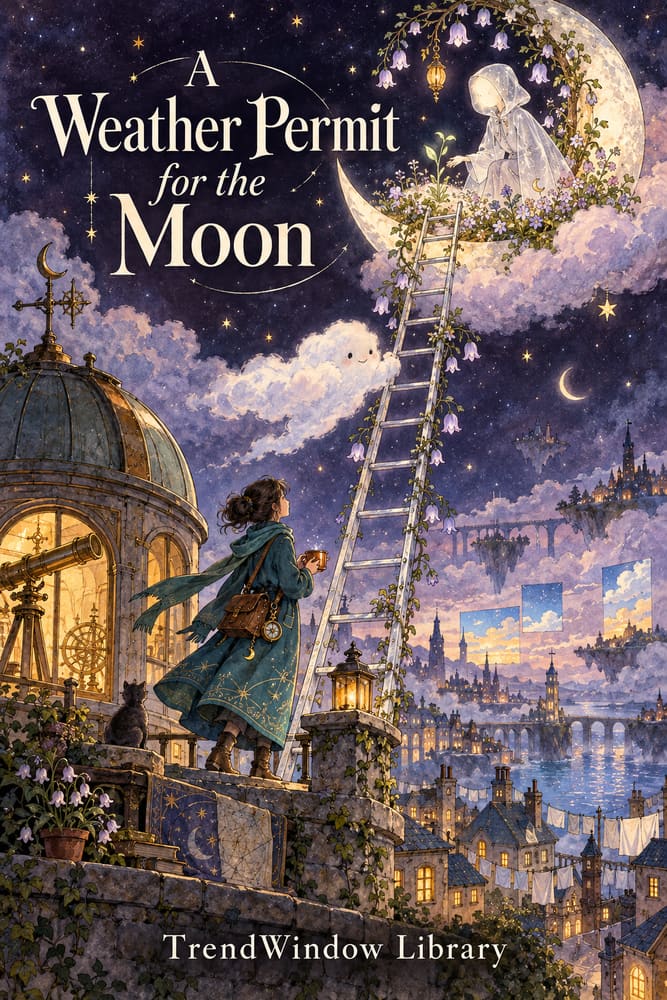
Front cover of A Weather Permit for the Moon

Fantasy & Science Fiction

A Weather Permit for the Moon

By TrendWindow Library

A complete original short fantasy: when the moon requests rain for her last seed, courier Elin must find a willing cloud, an agreed cup of shared water and a ladder beyond the town’s last chimney.

First five fixed content pages only. Full-book access and purchases are not available.

1. The Unusual Applicant

The moon arrived at the Weather Office in a raincoat that had never been wet. She was small enough to stand beneath the counter, although Elin could see a thousand silver valleys moving behind her eyes.

“Eight minutes of rain,” she said. “For a garden.”

Elin turned the application over. On the address line was a drawing of a crescent. On the line marked nearest public road, someone had written none.

“The forms prefer a street,” she said.

“So do most feet. I have managed without one.”

Outside the office, the town of Nacre was hanging out its washing beneath a sky divided into careful blue squares. Every district had borrowed a different hour of sunshine. The squares never quite matched, but the inhabitants had learned to hang shirts along their edges.

Elin was the youngest courier employed by the office. Her job was to deliver weather invitations, bring back replies and make sure that nobody confused a borrowed cloud with a possession. She had never delivered above the roof of the old observatory.

The moon removed one glove. In her palm lay a seed, thin as a sleeping eyelash.

“It has waited a long time,” she said.

Elin fetched Steward Orr. He studied the crescent address, the road that was not there and the seed.

“Our jurisdiction ends at the last chimney,” he said.

The moon looked towards the window. “Then perhaps your kindness needs a longer ladder.”

2. Three Rules and a Blank Space

Orr did not dismiss the application. He placed it beneath a paperweight shaped like a sleeping frog and opened the office rules.

There were three that every courier learned. Weather must agree to travel. A borrowed vessel must return before dawn or turn to stone. The source of borrowed water must be named, and the people sharing it must consent to its journey.

“These rules apply beyond the chimneys too,” Elin said.

“The rules might,” Orr replied. “Our ladders do not.”

The moon explained her garden. Once, rain had gathered in its hollows, and silver bellflowers had opened when no one was looking. Then the old path between sea and sky had faded. Her last seed remained asleep in dust.

Elin asked whether eight minutes was necessary, or simply what the moon remembered.

“I remember a sound,” she said. “The length may have grown in my loneliness.”

That was not enough to promise rain. It was enough to ask a better question.

Orr authorised one exploratory journey, provided Elin found willing weather, an agreed water source and a way home before dawn. No garden could be restored by stealing another place's morning. He wrote those conditions plainly on the application.

From a high shelf he took a narrow silver ladder folded like a letter. Its label read EMERGENCY HORIZONS ONLY.

“It belonged to the observatory,” he said. “I have never learned what an emergency horizon is.”

“Perhaps,” said the moon, “one that everyone has stopped imagining.”

3. Mallow, Who Would Not Be Carried

Elin found Mallow above the bread market. The cloud was shading a row of butter dishes and humming through her own edges.

“A journey to the moon?” Mallow said. “I dislike being poured.”

“I wasn't going to pour you.”

“People say that. Then they produce a jar.”

Elin had, in fact, brought a jar. She put it away.

She explained the seed and the missing rain path. Mallow listened until the market clock gave a wet little cough; it was recovering from last week's hail appointment.

“I could travel beside you,” the cloud said. “If there is water to carry. But I will not be shaped into a display animal or made to spell congratulations.”

Elin wrote those conditions down. Mallow peered over her shoulder and asked for an extra line: I may stop if the journey becomes unsafe for me.

“Of course.”

“It is surprising how often of course is left off the paper.”

The cloud needed only one cup of water for a small shower, but she could not tell whether it would wake a seed she had never met. She would offer rain, not a guaranteed flowering.

Elin returned to the office with a willing traveller and an unanswered question about water. The moon did not look disappointed.

“You have brought me something better than a promise,” she said. “You have brought somebody who can say what she means.”

4. The Shared Cistern

Nacre's public cistern stood beneath the bell tower. A blue line inside showed the reserve for the morning's agreed uses. Above it floated a little brass duck that complained when anyone leaned too far over the rim.

“One cup,” Elin told the water keeper. “For a moon garden.”

“One cup belongs to someone, even when the someone is a town.”

The keeper showed her the allocations: breakfast kitchens, washing places, the nursery roof garden and the potters' clay. Every share had already been agreed. Elin could request a change; she could not quietly take a small amount because her errand sounded beautiful.

She asked the nursery gardeners. They showed her shallow pots in which new shoots had only just appeared. She thanked them without asking them to feel guilty for keeping their water.

The potters needed theirs too. The baker offered half a cup from her own household share, then checked with her partner and returned to say that they had forgotten their guest. She withdrew the offer, embarrassed.

“It was an offer,” Elin said. “You are allowed to discover that it won't work.”

By afternoon, the cup remained empty. Mallow floated patiently above her head, no longer shading butter.

“I could lift water from the river,” the cloud suggested.

“Who shares it?”

Mallow looked at the river, which was very long and full of fish with strong opinions.

“That may take longer than one night to ask.”

5. The Roof That Caught Nothing

At the observatory, Elin found old Rune repairing a chair with string. People called him old because they had run out of other facts about him. He had once maintained the roof garden, before the astronomers stopped climbing the stairs.

He listened to the water problem, then handed her a flat white dish.

“The roof collects dew. We used to empty it into the garden. There is nothing growing there now.”

“Nothing still belongs somewhere,” Elin said.

“Good. You are listening.”

They climbed together. The garden beds were dry, but the dishes beneath the open sky held a little clear water. Rune explained the old agreement: water caught on that roof was shared by the observatory's caretakers for its garden. The remaining caretakers were Rune and the night attendant, Bea.

Bea arrived at dusk with her supper in a cloth. She and Rune agreed to lend one cup, provided the observatory garden received the first new seed if the moon's plant produced any. They did not demand that it do so. A possibility was not a crop already harvested.

Elin recorded the agreement. Mallow tasted the water with a small tendril and announced that it had excellent manners.

The moon stood by the empty beds. “I had forgotten,” she said, “how many places can have a garden that no longer blooms.”

Rune gave Elin a copper cup. “Bring the vessel back before dawn. We have enough stones.”

Explore more book previews →