BOOK PREVIEWS · First five content pages · Purchases not yet available
TrendWindow

← Book Library · Five-page preview

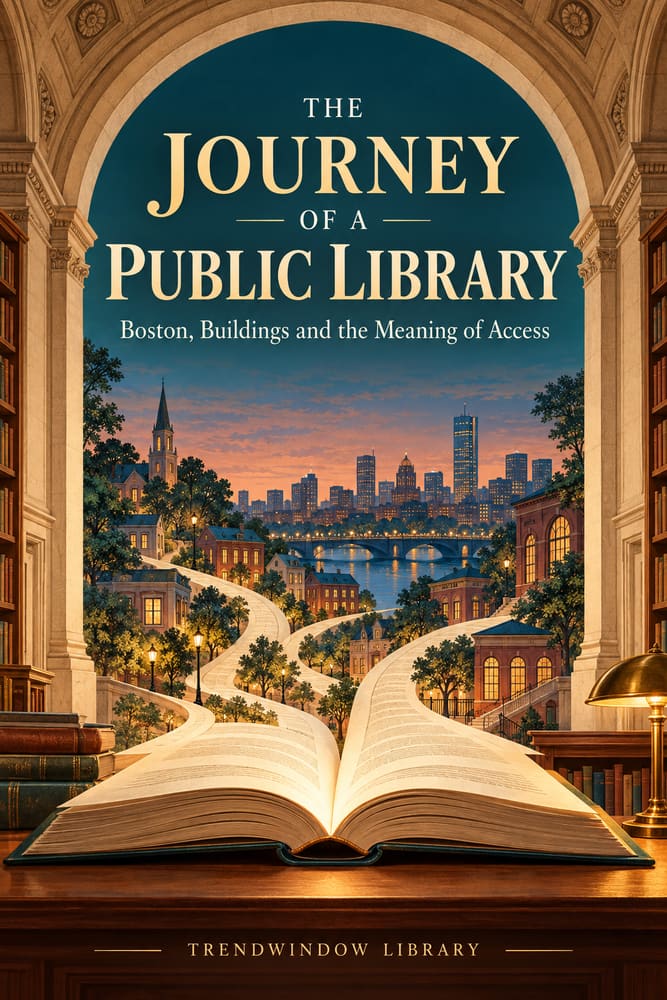
Front cover of The Journey of a Public Library

History & Culture

The Journey of a Public Library

By TrendWindow Library

A complete short cultural history following selected moments in Boston Public Library, from public opening and neighborhood branches to buildings, borrowing rules, privacy and digital collections, with sourced dates and clear interpretive limits.

First five fixed content pages only. Full-book access and purchases are not available.

1 An Institution Is Not Its Opening Day

On a map, a library is a point. In a life, it can be a route: from a question to a shelf, from a shelf to a desk, from a desk to another person who helps make the question answerable. The distinction between place and route is the thread of this short cultural history. Its documented case is Boston Public Library, not an imaginary institution and not a stand-in for every library in the world.

BPL records establishment in 1848 and a public opening on 20 March 1854 in a former Mason Street schoolhouse. [S1]

The two dates describe different events. Authorising an institution and opening a usable service are not the same achievement. Between an intention and a reader stand rooms, collections, people, procedures and decisions about how a resource will be shared. This is an analytical distinction, not a reconstruction of every step in those six years.

We will follow selected moments rather than an unbroken catalogue of events. The journey passes through a civic building, a neighbourhood branch, the work behind requesting a book and the rules surrounding physical and digital access. Each moment asks what the word public can mean in practice.

There are no invented historical conversations or visitor testimonies. Present-day thought experiments are labelled as such. The sources establish the brief facts attributed to them; the questions and interpretations are this book's own.

Begin by keeping the institution separate from its address. Buildings can change while a public purpose continues. A purpose can also remain on a wall while the arrangements needed to serve it require change.

2 A Promise Written in Stone

BPL dates the McKim building's opening to 11 March 1895; its entrance inscription states the ideal of access free to all. [S2]

An inscription does two kinds of work. It speaks to the visitor approaching a threshold, and it presents an account of the institution to the city. Its material suggests durability. Its promise concerns people whose needs, languages and circumstances do not remain fixed.

To read the promise historically, distinguish declared purpose from demonstrated experience. A motto is evidence that an institution chose to declare an ideal. It is not proof that every person, at every time, encountered no barrier. Nor should a present reader dismiss an ideal as meaningless simply because implementation needs examination.

The useful question is what arrangements give the words practical force. Can someone find an entrance? Can a question be asked without already knowing a catalogue term? Is an item available to consult, to borrow or only under particular conditions? These are different forms of access, not interchangeable measures of welcome.

This book does not claim to have surveyed historical visitors or audited present compliance. It reads the contrast between a public promise and the work needed to keep that promise usable. The distance between them is where institutional history becomes more than a list of construction dates.

A threshold, then, is both a physical feature and a useful question: what has to happen before the person outside can become a reader inside?

3 Architecture Is Also a Social Record

The National Park Service record 73000317 lists art, architecture and social history among the library's areas of significance. [S3]

Those categories suggest more than one way of looking at a civic building. An architectural reading asks about form and construction. A social reading asks about the activities those forms organise. Neither requires us to imagine that a building mechanically determines every experience inside it.

Consider a reading room as a thought experiment. A seat, a table and light are not a complete library. Yet without suitable conditions for using a book, a collection may remain formally available and practically difficult to consult. The room and the record of what it holds need each other.

There is a tension here between monument and service. A monumental space can declare that shared learning deserves dignity. It can also be read at a distance as something intended for somebody else. Which response a particular visitor had needs evidence; the building's grandeur alone cannot settle it.

When we read cultural history through architecture, the goal is therefore not to award a building a simple score of welcoming or forbidding. It is to ask how design, management and a visitor's circumstances meet. The same doorway can be photographed as a symbol while remaining part of an ordinary journey to a desk.

The cover of this edition is conceptual original artwork. Its arches and book-shaped paths do not document an exact room, street arrangement or historical view. They illustrate the question; the collection and institutional records supply the history.

4 The Neighbourhood Changes the Map

East Boston's reading room opened 28 November 1870; formal dedication followed 22 March 1871, according to BPL's anniversary account. [S4]

Here again, two dates need not contradict one another. A beginning of use and a formal ceremony may describe different stages. Flattening them into one convenient date would make the chronology less clear rather than more concise.

A branch changes the map of access. The analytical point is not simply that a system has another building. A service's location affects the route someone must take to use it. The existence of a central collection does not by itself answer every question about reaching it.

Imagine two present-day readers, solely as a thought experiment. One can readily make a long journey; the other has a short interval between responsibilities. The same nominal opening may offer them different practical possibilities. This is not a claim about two documented Bostonians or a calculation of historical travel times. It explains why the geography of a service belongs in its cultural history.

The centre and the branch should not be placed in a false competition. A local point of access and a larger shared collection can answer different needs. The important historical questions concern their relationship: what is provided locally, what connects the locations, and how a person finds the next useful step.

The library's public character is therefore a matter of distribution as well as declaration. A map of buildings is the beginning of that story, not the whole measure of who can use them.

5 The Work behind a Request

BPL describes historical closed stacks, staff retrieval and a pneumatic request system with a book railway at the McKim building. [S5]

The detail makes visible a distinction between holding an item and placing it in someone's hands. A reader's request is not identical to the stored object. Something must connect them. In a cultural history, that connective labour belongs beside the architecture rather than disappearing behind it.

A catalogue supplies one connection, but a catalogue entry does not move a book. A request supplies another, but a request still needs interpretation, retrieval and a place to be fulfilled. This is a functional reading of the described arrangement, not an invented account of a particular staff member's shift.

It also complicates an easy contrast between old and new. A visible technological device may attract more attention than the judgement required to use the arrangement. Conversely, describing human work should not erase the material systems through which it takes place.

For the reader, the apparently simple event is obtaining an item. For the institution, the event rests on a chain of responsibilities. The chain can remain largely invisible when it works. A history that looks only at ceremonial openings misses that ordinary continuity.

Ask of any library record: does it describe ownership, discoverability, retrieval or use? The answers may overlap, but they are not synonyms. An institution can preserve something without making it immediately available in every form to every requester.

Explore more book previews →