BOOK PREVIEWS · First five content pages · Purchases not yet available
TrendWindow

← Book Library · Five-page preview

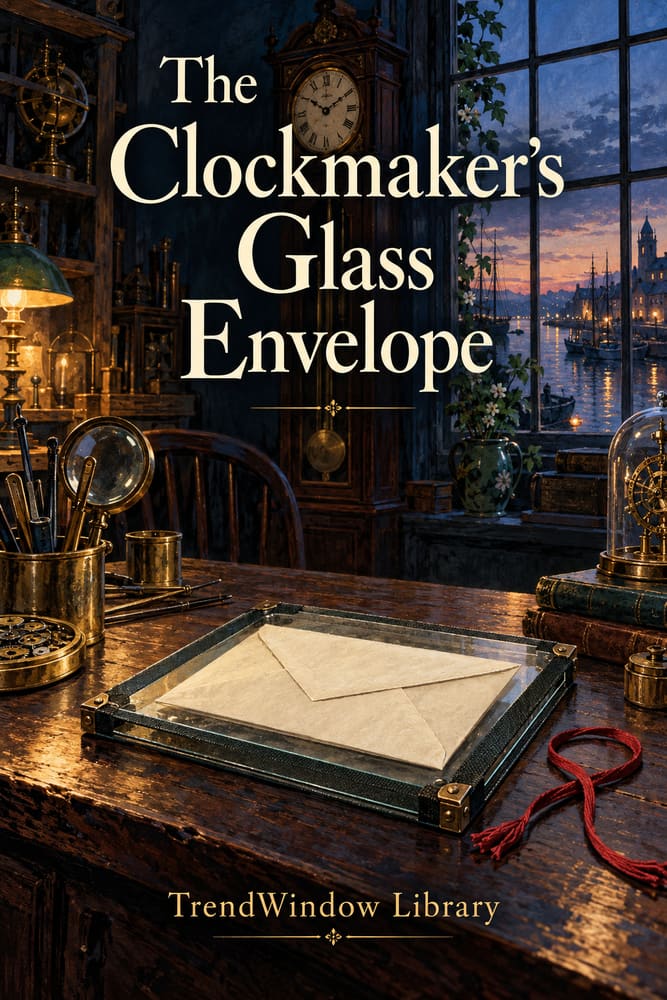
Front cover of The Clockmaker’s Glass Envelope

Mystery, Crime & Thriller

The Clockmaker’s Glass Envelope

By TrendWindow Library

A complete original short mystery: a vanished museum loan draws Mara Venn into a careful search through photographs, movement slips and a transcription that has quietly changed a maker’s story.

First five fixed content pages only. Full-book access and purchases are not available.

1. The Missing Rectangle

Mara Venn arrived at the Bracken Clock Rooms carrying the wrong kind of bread. Ada had always preferred the dark loaf with the cracked crust. Three months after Ada's funeral, Mara still bought it on days when she meant to visit the workshop, then remembered halfway down the hill that nobody there would ask whether she had eaten.

The museum occupied two rooms above a shuttered ironmonger's shop. From the landing came seven different ticks and the restrained voice of Edwin Saye, its director.

“Don't touch the cabinet,” he said.

There was a pale rectangle on the faded green lining. Yesterday it had held a sheet of paper between two thin panes of glass, secured around the edges with cloth tape. Ada had called it an envelope because the paper could be seen but not handled. A red thread lay loose beside the empty space.

The envelope was the centre of Saturday's exhibition. Its letter was supposed to show that Arthur Bell, the town's celebrated clockmaker, had designed the harbour clock alone. Celia Rook, whose family had lent the letter, was due at eleven to approve the display.

“When did you last see it?” Mara asked.

“After you left yesterday. Before I locked up.”

That sounded like a time, but was only a position in a story. Mara had left twice: once for bread at six, then finally after helping Ada's former pupil Kit pack the demonstration table.

Edwin looked at the loaf under her arm.

“You still have Ada's cabinet key.”

Mara put the bread down very carefully. “Yes,” she said. “But let's establish what is missing before we establish who you think took it.”

2. A Letter with Two Names

Ada's catalogue described the object in a handwriting so small that visitors mistook it for a printed label. Glass envelope; four taped edges; folded cream sheet; star-shaped loss at upper right; red cotton handling tie. No valuation. Ada disliked prices beside things people had made with their hands.

Mara read the exhibition panel propped against the wall. ARTHUR BELL: THE SINGLE MIND BEHIND BRACKEN'S CLOCK. Edwin had commissioned a handsome drawing of Bell leaning over a wheel. In the corner, a young woman carried a tray.

“Who is she?” Mara asked.

“An illustrator's detail.”

The catalogue named Lydia Norr as Bell's workshop assistant. Mara remembered Ada circling the name in pencil and saying that assistant was a word with a particularly roomy pocket: people put entire lives into it.

The displayed letter had never been unfolded during Mara's visits. Its visible opening thanked a customer for patience with the harbour mechanism. Edwin's typed transcription continued for a page. It ended with Bell accepting sole responsibility for the design.

There was another note in Ada's catalogue: interior text to be checked against donor's photograph before interpretation approved.

Edwin reached for the book. “That was an old working note.”

“Was it checked?”

“Celia approved the transcription.”

“Against what?”

His reply was interrupted by Tomas Benn, the caretaker, arriving with a cardboard tray of tea. He looked at the empty cabinet and set the tray on the floor.

“Not the glass packet,” he said. “After all that business last night.”

Edwin's chair scraped against the boards.

3. Last Night, in Pieces

Tomas had not meant anything sinister. The business was a leaking radiator in the west room. Water had reached the bottom of the display stand, and somebody had moved the objects while Tomas shut the valve. He had gone downstairs for a bucket. When he returned, everything looked orderly.

“At what time?” Mara asked.

“After seven. Before half past. I wasn't watching the clock.” He glanced around the room and almost smiled.

Edwin said the envelope had been returned to the cabinet afterwards. Mara asked whether he had seen it there or assumed it had been returned with the other items.

“I dealt with the move,” he said. “I'm telling you it was secure.”

Kit arrived at ten carrying yesterday's empty biscuit tin. At twenty-two, he had inherited Ada's habit of saving useful containers and none of her ability to remember where he put them.

“We finished the school table at about twenty past seven,” he told Mara. “You went down with me.”

She remembered the door closing, then the cold handle of her bicycle. She had not returned. Her key was still on the ring with the chipped blue tag, hanging inside her coat.

Kit had photographed the demonstration table for a teacher. In the edge of the picture, beyond a wooden model clock, the museum cabinet appeared open. The envelope's pale rectangle was empty.

The photograph did not establish who had removed it. It established something narrower and useful: the cabinet was already empty while Mara and Kit were still packing, not only after she had finally left.

4. The Window That Wasn't an Answer

Celia arrived early. She wore a raincoat the colour of wet slate and carried a folder tied with green ribbon. Edwin met her on the landing, speaking too quickly. From the west room Tomas called that a window latch was loose.

For a moment, everybody looked relieved. A window offered a stranger. A stranger offered a reason not to examine the room's familiar people.

Mara went no nearer than the doorway. The latch had been troublesome for weeks. Ada had put a folded card beneath it to stop the rattle; the card was still on the sill. Tomas confirmed that he had opened the window himself while dealing with the radiator.

“Then it tells us about the radiator,” Mara said. “It doesn't tell us where the envelope went.”

Edwin proposed calling the town watch and closing the rooms. Celia agreed that the missing loan had to be formally reported, but first wanted the movement record and a clear account of what had happened. She would not have staff accused through hints in a corridor.

The museum used a book of numbered object-movement slips. Whoever temporarily moved a loan wrote its name, destination and time, then signed. The original stayed in the book; a detachable copy travelled with the object. It was a simple system, and Ada had insisted on it even when the destination was the other side of a table.

Edwin said there had been no time for paperwork during a leak.

Tomas rubbed a thumb across his palm. “I remember a pencil,” he said. “I remember you asking me for one.”

5. The Slip in the Return Tray

The movement book lay beside a box of spare labels. Its last used page concerned a model escapement taken to the school table. The next page was blank. Edwin lifted both hands, as though the book had settled the matter.

Kit was searching the return tray for his teacher's address when he found a thin white sheet beneath a receipt for light bulbs. Across the top were the words GLASS ENVELOPE. Below them, in Edwin's square writing: dry storage, north dial base, 19:05. His signature filled the bottom line.

It was not the detachable copy. It was the original sheet, removed from the movement book.

“That's mine,” Edwin said at once. “I put it there to enter properly later.”

Mara did not reach for it. Celia asked Kit to set it flat where everyone could see it, then wrote down who had found it and where. The slip explained a movement; it did not explain why Edwin had subsequently said the envelope was back in the cabinet.

“North dial base?” Celia asked.

The tall demonstration clock against the far wall had a hollow wooden plinth. Edwin had the plinth key on his ring. At Celia's request he opened it while Tomas held the door clear.

Inside stood a padded box, high above the floor. On its lid was the detachable copy of the same movement slip. Inside the box, between folded cloths, lay Ada's glass envelope.

No one applauded. Finding the object made the room safer for the loan and less comfortable for its director.

Explore more book previews →