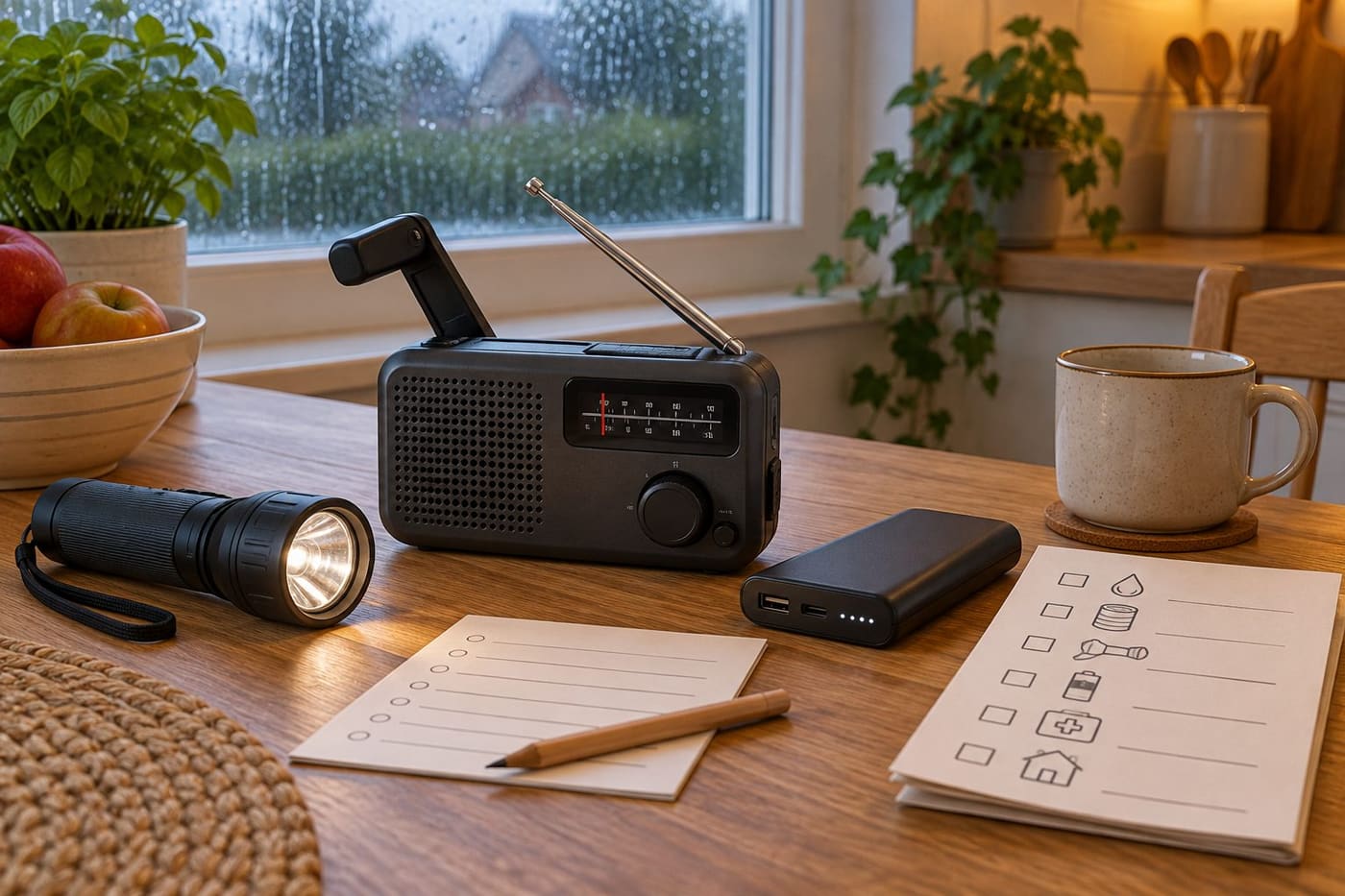
A wind-up radio is useful for one specific reason: it can receive broadcast information without depending on mains power at the moment you need it. UK government preparedness guidance recommends keeping a battery or wind-up radio at home, writing down local or national station frequencies and checking FM as well as digital modes. Ofcom likewise advises households to consider a battery-powered, wind-up or solar radio during severe weather. That makes a small radio a sensible backup, not a promise that every station will remain on air or that a hand crank can replace a complete household plan.
This guide explains how to choose, test and store a radio for a UK household. It does not claim that a particular model has been independently tested. Research checked 26 October 2026; check the current advice and your local broadcasters before relying on any frequency or device.
What a hand-crank radio actually provides
A hand-crank radio combines a receiver with one or more ways of supplying power. Depending on the model, it may use a rechargeable internal battery, replaceable cells, a small solar panel or a USB charging input. Turning the crank drives a generator that puts some energy into the internal system. The radio then receives whatever supported broadcast signal is available in the area.
The crank is not magic and it does not make the radio independent of every other failure. The amount of useful listening time produced by a given number of turns varies by model, battery condition, volume, lighting use, reception and the device’s electronics. A manufacturer’s claim may be measured in ideal conditions. Treat it as a specification to check, not a universal runtime guarantee.
The key value is a path to information when a phone battery is low, home broadband is unavailable or a local power cut has interrupted television and internet equipment. A broadcast can carry updates to many listeners at once. But the transmitter, studio, distribution links and household receiver all have to work. Radio is a backup channel, not a substitute for official instructions, emergency calls, a charged phone or neighbouring support.
Start with UK preparedness advice
The UK Government’s Prepare guidance for power cuts says to keep a battery or wind-up radio and spare batteries at home, write down frequencies of local or national stations, and try FM and digital modes. The national Be Ready emergency checklist lists an FM radio powered by batteries or a wind-up mechanism and suggests noting station frequencies. Ofcom’s severe-weather guidance also mentions battery-powered, wind-up or solar radios, including AM, FM and DAB options, for receiving local-authority or government updates.
These are practical recommendations, not an instruction to buy a particular product. The useful lesson is to plan the whole information route before an outage: know which stations cover your area, understand which bands your receiver supports and verify that it works away from its charger. If you live in a rural area, a valley, a basement flat or a building with heavy walls, test reception where the radio would actually be used.
Choose the bands that match your area
Product descriptions often list FM and DAB; some also list AM. Those labels do not tell you whether a station is receivable in your home. The right choice depends on local broadcast coverage and the outlets that carry useful emergency updates.
- FM: Many portable receivers support it. Reception can change with location, building materials, antenna orientation and interference.
- DAB: It can provide digital stations where coverage and the radio’s supported standard allow. A DAB-only device is not automatically a better emergency radio if FM is the more dependable option in your location.
- AM: Some models support medium-wave or long-wave reception, but do not assume a local service uses a band merely because the radio has it.
- Internet radio: This depends on connectivity and often more power. It may be useful in ordinary circumstances but should not be the only offline option.
Before buying, check the radio’s actual band list and compare it with local station information. A list of frequencies written down in advance is more useful than trying to discover the tuning controls in the dark. If a station changes frequency, update your household card when you learn about it.
Compare the whole device, not the word “emergency”
Marketing terms such as “emergency radio” do not establish reception quality, battery capacity or durability. Read the manual and look for details that can be checked:
- which broadcast bands and digital standards it receives;
- whether it uses a replaceable or built-in rechargeable battery;
- the maker’s stated crank charging and listening-time conditions;
- whether a torch or alarm drains the same battery used by the radio;
- how it charges from USB or solar input, if included;
- whether it can play while charging, and any limits stated by the maker;
- antenna design, controls, display visibility and available support information;
- water-resistance claims, if any, and the test standard attached to them.
A radio that is easy for household members to tune may be more useful than a feature-rich model with confusing menus. If someone has limited grip strength, reduced vision, hearing loss or difficulty reading a small display, assess the controls and speaker with that person in mind. A crank can require sustained effort. Do not assume it is the only power method an older person or someone with a disability can use.
Make a one-page information card
A simple card can keep the radio useful when phones are busy or uncharged. Write down the station name, frequency or tuning method, the area it serves and the official online page where you can verify current details later. Keep the card beside the radio and another copy with your household emergency plan. If your region has more than one relevant broadcaster, list alternatives.
Do not copy a frequency from an old forum post without checking the broadcaster. A station may have more than one transmitter, and a frequency that works in one town may be poor a few miles away. Digital tuning may show a station name instead of a frequency; record both the menu path and the station label if that will help another household member.
The card should also point to trusted official sources, such as your local council, the UK Government’s emergency guidance and your electricity network operator’s outage page. Radio can provide one-way information; an operator’s website or emergency service may be needed for a specific fault or instruction when connectivity is available.
Test it before there is a power cut
Testing does not mean simulating a disaster. It means checking ordinary operation in a calm, safe setting. Once every few months, and after long storage, use a short checklist:
1. Turn it on using the normal battery or charged-battery method.
2. Tune to the station you wrote down, then try the backup station.
3. Check reception in the room where you would keep the radio.
4. Confirm the volume is comfortable and the controls are understandable.
5. Check the crank, charging cable and any spare cells against the manual.
6. If the radio has a torch, test it separately and note whether it shares power.
7. Return the radio to its marked storage place and update the household card if anything changed.
Avoid leaving a rechargeable device unattended while charging if the manufacturer warns against it. Do not store loose batteries where they can short against metal objects. Follow the product manual for charging, cleaning and long-term storage; generic advice cannot override the model’s safety instructions.
Plan power without relying on constant cranking
The hand crank is a reserve method. If your model can be charged in advance, keep its internal battery at the manufacturer-recommended storage level and periodically check it. Spare batteries are useful only if they are the right type, in date and stored safely. A small power bank may help charge compatible equipment, but it also has a finite capacity and should be maintained.
If the radio includes a solar panel, think of it as a supplementary charging method. Output depends on light, panel size, angle, weather and how the unit is positioned. A small panel behind a window on a dim winter day should not be treated as a guaranteed full charge. If you have a compatible USB supply, test that route ahead of time and keep the correct cable beside the radio.
Use the receiver efficiently. Lower volume can reduce energy use on many devices, though the effect varies. Turn off a torch or other features when they are not needed. Keep the radio in a place where it can be reached without searching; avoid leaving it in a damp shed, a hot car or a sealed box that prevents access to the controls.
Keep a reception log, not a product score
Here is an original example of a useful household test note: “Kitchen table, battery mode, station name confirmed, speech clear at comfortable volume; bedroom shelf, same station intermittent; backup station usable.” This is a suggested format, not the result of testing any radio. It helps distinguish a device that turns on from one that delivers intelligible information in the place you plan to use it.
Change one variable at a time during a calm indoor check. If you move the receiver, change the station and switch power sources together, you will not know which change improved reception. Write down the location and mode that worked. Keep the instructions simple enough that another household member can repeat them without needing your phone or an online tutorial.
Do not switch off household electricity, disconnect telecare or call emergency services to test a receiver. Normal battery operation is enough to check its basic controls. If you cannot receive your chosen station, consult the broadcaster’s coverage information and the manufacturer’s guidance. A failed test is a reason to revise the information plan, not to walk into hazardous weather with an aerial.
For the wider arrangements, use our [three-day household planning guide](https://monetizearticle.com/article/uk-be-ready-guidance-build-a-three-day-household-plan-around-what-you-already-have-bf4a07). This article concentrates on the receiver, its power options and a repeatable listening check; it does not replace a plan for contacting help.
Check the exact model and regional version
A manufacturer’s documents provide a useful example of why names alone are insufficient. Sangean’s European MMR-88 specification sheet lists AM/FM reception and USB-C charging, while its FCC product page shows a version with a weather band and Micro USB input. Those are manufacturer descriptions, not our performance measurements. A shopper should match the exact regional model and manual to the unit being sold rather than combining features from different pages.
Treat a weather-band label on an imported model particularly carefully: it does not establish a UK emergency-broadcast service. Likewise, the presence of a USB output does not prove it can supply the power required by every phone or medical device. Confirm the equipment’s own requirements and the radio manufacturer’s limits. This is a document-checking example, not a recommendation to buy this brand or an assurance about current stock, price or UK reception.
Common claims to treat carefully
“A wind-up radio works forever.” No. The crank supplies limited energy and the result varies by device and conditions. It is sensible to test both the crank and other power methods.
“DAB is always the best option.” No. Coverage and station availability vary. A receiver that supports several useful local modes may give you more options, but check reception in your own area.
“The radio will work even if every broadcast system is down.” No receiver can provide a signal that is not being transmitted. The radio can reduce dependence on home internet, but broadcast services can also be disrupted.
“A hand crank is enough for all emergency communication.” It only supports listening on the radio. It does not power every phone, restore a landline or send a message to your family. Build a separate plan for two-way communication.
“An expensive model is automatically safer.” Price alone does not prove that a radio receives the stations you need or can be operated by everyone in your home. Compare verifiable specifications and test the device.
A compact buying and storage checklist
Before choosing a model, ask: Can it receive a useful local station? Can the people who may need it tune it? Does it have a power method they can manage? Are the battery and charging directions clear? Are its limitations stated? Does the total cost fit your budget without displacing essentials such as lighting, water or medication?
After purchase, record the model and manual location, add tested station details, charge or store batteries as directed and show household members the basic controls. Place the radio where it can be reached safely. Revisit the plan when you move, a broadcaster changes service or a family member’s needs change.
Conclusion
A wind-up radio is a practical information backup during a UK power cut because it can receive broadcast updates without mains power at the point of use. Its usefulness still depends on the supported band, reception, device condition, available broadcast service and the listener’s ability to operate it. UK Government and Ofcom guidance support keeping a battery, wind-up or solar radio and noting local station information, but neither makes a single model or runtime guarantee.
Choose a receiver that suits local coverage, test it in the room where it will be kept, write station details on paper and include the radio in a wider household plan. Keep current official instructions in view and follow situation-specific advice. The goal is a dependable extra route to information, not the illusion that one gadget can solve every outage.
Sources and research note
- UK Government Prepare, “Power cuts”: https://beready.campaign.gov.uk/be-informed-about-hazards/power-cuts/
- UK Government Be Ready, “Be ready for emergencies”: https://beready.campaign.gov.uk/be-ready-for-emergencies/
- Ofcom, “Stay connected in severe weather”: https://www.ofcom.org.uk/phones-and-broadband/vulnerable-customers/stay-connected-in-severe-weather
- UK Government Be Ready, “Phone and broadband outages”: https://beready.campaign.gov.uk/be-informed-about-hazards/phone-broadband-outages/
- Sangean, [European MMR-88 specification](https://web.sangean.com/files/0000143_MMR-88_en_dm_eu_0.pdf), [FCC product variant](https://www.sangean.com/product/mmr-88-fcc-yellow) and [manufacturer manual](https://web.sangean.com/files/0000144_MMR-88_manual_0.pdf). Specifications are attributed, not independently tested.
Google Trends GB RSS snapshot `trends-GB-1504.xml`, retrieved about 15:04 Dhaka on 25 October 2026, listed “wind up radios” at approximate 1,000+ traffic. Trends is a discovery signal, not proof of population-wide demand. Official pages were reopened and two limited phrase queries checked wording; this is not a comprehensive plagiarism review. The household reception-log example is original and hypothetical. This focused equipment guide is not counted as another independent trend. Research checked 26 October 2026. Original AI-assisted article. The unbranded radio-and-checklist illustration is an original built-in generation, not a photograph or a specific tested product.