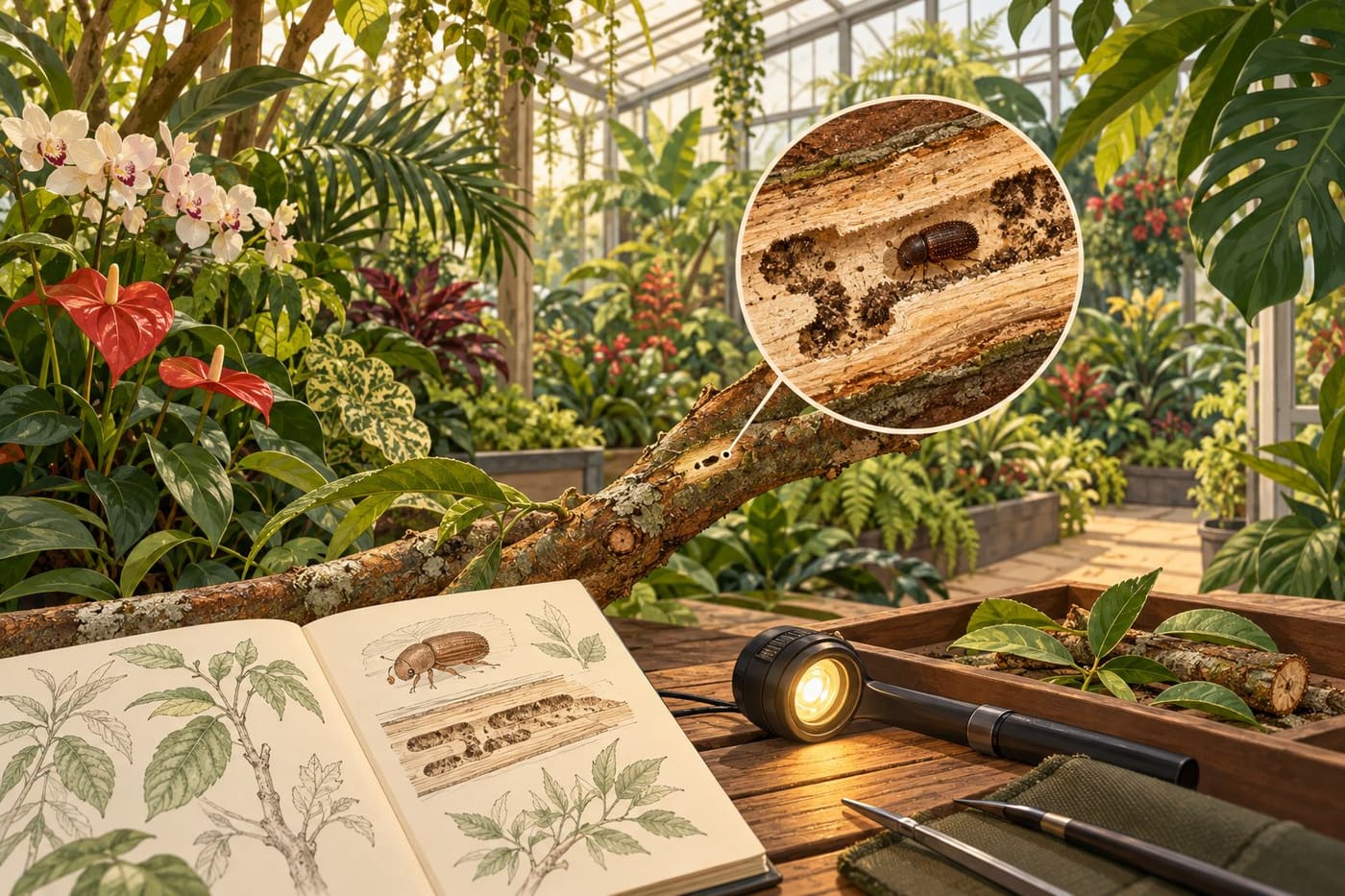
Wildlands Adventure Zoo Emmen says the Dutch Food and Consumer Product Safety Authority, NVWA, will carry out an expanded survey in the Rimbula tropical greenhouse from 2 to 13 November 2026. The zoo expects the greenhouse to reopen to visitors at 1 p.m. on working days during that period. The work follows multiple findings of the regulated ambrosia beetle Euwallacea fornicatus sensu stricto, first detected at the site in 2024. The full extent of its presence is not yet known, the NVWA says.
The announcement is a useful case study in plant-health surveillance: why a small insect can require a careful survey, what inspectors look for, and why a public update should distinguish a confirmed finding from an unresolved question. This guide is based on information available on 25 October 2026. It does not diagnose plants or imply that a pest has spread beyond the greenhouse.
What is happening at Rimbula
Wildlands says its staff will record trees by name and type, while NVWA inspectors investigate where the beetle occurs and which plants or plant parts may be affected. The inspection includes visual checks, followed where needed by closer examination of suspect areas. The zoo notes that damage may not always be visible on the outside of a plant, so additional investigation may be necessary. The survey is intended to clarify the scale and character of the presence and inform decisions about next steps. [Wildlands’ 23 October announcement](https://www.wildlands.nl/onderzoek-in-grote-kas-rimbula-na-aanwezigheid-van-schorskever).
For visitors, the practical detail is specific: the work is scheduled on weekdays from Monday 2 November through Friday 13 November, with Rimbula expected to be accessible from 13:00. The announcement says the survey takes place in the morning and during a quieter visitor period. It describes access to the greenhouse, not a closure of the entire zoo. Before travelling, check the zoo’s current notice in case the schedule changes.
The distinction between a survey and a final determination matters. The survey is being conducted because officials need better information. Its announcement does not provide a final count, a completed eradication result, or a conclusion about every plant in the building.
Why the name matters
The NVWA identifies the organism detected in the tropical greenhouse as Euwallacea fornicatus sensu stricto. In its current overview, the authority says the beetle was found there in 2024, that plant-health measures have been in force since then, and that additional findings occurred in 2026. It also says the extent is not yet fully known and that an intensive survey is under way. [NVWA overview of non-European bark beetles](https://www.nvwa.nl/onderwerpen/plant/plantenziekten-en-plagen/scolytinae).
The phrase “sensu stricto” identifies a narrower taxonomic grouping. It is useful because common names can cover organisms that are related but not identical. In public communication, retaining the authority’s scientific name avoids turning every bark beetle into the same pest or implying that a finding of one organism proves a broader outbreak.
The NVWA says this beetle belongs to the ambrosia beetles and carries fungi. Its risk page explains that serious tree damage has been associated with beetles and fungi in some regions, while establishment outdoors in the Netherlands is considered likely only in greenhouses. These are risk assessments and context, not evidence that local trees outside Rimbula are infected. [NVWA risk explanation](https://www.nvwa.nl/onderwerpen/plant/plantenziekten-en-plagen/scolytinae/wat-is-het-risico-van-niet-europese-schorskevers).
That boundary is important. A pest’s potential to cause harm under some conditions is not the same as a verified consequence at a particular site. A careful article identifies who made the assessment, where it applies and what investigators still need to determine.
The beetle and its fungal partners
Ambrosia beetles are known for a close association with fungi. The European and Mediterranean Plant Protection Organization, EPPO, describes E. fornicatus biology in its datasheet. Female beetles make galleries in woody plant tissue and carry fungal partners in specialized structures. The cultivated fungi provide food for developing beetles; some associated fungi can damage plant tissue. [EPPO datasheet for E. fornicatus sensu stricto](https://gd.eppo.int/taxon/EUWAWH/datasheet).
This partnership helps explain why surveillance may examine both insects and plants. Finding a small beetle is one question; determining its identity, host association and associated plant effects can require further work. It would be misleading to infer all of those answers from a surface mark alone.
The NVWA says most bark beetle species are difficult to discover because much of their life cycle occurs in wood. It notes that potential indicators include tiny bore holes, but signs alone cannot establish that a plant has Euwallacea or another scolytine beetle. The authority says destructive sampling may be needed to detect beetles, pupae or larvae and determine whether they are alive; expert identification, sometimes supported by molecular methods, is needed for species-level conclusions. Special attractant traps can also help detect adults when they are outside host plants. [NVWA identification guidance](https://www.nvwa.nl/onderwerpen/plant/plantenziekten-en-plagen/scolytinae/hoe-herkent-u-niet-europese-schorskevers).
These methods are not a do-it-yourself checklist. Cutting into a plant or moving suspect material could disrupt professional control measures. For a public visitor, the useful lesson is simply that a tiny sign is a reason for qualified assessment, not a reliable diagnosis.
Why a plant inventory helps
Wildlands says staff will map and register trees by name and type, while inspectors examine where the beetle occurs and which plants or plant parts may be affected. That inventory gives investigators a structured way to describe what was examined and connect findings with particular plants or zones.
Imagine a fictional greenhouse divided into several sections. If inspectors record only that “a beetle was seen,” later teams cannot readily tell which plants were checked, where a sample came from or whether a follow-up observation refers to the same area. A zone map and plant register provide a shared frame for observations. This example illustrates record-keeping; it does not describe Wildlands’ unpublished findings.
The survey can also help authorities decide what further work is proportionate. If evidence is concentrated in a small area, the investigation may focus there; if it is broader or uncertain, additional sampling may be appropriate. The zoo’s notice does not predict which outcome will result, and readers should wait for the responsible authorities to publish any conclusions.
Good surveillance makes uncertainty visible. It records what was searched, the method used and what remains unknown. A count without context can mislead: a number may describe trapped adults, sampled plants, visible signs or confirmed live specimens. Those are different measures and should not be substituted for one another.
What regulated plant-health response means
The NVWA states that E. fornicatus is a regulated organism and that measures aim to prevent spread and eliminate it. Its general page describes a monitoring process that can follow treatment or other measures before officials determine whether an infestation has been eradicated. The duration and steps depend on the organism and conditions. [NVWA measures after a finding](https://www.nvwa.nl/onderwerpen/plant/plantenziekten-en-plagen/scolytinae/maatregelen-bij-vondst-niet-europese-schorskevers-scolytinae).
That staged approach is one reason headlines should not jump from “inspection planned” to “pest eliminated” or “outbreak spreading.” Monitoring, sampling, identification, treatment and release from measures are separate events. Officials need evidence at each stage before reporting the next conclusion.
The EPPO database documents the distribution and biology of plant pests, but a database entry is not a live site-level report. Its datasheet includes material dated 2024; readers should treat such entries as background and consult the NVWA for the current Dutch status. A historical record may help explain why a species matters without answering what inspectors found this week.
Plant-health rules also explain why prevention is part of the wider picture. The NVWA advises against bringing plants or plant products into the Netherlands casually because they can carry pests and diseases. For many plants, seeds, bulbs and fresh produce arriving from outside the European Union, a phytosanitary certificate and inspection may be required, subject to specific exceptions. Travellers should consult the current official guidance for their origin and item rather than rely on a broad summary. [NVWA guidance for bringing plants to the Netherlands](https://www.nvwa.nl/onderwerpen/plant/op-reis-welke-planten-dieren-en-producten-mogen-mee/ik-wil-planten-of-plantaardige-producten-meenemen-naar-nederland).
That travel guidance is general prevention advice. It does not establish that an imported plant caused the Rimbula finding. Wildlands says the route into the greenhouse is not the purpose of the announced survey; readers should not infer a source without an official investigation addressing it. Careful reporting distinguishes a pathway that is biologically possible from one demonstrated in a specific case.
A quick guide to reading the next update
When the zoo or NVWA reports new information, compare it with the original announcement rather than relying on a headline alone. A useful update should tell readers whether the work is complete, which areas or plants were examined, what identification method supported any result and whether measures have changed. It should also say whether the finding applies to the greenhouse, a particular zone or a wider area.
If the update does not answer a question, mark it as unknown. For example, “the survey found the beetle in two zones” would not automatically tell readers the total number of beetles or establish a preferred host plant. Likewise, “no beetle detected in a sample” is bounded by the sample and method; it is not proof that no individual exists anywhere. Precision about the scope of evidence makes a short public notice more useful.
Readers can also check whether a reported date describes publication, inspection or a future visitor arrangement. Those dates can be close together but answer different questions. A notice dated 23 October about a survey planned for November is a schedule, not a report of November results.
How to follow the visitor schedule and later updates
If Rimbula is part of a planned visit, check the official Wildlands notice before departure. The published plan says the greenhouse is expected to reopen daily from 13:00 on working days during the 2–13 November survey. Check whether the zoo has posted a later update, and confirm opening arrangements for the rest of the park separately.
When a survey result appears, read the date and the authority named in the notice. Look for what was measured, whether the statement concerns the greenhouse or a wider area, and whether the finding is preliminary or final. If a report gives a beetle count, check whether it is a trap total, a sample result or a confirmed count across a defined area.
For a broader risk question, prefer the NVWA’s plant-health material over an unattributed social post. The authority’s pages explain the regulated status, identification limits and response measures. EPPO provides additional scientific background. Neither source should be stretched to make a claim about a particular tree that has not been examined.
What visitors should not infer
The announcement does not say the whole zoo will close. It does not say the greenhouse is closed on weekends during the survey. It does not report the final population size, prove how the beetle entered the greenhouse, or establish that nearby gardens are affected. It does not say the investigation is complete.
The NVWA’s risk information describes possible plant effects and geographic establishment risk. That is not a public-health warning, and this article makes no claim about harm to visitors or animals. Keep any health or safety statement tied to an explicit official source rather than inferring it from the words “regulated pest.”
This careful framing is useful beyond one zoo. When an institution announces an inspection, readers can distinguish a confirmed detection from the questions the inspection is meant to answer. That keeps a local update informative without turning uncertainty into alarm.
Conclusion: wait for the survey’s evidence
Wildlands and the NVWA have described a defined inspection period, a visitor schedule and the purpose of their Rimbula survey. The beetle was detected at the greenhouse in 2024, and the NVWA reports further findings in 2026; the extent remains under investigation. The next useful update will be the one that explains what the survey examined and what its results support.
Until then, visitors can use the zoo’s current notice for planning, while readers interested in plant health can consult the NVWA and EPPO for context. A measured account keeps location, date, method and uncertainty together. That is how a small insect finding becomes a clear public explanation rather than an unsupported claim about a wider outbreak.
Research date: 25 October 2026. Visitor schedule is drawn from the Wildlands announcement dated 23 October and should be rechecked before travel. This AI-assisted article uses original editorial explanation; it does not claim first-hand inspection, professional diagnosis or a completed outbreak determination. The cover is a conceptual AI-generated illustration, not documentary imagery from Rimbula. Limited web-search similarity checks are not comprehensive plagiarism certification.