A woman walks down a corridor carrying a glass of water. At the far end she slows, takes one more step, and stops at a closed door. In the wide shot, her shoes are barely visible. In the close-up, the glass trembles in her hand. The scene may have been shot from different angles hours apart, with a microphone placed to capture her line at the door. Yet in the finished scene, the footsteps make the approach feel like one uninterrupted decision.
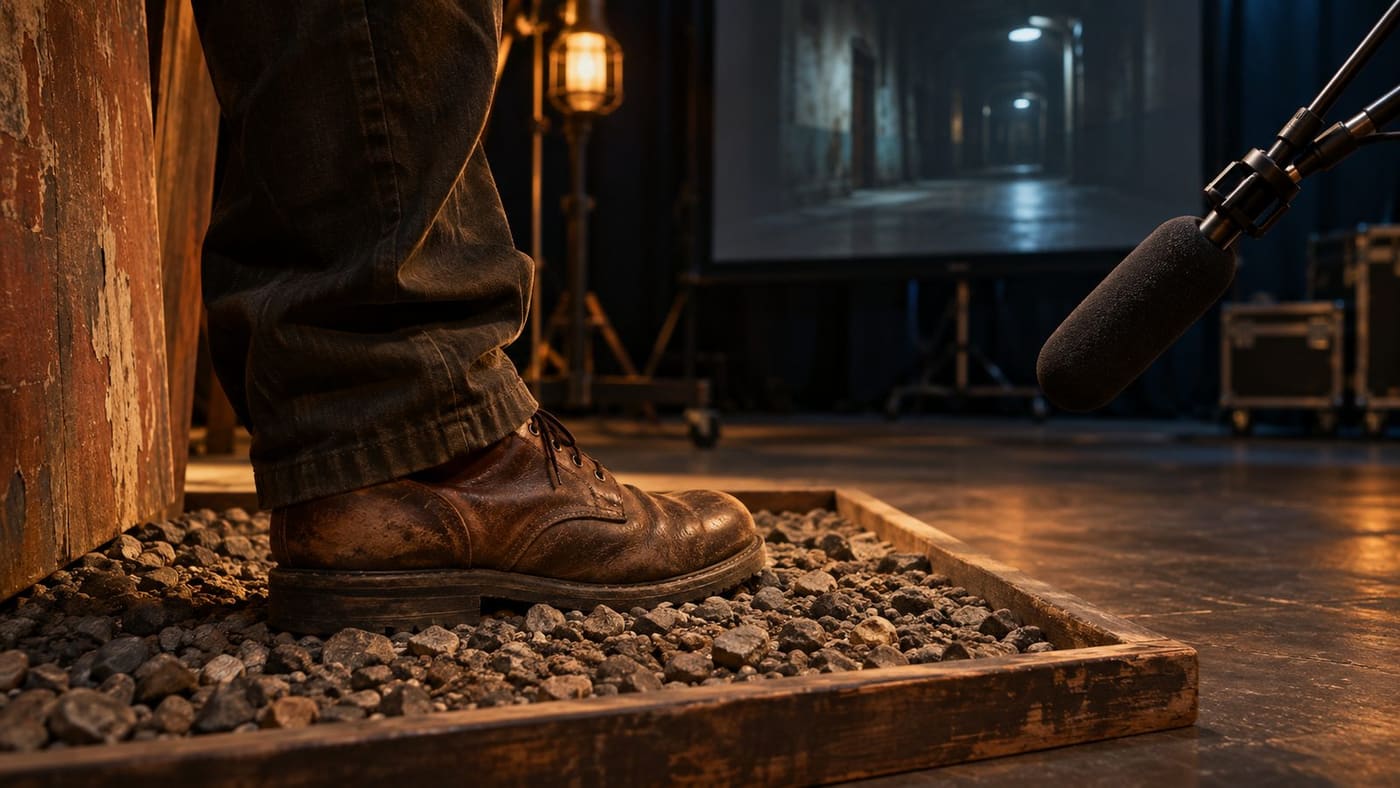
Some of those steps may have been recorded after filming. On a Foley stage, a performer watches the picture and makes sounds that follow the action. A mixer records the performance so it can be edited and placed alongside the other sounds. Footsteps are an especially clear example because the smallest changes in rhythm, surface and emphasis can alter the way a viewer understands a walk. The corridor scene is invented, but it offers a useful way to follow the job from a first viewing to the finished soundtrack.
Why the sound from the set may need help
The sound recorded during filming can be valuable. It may capture the actor's actual movement, the response of a real surface, and the relationship between action and dialogue. A quiet production recording of one shoe scraping the floor could already have exactly the sound the scene needs. A Foley pass gives the team choices when the original is hard to hear, sounds different from one shot to another, or cannot easily be adjusted on its own.
Think about the corridor across three shots. In the wide shot, the production microphone may favor the voice far down the hall. In a closer angle, it may catch more of the actor's jacket or the sound of a crew member moving nearby. The floor itself may sound different where the shot was staged. Once those angles are cut together, the viewer sees one continuous hallway. The separate recording makes it possible to carry a similar shoe and surface through that sequence while still retaining the dialogue or any useful location detail.
There is also an advantage in having independent controls. If the decisive step and the actor's first word occur together on the same recording, lowering one may also lower the other. A separate footstep track can be adjusted without making that same change to the word. The Academy's sound and music activity guide describes Foley as performance done while watching the picture and includes movement such as footsteps, clothing and props among the sounds it can supply.
Find the gesture inside the walk
Watch the invented corridor scene first with the idea of marking the visible contacts. The heel makes contact, then the sole settles. At the next step a cut hides the moment of impact, but the movement of the actor's shoulders suggests where it belongs. Near the door she shifts her balance and draws her back foot inward. A performer can use these cues to play a connected movement rather than placing an identical sound at every visible shoe position.
The difference becomes easier to hear if you imagine two versions. In the first, she is about to knock at an apartment where she is expected. The pace is ordinary, and there is a small scuff as she comes to a familiar stop. In the second, she has heard an argument behind the door. The pace falls away, weight gathers on one foot, and the other foot moves cautiously forward. The sequence of visible contacts might be similar in both versions. The character of the movement comes through in the force, gap and texture between them.
A performer can also decide which movement deserves a distinct sound. Every contact in the wide shot does not need the same prominence. A pause may be more effective if one step falls almost out of hearing, while a final scrape announces exactly where the person stopped. This is one reason a continuous take on the Foley stage can be valuable. Even if the editor uses only parts of it, the performer can build a rhythm across the whole action and give the editor material with a coherent pace.
Choose the shoe and surface by listening
A Foley stage can offer several surfaces and shoes. The first question is what the audience needs to hear about the contact. A heel can make a hard tick. A softer sole may spread the impact and give more emphasis to friction. A step on loose material might contain a short burst of movement after the initial impact. Skywalker Sound describes its Foley stage work as original sound performance and recording, with examples ranging from footsteps to prop movements.
In the hallway example, the frame might show stone while the desired effect is a faint tap followed by a slight drag. Testing a few shoes on a hard surface is a way to find that pair of sounds. A literal match between the prop and the photographed material can be a useful starting point. How the recorded sound fits the image and the other tracks decides whether it belongs. The image tells a viewer what the floor looks like, while the mix supplies a specific impression of contact with it.
Consider the glass in the actor's hand. If the water moves subtly, a large splash would imply a different gesture. A faint sound from the hand changing its grip could be enough to draw attention to the close-up. The performer can record that detail separately from the steps. If it distracts when heard with the dialogue, the mix can turn it down or leave it out. Having a separate piece of sound creates the opportunity to make that choice after hearing the scene together.
Align contact, rhythm and the cut
A sound can be technically close to a visible step and still feel wrong. The contact might be early enough to suggest that the foot has hit the ground before it does on screen. A heavy sound can also make a light step seem to belong to someone elsewhere. Where the frame shows the heel hitting the surface, that contact provides a strong reference. Where the feet disappear, the editor can use nearby movement and the established pace to decide where a sound will make sense.
In one version of the scene, a wide shot ends with the left foot descending and the close-up begins on a hand holding the glass. A step that crosses the edit can preserve the sense of motion. Another edit might cut from the approach directly to the moment the woman is standing still. Carrying one more step across that cut could make the transition feel late. The best timing depends on which movement the edit implies between the two shots.
Editing gives the team ways to refine a performance after recording. They can move a contact slightly, choose a stronger ending from another take, or leave a gap where the original recording already has a useful sound. When the timing is delicate, it helps to review the whole sequence at normal speed. A tiny mismatch that looks obvious in frame-by-frame review may be inaudible with the full mix, and a technically accurate isolated contact may still disrupt the pace of the scene.
Give a close recording a place in the room
A recording can be clean and precisely timed while sounding as though the foot is much closer than the camera suggests. This is an issue of perspective. In a wide hallway shot, footsteps might sit below the ambient room sound, with enough reflection to feel part of the space. In a tighter shot, the same approach could bring a scrape into focus. The change can follow what the scene wants the audience to notice, which may differ from a strict reading of the camera's distance.
The scene might also stay visually close while the steps grow less prominent. If the woman listens at the door, the mix can shift attention toward a faint sound from the room beyond it. A prominent footstep at that moment might pull the listener's attention back toward the corridor. An earlier, sharp step could be exactly what the scene needs to explain why the person behind the door goes quiet. The same recorded material can serve both approaches when the team can change its level and timing independently.
Volume is only one cue. A dry, detailed sound can feel close even when quiet, while a sound blended with the room and its reflections can feel farther away. The audience also uses the other sounds as reference points. A hallway with ventilation, distant activity and a closing door gives a listener more spatial information than an isolated track of shoes. The final choice is made in relation to the rest of the scene.
Follow the sound through the crew
The roles overlap in conversation about a soundtrack because the audience hears their combined result. Production sound begins on set. Foley supplies performed effects matched to action. Sound effects editors can also place other recordings, such as an ambient corridor bed or the mechanical sound of the door latch. Dialogue replacement is a separate task involving new recordings of speech. The precise division of responsibilities depends on the production and can be explored through the film's credits.
In the invented scene, a clear production line might survive unchanged. The walk could use a mixture of performed steps and useful location sound. A separate door effect may be added so its click is distinct from the steps. A little cloth movement can help join the hand and shoulder gestures from different takes. At the final mix, those elements compete for attention with the actor's voice, the room tone and any music. The audience can follow the scene even when they cannot identify which source supplied each detail.
The distinction matters for what can be concluded by watching. A footstep may feel unusually sharp or well timed, but those qualities do not establish its origin. A viewer who wants to identify who performed it or how it was recorded needs production documentation or a firsthand account. The Skywalker Sound services page separates sound editorial, Foley and re-recording mixing, and the Academy guide gives a broader account of assembling a film soundtrack. Neither gives a record of how an arbitrary finished scene was made.
Listen to one scene twice
Pick a short scene in a film you can already watch, ideally an arrival or departure with a clear change of surface. On the first pass, pay attention to where the character is headed and how confidently they are moving. On the second, track which steps you can actually hear. Notice whether the sound starts before you see the person, whether it carries through a cut, and whether it changes when the person stops or turns. Try keeping your attention on the character's movement even when the feet leave the frame.
Then listen for details around the walk. A key moving in a pocket can signal that the person is approaching a lock. Cloth can make a small turn audible. A floor creak can make the space seem occupied before the camera reveals who is there. Consider which sounds are left faint. If the footsteps stay under a conversation, the scene may be using them to establish movement without asking you to listen to every step.
A simple exercise can make the technique tangible. Record a few seconds of your own shoe crossing a safe, ordinary surface, then use a separate recording of the same movement while watching the clip. Try three versions of a final step with different force, timing and texture. Compare them at the same playback level. One might make the action seem awkward, one might disappear into the scene, and one might suggest a deliberate stop. The exercise illustrates the relationship between a performance and an image even with basic equipment.
Conclusion
The woman with the glass finally stops at the door. A short contact, the faint drag of a sole and the disappearance of the walking rhythm can tell the viewer that her attention has shifted to whatever is on the other side. Foley gives a film crew a way to perform and adjust those details after the picture takes shape. Its contribution can be as small as making two cuts feel like one walk, or as consequential as making a pause audible before anyone speaks.
For a companion guide to what sounds mean inside a film, see how to separate the story world from the recording process.
Sources consulted 4 November 2026 include the Academy's sound and music activity guide and Skywalker Sound's Foley and sound services descriptions.