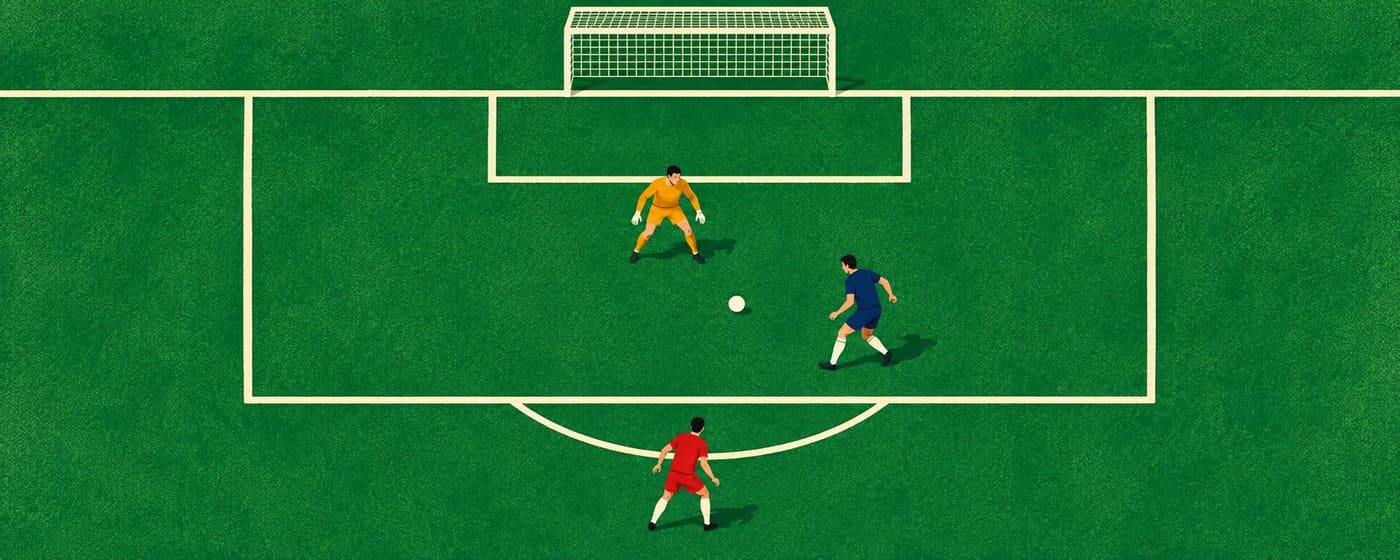
The goalkeeper puts the ball down in the goal area. A centre-back stands a few metres away, still inside the larger penalty area. The goalkeeper rolls a short pass with the foot. The centre-back takes a touch and an opponent runs in from outside the box. All of this can happen before the ball crosses the penalty-area line. For someone who expects the restart to send the ball beyond the box, it can look as though the teams have started playing too soon.
Under IFAB Law 16, the ball is in play once it is kicked and clearly moves. A teammate can receive it inside the penalty area. Opponents generally have to stay outside that area until the ball comes into play. That sequence explains much of what you see in a short goal kick. The first touch starts the restart, the receiver can be nearby, and the defending team may have only a moment before an opponent is allowed to press.
Separate the goal area from the penalty area
The two marked rectangles around the goal have different roles. The smaller rectangle is the goal area. A goal kick is taken with the ball stationary from somewhere within that area. A player of the defending team can take it. In many matches that player is the goalkeeper, but the procedure does not depend on the goalkeeper being the kicker.
The larger rectangle is the penalty area. It matters to the opponents’ starting position. When you watch from a side camera, the larger line can be easier to see than the smaller one. Keep track of which line you are looking at. A teammate who receives inside the larger rectangle may be well outside the smaller one. Neither position alone makes the receipt illegal.
The restart is awarded after the whole ball crosses the goal line, a player of the attacking team touched it last and no goal was scored. The ball can cross in the air as well as on the ground. That explains why a goal kick can follow an overhit cross as well as a shot that goes wide. Once it is awarded, the question changes from who touched the ball last to whether the restart is taken correctly.
The ball has to be kicked and clearly move. A player walking up to the ball or putting a foot next to it has not yet restarted play. A very small touch can be enough if it is a kick and the ball clearly moves. When watching a replay, use the moment of that movement as the reference point for where other players were and what they did next.
Watch the opponent as well as the receiver
Imagine the centre-back standing ten metres from the kicker and still inside the penalty area. An opponent waits outside. The kicker passes the ball along the ground. It clearly moves, and the opponent runs into the area before the centre-back receives. If the opponent reaches the pass first, the interception can be legal. The opponent was outside until the restart and entered after the ball was in play. The receiver has no protected period in which to take a first touch.
Now change the sequence. The opponent runs across the line while the ball is still stationary, then challenges before the ball is in play. That is a different case. The current law and its examples distinguish entering or interfering before the restart from pressing after it. A retake can be appropriate when an opponent enters early and touches or challenges for the ball before it is in play. If a foul also occurs, the referee can have a separate decision about misconduct. A restart decision and a disciplinary decision can both arise from one incident.
The difficult view is often the live camera angle. A player on the far side may be moving towards the line at the same time as the kicker’s foot moves. When the camera follows the ball, it can lose the opponent’s feet. A replay that shows the ball and the penalty-area line together is more informative than a close-up of the interception. If the angle does not show the relevant movement, leave room for uncertainty.
There is an equally useful view when a pass succeeds. Notice when the opponent starts to accelerate, which path they take, and whether the centre-back receives facing upfield. The same legal starting position can lead to very different pressure depending on the speed and direction of the pass. The law tells you when the press can begin. The players’ choices determine whether the defender has space when the ball arrives.
Distinguish a quick restart from deliberate lingering
A quick goal kick can leave an opponent inside the area because there was no reasonable time to get out. IFAB gives an example of an attacker who was on the ground after a move and runs away as soon as they can. The defending team kicks before the attacker finishes leaving. In that example the attacker can play the ball after it is in play. The referee looks at the circumstances, including whether the player had enough time to leave.
Contrast that with an attacker who deliberately stays in the area, watches the goalkeeper and tries to seize the ball as soon as the kick is taken. IFAB’s examples direct a retake where the player exploits that position. A quick restart does not turn a deliberate failure to leave into permission to gain an advantage. The difference between the two examples is the player’s opportunity and conduct before the kick, even if both players were physically inside the box at the same instant.
When you analyse a clip, start it several seconds earlier than the interception. Did the attacker get up late and head towards the line? Did they stop and wait near the expected pass? How quickly did the goalkeeper put the ball down and kick it? Those facts help explain why two clips with an opponent inside at the moment of the kick might lead to different decisions. A freeze frame can answer where the player was. A sequence gives the referee more evidence about how they got there and what they were doing.
Follow the next touch and the next pass
The player who takes the goal kick cannot simply kick it forward and then play it again before another player touches it. Law 16 provides an indirect free kick for an ordinary second-touch offence after the ball is in play, and specifies how a handball offence is dealt with, including the goalkeeper exception inside their own penalty area. A clean return pass from a teammate is different because that teammate has supplied the intervening touch.
This matters when the short kick is poorly directed. Imagine the kicker nudges the ball and sees it slowing down before reaching the centre-back. The obvious reaction is to run over and kick it again. In a replay, find out whether anyone else actually touched it first. A teammate running close to the ball does not establish that there was a touch. The referee’s decision can turn on that evidence.
IFAB Law 11 also distinguishes a goal kick from the pass that might follow. A player who receives directly from a goal kick does not commit an offside offence on that direct receipt. If the team instead takes a short goal kick to a centre-back and the centre-back launches a new pass upfield, that later pass is assessed under the ordinary offside rules. The goal kick’s direct-receipt provision does not carry through a sequence of passes.
The two rules invite different observations. For the second touch, identify who kicked the restart and whether another player touched the ball in between. For offside, identify the pass from which the player received directly. Calling every later action part of the goal kick can obscure the event that matters. Once the restart is taken, follow the play as a sequence rather than as a single extended action.
Read the countdown as a separate decision
The current IFAB text includes a procedure for deliberate delay. The throw-in and goal-kick countdown protocol describes a referee starting a visible five-second countdown after judging that the restart is being delayed deliberately. It is not an automatic five-second limit that begins whenever the ball crosses the goal line. The referee signals the countdown. If the ball is still out of play when the time expires, the protocol calls for a corner kick to the opponents, with the stated allowance for a player already in the process of kicking as the count ends.
In a replay of a delay decision, watch the referee as well as the players. A goalkeeper can spend time getting the ball into position without the referee having begun a countdown. Conversely, the protocol allows the referee to begin it before a player has collected the ball if the player is deliberately slow in doing so. The signal and the referee’s judgement matter more than a viewer’s stopwatch started at an arbitrary point.
This procedure addresses the time before the restart. It does not change the point at which a correctly taken kick puts the ball in play. When comparing matches from different seasons or competitions, check which edition of the Laws and which competition arrangements applied to the match. An older replay may be governed by different text. The examples here refer to the current IFAB text checked for this article.
See why a team might choose the short pass
The law permits several ways to restart. A longer ball can bypass an initial press and move the immediate contest away from goal. A short pass can let the team keep possession and draw an opponent towards one side. Neither choice is automatically safer. A slow short pass can invite an interception close to goal. A long kick can give the other team possession if the intended receiver loses the contest.
Imagine a side with two defenders available, one on each side of the box. The goalkeeper passes left. A forward closes that defender, who has a midfielder available just beyond the pressing player. If the centre-back receives with a clear view of the field and the midfielder is ready, the team might pass through the first pressure. If the midfielder is covered and the defender receives facing their own goal, the same short kick can leave few options. The first pass has to be read in light of the second option.
The pressing team also has a choice. A forward can wait outside the area and sprint at the receiver as soon as the ball moves. A teammate can move to block the return pass rather than joining the first sprint. A third player might watch the midfielder. Looking at those three decisions explains more than counting how many players stood near the line. A press can work by removing the next pass even when the first receiver has time to touch the ball.
Compare two passing angles from the same starting spot. A pass straight towards the touchline may pull the receiver away from the nearest opponent, but the line then limits where the receiver can turn. A diagonal pass into the middle may leave more options while exposing a wider area if the ball is intercepted. Pause the replay just before the kick and identify an exit route for each receiver. Then watch whether the press leaves that route open. This gives you a reason to judge the choice even when a pass happens to reach its target.
To read a short goal kick, find the stationary ball and the kicker first. Then find the opponents’ positions when the ball is kicked and clearly moves. Follow the receiver, the first press and the next available pass. Those observations let you separate a question about the restart from a question about what the team did with it. The pass can be perfectly legal and still put the receiver under immediate pressure.
For an example of another football restart, see how Niigata won at Kofu with a late free kick.
Sources consulted 4 November 2026. Tactical plays described here are illustrative.