Katerina Siniakova won the Osaka singles title on 25 October 2026, beating Ashlyn Krueger 6–1, 6–0 in the final. The result also offers a useful way to understand a question tennis fans often ask: how can a player be one of the sport’s most accomplished doubles specialists while still being an underdog in singles? The answer is not that one discipline is easier. Singles and doubles reward overlapping skills, but they ask players to use space, time, risk and decision-making differently.
This guide uses Siniakova’s Osaka run as a timely example, not as proof that a single match explains her career. It separates verified results from tactical interpretation, explains the court and scoring differences that shape doubles, and gives viewers a practical checklist for watching the two formats with more context.
The Osaka result, in context
The WTA tournament page identifies Siniakova as the Osaka champion and calls it her sixth career singles title. Its updated player record also records six WTA 250 titles. Richard Pagliaro’s 25 October report for Tennis Now supplies the final score against Krueger, 6–1, 6–0, and identifies Nanchang in 2023 as her previous singles title. The event was played on outdoor hard courts. Those facts establish the outcome; they do not explain every rally.
Siniakova is widely known for doubles. The WTA’s player record lists 39 doubles titles at the time of research, including 12 Grand Slam women’s doubles titles, and now six WTA singles titles. Her record illustrates the breadth of her career, but it is important to keep the categories separate. A doubles title is not a singles result, and a singles final does not erase a player’s doubles specialism. The formats test related athletic and technical abilities under different tactical conditions.
For a viewer arriving through a search for Siniakova or the Osaka final, this distinction matters. A doubles résumé helps explain why a player may be comfortable reading a partner’s movement, taking the ball early and changing direction at the net. It does not automatically predict how that player will handle a singles opponent who can target the full width of the court, make the player cover every ball alone and build points with depth.
What changes when the partner disappears?
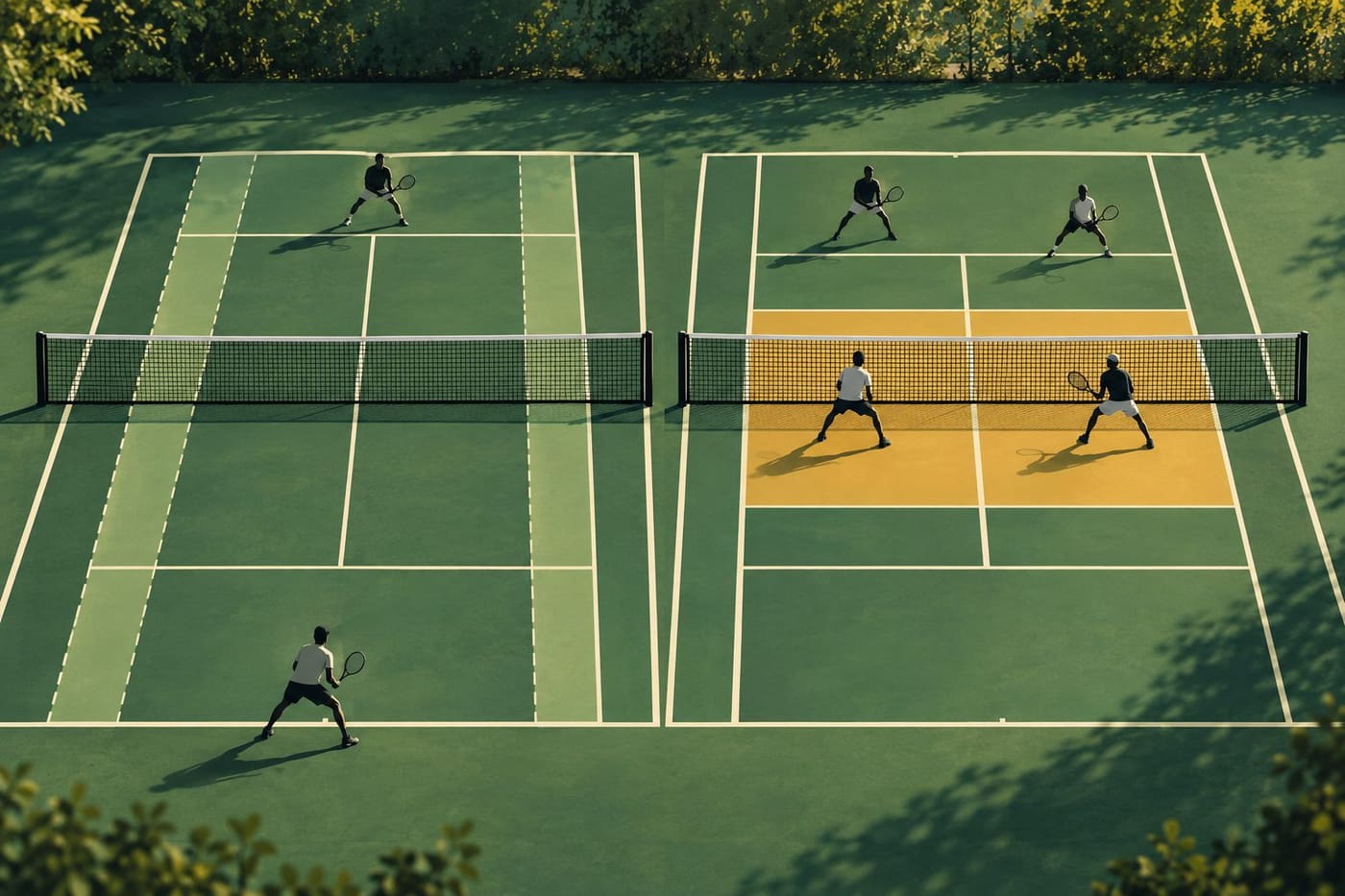
The court is the first visible difference. Singles uses the narrower singles sidelines. Doubles uses the alleys as well, making the playing area wider. The service boxes remain the same size, but the extra space in doubles changes the geometry after the serve. A team can create angles and use one player near the net while the other covers from the baseline. In singles, the same player has to defend the resulting open court.
That changes a simple calculation. In doubles, a cross-court return may travel past a net player and still leave a partner in position to cover the next ball. In singles, a cross-court shot can pull the opponent wide, but the hitter must recover toward the middle before the reply. The shot is not merely about making contact; it is also about where the player can stand for the next exchange.
The partner also supplies information. Two players can divide responsibility, communicate about who takes a ball through the middle and use agreed formations. In singles, there is no partner to call a switch or protect the line. The player has to read the opponent, choose a response and recover without shared coverage. Doubles coordination can sharpen anticipation, but singles demands a different form of independent court management.
The [2026 Rules of Tennis](https://www.itftennis.com/media/7221/2026-rules-of-tennis-english.pdf) set the formal framework for court dimensions, scoring and play. The rules explain what is legal; they do not prescribe a strategy. When we describe a player as “taking the ball early” or “closing the net,” those are observations about tactics, not official statistics unless a match report or data provider records them.
Why doubles skill can help in singles
Some abilities travel well between formats:
- Reading the opponent’s preparation. A player who must react to volleys and fast exchanges develops habits of watching the racket and body position closely. That awareness can help in singles when a short backswing or change in contact point signals a possible direction.
- Taking time away. Doubles often rewards compact swings and early contact because the net player can intercept a slow reply. In singles, an early strike can prevent an opponent from settling into a rally, although it also reduces the hitter’s margin for error.
- Touch and control. Drop volleys, angled volleys and controlled blocks can end a point without a large swing. These shots can be useful in singles, where a player may draw an opponent forward and then pass or lob them.
- Serve-and-first-ball planning. Doubles partners frequently plan the next shot after the serve. The same habit can help a singles player think beyond the serve itself: where will the return likely go, and what court position should follow?
- Composure in quick exchanges. A fast net exchange gives little time for hesitation. The ability to make a clear decision under pressure is valuable in any format.
These are general tactical connections. They should not be presented as personal facts about Siniakova’s training or intentions unless she or her team has said so. Her public results show that she has achieved at a high level in both formats; they do not reveal every private practice choice.
Why singles remains its own test
Singles asks one player to cover every part of the court. The wider doubles court can create more attacking angles, but a singles player must protect both sidelines without a partner. That puts a premium on recovery steps, shot tolerance and the ability to recognize when to defend rather than attempt a low-percentage winner.
The baseline exchange can also be longer. A player may need to construct a point through several deep shots before a short ball appears. This requires patience: keep the ball in a safe area, move the opponent, and attack only when the opening is real. A spectacular winner is easy to notice, but the decision to wait one more shot can be the more important choice.
Singles places a larger share of the match’s emotional load on one person as well. In doubles, a partner can help reset after a missed return or discuss a pattern between points. A singles player manages the same pause alone. That observation is about the format, not an assumption that a particular athlete feels pressure in a particular way.
Physical demands differ too. Doubles points can be explosive and involve sharp changes of direction at the net; singles often asks a player to cover more ground over a longer sequence. Neither is universally more demanding. The workload depends on surface, opponent, rally length, match format, schedule and the player’s condition. Without reliable match-specific tracking, it would be misleading to claim that one Osaka match demonstrates a player’s fitness or stamina.
How to read the semifinal score without overreading it
The 6–1, 6–4 score tells us that Siniakova won the semifinal in straight sets and that the first set was more one-sided on the scoreboard than the second. It does not tell us the number of break points, unforced errors, net approaches or long rallies. Those details require a full statistics sheet or point-by-point record. The official result page is the right source for the score and event details; it is not a substitute for every tactical statistic a fan might want.
When watching a replay or highlights, use a small set of questions rather than jumping to a broad conclusion:
1. Where does the rally begin? A strong serve or a short return can shape the point before a baseline exchange develops.
2. Who controls the middle? Players who hit deep through the centre can reduce the opponent’s angles, while a shot pulled wide may open the opposite side.
3. What happens after a wide ball? Look at recovery position. A good shot can still leave the hitter exposed if they do not move back toward a useful defensive position.
4. When does a player approach the net? Notice whether the approach follows a short ball, a weaker reply or a deliberate serve-and-volley pattern. One approach alone does not establish a match-long strategy.
5. Does the pattern repeat? A single winner is an event; repeated pressure to the same side may indicate a plan. A full match sample is better evidence than a short highlight clip.
This method helps viewers avoid a common mistake: treating a scoreline as a complete explanation. A 6–1 set could reflect one player’s clean execution, the other’s difficult start, a matchup advantage or several small factors. The score establishes what happened, not every cause.
What Siniakova’s record can—and cannot—tell fans
The WTA pages also illustrate a practical research problem: a biography can lag behind a newly updated results table. At this check, the profile’s career-highlights text still listed five singles titles, while the results record and tournament coverage showed six. For the new total, this article uses the updated results rather than carrying forward the older biography number.
They do not create a simple formula for predicting a future match. Past titles do not guarantee a result. A player’s ranking can vary by format and date, and ranking points are not interchangeable between singles and doubles. Match conditions, opponent strengths and day-to-day form all matter. Fans should check a current official ranking page rather than rely on an old article or search snippet when exact rank is important.
The distinction between singles and doubles rankings is especially useful when a headline calls someone “world No. 1.” Ask: No. 1 in which discipline, and on what date? A player may lead the doubles ranking while holding a different singles position. Both can be true at the same time. That is not a contradiction; it reflects two separate ranking tables and bodies of results.
Partnership history also needs care. Siniakova has won titles with multiple partners, and the WTA lists those pairings in its record. A partnership’s success should not be reduced to one player’s individual achievement or used to suggest the other partner contributed less. Doubles is collaborative by design. Each player affects positioning, communication, serving order and shot selection.
A practical viewing guide for a final replay
For a replay, start with the completed result and the video’s scope. A five-minute highlights package selects moments from a much longer match; it cannot show every missed return or recovery step. The Osaka final is complete, so an older preview describing the title as undecided is out of date. A recap and a replay answer different questions.
Then watch for three things:
- Serve patterns: Does the server use the same direction repeatedly, or vary placement? Do not infer a serve speed unless the broadcast or official stats provide it.
- Return depth: A deep return can make the server play the next shot from a less comfortable position. Notice whether the receiver follows the return forward or stays back.
- Point construction: Does a player build toward a forehand, test the backhand, or use a short ball to bring the opponent forward? Look for patterns over multiple points rather than one dramatic rally.
A useful exercise is to take ten consecutive points from a full replay and record the first two shots. Write down serve direction, return depth and which player moved forward first. Leave an entry blank when the camera angle makes it uncertain. This small sample is a viewing aid, not a statistical verdict on the whole match. It can show why a highlight’s spectacular finish is sometimes less revealing than the ordinary return that made it possible.
A court-position exercise you can use at club level
Imagine two points beginning with the same cross-court return. In the singles example, the returner stays behind the baseline and watches the server’s next contact. If the return has pulled the server wide, the returner may have time to recover; if it lands short, the server may attack before that recovery is complete. The useful question is not whether cross-court is always correct, but what the shot has bought in time and space.
In the doubles example, add the server’s partner near the net. The returner now has to consider whether that player can intercept the ball. A return that would be comfortable in singles might give the net player an attacking volley. Sending it wider can avoid the interception, but may also lower the margin for error. A lob changes the immediate problem again: both opponents must decide who will move back and who will protect the next reply.
These are hypothetical points, not reconstructions of Osaka. You can sketch them on paper before practice and compare your prediction with what happens on court. Mark the ball and all players at contact, then mark their likely next positions. Avoid assigning a point to a supposedly weak partner after one mistake; the preceding shot may have left that player with no comfortable option.
For a beginner, that exercise is more useful than copying a professional’s most difficult winner. Try asking whether your shot gave you time to recover, whether your partner knew which space to cover, and whether you chose an attacking ball from a stable position. A coach can adapt the exercise to your level; the professional result itself is not a personalised training prescription.
Frequently asked questions
### Is Katerina Siniakova primarily a singles or doubles player?
Her record is especially decorated in doubles, including 12 Grand Slam women’s doubles titles listed by the WTA. The Osaka win brought her WTA singles title total to six. “Primarily” describes emphasis, not an exclusive role: she competes in both disciplines.
### What was Siniakova’s Osaka semifinal score?
The tournament organiser records a 6–1, 6–4 win over Katie Boulter in the semifinal of the 2026 Kinoshita Group Japan Open in Osaka. She subsequently won the final against Krueger, 6–1, 6–0.
### Does being an elite doubles player make someone automatically strong in singles?
No. The formats share skills such as anticipation and touch, but singles requires one player to cover the whole court and construct points alone. Doubles success can be relevant context, not a guarantee of singles outcomes.
### Is the doubles court wider than the singles court?
Yes. Doubles includes the alleys outside the singles sidelines. The service boxes are unchanged. The extra width affects angles and positioning, especially after the serve.
The useful takeaway
Siniakova’s Osaka title adds a singles achievement to a career already distinguished in doubles. Her 6–1, 6–4 semifinal win over Boulter is verified; interpretations about tactics should be grounded in the match itself rather than assumed from her résumé. The best way to appreciate her career is to keep separate records for singles and doubles while noticing how anticipation, touch and early contact can cross between them.
Use the WTA tournament page for official event updates and treat this guide as a format explainer, rather than a point-by-point match report. For any ranking or title count, check the dated official player record. That keeps a timely tennis search useful without turning one result into an unsupported claim about what must happen next.
Sources and research note
Research refreshed 26 October 2026 (Asia/Dhaka), after the completed Osaka final. The primary references are the [WTA Osaka 2026 scores and draw](https://www.wtatennis.com/tournaments/405/osaka/2026/scores), [official semifinal scorecard](https://www.wtatennis.com/tournaments/405/osaka/2026/scores/LS003), [WTA player profile and career highlights](https://www.wtatennis.com/players/320301/katerina-siniakova), [WTA Grand Slam record](https://www.wtatennis.com/players/320301/katerina-siniakova/record), and the [ITF Rules of Tennis](https://www.itftennis.com/en/about-us/governance/rules-and-regulations/). The WTA tournament coverage and updated record support the completed title and current total; the career-highlights biography had not yet incorporated it. The [organiser’s semifinal report](https://www.japanopentennis.com/wta/en/news-and-media/news/20261024-siniakova-defeats-boulter-straight-sets-reach-final/) confirms the Boulter score; the WTA scorecard did not render its detail on the final refresh, so no match-duration claim is retained. [Tennis Now’s dated final report](https://tennisnow.com/siniakova-crushes-krueger-for-sixth-crown-in-osaka/) corroborates the opponent and final score. The ITF rules support the court-format explanation. Results and rankings can change, so consult the linked official pages for updates after this research cutoff.
The illustration is an original AI-generated conceptual tennis-court scene, not a photograph, actual match diagram or depiction of Siniakova. Tactical examples are explanatory analysis, not claims that the author attended the match or interviewed the player.