Amsterdam Dance Event is easy to recognise through photographs of crowded dance floors. Those images explain only part of it. Alongside performances, ADE brings together people who make, release, distribute, promote and support electronic music. For someone encountering the name for the first time, understanding those different activities is more useful than treating the whole week as one enormous party with one ticket.
The 2026 edition runs from 21 to 25 October and marks thirty years of ADE. This article examines its professional side: what the conference is for, how it differs from a performance programme, and how an independent creator can turn a meeting or a useful session into a concrete next step. Information was checked on 25 October 2026. It is an independent explainer, not a claim of attendance, a review of sessions we did not witness or a promise of access to events that may already have finished.
One name, several different experiences
The organiser distinguishes the festival from its conference and other programme strands. ADE Pro addresses the electronic music industry through talks, business activity and networking. ADE Lab is a separate offering, while the broader programme also includes arts and culture. That distinction matters because a reader asking “what is ADE?” may be looking for a night out, professional learning or a route into the industry. These are related interests, but they are not interchangeable purchases.
Start with the [official programme](https://www.amsterdam-dance-event.nl/program/) rather than an isolated artist announcement. Identify the specific event, its organiser, location and access conditions. A familiar name appearing in several places does not mean the same ticket covers all of them. A conference appearance and a club performance can have very different purposes even when they involve the same artist.
For a first visit, write down your primary reason for going before choosing individual activities. If you want to hear music, prioritise performances. If you need to understand distribution, choose relevant professional sessions. If you want feedback on your work, look for an appropriate format and check how participation works. A crowded schedule is not automatically a useful one.
What ADE Pro reveals about the industry
The organiser's 1 October announcement placed artists alongside companies working across platforms, technology, labels, agencies and events. It included sessions involving Spotify, YouTube Music and Suno, and a discussion about artists' relationships with technology across generations. Those choices show the range of questions that sit behind a release or a performance: how work is made, how it reaches an audience, and how the organisations around it operate.
The [ADE Pro programme announcement](https://www.amsterdam-dance-event.nl/en/news/ade-pro-program-complete/2916184/) describes planned activity. It does not, by itself, establish what speakers ultimately said or what participants achieved. A useful reader keeps that distinction intact. An advertised discussion about a difficult issue is an invitation to examine it, not proof that the issue has been solved.
For an independent musician, the programme can be used as a map of the business even without attending every session. Notice which questions recur, then relate them to your own work. A release that has not found its audience may need a clearer identity or distribution plan. A promising collaboration may need clearer responsibilities. The value comes from identifying your actual problem, not collecting fashionable terminology.
Check access carefully, especially at the end of the edition
On the official ticket page checked for this article, the Pro offer described conference access, networking and business hubs, together with festival access subject to capacity limitations. It specifically excluded ADE Lab. The same page was already inviting pre-registration for 2027. That changing context is why this guide does not reproduce a price or imply that a 2026 pass is still available to buy.
Consult the [current ticket information](https://www.amsterdam-dance-event.nl/en/tickets/) and the particular event listing before making a decision. Distinguish a benefit described for a pass from guaranteed entry to a specific crowded room. Check dates, capacity conditions and any separate registration. Save your confirmation rather than relying on a screenshot of an earlier announcement.
This also changes how to plan future editions. Do not carry a list of benefits from one year into the next as if it were a permanent contract. A useful planning note records what mattered to you, then prompts you to verify it when the next edition's terms become available. That is more reliable than building a budget around a benefit you remember someone mentioning.
Begin with one business question
Before browsing dozens of sessions, finish this sentence: “The decision I need to make is…” A producer might need to decide how to present an unreleased project. A small promoter might be comparing ways to communicate an event's identity. A manager might want a clearer process for coordinating collaborators. These examples are planning prompts, not claims that a particular ADE session provides personal advice on each situation.
Turn the decision into a question that another person can answer in a short conversation. “How do I become successful?” is too broad. “What information would you need before deciding whether this project fits your programme?” gives someone a practical starting point. It also tells you which materials to prepare and which parts of your own plan are still unclear.
Choose one main objective and one secondary objective for the day. Leave space between activities to record what you learned. If every minute is booked, an unexpectedly useful conversation becomes an inconvenience. A realistic schedule protects room for the very encounters that made attending worthwhile in the first place.
Prepare a small, clear project packet
The most useful introduction is often shorter than its creator expects. Prepare a concise description of the project, one appropriate link and a clear explanation of what you are seeking. Make sure the link works on a phone and that its recipient can understand what they are opening. Do not send a folder full of unexplained versions and expect a stranger to identify the finished work.
For an unreleased track or other confidential material, think about what you are comfortable sharing and with whom. You can describe a project without distributing every file. Ask about the recipient's preferred process before sending attachments. A professional meeting is not an obligation to disclose material on the spot, and a friendly response is not a commitment to work together.
A simple preparation list might include:
- A two-sentence project description written in ordinary language.
- One relevant listening or portfolio link with clear file names.
- A short explanation of your role and the current stage of the work.
- A specific question or request that fits the person you hope to meet.
- A way for that person to contact you if they choose to continue.
The packet should support the conversation. It should not replace listening to what the other person actually needs.
Treat networking as an exchange of context
There is a difference between introducing yourself and delivering a sales presentation to someone who has not asked for one. Start by asking about their work and explaining why you thought the conversation might be relevant. If the fit is weak, thank them and move on. A brief respectful interaction is preferable to extending a pitch after the other person has made their situation clear.
Take notes after the conversation rather than trying to preserve every sentence while someone speaks. Record the person's role, the topic discussed and any next step they actually agreed to. Keep your interpretation separate. “Asked for a link” is a useful note. “Will sign the project” is not a justified conclusion unless that was explicitly established through the appropriate process.
For a hypothetical example, imagine a producer meeting an event programmer. The programmer says the current project is not right for their next event but suggests sending a future live recording. A good follow-up respects that narrow invitation. It does not turn the encounter into a claim of endorsement or send repeated unrelated updates. Clarity protects the relationship and your own expectations.
Turn a panel into a decision note
A session can be interesting without changing what you do. To make it useful, write a short decision note afterwards: the problem discussed, the idea you might test, the information still missing and the smallest next action. This makes room for disagreement. You do not have to adopt every recommendation simply because the speaker works at a prominent organisation.
Pay attention to context. Advice designed for an established catalogue may not fit a first release. A process that works with a large team may be impractical for one person. Ask what assumptions the advice depends on, then compare them with your resources. A sensible experiment is often more useful than copying an entire strategy whose supporting conditions you do not share.
Suppose a discussion prompts you to improve your release presentation. A modest next action could be rewriting the description and asking a trusted collaborator whether it clearly communicates the project. That is a test you can complete. “Rebuild the whole brand” is a much larger commitment and may obscure the simple improvement that first caught your attention.
The less visible work around music
BumaStemra's published ADE programme included topics such as international collaboration and funding, music created live on stage, brand-related music selection, and building a publishing business. These are examples of how professional discussion reaches beyond performance itself. They concern the systems through which work is identified, organised and connected with opportunities.
The [BumaStemra programme](https://bumastemra.nl/ade/) is useful for seeing those questions in concrete form. Its descriptions are not a substitute for individual legal, contractual or financial advice. This article does not infer a royalty rate, funding entitlement or licence permission from a session title. If a discussion raises a decision with contractual consequences, take the actual documents to an appropriately qualified adviser.
For everyday project management, a practical first step is to keep a clear record of contributors, versions and agreed responsibilities. That record will not resolve every rights question, but it can make later conversations less confused. Avoid treating administrative work as something to reconstruct only when a promising opportunity arrives and everyone remembers the project differently.
Evaluate technology through your workflow
A music-business programme can introduce many tools, platforms and ideas at once. Resist the temptation to treat each announcement as an urgent requirement. Start with a task you already perform and ask whether a proposed tool makes that task clearer, faster or more reliable. If you cannot identify the problem it solves, you may not need to make a decision immediately.
Prepare a small evaluation checklist: what you would upload, what result you expect, what permissions or terms apply, how you could export your work and what ongoing cost would be involved. These are questions to investigate, not assurances about any company mentioned in the programme. Do not upload confidential material merely to make a demonstration feel realistic.
When a tool appears promising, test it on an appropriate low-risk example before redesigning your process around it. Compare the result with the work you would otherwise have done. Keep the comparison specific. An impressive demonstration is interesting; a repeatable improvement in your own workflow is a stronger reason to adopt something.
Follow up without creating a second workload
After an event, sort notes into three groups: agreed actions, ideas worth testing and information to keep for reference. Complete the agreed actions first. Send what was requested, briefly remind the recipient of the context and avoid adding several new requests to the same message. A concise follow-up makes it easier for someone to recognise the conversation and respond when they can.
Not every meeting needs a campaign of messages afterwards. If there was no clear invitation to continue, consider whether another message would be useful to the recipient as well as to you. Respect a lack of interest and any stated communication preferences. Professional persistence is compatible with boundaries; it does not require repeated contact until someone answers.
Review the week in terms of decisions rather than the number of contacts collected. Did you clarify the next release step? Identify a missing skill? Find a collaborator whose goals genuinely overlap with yours? An honest answer may include things that did not work. Those notes can improve the next event more than an inflated account of how productive everything felt.
What ADE means beyond the dance floor
ADE brings the creative and organisational sides of electronic music into the same wider event. For a new reader, the first useful distinction is between attending a performance and participating in a professional programme. From there, the task is to choose the experience that fits your purpose and verify its actual access conditions.
For a creator or small business, the strongest outcome may be a clearer question, a better project presentation or one well-defined next step. None of those requires pretending that a conference guarantees a career breakthrough. The music remains the reason for the work; the business conversations can help give that work a more deliberate path.
### Editorial and source note
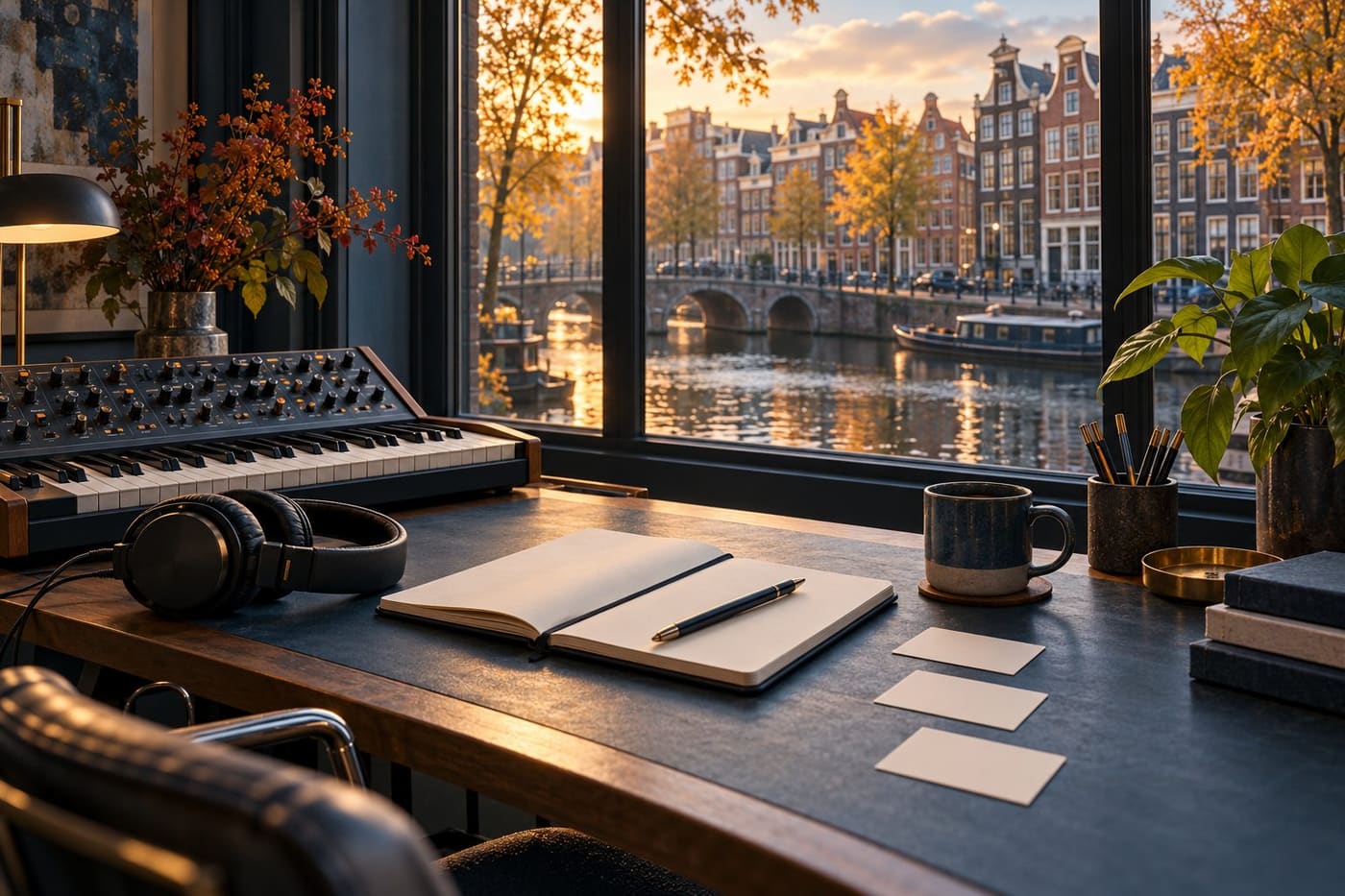
Researched 25 October 2026 using the official ADE programme, ADE Pro announcement, ticket information and BumaStemra's published programme linked above. Practical planning examples are original editorial suggestions, not reports of private meetings or session outcomes. Event access and future-edition terms require fresh verification. The accompanying generated illustration is a conceptual Amsterdam music workspace, not a photograph of an ADE venue or an official event asset.