A calculator can return a plausible number from an unsuitable calculation. It cannot automatically know whether you meant metres or centimetres, a total or a rate, or the area of a surface rather than the length of its edge. Writing the units throughout your working gives you another way to inspect the reasoning.
This guide develops an original practice notebook using length, area and classroom planning examples. All numerical tasks are invented for teaching; no student experiment, learning study or improvement in grades is claimed. The aim is to produce working that another person can follow and a student can correct without guessing where the answer came from.
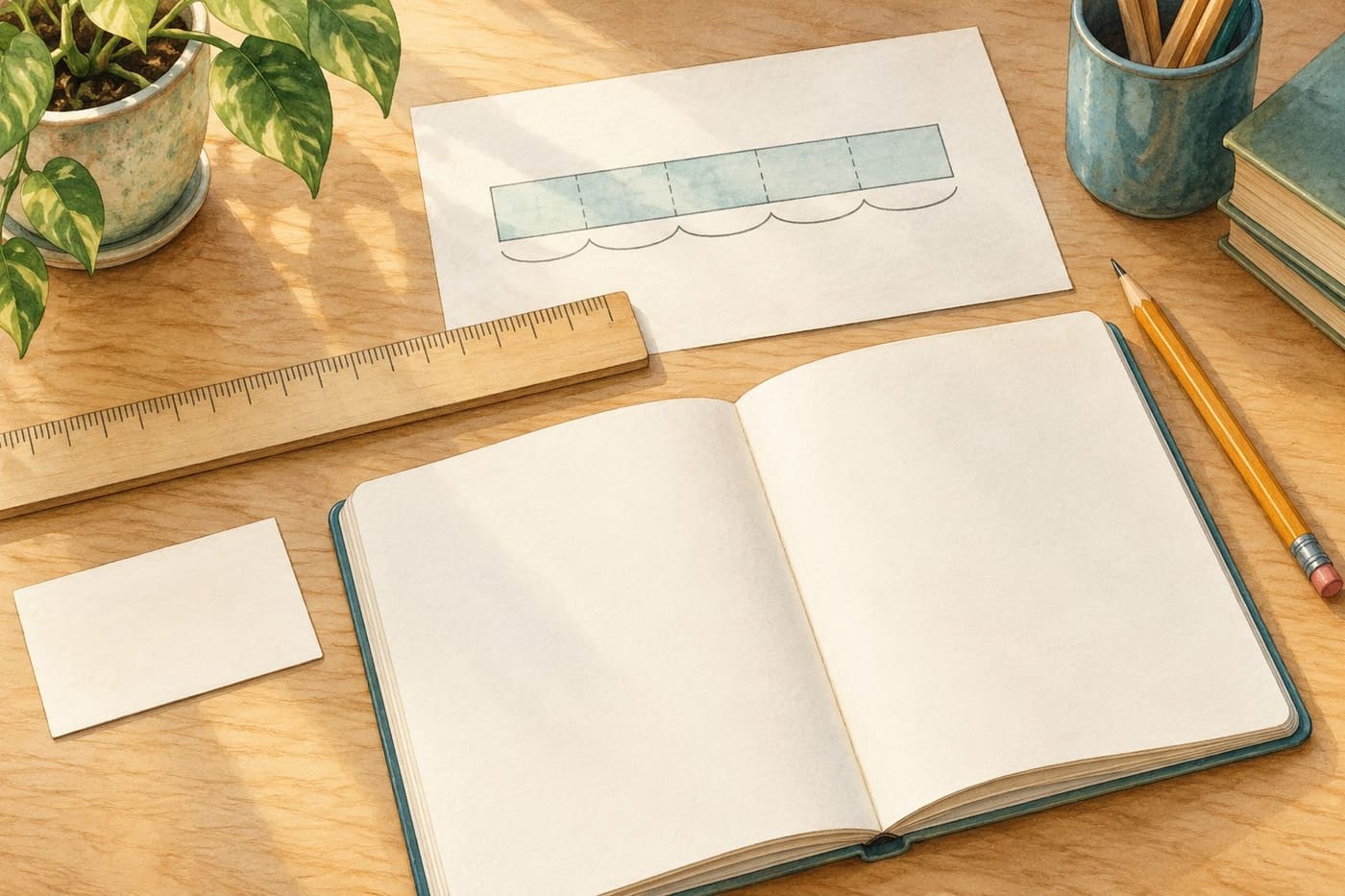
You will need only paper and ordinary arithmetic. The original conceptual image shows generic measurement and writing materials, not a completed laboratory investigation. Follow your teacher's required notation and rounding rules when an assignment specifies them.
Begin by naming the requested quantity
Before calculating, write a sentence that identifies the result you need. “Find the length in metres” is more useful than “convert this.” It identifies both the kind of quantity and the target unit. Copy the given value beside it, including its unit and any qualification in the question.
For the first invented task, the given length is 350 cm and the requested answer is in metres. Write those facts on separate lines. Do not start by deleting the letters and deciding whether the decimal point should move left or right. The relationship between the units should determine the operation.
An effective notebook also distinguishes supplied information from assumptions. If the question gives the length, record it as given. If you choose a hypothetical length to demonstrate a method, label it as an example. Mixing those roles can make an internally neat calculation answer a different question from the one assigned.
This first step often reveals a missing detail before any arithmetic begins. If the unit is absent, the numerical value alone may not identify a physical quantity. Ask for the missing information rather than adding a unit that happens to make the later answer look reasonable.
Use an equality to build the conversion
OpenStax explains dimensional analysis through conversion factors formed from equivalent quantities. The numbers and units undergo the same operations, so a correctly arranged factor cancels the starting unit and leaves the desired one. This is a check on the arrangement, not simply a trick for moving a decimal point. Source: https://openstax.org/books/chemistry/pages/1-6-mathematical-treatment-of-measurement-results
For the original length task, use the defined relationship 100 cm = 1 m. Arrange it as 1 m divided by 100 cm, because the starting value already carries centimetres. The calculation is:
350 cm × (1 m / 100 cm) = 3.5 m.
Centimetres appear once above and once below the division, leaving metres. The numerical division is 350 divided by 100. The value becomes a smaller number because one metre contains many centimetres; the physical length represented has not become shorter.
Now deliberately reverse the factor on a practice line. Multiplying 350 cm by 100 cm / 1 m produces units of cm²/m, not the requested unit in the displayed form. That visible mismatch is a prompt to inspect the factor before accepting the calculator result. The mistake is in the setup, not in the machine's ability to multiply.
Check the direction with a simple estimate
An estimate gives you a second check that uses a different question: is the size of the result sensible? In the invented task, 350 cm is more than 300 cm and less than 400 cm. Those boundaries correspond to 3 m and 4 m. An answer of 3.5 m sits between them; 35 m does not.
Keep this estimate short. It is not a separate elaborate solution and does not need to repeat every line of arithmetic. Its purpose is to catch a result that is off by a large factor or has moved in the wrong direction.
Reverse conversion provides another check: 3.5 m × (100 cm / 1 m) returns 350 cm. This round trip supports the conversion, but it does not prove that 350 cm was the correct value to copy from the question. A copying error can survive a perfectly consistent forward and reverse calculation.
In your notebook, give the checks different labels: “conversion reversed” and “given value checked.” That distinction stops one successful arithmetic check from being treated as proof that every earlier choice was correct.
Write unit symbols so they remain readable
NIST's SI writing guidance uses a space between a number and its unit symbol, keeps a prefix attached to the symbol, and does not pluralize unit symbols. Symbol case also matters: the guidance distinguishes, for example, the prefix m for milli from M for mega. These conventions help preserve the meaning of a written value. Source: https://www.nist.gov/pml/owm/writing-si-metric-system-units
For a student notebook, consistency is more helpful than decorative formatting. Write 3.5 m rather than attaching a homemade plural ending to the symbol. Keep the same unit notation through the calculation, and use words when a handwritten symbol might otherwise be mistaken for something else.
If you photograph your working, make sure a reader can distinguish the unit from the number and see which quantities belong inside a fraction. An unreadable line can hide an otherwise sound calculation. A clear copy should preserve the original given information rather than silently correcting it while you rewrite.
When an assignment uses a different language or spelling convention, the important task is to understand the quantity and the unit system involved. This article follows ordinary English explanations and uses clear symbols; it does not require every school to use one particular national spelling style.
Do not convert an area as though it were a length
Here is a second original exercise. A rectangular card is described, for this arithmetic task, as exactly 40 cm by 30 cm. Its area is 40 cm × 30 cm = 1200 cm². The square unit records that two lengths were multiplied.
Convert the two sides first: 40 cm becomes 0.4 m, and 30 cm becomes 0.3 m. Multiplying those converted sides gives 0.4 m × 0.3 m = 0.12 m². This provides a route to the answer without relying on a remembered area-conversion shortcut.
Now check directly from the area. Both length factors need conversion, so write:
1200 cm² × (1 m / 100 cm) × (1 m / 100 cm) = 0.12 m².
The numerical divisor is 100 × 100, or 10000. Dividing by only 100 would convert one length factor while leaving the other unconverted. The two-side method makes that missing factor visible.
For this exercise, the dimensions were stipulated exactly to focus on the unit conversion. That is different from measuring a real card with a ruler and claiming perfectly exact sides. A classroom problem can set idealized inputs; a measurement record should state what was actually observed and how it was measured.
Keep a rate's numerator and denominator visible
For a third invented task, a practice route has a stated length of 3.6 km and a stated duration of 90 min. The requested average rate is in km/h. First convert the duration: 90 min × (1 h / 60 min) = 1.5 h. Then divide the distance by the time: 3.6 km / 1.5 h = 2.4 km/h.
These values are arbitrary teaching inputs, not a recorded journey or an exercise recommendation. The calculation describes the supplied total distance divided by the supplied total duration. It does not say that the speed was identical at every moment.
If you instead calculate 3.6 divided by 90, the number is 0.04 and the associated unit is km/min. That can be a valid rate in a different unit, but it is not yet the requested km/h answer. Multiplying by 60 min/h produces 2.4 km/h, matching the first route.
The lesson is not that one numerical route is always better. It is that each intermediate answer needs its unit. Without km/min beside 0.04, a reader could easily mistake an unfinished conversion for a finished answer.
Compatible units do not prove compatible assumptions
Suppose an invented reading log says 12 pages were read in 30 minutes. Dividing gives 0.4 pages per minute. Multiplying that rate by 60 minutes gives 24 pages under an explicit assumption that the same average pace applies throughout the longer period.
The units cancel correctly. That does not establish that the next 12 pages are equally difficult, that there are no interruptions, or that the reader understood the material. A calculation can be dimensionally consistent while its use as a prediction remains poorly justified.
Write the assumption beside the result: “Illustrative projection at unchanged average pace.” Do not rename it “actual pages completed.” If you later collect an actual reading record, keep it separate from the projection so that the comparison remains honest.
This is particularly useful in group projects. One student may calculate accurately from an assumption supplied by another. Checking the units catches some mistakes, but the group still needs to inspect whether the starting information answers the real question. Dimensional checking is a tool within reasoning, not a replacement for it.
Preserve the distinction between exact and measured values
OpenStax's measurement chapter distinguishes exact defined or counted quantities from measured values with practical uncertainty. It explains that reported digits and rounding should reflect the information in the measurements. A unit conversion does not make an uncertain measurement more precise merely by displaying extra decimal places. Source: https://openstax.org/books/chemistry/pages/1-5-measurement-uncertainty-accuracy-and-precision
For a notebook exercise, label the type of input. A defined unit relationship is not a fresh measurement. A dimension stipulated exactly for an idealized problem is not a ruler reading. A real observation should retain its stated precision rather than acquiring fictitious precision during a rewrite.
If your teacher specifies significant-figure conventions, apply those to the final reported answer. Keep enough working to show the calculation, and explain any rounding the task asks you to justify. Do not use a long calculator display as evidence that you measured something to all those decimal places.
The invented card example used exact dimensions on purpose. If the task were changed to measured dimensions, the reporting question would change too. Preserving that distinction lets the same arithmetic method serve different classroom purposes without making misleading claims about a real object.
Use an error log that identifies the failed step
When an answer is wrong, “careless mistake” gives you little to practise. Identify whether the issue was copying the given unit, reversing a factor, treating an area as a length, forgetting a denominator conversion or reporting unsupported precision. Then create a small new exercise that targets that step.
For example, after missing the second area factor, practise a rectangle with different side lengths and solve it both ways: convert sides first, then convert the area directly. Compare the methods before looking at an answer key. A different set of numbers helps you test the method rather than recall the earlier result.
Our guide to turning exam feedback into a checkable study plan discusses that broader review habit: https://monetizearticle.com/article/after-the-exam-turn-feedback-into-a-study-plan-you-can-test-6c660c . Here, the useful evidence is your written setup and explanation, not a promise that a particular notebook format will raise marks.
Keep the first attempt when it reveals a useful error. Put the corrected line beside it and explain the difference. That makes a later review possible without having to reconstruct a mistake you have erased.
A short final check before submitting
Read the question again and name the requested quantity. Check that you copied the given values correctly. Inspect each conversion equality, follow the units through the working, and see whether the final unit matches the request. Use a quick magnitude estimate and check any assumptions that the calculation needs.
Finally, read the answer as a sentence. Does it describe a length, an area, a rate or a projection? Does its precision fit the task? If another person could understand the calculation only by asking what you meant, add the missing label before treating the solution as finished.
Conclusion: let the units carry part of the explanation
Write units from the first line, use a known equality to arrange each conversion factor, and check the requested quantity at the end. For area, follow both length factors. For rates, keep the numerator and denominator visible. For measured inputs, preserve the limits of the measurement.
A correct unit is valuable evidence that the calculation is arranged sensibly. Pair it with a check of the copied information and assumptions, and your working becomes something you can explain rather than merely a number you can display.
Sources and research note
Primary educational and standards guidance checked on 29 October 2026: NIST's SI writing page and OpenStax Chemistry sections 1.6 and 1.5, linked above. Brief explanations support the method and notation. All card, route and reading-log figures are original stipulated classroom exercises; no published textbook problem, figure or solution is reproduced. Calculations were independently recomputed. No classroom trial, measured object, actual journey, reading outcome or guaranteed academic improvement is claimed.