A recall creates several different jobs for a household: identify the product, deal with any health concerns, arrange its return, and keep a useful record. Trying to solve all four in a social-media comment thread can expose private information while leaving the important questions unanswered. This guide separates those jobs and explains where each belongs.
The current notice and package identifiers
The FDA-posted company announcement dated 24 October 2026 says Tonight We Ride, LLC recalls all lots of Ultimate Forza Male Supplement after testing found undeclared sildenafil, tadalafil and dapoxetine. Stop using it. The listed packages are:
- Ten-capsule box: item 810208; UPC 868592000002.
- Single capsule: item 810222; UPC 868592000040.
The company describes US distribution through certain independent GNC franchises from 2017 through 1 October 2026, excluding corporate stores. Unopened or partly used products can be returned to GNC for a full refund, with a receipt or purchase-linked loyalty phone/email for verification. Questions: 1-877-462-4700 or GNCRecalls@gnc-hq.com. The notice reported no adverse events at publication and directs people experiencing related problems to a healthcare provider. It also lists MedWatch reporting. FDA hosts this company statement as a public service, not an endorsement. Read the [complete announcement](https://www.fda.gov/safety/recalls-market-withdrawals-safety-alerts/tonight-we-ride-llc-issues-voluntary-recall-ultimate-forza-male-supplement-due-presence-undeclared) for updates.
Research checked 26 October 2026, Asia/Dhaka. The explanation below is an editorial aid, not a diagnosis or an additional official recall procedure.
Start with the package, not a search-result photograph
Set out the information you actually have before trying to reconstruct a purchase from memory. A package, an order confirmation and a card transaction each answer different questions. The package identifies the item. An order confirmation may identify the seller and quantity. A card statement usually identifies a payment, but it may not name every item bought in the same transaction.
For example, imagine a fictional shopper who bought three unrelated products in one visit. The statement shows a single total. That total cannot tell a customer-service representative which of the three products is now sitting in the cupboard. A photograph of the product label plus the transaction date provides a clearer starting point than a screenshot of an entire banking history. This example is about organizing evidence; it does not describe a reported customer or a guaranteed refund outcome.
Copy identifiers carefully. Read long numbers in small groups and compare them a second time with the original, rather than trusting a phone's automatic text recognition. A blurry photograph can turn one digit into another. If a number cannot be read, write “unreadable” in your notes. Filling the gap with a plausible digit makes the record look more certain than it is.
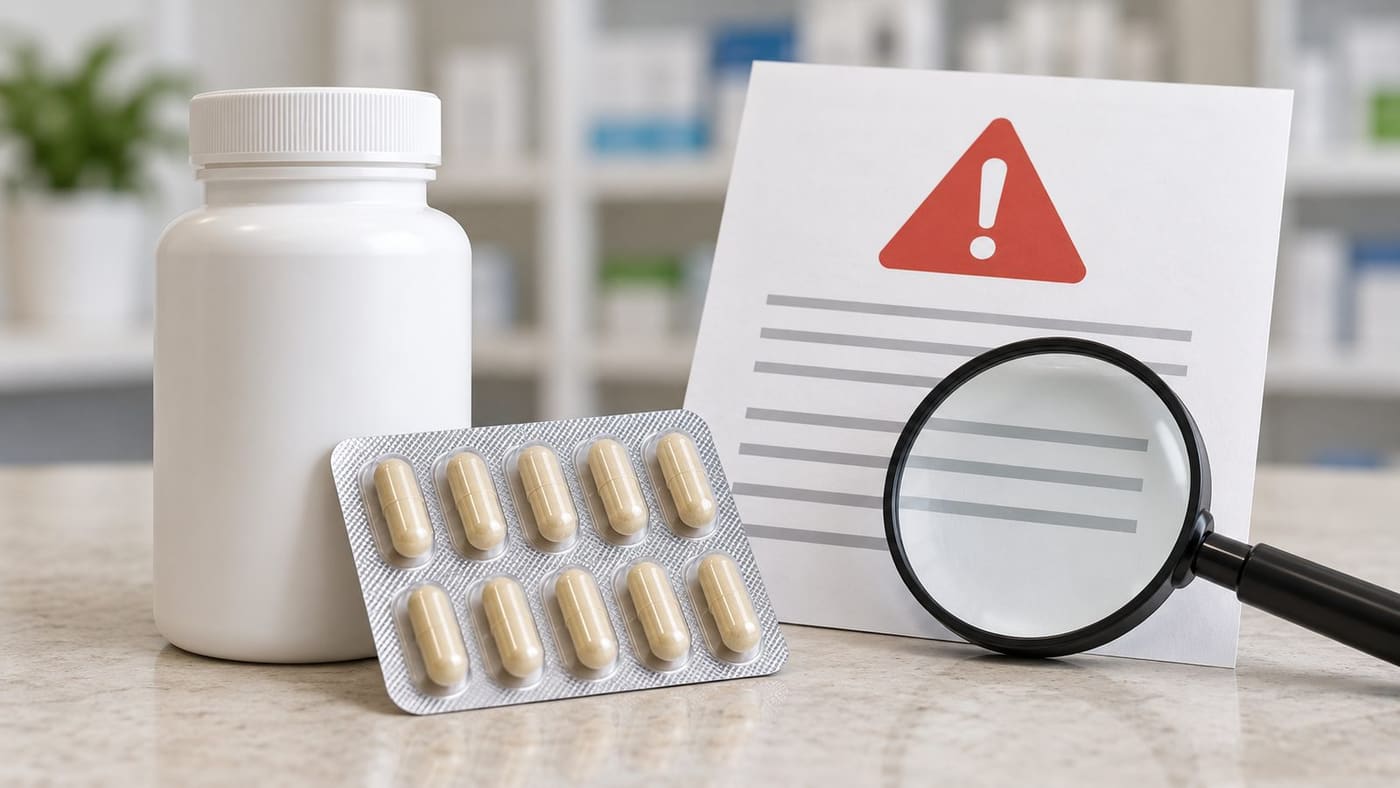
Our illustration is conceptual and shows an unbranded container. It is not a photograph of the recalled packaging. Use the product photographs on the official notice when a visual comparison is needed; an illustration on a news article cannot establish a match.
Give each question to the right person
A retailer can answer questions about a transaction or return. A healthcare professional can assess an individual's exposure and health. A regulator receives product-safety information. These conversations may involve the same package, but they have different purposes and should not be treated as interchangeable.
Consider another fictional example. Someone remembers buying a supplement but is unsure whether they took it last week or last month. Asking a store clerk to decide whether that uncertainty creates a medical risk would put a clinical decision in the wrong place. Equally, asking a clinician to promise that a store will find a missing receipt confuses treatment with a transaction. Write separate questions for the two conversations so neither important issue disappears inside the other.
For a health conversation, describe what happened in your own words and say what is uncertain. Do not change the date to fit a story you read online. For a purchase conversation, describe the item and the records available. You do not need to tell an entire personal health history in a public store queue merely to ask how a return is processed.
If there is an urgent medical problem, seek urgent care rather than waiting for a refund response or an online report to be reviewed. This article cannot determine a safe dose, diagnose a reaction or tell someone to alter prescribed treatment.
Why a supplement label is not a clinical assessment
The National Center for Complementary and Integrative Health explains that sexual-enhancement supplements can contain undisclosed drug ingredients, including combinations or doses that create risks. It warns that such ingredients can interact with prescription medicines, including nitrates, causing a dangerous blood-pressure decrease. NCCIH also says there is no definite evidence that herbal products are safe and effective for erectile dysfunction, and recommends discussing supplements with healthcare providers. These are general cautions, not a finding about every product on a shop shelf. See its [consumer guidance](https://www.nccih.nih.gov/health/tips/4-things-to-know-about-dietary-supplements-marketed-for-sexual-enhancement).
For a reader, the useful distinction is between identification and evaluation. You can help identify a package by recording its printed details. That does not mean you can evaluate its chemical contents at home. A familiar logo, a persuasive review or a friend's experience does not replace the missing information about what a particular capsule contains.
Avoid turning an internet discussion into a substitute shopping recommendation. “This one was recalled, so buy that one instead” is a much larger claim than identifying the affected product. It would require evidence about the proposed substitute as well as the person's circumstances. This guide recommends no replacement supplement and has no affiliate purchase links.
Prepare a small, private case note
A short note can save repeated explanations. It should be clear enough that another authorized person helping you can understand it, but narrow enough that it does not become an unnecessary collection of sensitive documents. Suggested headings are:
- Product details copied from the packaging.
- Where and approximately when it was bought.
- Which purchase records are available.
- Date the official notice was consulted.
- Question asked and the response received.
- Any reference number and the agreed next step.
These are suggested organizational headings, not mandatory FDA fields. Keep medical observations in a separate private section if they are needed for a healthcare conversation. Avoid placing receipts, addresses, account details or health descriptions in a shared neighborhood group.
For instance, a fictional note might say, “Called the verified retailer contact on Monday; representative requested a clearer label photograph; follow-up reference saved.” That records an action without making a claim about the outcome. “Refund definitely approved” would be inaccurate if the only response was a request for more information.
After a follow-up, add a new dated line instead of silently replacing the earlier account. A brief sequence makes it easier to distinguish a first inquiry from a later resolution. There is no need to write a lengthy narrative when a few precise entries capture what actually happened.
Handle an incomplete purchase record honestly
Missing paperwork is a practical problem, not a reason to invent a transaction. If a package was a gift, say that. If the purchase date is approximate, label it approximate. If the seller's name cannot be remembered, separate that uncertainty from the package information you can read directly.
Before contacting support, decide which question needs answering. “I have the packaging but no receipt; what evidence can you accept?” is clearer than “Can you fix everything?” It gives the recipient a specific issue to resolve. Do not assume that a policy for one retailer or another recall applies here merely because it sounds similar.
If you receive instructions by telephone, repeat back the next step in plain language. For example: “You want a picture of this label, and I should keep the reference number for the follow-up.” That confirms your understanding without requiring a recording or sharing someone else's personal details. Keep any written reply with the same case note.
A disagreement about a return should not be solved by publicly posting a cashier's name and a customer's medical details. Ask for the appropriate customer-service route and describe the unresolved transaction issue. The aim is a usable answer, not a public argument that makes the original paperwork harder to follow.
Reporting a suspected product problem
FDA's [serious-problem reporting guidance](https://www.fda.gov/safety/medwatch-fda-safety-information-and-adverse-event-reporting-program/reporting-serious-problems-fda) explains that consumers can report suspected serious reactions and product-quality problems. A healthcare provider can supply helpful clinical information, but consumers can also submit their own voluntary report. The page links the online route and the consumer reporting form. A report is not the same as a medical consultation or proof that the product caused a particular event.
There is a routing detail worth checking: the recall announcement names MedWatch, while FDA's broader [consumer reporting guide](https://www.fda.gov/consumers/consumer-updates/fda-101-how-use-consumer-complaint-system-and-medwatch) identifies the Safety Reporting Portal as the primary route for dietary-supplement problems. Use the current FDA reporting navigator or ask FDA if the route is unclear. Follow the agency's current product-specific instructions rather than sending duplicate reports simply to cover every possible portal. FDA says reporting systems do not provide medical advice; health concerns belong with a healthcare professional.
When describing an experience, distinguish an observation from an explanation. “I noticed a problem after taking this product” records a sequence. “The product definitely caused the problem” makes a causal conclusion that the person may not be able to establish. You can provide useful information without claiming more certainty than you have.
Write down approximate times as approximate, and avoid copying another person's symptoms to make a report sound complete. If you later locate a missing detail, follow the reporting system's instructions for supplying additional information. Do not publish your report in a comment section as a substitute for sending it through the intended channel.
Share a useful alert without sharing private records
If you want to warn someone who may have the product, send the official notice with a short explanation of why you are sharing it. Leave room for them to check their own package. A message such as “Please compare your packaging with this notice” is more useful than telling an entire group that everyone has consumed a dangerous product.
Before forwarding a screenshot, look at its edges. A browser window may show an email address, a loyalty-account page or another person's message. A photograph taken on a kitchen counter may contain a prescription label in the background. Sharing a direct public link avoids many of these accidental disclosures.
Do not offer to collect other people's medical histories or account details in order to “manage” their recalls. They can contact the relevant organizations directly. If someone needs help reading a form, assist with their permission and let them decide what is submitted. Helping someone understand an instruction does not give a helper authority to make medical decisions for them.
Read later updates without losing the original context
A dated article is a snapshot. When returning to an alert after several days, compare the current official page with your saved note. Check whether the scope, contact information or instructions have changed. A new publication date on a news summary does not necessarily mean the underlying notice has changed.
Suppose, hypothetically, two websites describe a recall differently. One says a company's testing identified a problem; another says the regulator tested every package. Those statements are not equivalent. Trace the stronger claim to its source before repeating it. If the original notice does not support it, keep the narrower wording.
The same principle applies to outcomes. The absence of a public update does not establish that every return is complete, every customer has been reached or every health concern has been resolved. A careful reader keeps the published facts separate from assumptions about events that were never reported.
Conclusion
The most useful response combines accurate product identification with the right contact for each question. Keep the official notice available, record uncertainty honestly, protect private purchase and health details, and let qualified professionals handle individual medical concerns. Bring the package details and your unanswered questions to the relevant contact; leave guesses out of the record.
Sources and research note
Primary links appear beside the facts they support: the FDA-hosted company recall, NCCIH supplement guidance, and FDA reporting instructions. Checked 26 October 2026, Asia/Dhaka. Examples in this article are fictional organizational scenarios, not interviews or firsthand experiences. Original AI-assisted conceptual illustration; it does not depict the recalled packaging. Limited web-search similarity review is documented in the editorial record and is not a comprehensive plagiarism scan or a uniqueness guarantee.