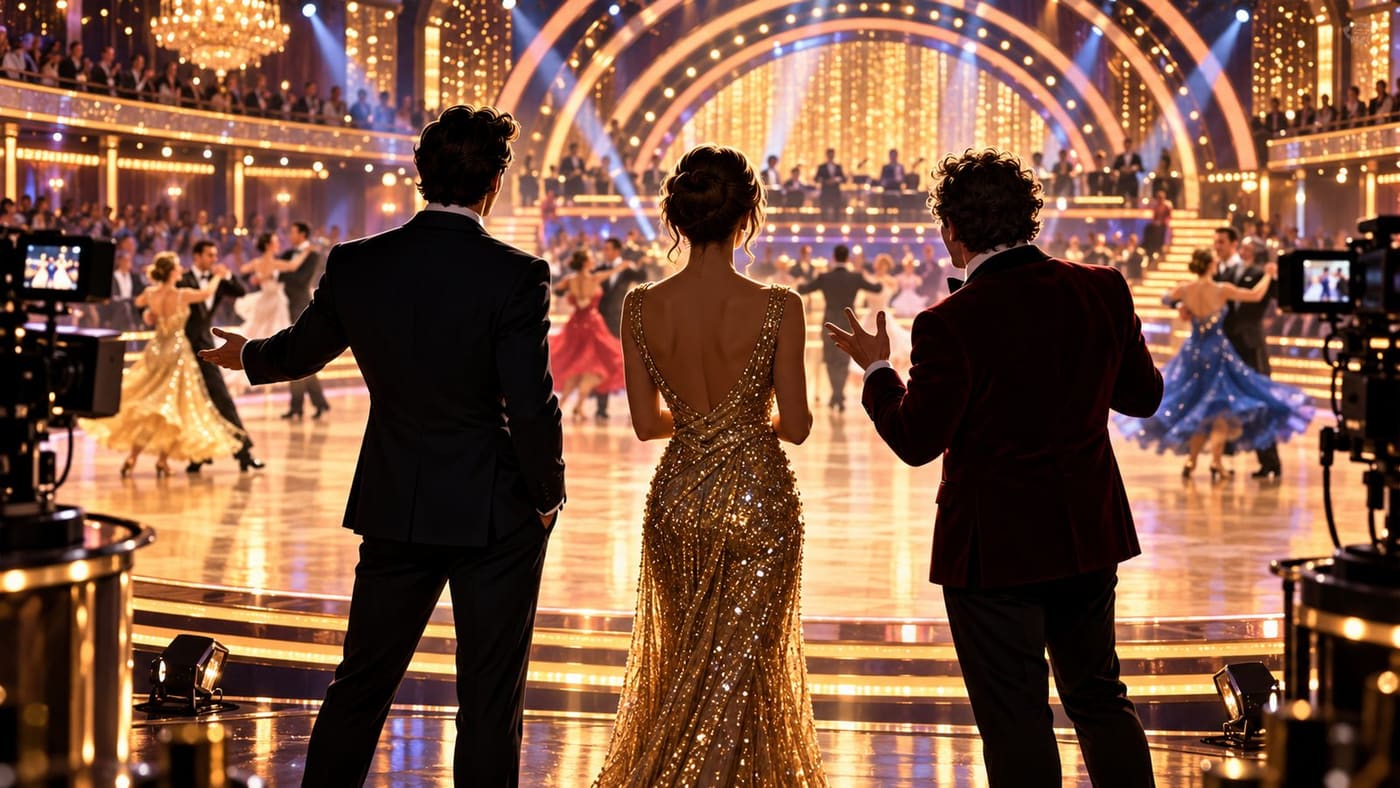
Strictly Come Dancing returned in 2026 with a presenting team of three for the first time: Emma Willis, Johannes Radebe and Josh Widdicombe. That is a clear change in the programme’s on-screen setup, but it does not automatically mean three fixed jobs or a wholly new format. In a September interview reported by Rayo, the presenters described a flexible arrangement rather than fixed, one-for-one replacements for the previous hosts. Viewers can therefore watch the trio’s chemistry and movement around the ballroom without treating speculation about a permanent role split as confirmed fact.
The 2026 series is also a useful moment to separate what the BBC has officially announced from what viewers may infer after an episode. This guide explains the presenting change and offers a practical framework for assessing it. It is an analysis of the announced approach, not a review claiming to have watched every episode or a report on the latest elimination. The accompanying image is an original AI-generated conceptual illustration; it does not depict the actual presenters or a BBC set.
The confirmed presenting line-up
The Royal Television Society reported the announcement on 19 May 2026: television presenter Emma Willis, dancer Johannes Radebe and comedian Josh Widdicombe would take over after Tess Daly and Claudia Winkleman. Their different backgrounds are relevant context, but do not establish a permanent division of work.
In Paul Revoir’s September interview with the programme’s producers for the Royal Television Society, executive producer Sarah James explained that the initial plan had been for two presenters. Testing the three together changed that decision. She presented the season as an evolution of a recognisable programme rather than a complete relaunch. This is first-hand reporting of the producers’ intentions; it does not independently demonstrate that every subsequent broadcast achieved them.
Rayo’s Alex Ross reported the trio’s appearance on The Rest Is Entertainment on 10 September. Willis described flexible responsibilities and rejected the suggestion of a dedicated backstage roving reporter. Treat that as a dated pre-series explanation. It is not a promise that the same arrangement must remain unchanged throughout the season.
What “three hosts” does—and does not—tell us
Adding a third host changes the number of voices viewers see, but it does not by itself establish that the show has changed its competition rules. The important questions are concrete: who introduces a dance, how couples are interviewed, where the presenters appear, and how the programme moves between performances, scores and results. Those details are observable in each broadcast. They should not be confused with claims that the voting system, judging criteria or elimination process has changed.
The practical distinction is between presentation and competition. A different person asking the questions does not, by itself, change what a score means or how a viewer should vote. Any claim about a rule change needs its own evidence from the programme’s current instructions. It cannot be inferred merely from a new photograph of the hosting team.
For a viewer, a useful way to assess the shift is to compare like with like across episodes. Notice whether the presenters share transitions naturally, whether a segment has a clear purpose, and whether interviews give the dancers room to explain a performance. A single awkward pause or joke is not enough to establish that the format is failing. Likewise, one lively exchange does not prove the new arrangement has solved every pacing challenge. The show is a live entertainment programme, and the balance can vary with the running order and the stories of the couples.
Keep the dancers at the centre of the comparison
A useful assessment of a host asks what their contribution helps the audience understand. After a difficult performance, a concise question might allow a celebrity to explain where concentration slipped. A longer exchange might reveal how the partnership approached rehearsal. Neither is automatically better: the question is whether the answer adds something that the dance and judging comments did not already communicate.
That also sets a boundary around the presenter’s role. An encouraging response is not a technical score. A joke about a stumble is not evidence that a judge has changed their assessment. If viewers combine these different kinds of speech into one verdict, they can misunderstand a segment that was intended simply to give a nervous performer a moment to recover.
For a new viewer, it helps to separate three layers. First is the performance itself. Second is what the judges say about it. Third is the conversation that helps the audience process the moment. The hosts work principally in that third layer, although they also introduce what is coming next. A clearer conversation can improve the viewing experience without altering the dance that has already happened.
Why an announcement is not an episode review
The producers’ explanation tells us why they selected a trio. It cannot tell us how well a particular transition worked on a particular evening. To evaluate that, a reviewer would need to identify the broadcast and the relevant sequence. This article does not substitute a casting announcement for that observation.
The same caution applies to a short online clip. A few seconds may show a missed cue but omit the recovery, or show a successful joke without the pause that preceded it. A clip can support a narrow description of what appears in the clip. It is a weaker basis for declaring that an entire programme has become faster, slower or less coherent.
If you are catching up, distinguish the original publication date of a preview from the date you found it. A September plan can still explain the thinking behind the season in October, but it should not be presented as a fresh update on the latest episode. Check current schedules and availability on the broadcaster’s own service before making viewing plans.
How the trio’s open roles could work on screen
An open role arrangement gives producers flexibility, but it also asks the programme to make each transition clear. If presenters move between the ballroom and other parts of the set, viewers need to understand why the segment is happening and what information it adds. A conversation with a couple can provide emotional context; an introduction can set up the performance; a post-score exchange can make the result feel more personal. Those functions are not tied forever to one named presenter if the show’s approach is intentionally fluid.
The trio’s contrasting professional backgrounds could support that flexibility. Radebe’s experience as a dancer can help him discuss the demands of a routine in accessible terms. Willis’s hosting work may help maintain a clear through-line for the evening. Widdicombe’s comedy experience could add levity. These are reasonable possibilities based on their public roles, not a guarantee about how the editors will use them or a claim that each presenter will perform only that task.
Viewers can assess the arrangement with a few practical questions:
- Does each segment have a clear point, or does it repeat information already given?
- Do the hosts make room for the couples and dancers to speak in their own words?
- Are jokes and light moments timed so they support rather than interrupt the competition?
- Can a new viewer understand what happens next without already knowing the show’s shorthand?
- Do the hosts help bridge performances, scores and results while keeping the dancers at the centre?
These are more useful questions than guessing which presenter has “replaced” a particular previous host. The September interview provides a reason to avoid a one-for-one replacement chart; a later change would need a later source.
A practical viewing notebook, without turning entertainment into homework
If you want to compare the new arrangement across weeks, choose one recurring task rather than trying to rate every second. For example, follow the transition from a couple finishing a dance to the start of the judges’ feedback. Note whether the audience is clearly told what happens next, whether anyone has to repeat a question, and whether an interruption loses useful information.
Keep observation separate from interpretation. “Two people began speaking at once” describes an event. “They cannot work together” is a much larger conclusion. A single overlap could reflect an excited audience, a delayed cue, or a spontaneous response. Unless the broadcast establishes the cause, leave the cause open and see whether the same problem recurs.
An optional note can be just four lines:
- Episode and segment: identify the moment precisely enough to find it again.
- What happened: record the exchange without adding a motive.
- Effect on understanding: explain whether any information became clearer or was lost.
- Comparison: look for a similar moment in another episode before generalising.
There is no need to award numerical marks to personalities. A short description often captures the experience more accurately. Someone may be warm in an interview but less clear when reading instructions; another may deliver a concise introduction but struggle to leave room for an emotional answer. Specific feedback gives each contribution a fairer hearing.
For voting and results, use the instructions shown for the current programme. Do not infer a voting window, charge, eligibility rule or result from an old preview, an unofficial countdown or a cropped video. A host’s light-hearted remark should not be treated as a substitute for the published voting information.
Three fictional examples of useful and unhelpful handovers
Imagine a couple has just received mixed comments. One presenter asks which part of the dance felt most secure. The contestant answers with a specific moment, and another presenter moves the programme on. That exchange has a clear purpose: it lets the contestant respond without repeating every judging comment. The number of people on screen is less important than whether each contribution advances the conversation.
Now imagine a second version. All three presenters ask variations of “How do you feel?” before the contestant has finished the first answer. The issue is not that three hosts are inherently too many. It is that the questions compete for the same information. A viewer can reasonably describe the repetition without deciding that any individual lacks talent or belongs in a different job.
In a third version, an unfamiliar dance term comes up. A presenter asks for a short explanation, the professional partner gives an example, and the conversation returns to the celebrity’s experience. This can make the segment accessible without turning it into a second judging session. A useful explanation answers the immediate question; it does not need to become a lecture.
These are invented examples, not incidents reported from Strictly. They illustrate a way to assess the format by what it does for a viewer. Applied consistently, the same test could praise one exchange and criticise another without forcing a sweeping verdict about the entire presenting team.
Accessibility matters alongside pace
A rapid handover may feel energetic to a regular viewer while confusing someone joining halfway through. Clear names, short introductions and an explicit indication of the next segment can help that newcomer catch up. Fast is not always clear, and a brief pause is not always wasted time.
Consider someone watching while preparing dinner and occasionally looking away. They may miss a visual cue that tells a fully attentive viewer who is about to speak. If the spoken introduction establishes the context, the sequence remains easier to follow. This is an example of a viewing need, not a claim about any presenter’s performance.
For someone relying on captions, several voices speaking at once can also make the exchange harder to follow. That does not mean spontaneous conversation should disappear. It means that leaving room for an answer has an audience benefit as well as a production benefit. A clean handover is often most valuable when viewers barely notice it.
Conclusion: assess the contribution, not just the headcount
Willis, Radebe and Widdicombe’s appointment is a concrete change. The producers’ September interview explains the thinking behind the trio, while the presenters’ reported comments warn against assuming three fixed replacement roles. Neither source supplies a verdict on every episode that followed.
For viewers, the more useful test is specific: does an introduction make the next dance clear, does an interview let the couple say something worthwhile, and does the transition keep the programme understandable? Those questions leave room for different personalities while keeping the dancers and the audience’s experience at the centre.
### Sources and research note
Refreshed 26 October 2026, Asia/Dhaka. This is a format explainer based on dated announcements and interviews, with original analytical examples. It is not a latest-results report or a first-person episode review. The illustration is original AI-generated conceptual artwork, not the actual presenters or a BBC set.
- [Royal Television Society announcement report, Ella Christian-Sims, 19 May 2026](https://rts.org.uk/article/bbc-announces-three-hosts-strictly-come-dancing-2026-emma-willis-johannes-radebe-and-josh).
- [Paul Revoir’s first-hand interviews with Strictly producers, Royal Television Society, 1 September 2026](https://rts.org.uk/article/we-re-not-going-scare-horses-behind-scenes-new-strictly-come-dancing).
- [Alex Ross’s report on the presenters’ podcast interview, Rayo, 10 September 2026](https://www.hellorayo.co.uk/news/entertainment/television/strictly-2026-hosts-format).
The linked producer interview provides primary testimony about the casting decision. No current episode availability, viewing totals or audience consensus is claimed.