If a fallen tree or storm damage presents immediate danger, call 112. A municipal online report is not an emergency response channel. For a non-urgent situation that still needs the fire brigade, the Dutch national number is 0900-0904. The right route depends on the danger and the help needed, not simply on whether the object involved is a tree.
For residents of Maassluis, there is also a specific municipal route for problems in public space. The municipality lists fallen branches and trees among the issues that can be reported through its reporting service. Knowing the difference between these routes helps you describe a problem without delaying an urgent call or sending routine maintenance requests to emergency dispatch.
This English-language service guide was researched on 26 October 2026 following local storm-related search interest. It does not establish the cause, ownership or consequences of any particular fallen tree. Local incident headlines prompted the research, but the full reports could not be retrieved reliably; no casualty figures, damage totals or inspection findings are inferred from them. The practical information below comes from the linked public authorities.
Start with the situation, then choose the channel
[Brandweer Nederland's official guidance](https://www.brandweer.nl/onderwerpen/geenspoed/) distinguishes urgent danger from non-urgent situations requiring firefighters. It directs urgent or life-threatening cases to 112 and non-urgent fire-brigade assistance to 0900-0904. If in doubt about urgency, its advice is to call 112. The non-urgent service asks for the place name to connect the caller to the appropriate regional control room.
For a non-dangerous problem in public space, use the [Maassluis municipal reporting page](https://www.maassluis.nl/melding-openbare-ruimte). Do not assume that submitting a photograph through an app means someone is monitoring the scene in real time. Conversely, an online form being available does not make it the right route when circumstances are dangerous.
The distinction is easier to apply if you separate three questions: What is happening now? Who or what is exposed to it? What kind of assistance is needed? You do not need a professional diagnosis of the tree before describing an immediate concern to a dispatcher.
What belongs in a clear first description
A useful report begins with a location another person can find. “A tree near our building” may be obvious to you and meaningless to someone covering the whole municipality. Give the street, nearest identifiable junction or address, and which side of the street you mean. If you are unsure of a house number, say so instead of guessing.
Then describe what you can actually observe. A branch lying on a verge, a blocked pavement and a tree moving above a busy route are different descriptions. Do not replace the observation with a conclusion such as “the entire street is unsafe” unless you can explain the situation behind that concern.
A compact sequence is:
- Location: where the problem is, with a useful nearby landmark.
- Observation: what you can see from your safe position.
- Exposure: whether people, traffic or an entrance appear affected.
- Timing: when you saw it and whether you are describing the present situation.
- Uncertainty: anything important you cannot establish.
These are editorial suggestions for making a report understandable, not an official form or a guarantee of how it will be prioritised. Follow the questions and instructions of the receiving service. Do not delay an emergency call to complete a checklist.
A worked example of useful wording
Consider this fictional, non-emergency reporting example: “A large branch is lying on the grass verge on the east side of Example Street, near the junction with Sample Lane. I saw it from my window at about 10:15. I cannot see whether there are loose branches higher in the tree.”
The example gives a place, an observation, a time and a limitation. It does not claim that the tree is healthy, that nobody could be injured, or that the branch is safe to move. Those conclusions would go beyond the description.
Compare that with “Dangerous tree, council ignored it again.” The second version expresses concern but leaves the recipient searching for the basic facts. If you have previously reported the same location, add the earlier reference and date separately. A prior report is useful context; it does not replace a description of what has changed today.
Keep your first message short enough for the essential information to be found quickly. Additional background can follow where the service allows it. A clear first sentence is more useful than a long account in which the street name appears only at the end.
Using the Maassluis reporting service
The municipality's public-space page links to Fixi and identifies fallen branches, fallen trees and damaged public greenery among reportable issues. It says that a photograph can accompany a report and that reporters are kept informed about handling. Use the link from the municipal website so that you are entering the intended service rather than a similarly named third-party page.
Before submitting a routine report, review the location you selected. A map pin placed at your own home can be misleading if the problem is across the road or around a corner. Where the interface offers a text field, use it to clarify the actual location rather than relying on the pin alone.
Keep whatever acknowledgement or reference the system provides. It gives you a way to connect a later clarification with the original report. Do not promise neighbours a response time that the authority has not supplied. An acknowledgement confirms receipt; it is not the same thing as an inspection, attendance or completed work.
If your circumstances change after submission, assess the new situation rather than continuing to rely on the earlier description. A routine maintenance report and an urgent development are different matters. Follow the appropriate emergency guidance when danger is present.
Photographs should clarify, not create another risk
A photograph can help explain an already observed location, but it is not a reason to approach a damaged tree. Do not enter a road, cross a barrier or stand below branches to get a more dramatic image. A picture already available from a safe position is preferable to a closer image obtained by taking a risk.
When choosing between existing pictures, ask what each adds. One may establish the location; another may show the obstruction more clearly. Several almost identical close-ups can obscure rather than improve the report. Include a short description of what the picture shows if the context is not obvious.
Avoid editing an image in a way that removes relevant surroundings or exaggerates the apparent size of the problem. If you crop it, retain the original for your own reference. Do not identify a cause from a photograph alone: visible damage and an explanation for that damage are separate pieces of information.
Before sharing images publicly, consider whether the same purpose could be served by a factual text update. A report sent to the relevant authority and a post circulated around a neighbourhood have different audiences. Public speculation about a particular property or person can spread much further than the original practical concern.
Stay away from repair and removal work during the storm
The [safety region Midden- en West-Brabant's storm guidance](https://www.vrmwb.nl/wat-te-doen-bij-1/storm-en-windstoten) advises people to seek safe shelter, avoid trees and open water, and not undertake emergency repairs to their homes during a storm. This is general safety guidance from a different Dutch region, not Maassluis's local incident channel.
For someone looking at a fallen branch from indoors, the useful task may be reporting it rather than trying to clear it. A photograph cannot tell you whether other branches, nearby structures or traffic create additional hazards. This guide does not provide instructions for cutting timber, climbing trees, handling cables or repairing roofs.
Likewise, do not interpret an ordinary household-maintenance route as an instruction to do specialist work yourself. Arranging suitable assistance and personally attempting removal are not the same action. Emergency responders or qualified professionals can assess work that is beyond a resident's competence.
If a cordon or closure is in place, keep clear. The fact that someone else has stepped around it does not establish that the route is safe or open. Plan around the restriction rather than treating a short delay as a reason to improvise a route through a work area.
Check the current weather information, not an old screenshot
[KNMI's wind and storm guidance](https://www.knmi.nl/kennis-en-datacentrum/waarschuwingen/windstoten) explains risks and actions associated with its warning levels. It distinguishes the weather hazard from the practical choices people may need to make, including travel. Read the current warning for the relevant place and time rather than using a general explanatory page as evidence that a warning is active.
For a screenshot shared in a group chat, check the date, issue time and validity period before relying on it. Ask whether it concerns the place where you are now, the place you intend to visit, or somewhere else. A message can be authentic and still be outdated or irrelevant to your route.
There is also a forthcoming change to understand. In a [14 October 2026 announcement](https://www.knmi.nl/over-het-knmi/nieuws/knmi-waarschuwt-vanaf-november-gerichter/), KNMI says that from November it will show warnings for flexible areas rather than whole provinces. The announcement describes location-based viewing in its app and website. On this article's research date, that announced November change is still ahead; it is not presented here as an already completed rollout.
Whichever map format is in use when you read this, examine the hazard and time window as well as the coloured area. A map boundary is not a physical barrier that stops weather. KNMI's announcement specifically advises extra attention near the edge of a warned area.
What the city's tree policy can tell you
The official [Bomenplan Maassluis 2025](https://lokaleregelgeving.overheid.nl/CVDR754664/1), shown as effective from 9 January 2026, sets out the municipality's approach to its trees. It discusses growing conditions, maintenance and inspection. Its glossary describes a tree-safety inspection as an assessment of stability, health and safety intended to reduce risks such as branch failure or falling trees.
That policy supplies context for sensible questions. It is not an inspection report for a particular tree and does not establish why a particular incident happened. Nor should a historical inventory figure in the plan be presented as a live assessment of the street outside your home.
If you want to follow up a specific concern, keep the question focused: Is this tree managed by the municipality? Has this location been assessed following the report? Is there information about any planned follow-up? These are requests for information, not assertions that a particular answer already exists.
Separate the immediate safety report from a longer policy discussion. The first needs a clear location and present observations. The second may concern maintenance priorities, replacement planting or public records. Combining every question into one message can make both purposes harder to recognise.
Keep a simple follow-up record
A small personal log can prevent confusion when several household members are discussing the same problem. Record the observation time, the reporting channel, any reference, and the response actually received. Use separate entries for later changes rather than silently rewriting the first description.
For example, “reported at 11:20” and “received acknowledgement at 11:22” should remain separate from “work observed at 15:00.” If you did not see what work was done, do not turn a vehicle's presence into a claim that the problem was resolved. The log should preserve uncertainty as carefully as it preserves dates.
When following up, refer to the existing reference where possible and explain the new information. Avoid sending repeated identical reports simply to produce a larger count. A clear change in the situation is more informative than another copy of the same description.
This record is an organisational aid. It is not proof of responsibility, an insurance decision or a finding that anyone failed a legal duty. Questions about a particular claim or dispute need the actual facts and the relevant professional or service provider, rather than conclusions drawn from a general article.
Help neighbours without circulating assumptions
A useful neighbourhood message can say that a route is obstructed, identify the source of an official update and state when the information was checked. It does not need to name a supposed culprit or diagnose the condition of every nearby tree.
If you pass along a report reference, make clear what it means. “This has been reported” is different from “the authority has said it is safe.” If you share a warning, link the official page so recipients can see updates instead of relying on your saved image.
For someone who cannot easily use a digital form, helping organise the location and observation details may be useful. Do not promise to act for them without agreement, and do not expose their personal circumstances in a public neighbourhood discussion. Keep the practical need and the person's privacy in view together.
Conclusion: report what you know, through the right route
The most useful response to a storm-damaged tree starts with present danger, a precise location and a factual description. Use emergency assistance when it is urgent, the fire brigade's non-urgent route when that assistance is needed without urgency, and the municipality's service for suitable public-space reports.
Keep observations separate from explanations. A clear report can help the responsible service assess a problem; it cannot, by itself, establish cause, liability or that the area is safe again. Follow current official instructions and leave hazardous assessment or removal work to the appropriate people.
Sources and research note
Research date: 26 October 2026. The linked Maassluis reporting page, Brandweer Nederland guidance, KNMI pages and official tree policy were directly consulted. The [Dutch police storm-information page](https://www.politie.nl/informatie/overlast-door-noodweer-bel-0900-8844.html) also directs readers toward fire-brigade reporting guidance; the number embedded in that URL should not be mistaken for the non-urgent fire-brigade number.
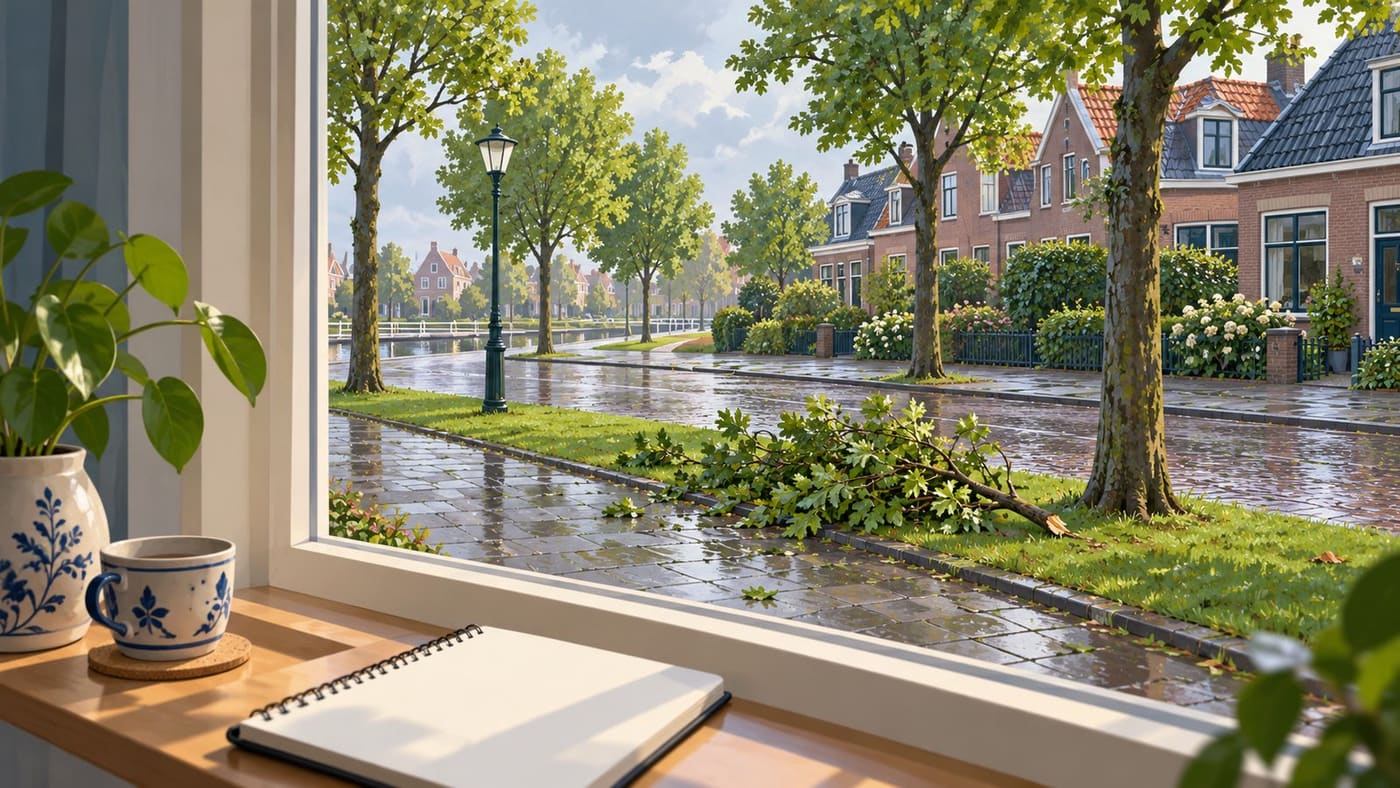
The reporting example and personal-log suggestions are original editorial illustrations, not real resident testimony or official response guarantees. The original AI-generated hero illustration shows an imagined Dutch street viewed from indoors. It is conceptual, not a photograph of a Maassluis incident. No claim is made that this article verifies the details of the local incident headlines that prompted the research.